Paper manuals and PDF work instructions have a translation problem: a worker has to look at a flat diagram, then look up at a 3D machine, and mentally map one onto the other. Augmented reality (AR) work instructions remove that step by overlaying the guidance directly on the equipment itself.
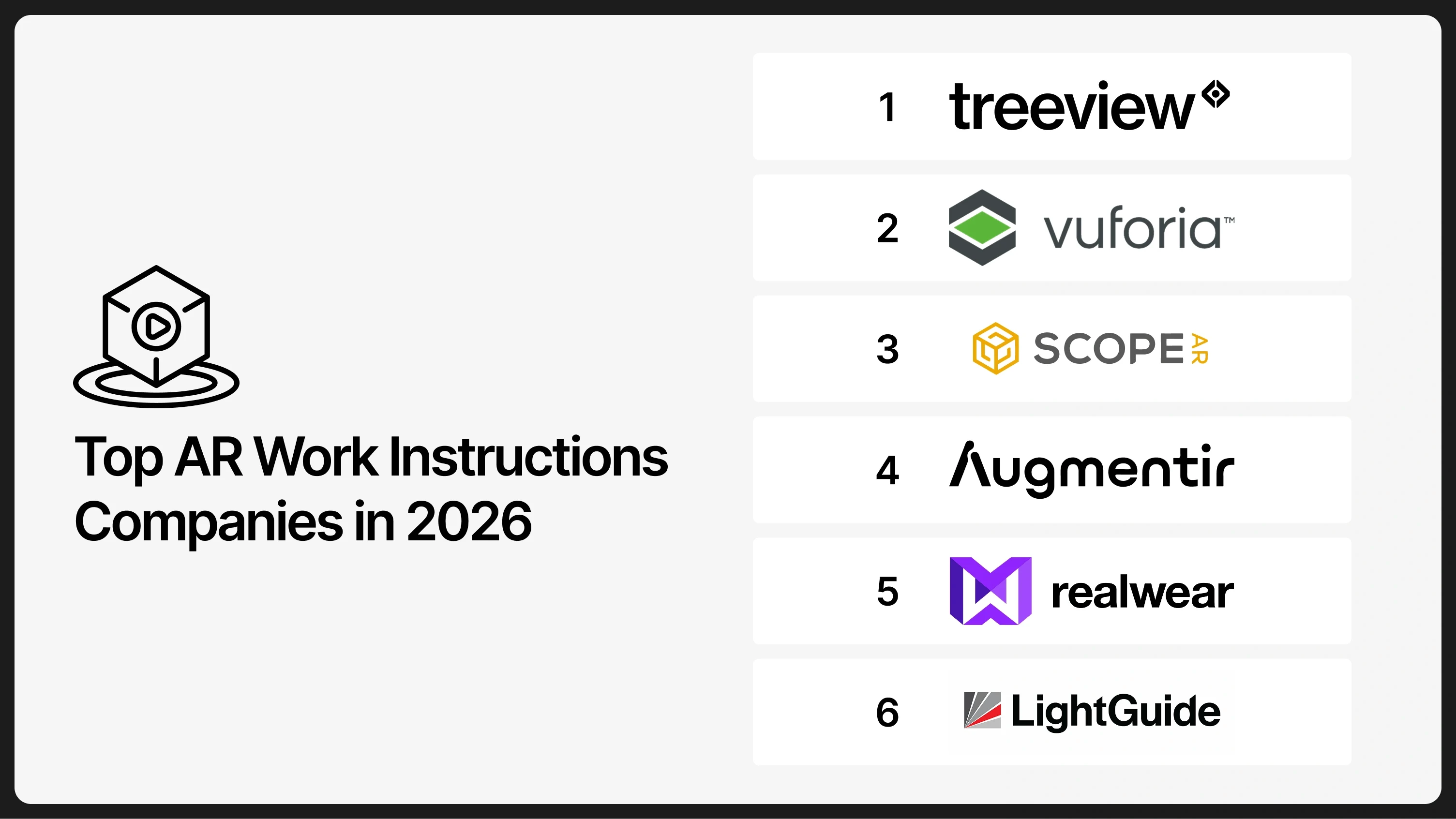
Best AR Work Instructions Companies Ranking
Rank | Company | Category | Best for |
|---|---|---|---|
1 | Treeview | Custom development | Enterprises that need a proprietary AR work instructions app built around a specific product, procedure or piece of equipment, with full IP ownership at project close |
2 | PTC Vuforia | Platform | Manufacturers that want to turn existing CAD and PLM data directly into step-by-step AR work instructions at scale |
3 | Scope AR | Platform | Enterprises that need AR work instructions and live remote expert assistance in the same platform |
4 | Augmentir | Platform | Manufacturers that want AI-driven work instructions tied to a worker's actual skills and performance data |
5 | RealWear | Hardware | Enterprises that need rugged, voice-controlled AR headsets to display work instructions hands-free in industrial environments |
6 | LightGuide | Hardware | Manufacturers that want AR work instructions without wearables, using projectors to display guidance directly on the work surface |
Why AR Work Instructions Are Replacing Paper Manuals
AR work instructions are replacing paper manuals because they remove the mental translation step between a flat diagram and the physical machine a worker is looking at.
Manufacturing floors run on tribal knowledge as much as documentation. When an experienced technician retires or a new hire is still learning the line, that gap shows up directly in scrap rates, inspection failures and slower ramp-up time. AR work instructions convert that tribal knowledge into a repeatable, hands-free guide anchored to the physical equipment, so accuracy does not depend entirely on who happens to be on shift.
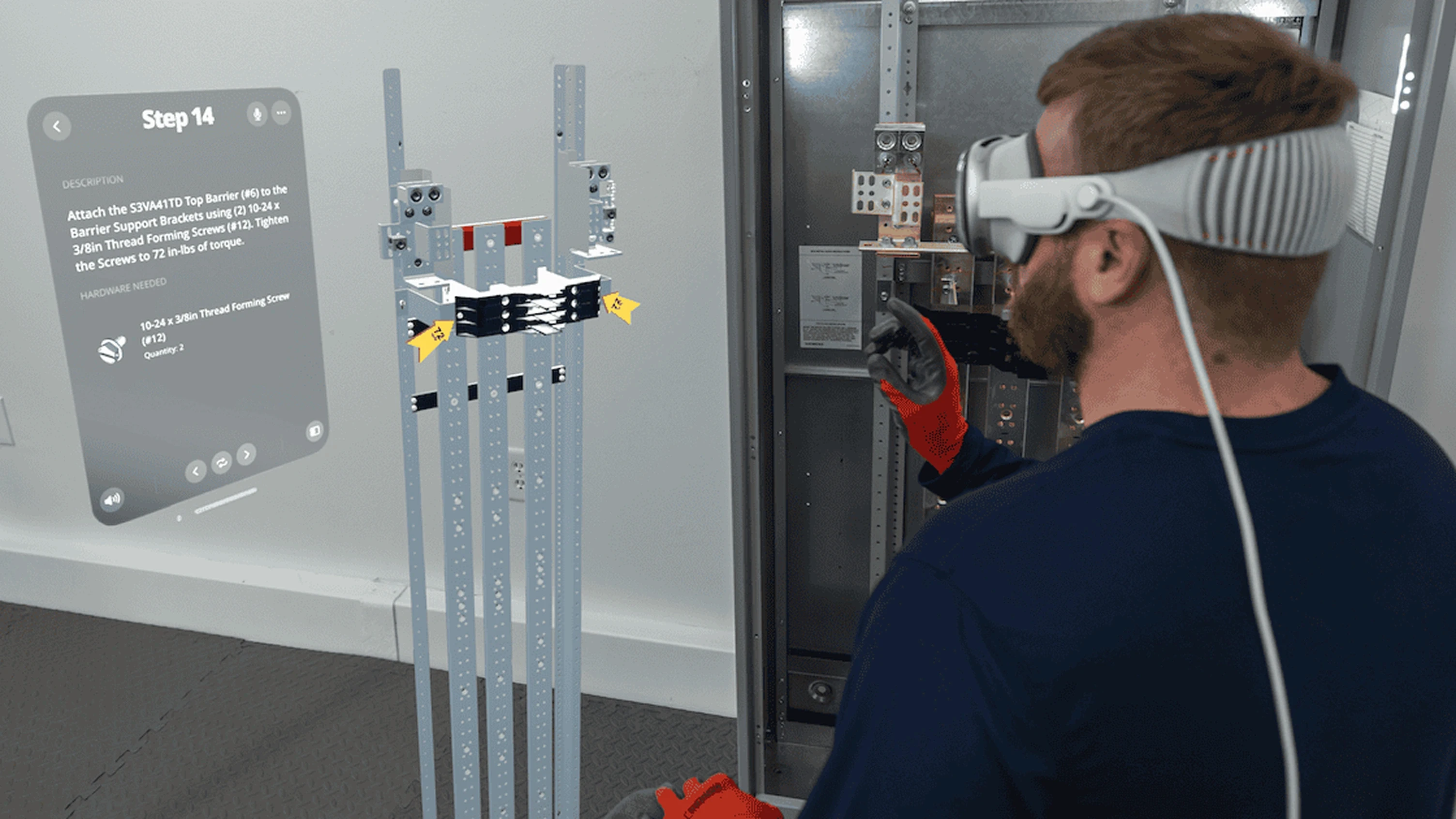
The results show up in named deployments rather than just vendor claims. Lockheed Martin's Space division cut manufacturing training and activity ramp-up time by 85% after adopting AR work instructions. Merck used the same approach to standardize execution and cut human error in production, and Vuforia customer Howden used step-by-step AR guidance to reduce customer equipment downtime in the field.
Healthcare offers a useful data point on the underlying mechanism, not just the manufacturing floor: organizations using AR training report up to 230% better performance versus traditional instructional methods. Work instructions are one of the most mature applications of augmented reality training, alongside onboarding and safety simulations. The pattern holds wherever a procedure is complex enough that a 2D reference cannot fully substitute for standing in front of the real thing.
The broader augmented reality market reflects this shift toward operational use cases. It was valued at $149 billion in 2025 and is projected to reach $2.8 trillion by 2034, growing at more than 40% CAGR through 2030, with industrial and manufacturing AR remaining one of the largest segments.
Custom AR Work Instructions Development
Custom AR work instructions development means building the app from scratch around a specific machine, procedure or product rather than fitting it into a platform's templates.
This is the right call when the process, compliance requirements or equipment are specific enough that no authoring tool's templates fit cleanly. It costs more and takes longer than a platform subscription, and it buys software shaped around the exact workflow instead of one bent to fit a vendor's constraints.
1. Treeview
Best for: Enterprises that need a proprietary AR work instructions app built around a specific product, procedure or piece of equipment, where the organization needs to own the resulting software outright
Type: Enterprise XR development studio
Key clients: Medtronic, University of Adelaide, Transfr, University of Alberta, Northwestern University, Teck Resources
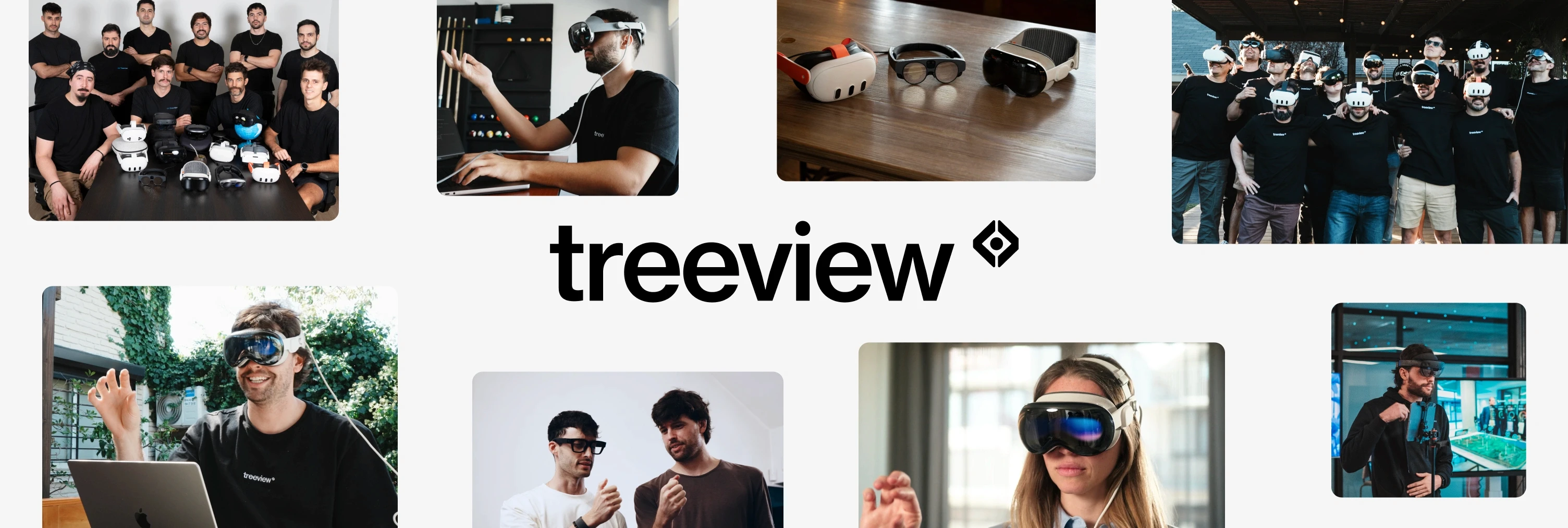
Treeview is a senior-only enterprise XR development studio founded in 2016, with offices in New York and Montevideo, Uruguay. Instead of working inside a pre-built authoring platform, the studio builds custom apps for AR work instructions from the ground up, using the CAD, IoT and PLM data an organization already has as the foundation.
For Medtronic, Treeview built the Micra XR Trainer, a procedural simulation for the company's leadless pacemaker. The studio builds on Unity for enterprise headsets including Meta Quest, Apple Vision Pro, HoloLens 2, PICO and Samsung Galaxy XR, as well as smart glasses and AI glasses. Work instructions sit alongside training simulations, product visualization and remote assistance apps in Treeview's broader AR development portfolio.
Custom development costs more upfront than a platform subscription, and that tradeoff is deliberate: it buys software shaped around the exact equipment, compliance requirements and workflow rather than one bent to fit a vendor's templates. For organizations where no authoring tool's constraints match the real process, that fit is the difference between an instruction workers actually trust and one they route around. The client owns the resulting software outright once the project closes, with no ongoing license tying them to Treeview.
AR Work Instructions Platforms
AR work instructions platforms let a non-technical team author, manage and update instructions themselves, without commissioning custom software for every new procedure.
They fit best when the use case is common enough that an authoring tool already covers it, such as CAD-based assembly guidance, equipment inspection or skills-linked digital workflows. Instructions typically reach workers through wearable headsets, mobile devices or fixed projectors overlaying the work surface. Some platforms are software only; RealWear and LightGuide, covered last in this section, represent the two hardware-first approaches on this list.
2. PTC Vuforia
Best for: Manufacturers that want to turn existing CAD and PLM data directly into step-by-step AR work instructions at scale
Type: Industrial AR platform
Key clients: Howden, Merck, Nascote Industries (Magna International), Atlas Copco
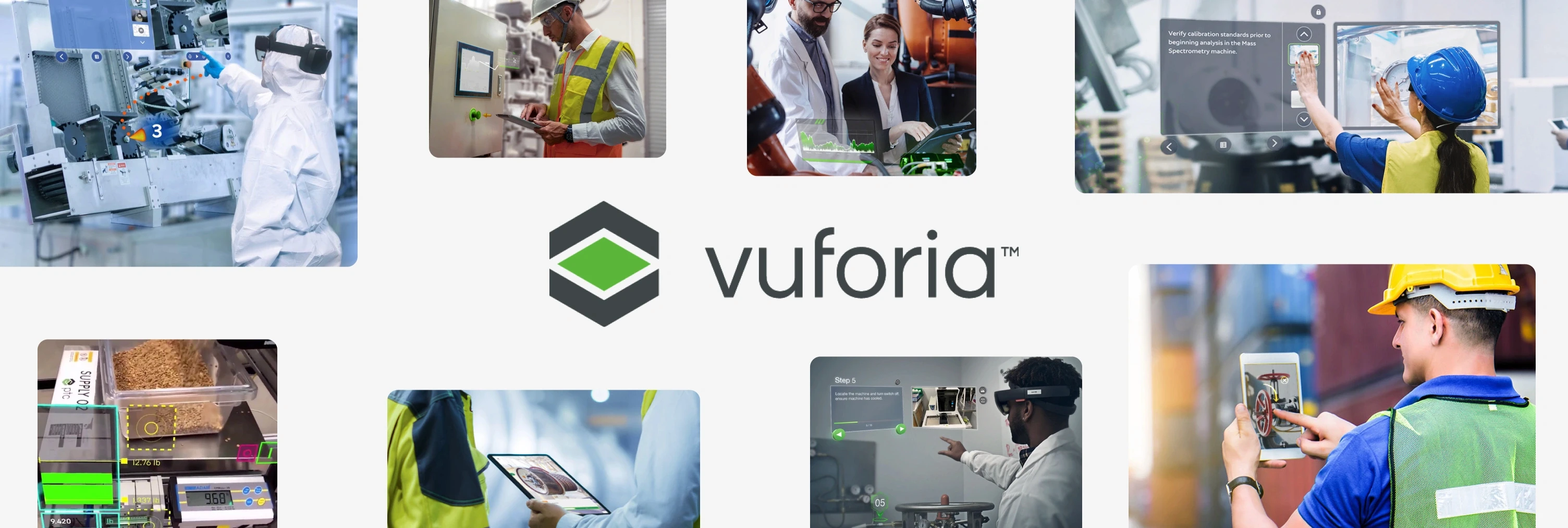
PTC Vuforia turns existing 3D CAD, PLM and IoT data into step-by-step AR work instructions without a from-scratch build. Vuforia Studio handles animated, CAD-based instructions, Vuforia Expert Capture lets frontline experts record their own knowledge as AR guidance, and Vuforia Chalk layers live remote annotation on top of either.
Vuforia deploys across mobile devices, tablets and headsets including Microsoft HoloLens 2, Magic Leap and RealWear, and Quadrant Knowledge Solutions has ranked PTC the top AR solution portfolio among 11 vendors for four consecutive years.
Vuforia's speed advantage depends entirely on what data an organization already has. Manufacturers with existing CAD and PLM systems can have a first work instruction live in days, since Vuforia builds on data already created for other purposes. Organizations without that digital thread in place will spend more time on data prep than the platform itself, which is worth factoring into any timeline estimate.
3. Scope AR
Best for: Enterprises that need AR work instructions and live remote expert assistance in the same platform
Type: Enterprise AR knowledge platform
Key clients: Lockheed Martin, Mitsubishi Heavy Industries
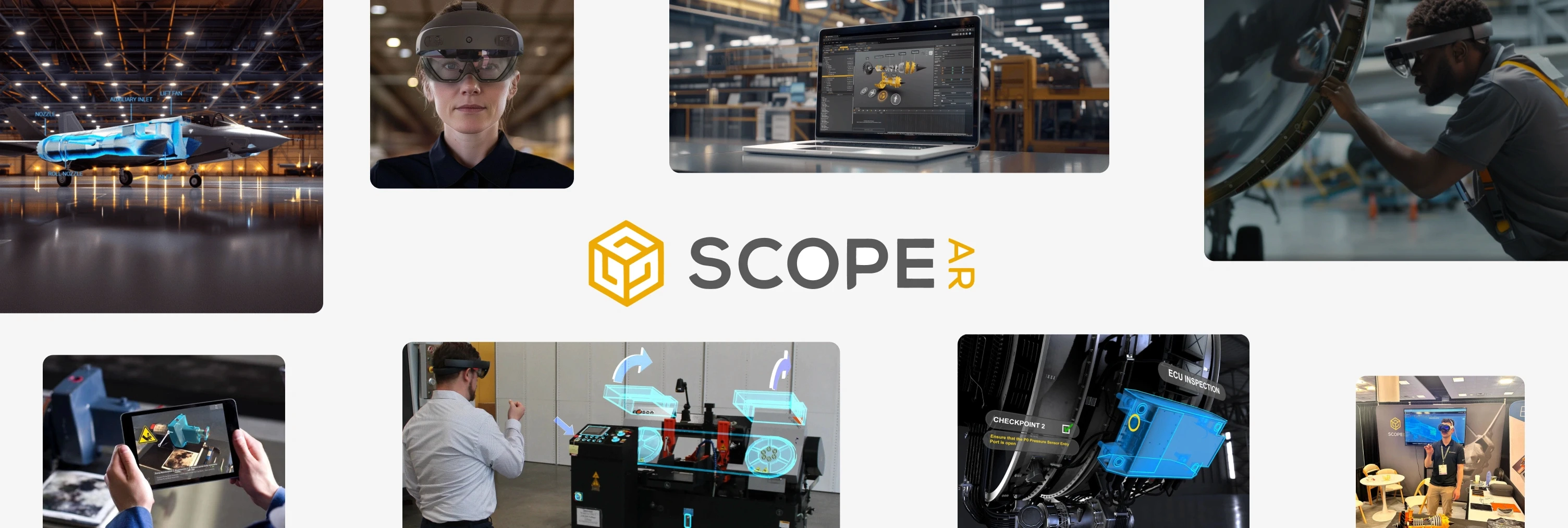
Scope AR built its WorkLink platform around a single idea: work instructions and remote expert assistance belong in the same session, so a technician can escalate from a self-guided instruction to a live video call without switching tools. WorkLink Create lets teams author no-code AR instructions from any CAD file, and the platform runs across phones, tablets and headsets.
Flatirons Solutions acquired Scope AR in June 2026, pairing WorkLink's AR guidance with Flatirons' technical content authoring and compliance tools under one company headquartered in Boulder, Colorado. Scope AR continues to operate under its own brand within the combined business.
Lockheed Martin's Space division reported an 85% reduction in manufacturing training and activity ramp-up time after adopting WorkLink, and has since expanded its use into additional manufacturing applications.
Where WorkLink separates itself from Vuforia is the built-in escalation path. A static instruction and a live expert call are the same product rather than two tools stitched together, which matters most for organizations where the failure mode is not "the instruction is missing" but "the instruction doesn't cover this edge case."
4. Augmentir
Best for: Manufacturers that want AI-driven work instructions tied to a worker's actual skills and performance data
Type: AI-powered connected worker platform
Key clients: The Hershey Company
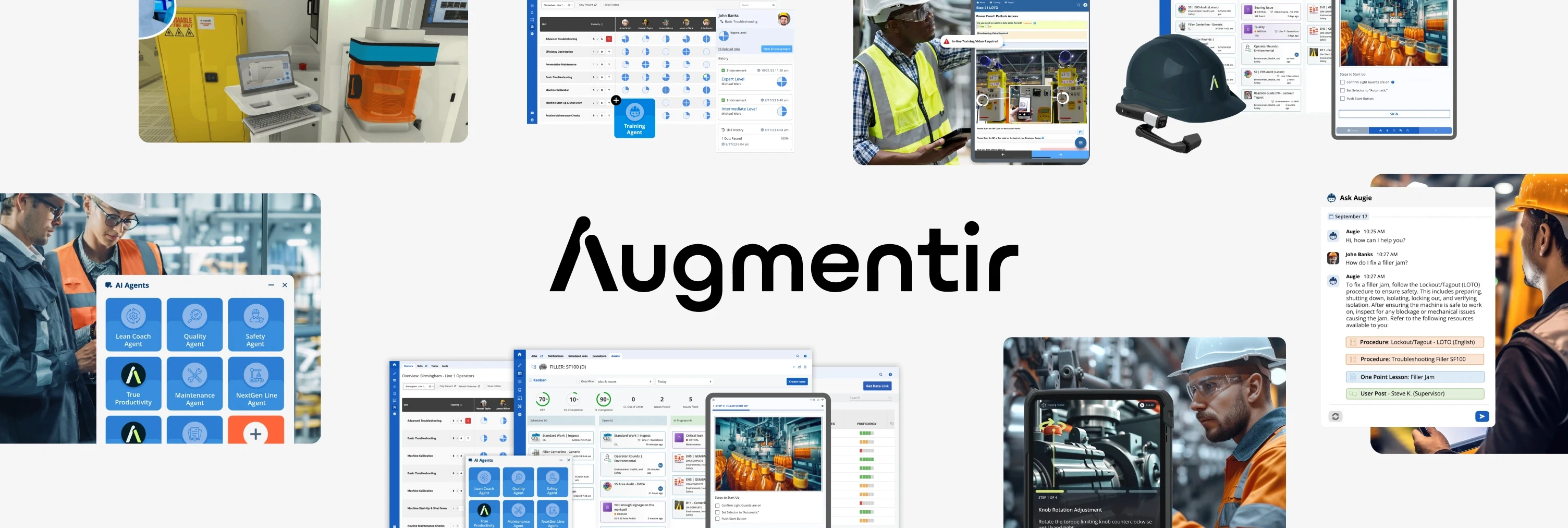
Augmentir pairs no-code digital work instructions with an AI layer that tracks which worker is qualified for which task and where errors are actually happening. Augie, the platform's generative AI assistant, can turn an existing video, PDF or Word document into a step-by-step digital procedure automatically.
The skills management module ties directly into the work instructions themselves, so a worker only sees a task once the system confirms they are certified for it, and managers get a live skills matrix showing exactly where gaps remain. Augmentir also connects to existing ERP and MES systems, so instructions reflect live production data instead of sitting disconnected from the rest of the factory floor.
Augmentir is worth a closer look specifically because it treats AR as one feature inside a broader connected-worker platform rather than the whole product. That's an advantage if skills tracking and continuous improvement data matter to you as much as the instructions themselves, and a reason to look elsewhere if all you need is a lightweight way to author and display AR guidance.
5. RealWear
Best for: Enterprises that need rugged, voice-controlled AR headsets to display work instructions hands-free in industrial environments
Type: Industrial AR headset manufacturer
Key clients: Shell, Goodyear, BMW
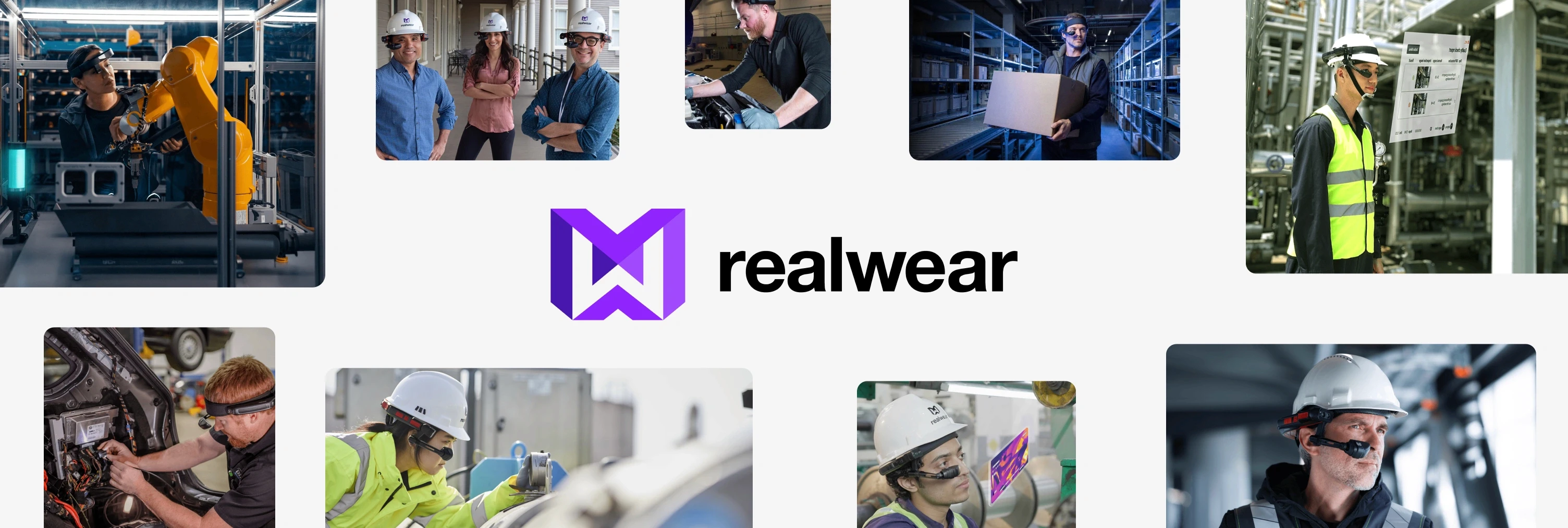
RealWear makes ruggedized, voice-controlled headsets built to display AR work instructions and connect workers to remote experts without taking their hands off the job. The devices integrate with software partners including PTC Vuforia, Scope AR and Microsoft Teams rather than running a proprietary content platform of their own.
RealWear devices are used by 41 of the Fortune 100 and are certified for hazardous environments including ATEX Zone 1, which matters for oil and gas, chemical and heavy manufacturing sites where standard consumer electronics are not permitted.
RealWear is the one company on this list that will not solve the whole problem by itself: it is hardware, not authoring software, so it still needs to be paired with a platform like Vuforia or Scope AR, or a custom Treeview build, to actually generate the instructions it displays. Where it earns its place is durability and hands-free use in environments where gloves, hard hats or PPE rule out a phone or tablet.
6. LightGuide
Best for: Manufacturers that want AR work instructions without wearables, using projectors to display guidance directly on the work surface
Type: Projected AR work instructions platform
Key clients: Ford, GE, Rexroth (Bosch), Luxottica
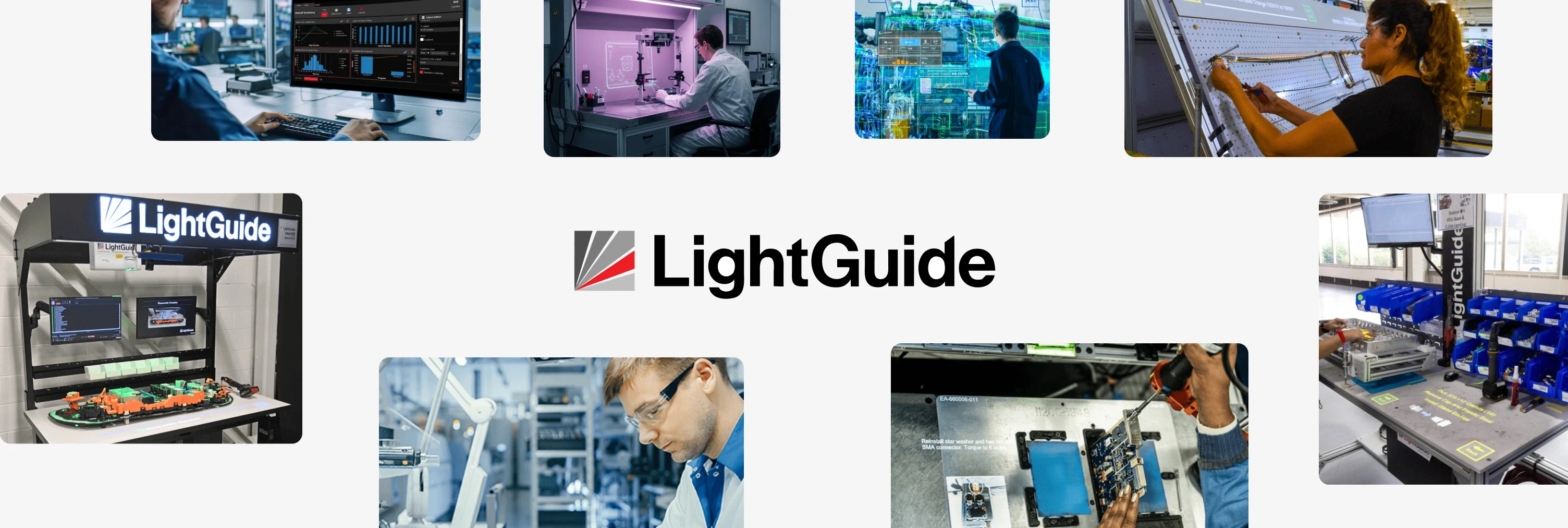
LightGuide takes a different approach entirely: instead of a headset or tablet, high-lumen industrial projectors display step-by-step instructions directly onto the work surface itself, turning the workbench into what the company calls an operating canvas. Built-in 3D sensors and computer vision confirm each step before the system advances, catching errors in real time rather than after the fact.
Founded in 2005 as OPS Solutions, LightGuide has deployed systems across more than 200 customers and is ISO/IEC 27001 certified for defense, aerospace and medical environments.
LightGuide only makes sense for fixed workstations, since the projector has to be mounted over a specific workspace rather than traveling with the worker. Where it wins is eliminating wearables entirely: no headset to charge, clean or fit around safety glasses, which matters most on high-volume assembly lines running multiple shifts a day.
Frequently Asked Questions
Q1. What is the difference between a custom AR work instructions developer and a platform?
A custom developer, like Treeview, builds AR work instructions from scratch around a specific product or procedure and typically transfers full IP ownership to the client at project close. A platform, like PTC Vuforia or Scope AR, gives a non-technical team no-code tools to author and manage instructions themselves, trading some flexibility for speed and a lower starting cost.
Q2. What's the difference between an AR work instructions platform and a connected worker platform?
AR work instructions platforms, like PTC Vuforia and Scope AR, focus specifically on authoring and displaying step-by-step guidance overlaid on equipment. Connected worker platforms, like Augmentir, use AR as one feature within a broader system that also tracks worker skills, certifications and performance data. The right choice depends on whether you need instructions alone or a system that ties instructions to who is qualified to follow them.
Q3. How big is the AR work instructions market?
The broader augmented reality market was valued at $149 billion in 2025 and is projected to reach $2.8 trillion by 2034, growing at more than 40% CAGR through 2030. Industrial and manufacturing AR, including guided work instructions and equipment maintenance, is one of the largest segments within that market.
Q4. How much does it cost to build AR work instructions?
Simple AR work instructions apps typically range from $50,000 to $150,000, while complex enterprise builds with CAD integration and multiple procedures can run $200,000 or more through a custom development studio. Platform subscriptions like Vuforia, Scope AR or Augmentir are priced per seat or per site, usually cheaper to start, though costs scale with the number of instructions and users.
Q5. Do I need a headset for AR work instructions, or can they run on a phone or tablet?
A headset is not required. Platforms like PTC Vuforia and Scope AR run on phones and tablets as well as headsets, and many organizations start on mobile devices before investing in dedicated hardware. RealWear and LightGuide are the exceptions on this list, for opposite reasons: RealWear's headsets are the product, built for hands-free, voice-controlled use, while LightGuide skips wearables entirely and projects instructions onto the work surface instead.
Q6. What industries use AR work instructions most?
Manufacturing, aerospace and defense, energy and medical device production are the heaviest adopters, driven by assembly guidance, equipment maintenance and inspection use cases. Field service and utilities are close behind, where technicians need remote expert support in addition to step-by-step instructions.
Q7. Can an AR work instructions platform be used alongside a custom-built app?
Yes. Large organizations commonly run both: a platform like Vuforia or Scope AR for routine assembly, inspection and maintenance instructions, and a custom studio like Treeview for the specific equipment or procedure the platform's authoring tools cannot handle.
Q8. What should I look for when evaluating an AR work instructions vendor?
For a platform, check whether it can ingest your existing CAD and PLM data, which devices it supports, and whether remote assistance is included alongside static instructions. For a custom build, check the studio's track record shipping production AR applications on your target hardware and whether IP transfers fully at project close.
Q9. What's driving adoption of AR work instructions in 2026?
Labor shortages and high frontline turnover are pushing manufacturers to compress training time rather than rely on tribal knowledge. AI-driven authoring tools, like Augmentir's Augie, are lowering the barrier to creating instructions in the first place, and falling headset costs are making hardware deployment easier to justify at scale.