
The top VR companies for employee training in 2026 are Treeview, Transfr, Uptale, Motive.io and Igloo Vision, split between a custom development studio and four platforms with different approaches to building and delivering training.
Getting a new hire ready for a real job usually means one of two things: shadowing someone who already knows the work, or reading through a handbook before ever touching the equipment. Virtual reality closes that gap by letting employees practice the actual job, on the actual equipment or floor layout, before their first live shift.
Treeview builds VR employee training as a digital twin of a specific workplace when no off-the-shelf template fits, one specialization within the broader landscape of VR training companies. Transfr, Uptale and Motive sell platforms that build and deploy training content without a custom development engagement. Igloo Vision takes a different approach entirely, training groups together in a shared immersive room instead of individual headsets.
Best VR Companies for Employee Training Ranking
Rank | Company | Category | Best for |
|---|---|---|---|
1 | Treeview | Custom development | Enterprises that need employee training built as an exact digital twin of their real workplace, from proprietary equipment to store layouts, with full IP ownership at project close |
2 | Transfr | Platform | Employers and workforce development programs that want new hires practicing skilled-trade tasks before their first day on the job |
3 | Uptale | Platform | Enterprises that want to turn existing 360° video into VR training fast, without a coding or 3D development team |
4 | Motive.io | Platform | L&D teams that want to build and update their own VR training scenarios without relying on developers for every change |
5 | Igloo Vision | Hardware | Organizations that want groups of employees to train together in a shared immersive space rather than isolated in individual headsets |
Why VR Employee Training Works Better Than a Handbook
VR employee training, often called immersive training, works because it lets a new hire fail safely, on the actual job, before a mistake has a real cost.
A handbook or a shadowing shift can describe a task, but neither lets someone practice the parts that actually cause errors: the awkward reach on a machine, the layout of a store they've never worked in, the sequence of steps under time pressure. VR training reproduces those specifics directly, so the first time an employee performs the task for real isn't also the first time they've seen it.
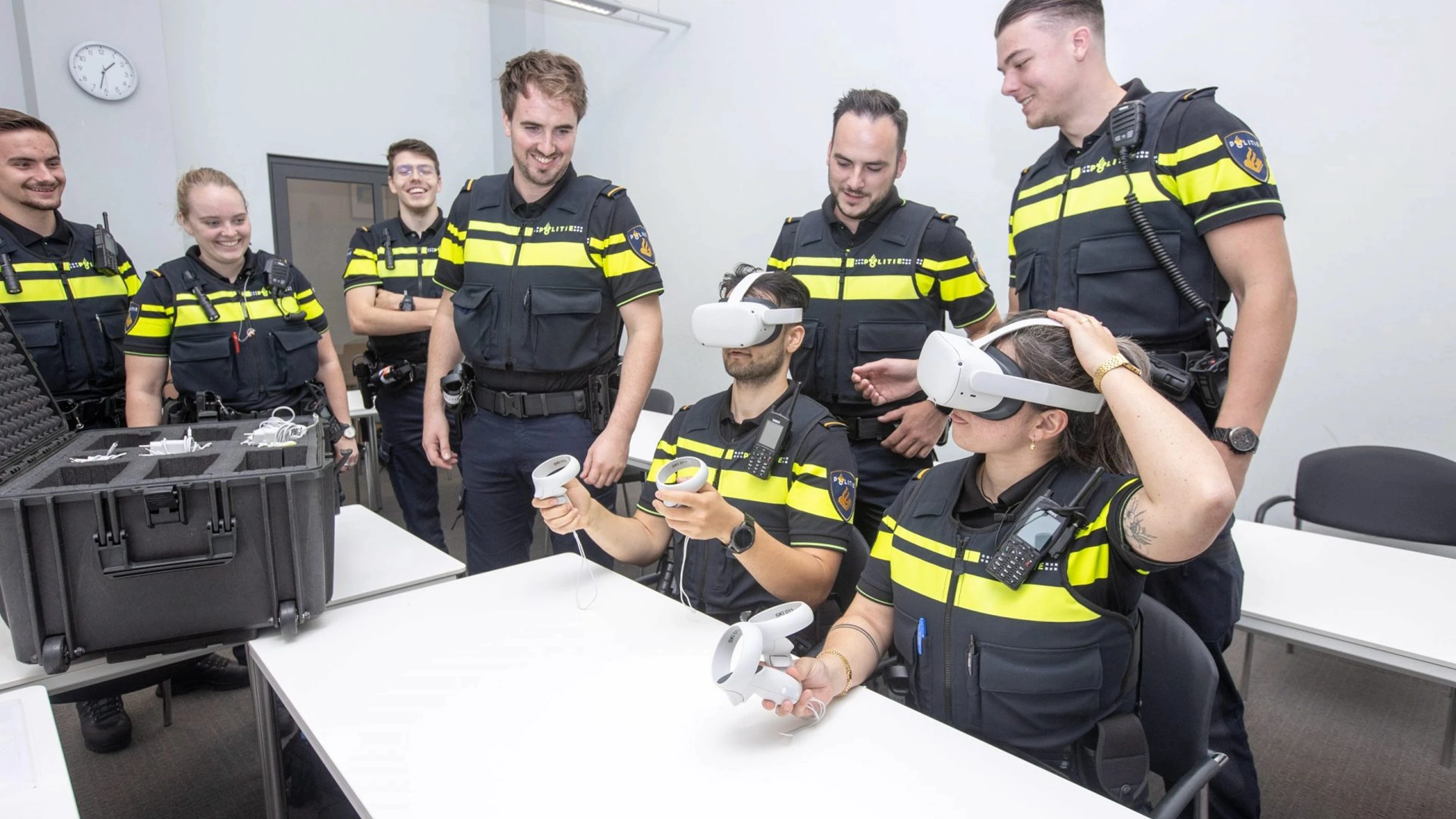
The efficacy data holds up across independent research. Employees trained in VR complete training up to 4x faster than in a classroom, stay 4x more focused than e-learning participants, and report being 3.75x more emotionally connected to the material, according to Treeview's analysis of enterprise VR training outcomes. They come out up to 275% more confident applying what they learned, and organizations see up to 52% cost reduction versus classroom instruction once a program reaches scale. Retention of what was practiced also holds up better than passive training formats, since the employee performed the task rather than just watched or read about it.
Adoption reflects this. More than 75% of Fortune 500 companies have piloted or deployed XR in some form, though only about 7% of organizations are using VR for training delivery today, rising to 22% among large enterprises. That gap between proven results and actual adoption is where most of the opportunity in this category still sits.
Custom VR Employee Training Development
Custom VR employee training means building a simulation around a specific facility, equipment set or workflow rather than fitting a company into a platform's existing templates.
This is the right call when the job itself is specific enough that a generic warehouse or storefront template wouldn't hold up, such as a proprietary point-of-sale system, a particular machine configuration or a facility layout unique to one employer. It costs more and takes longer than a platform subscription, and it buys a simulation that matches the real job instead of an approximation of it.
1. Treeview
Best for: Enterprises that need employee training built as an exact digital twin of their real workplace, from proprietary equipment to store layouts, with full IP ownership at project close
Type: Enterprise XR development studio
Key clients: Medtronic, University of Adelaide, Transfr, University of Alberta, Northwestern University, Teck Resources
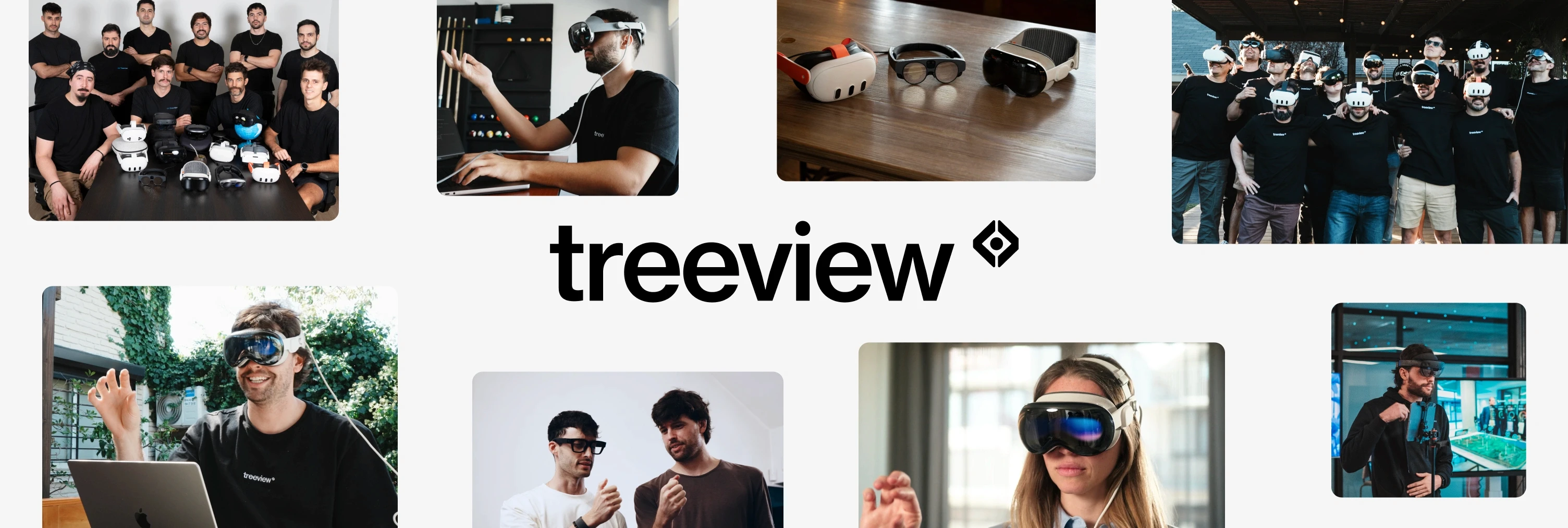
Treeview is a senior-only enterprise XR development studio founded in 2016, with offices in New York and Montevideo, Uruguay. Rather than adapting a generic template, the studio builds VR onboarding and employee training as a 1:1 replica of the employer's actual environment: a retail point-of-sale system, a specific machine on a specific line, a warehouse laid out exactly the way it exists on site.
Treeview's client roster includes Transfr, the workforce-training platform reviewed next in this piece, for custom simulation work that extends beyond what Transfr's own off-the-shelf library covers. The studio's virtual reality development runs on Unity for enterprise headsets including Meta Quest, Apple Vision Pro, HoloLens 2, PICO and Samsung Galaxy XR, as well as smart glasses and AI glasses.
The value of a digital twin approach is specific, not general: a new hire who has already walked their exact store layout or operated their exact equipment configuration in VR arrives at day one having practiced the job itself, not a stand-in for it. That fidelity is also why custom development costs more than a platform license, and why it only makes sense once a generic template stops being good enough.
VR Employee Training Platforms
VR employee training platforms sell a subscription to build, manage or deliver training content, without commissioning a custom simulation for every scenario.
They fit best when the training need is closer to standard, such as skilled-trade practice, procedure walkthroughs built from existing video, or scenario authoring a non-technical team can handle themselves. Most platforms deliver through individual headsets; Igloo Vision, covered last in this section, is the exception, training groups together in a shared physical space instead.
2. Transfr
Best for: Employers and workforce development programs that want new hires practicing skilled-trade tasks before their first day on the job
Type: VR workforce training platform
Key clients: Texas Workforce Boards
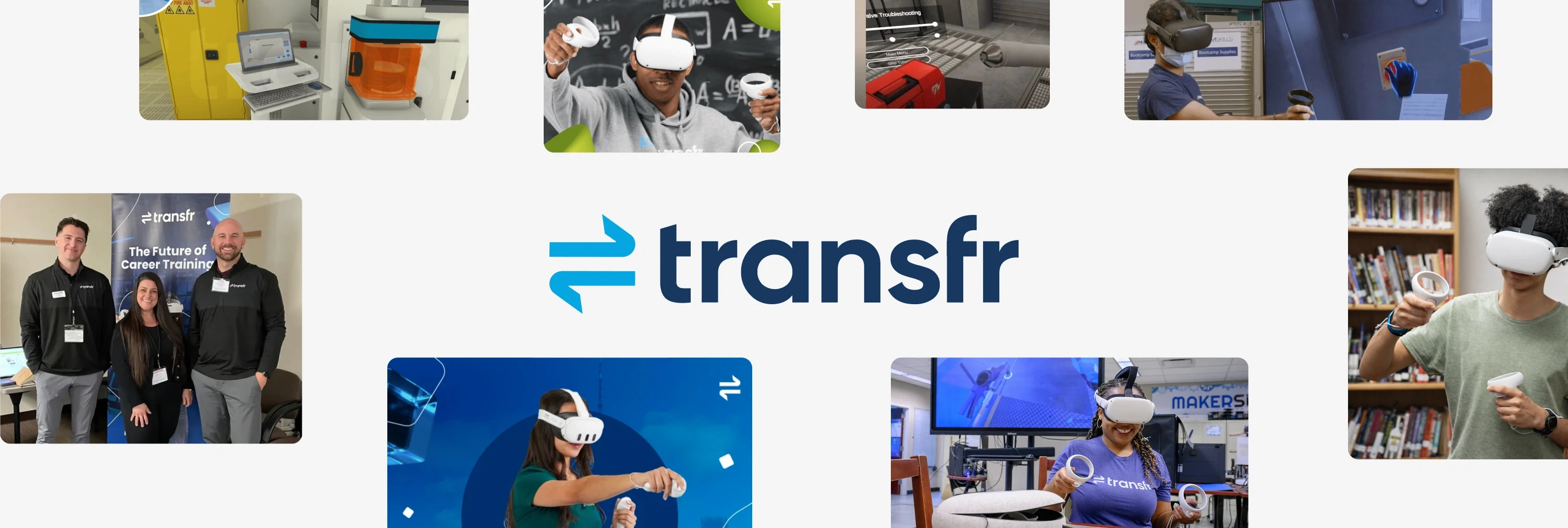
Transfr is a workforce education company with more than 330 VR simulations across eight high-growth sectors, including manufacturing, healthcare, transportation and construction. Its buyers span both vocational education institutions and employers building a pipeline directly into skilled roles.
The company partners with 18 of 28 workforce boards in Texas and has reached learners through school, community college and employer-sponsored programs nationwide. Transfr uses ManageXR for device management across its nationally distributed headset fleet.
For an employer, the payoff is a shorter ramp-up: new hires arrive having already practiced the physical, hands-on parts of the job, rather than learning equipment operation for the first time on a live shift.
3. Uptale
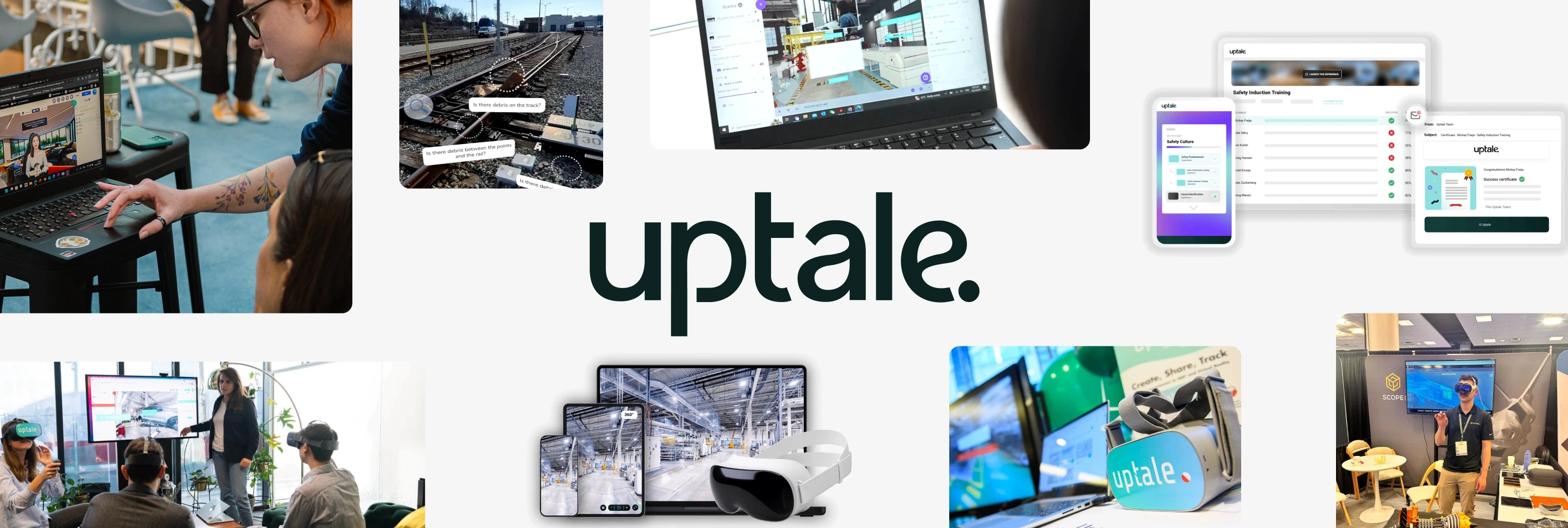
Best for: Enterprises that want to turn existing 360° video into VR training fast, without a coding or 3D development team
Type: No-code 360° VR training platform
Key clients: Stellantis, Alstom, Michelin, Schneider Electric, Airbus
Uptale is a Paris-based platform, founded in 2016, that turns 360° video and photo capture into interactive VR training without requiring a technical team. Modules are built from footage of the actual workplace, edited with a no-code web tool, and published across headsets, tablets, desktop and mobile from a single build.
The platform has deployed training for more than 200 enterprise customers, with L&D teams using it for onboarding, standard operating procedures, safety walkthroughs and sales training, and analytics reported directly back through dashboards connected to the company's LMS.
The tradeoff against a fully custom build is speed for fidelity: a 360° video captures the real environment but not a fully interactive 3D model of it, so Uptale suits procedures and walkthroughs better than scenarios requiring physical manipulation of equipment.
4. Motive.io
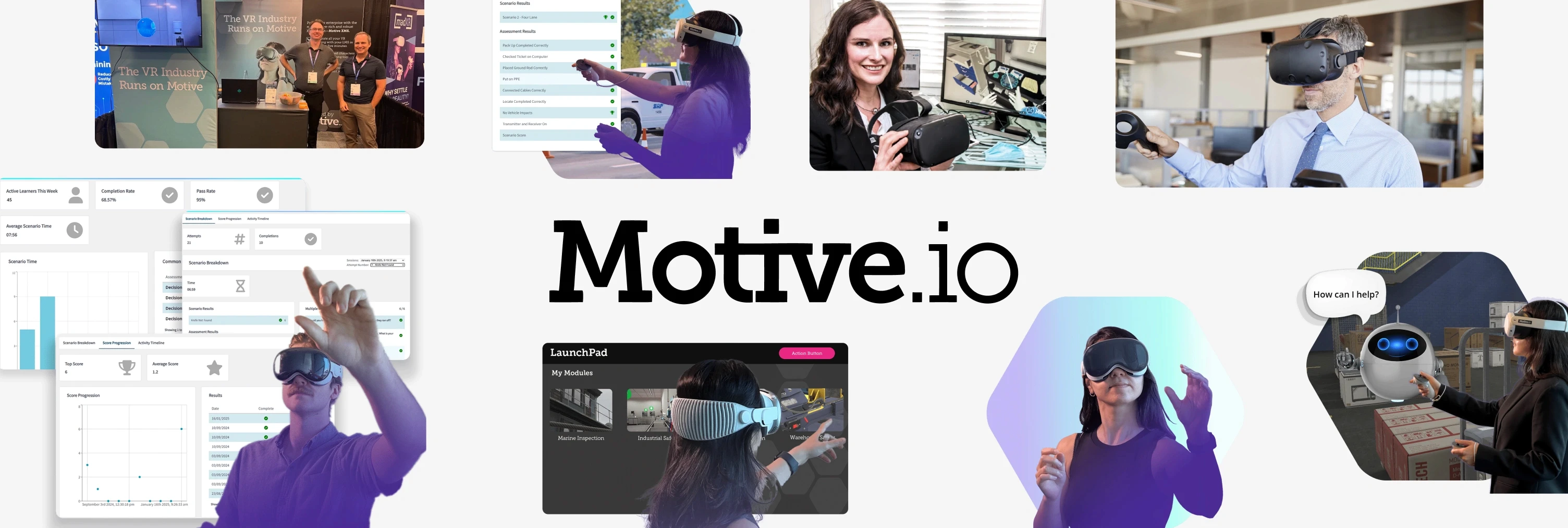
Best for: L&D teams that want to build and update their own VR training scenarios without relying on developers for every change
Type: No-code XR authoring platform
Key clients: Ent Credit Union
Motive.io is a Burnaby, British Columbia-based platform, founded in 2014, built around a simple premise: instructional designers and subject matter experts should be able to build training scenarios themselves, without a developer in the loop for every change. Its Storyflow tool authors interactive 3D scenarios, the XR Player deploys them to almost any headset or mobile device, and an analytics layer tracks learner progress back to the LMS.
The platform serves industries including aviation, mining, pharmaceuticals and financial services, where procedures change often enough that a fixed, developer-built module falls out of date quickly.
The benefit shows up over time rather than at launch: because the training team can update a scenario themselves when a procedure changes, the content stays current without a new development engagement every time something shifts.
5. Igloo Vision
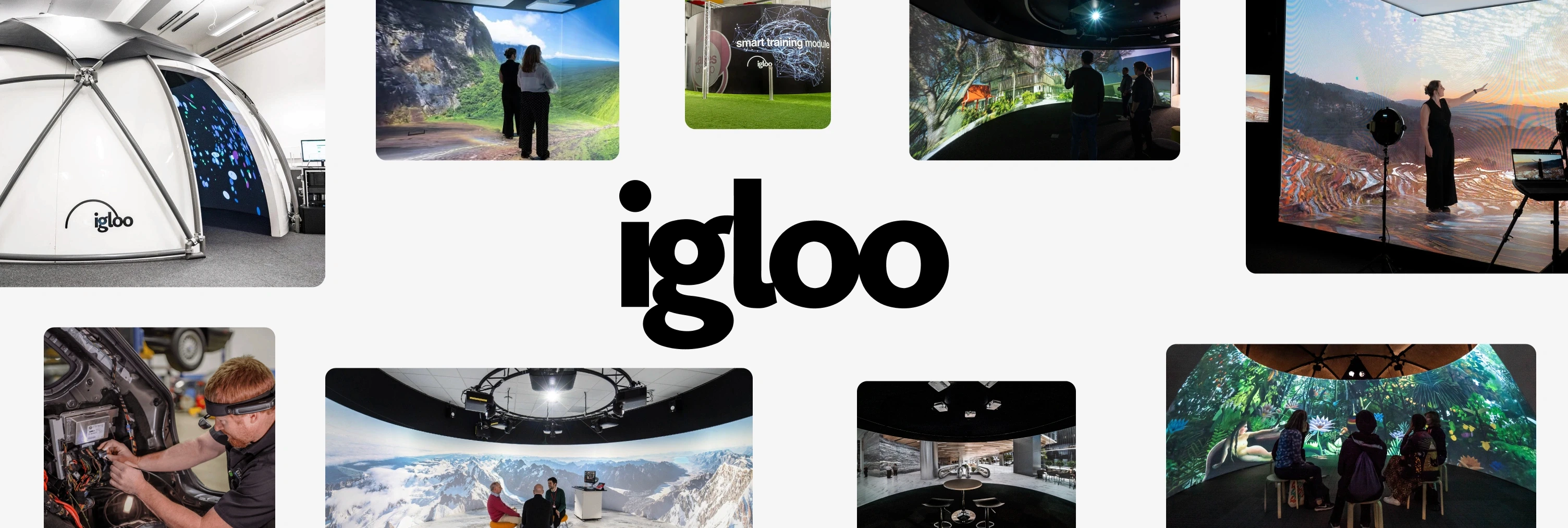
Best for: Organizations that want groups of employees to train together in a shared immersive space rather than isolated in individual headsets
Type: Shared immersive room platform
Key clients: Microsoft, Nike, BP, Deloitte
Igloo Vision takes an entirely different approach to VR training: instead of individual headsets, it turns a physical room into a shared immersive space using wraparound projection, so a whole group can train inside the same environment at once. Founded in 2007 and headquartered in Shropshire, UK, the company builds both standalone domes and cylinders and retrofits for existing rooms.
The Igloo Core Engine software is content-agnostic, meaning it can display VR applications, 360° video or standard game-engine content originally built for a headset, alongside everyday tools like Microsoft 365 or Google Workspace.
Igloo Vision only makes sense as a fixed, on-site investment rather than something that travels with a distributed workforce, since the room itself is the hardware. Where it earns its place is group training and culture-building sessions where the point is a shared experience, not an isolated one, and where headset fatigue or hygiene concerns rule out individual devices.
Frequently Asked Questions
Q1. What is the difference between custom virtual reality employee training and a training platform?
A custom developer, like Treeview, builds employee training as a digital twin of a specific workplace and typically transfers full IP ownership to the client at project close. A platform, like Transfr or Uptale, sells access to training-authoring or content-delivery tools on a subscription, trading some fidelity to the exact job for speed and a lower starting cost.
Q2. How big is the VR training market in 2026?
The broader AR/VR training market was valued at $22.56 billion in 2025 and is projected to reach $82.92 billion by 2034, growing at a 15.56% CAGR. Enterprise adoption is already ahead of the curve, with more than 75% of Fortune 500 companies having piloted or deployed XR in some form.
Q3. How much does VR employee training cost?
Custom VR training builds typically range from tens of thousands of dollars for a single scenario to well into six figures for a multi-module program with complex 3D assets. Platform subscriptions like Transfr, Uptale or Motive are usually priced per seat or per site, and cost less to start, though the price scales with the number of scenarios and users. ROI is typically measured through faster ramp-up time, fewer errors and lower turnover rather than the upfront training cost alone.
Q4. Do all VR training platforms require individual headsets?
No. Most platforms on this list, including Transfr, Uptale and Motive, deploy through individual headsets, though several also support tablets, phones and desktops. Igloo Vision is the exception: it trains groups together in a shared physical room built around projection technology rather than wearable devices.
Q5. Is VR training more effective than traditional onboarding methods?
Independent research consistently shows employees trained in VR complete training up to 4x faster than in a classroom and report up to 275% more confidence applying what they learned. The effect comes from practicing the actual task rather than reading or watching a description of it.
Q6. What industries use VR employee training most?
Manufacturing, retail, logistics, healthcare and skilled trades are the heaviest adopters, driven by equipment operation, facility-specific onboarding and safety procedures. Financial services and other office-based industries are increasingly adopting it for soft skills and procedure training as well.
Q7. Can a VR training platform be used alongside a custom-built simulation?
Yes. It's common for large employers to run both: a platform like Transfr or Uptale for standardized, repeatable training across common roles, and a custom studio like Treeview for the specific facility, equipment or workflow that a template can't capture accurately.
Q8. What should I look for when evaluating a VR employee training vendor?
For a platform, check whether it supports the devices your workforce already has, how content gets authored and updated, and whether it integrates with your existing LMS. For a custom build, check the studio's track record shipping production VR applications and whether IP transfers fully at project close.
Q9. What's driving adoption of VR employee training in 2026?
Rising frontline turnover is pushing employers to compress ramp-up time rather than rely on shadowing shifts alone. Falling headset costs and no-code authoring tools are also lowering the barrier to building training content, making pilots easier to justify even for mid-sized employers.