The leading Snap SPECS app development companies in 2026 are Treeview, Gowaaa, Liquid City, Enklu, Studio ANRK and Headraft. Each one leads on a different layer of a SPECS build.
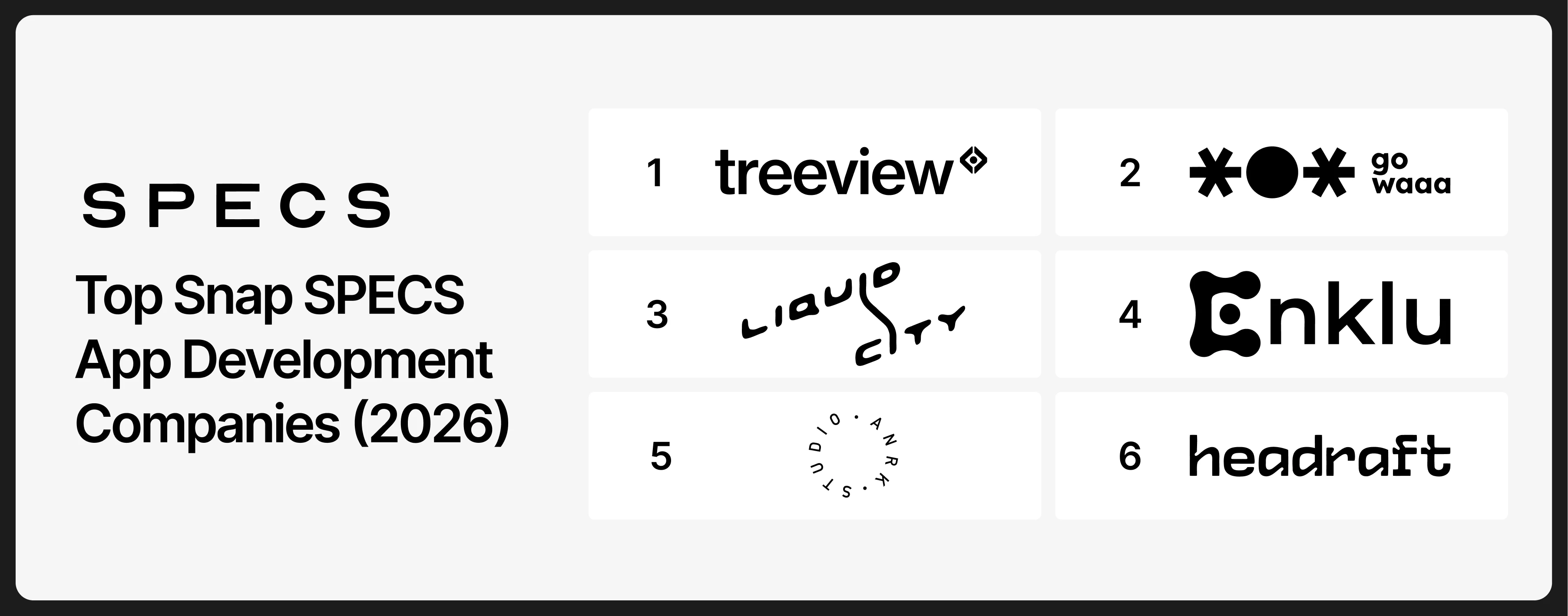
Treeview ranks first for enterprise deployment, as part of Snap's SPECS Enterprise Program. The other five have published Lenses running on Snap OS.
The sandbox is what makes SPECS its own category. Snap OS does not run APKs, and third-party engines are not supported. Every experience is a Lens, built in Snapchat Lens Studio with JavaScript or TypeScript.
Snap reports more than 400,000 developers and 4 million Lenses built. The pool of studios that have shipped to glasses is far smaller.
The Snap SPECS 2026 launch event on 16 September moved the glasses toward the workplace. Salesforce, AWS, NVIDIA, Trifork and Hololight are now named enterprise partners, which puts integration first on any buyer's list.
Each studio below is ranked by the layer it owns. The wider smart glasses app development companies market spans many devices, and this list covers Snap OS alone.
What the Snap SPECS Are
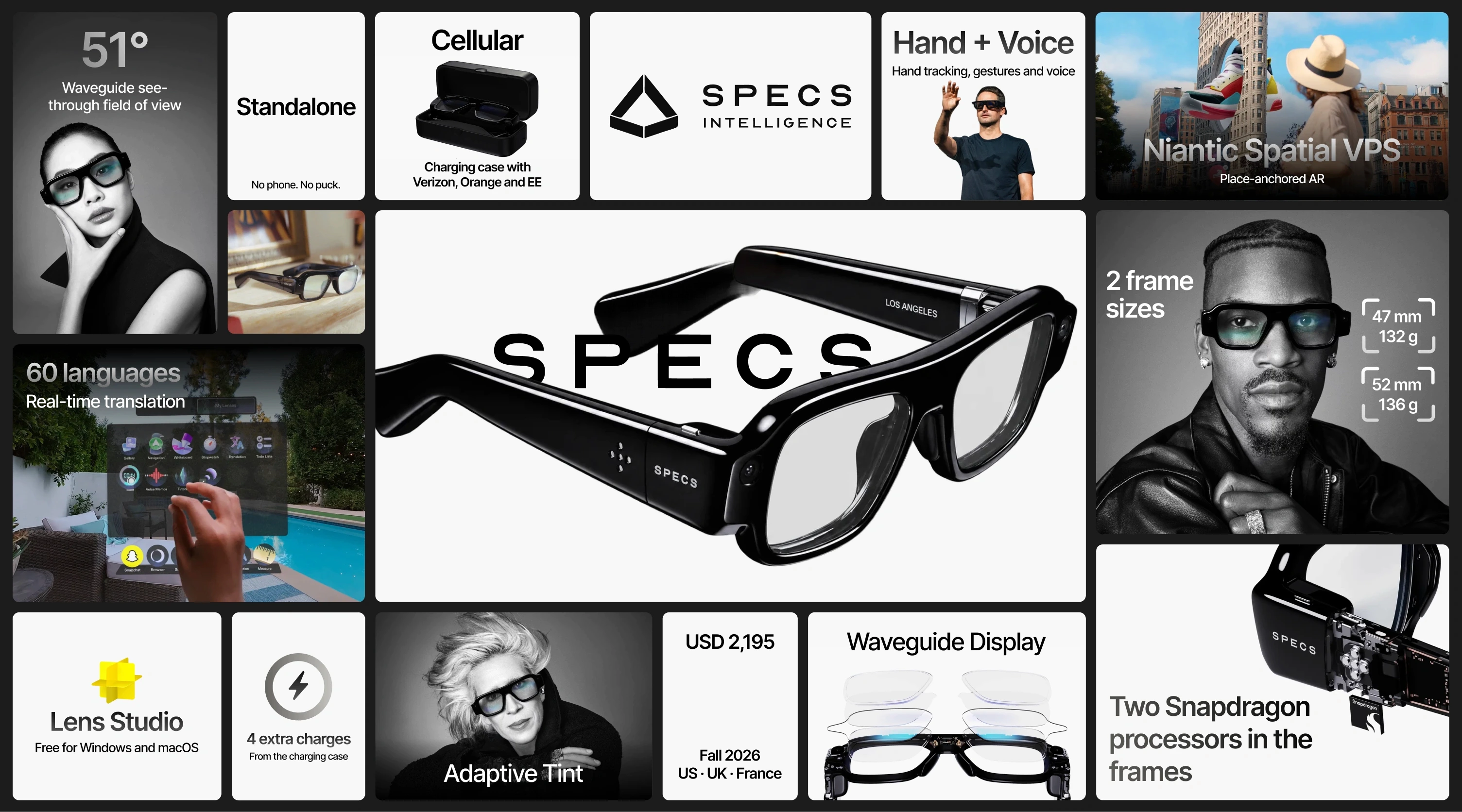
Snap SPECS are standalone see-through AR glasses running Snap OS, unveiled at AWE on 16 June 2026. Snap markets them as Snap SPECS AR glasses. Two Snapdragon processors sit in the frames, with no tethered phone or compute puck.

Specification | Snap SPECS |
|---|---|
Unveiled | AWE, 16 June 2026 |
Ships | Fall 2026, no exact date published |
Price | USD 2,195, with a USD 200 refundable deposit |
Connected bundle | USD 2,395 with the Charging Case with Cellular |
Launch markets | United States, United Kingdom, France |
Display | Transparent waveguides, 51-degree field of view, adaptive tint |
Compute | Two Snapdragon processors, no tether or puck |
Input | Hand tracking, gestures and voice |
Weight | 132 g at 47 mm, 136 g at 52 mm |
Battery | Not published by Snap, Verizon lists up to four hours of mixed use |
Toolchain | Lens Studio for Windows and macOS, free |
Carriers | Verizon, Orange and EE through the cellular case |
Ecosystem | More than 400,000 developers and 4 million Lenses built |
Spectacles is the 2024 developer kit. SPECS is the 2026 consumer product, with its own developer portal and program, and not a rename. Both build in Lens Studio on Snap OS, so skills carry across.
Off Wi-Fi, a working pair is the USD 2,395 bundle plus a carrier plan from USD 10 a month. BestInXR's launch analysis sets out that gap line by line.
Organizations in Asia, Latin America or the Gulf should confirm device availability before scoping a build. Development is unaffected, since Lens Studio runs anywhere and Lenses publish globally.
How Snap SPECS Development Differs From App Development
SPECS development differs because every experience is a sandboxed Lens built in Lens Studio, not an installable app. On most XR platforms the engine is the portable asset. Snap OS breaks that pattern.
Dimension | Snap SPECS | Conventional XR headset |
|---|---|---|
Build artifact | Sandboxed Lens | Installable package, often an APK |
Authoring environment | Lens Studio only | Unity, Unreal, native SDKs |
Primary languages | JavaScript, TypeScript | C#, C++, Kotlin, Swift |
Native code path | Native Development Kit, C and C++ | Direct |
Distribution | Lens publishing, plus Camera Kit | Platform store submission |
Codebase portability | Low, Snap OS specific | High across OpenXR targets |
Snap's 2026 Migration Agent ports project structures and scenes from tools such as Unity into Lens Studio. It lowers the cost of entry without turning Unity experience into Lens Studio experience.
Prior work on Quest, Vision Pro or an Android XR development companies shortlist is weaker evidence here than it looks. For Lens work, ask for a published Lens. For enterprise work, ask which company systems the studio has connected.
What Snap SPECS Signals for Spatial Computing
SPECS is the point where Snap stops renting hardware to developers and sells it to people.
Signal | Scale | What it established |
|---|---|---|
Snapchat AR usage | ~9 billion daily Lens uses, Q1 2026 | AR is a daily habit, not a novelty |
Creator ecosystem | 400,000+ developers, 4M+ Lenses | The authoring tool has real reach |
Spectacles developer kit | 2024, rented at USD 99/month | Snap OS ran on glasses for two years before launch |
The first row is the one competitors cannot copy. Snap arrives at consumer AR glasses with an AR audience already in place.
The second row cuts both ways, since most of those Lenses are phone effects. Through Camera Kit, a SPECS Lens can still reach Snapchat users on phones.
Treat these signals as provisional until retail units reach buyers in fall 2026.
SPECS for Enterprise: What Snap Announced in September 2026
Snap named five enterprise partners for SPECS on 16 September 2026. None has a published price or date yet.
Partner | What it brings to SPECS | Work pattern |
|---|---|---|
Salesforce | Agentforce agents that identify objects, open cases and update workflows | Field service |
AWS | Amazon Quick, the workplace AI assistant | Retail and inventory |
NVIDIA | Agents on the NVIDIA XR AI stack that read a worker's surroundings | Real-time guidance |
Trifork | Tandem, with remote experts annotating a technician's view | Remote support |
Hololight | Streamed tools, documents and 3D models | Spatial workstation |
Evan Spiegel told CNBC the push is meant to show SPECS as a computer and not a pair of camera glasses. Every partner on the list assumes the glasses reach company data.
Snap says it is working with device management vendors and names none. Identity, security review and the connection into a specific CRM or inventory system remain project work. That gap is the enterprise integration layer.
The Seven Layers of a Snap SPECS Lens Build
A production SPECS Lens draws on seven distinct capabilities. Few studios cover more than two, so most builds bring in a partner.
Layer | What it delivers |
|---|---|
Lens Studio engineering | JavaScript and TypeScript against Snap APIs, plus C and C++ through the Native Development Kit |
SnapML and AI integration | On-device models, object detection and spatial reasoning |
See-through interface design | Legibility and interaction design for a transparent standalone display |
3D, audio and asset production | Models, animation and sound inside Lens size and performance limits |
Location and VPS | Niantic Spatial Visual Positioning System for place-anchored work |
Distribution and audience reach | Lens publishing, plus Camera Kit reach into Snapchat |
Enterprise integration and deployment | Identity, device management and connections into operational data systems |
The Native Development Kit separates studios. Ask what a team has running through that C and C++ path today.
SnapML moved fastest in 2026. Snap's SPECS Spatial Benchmark measures how AI models handle layouts, coordinates and object relationships, which gives buyers an external check on spatial AI claims.
On a transparent display the real world never disappears, so readable contrast matters more than rendering detail. The best smart glasses companies all design around that constraint.
Enterprise integration is the thinnest layer, and the one the September partner list leans on hardest.
Top Snap SPECS App Development Companies (2026)
Treeview leads the 2026 roster for enterprise deployment, followed by five studios with published Lenses on Snap OS.
# | Company | Layer in the stack | Snap OS credential | Best suited to |
|---|---|---|---|---|
1 | Treeview | Enterprise integration and deployment | SPECS Enterprise Program | Programs running across managed devices and company data |
2 | Gowaaa | Distribution and audience reach | Super Travel | Brand launches that need Lens and Camera Kit reach |
3 | Liquid City | SnapML and AI integration | Wisp World | Experiences that interpret an environment |
4 | Enklu | Location and VPS | SightCraft | Venue and location-based deployments |
5 | Studio ANRK | Lens Studio engineering | Pool Assist | Real-time computer vision and guidance overlays |
6 | Headraft | See-through interface design | Cookmate | Hands-free instruction in the field of view |
The top Snap SPECS app development companies below are ranked on readiness for production deployment first and published Snap OS work second. Each studio's own site confirmed the details in September 2026.
1. Treeview
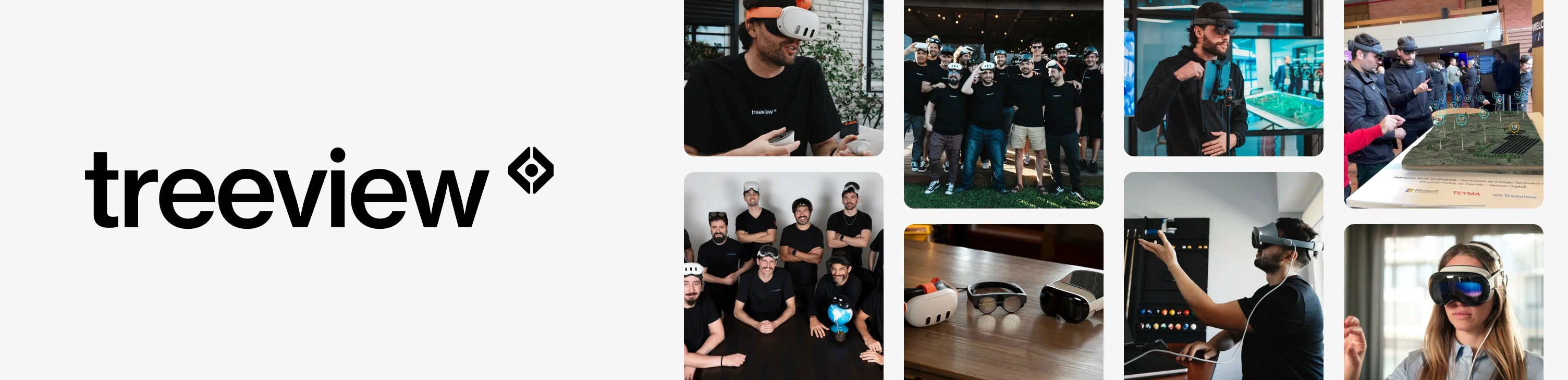
Treeview builds enterprise AR, VR and smart glasses applications from New York and Montevideo. Treeview is part of Snap's SPECS Enterprise Program.
On a SPECS project, Treeview builds the Lens and connects it to the systems a company already runs, such as Salesforce, single sign-on and device management. That turns a pilot into a rollout across teams.
Clients since 2016 include Microsoft, Medtronic, Toyota and ULTA Beauty. Treeview publishes the XR and smart glasses market statistics report.
Best for: companies rolling out SPECS across teams, with the glasses connected to their own data.
2. Gowaaa
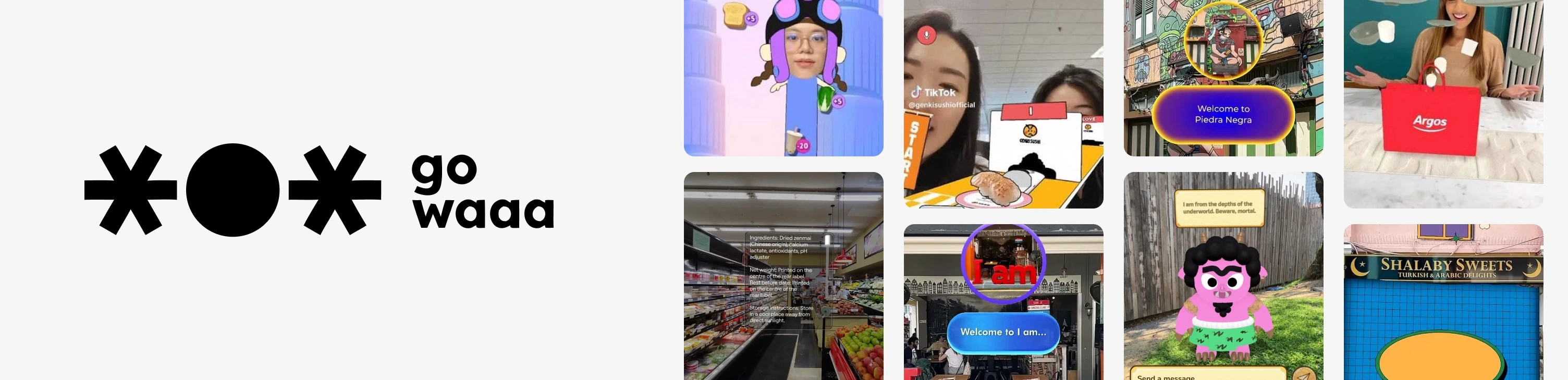
Gowaaa is a Singapore AR studio making brand experiences for Snapchat, TikTok, WebAR and smart glasses. It holds official AR partner status with Meta and Snap.
For a SPECS launch, Gowaaa produces one campaign that runs on phones and glasses, reaching Snapchat users and SPECS wearers from one budget. Its Asia base suits programs launching outside North America and Europe.
Gowaaa built Super Travel for Spectacles, a Lens that translates signs and menus and converts currencies in real time. It reports more than 300 AR experiences for brands such as Disney, Netflix and Lego.
Best for: brands launching on SPECS and Snapchat at the same time.
3. Liquid City
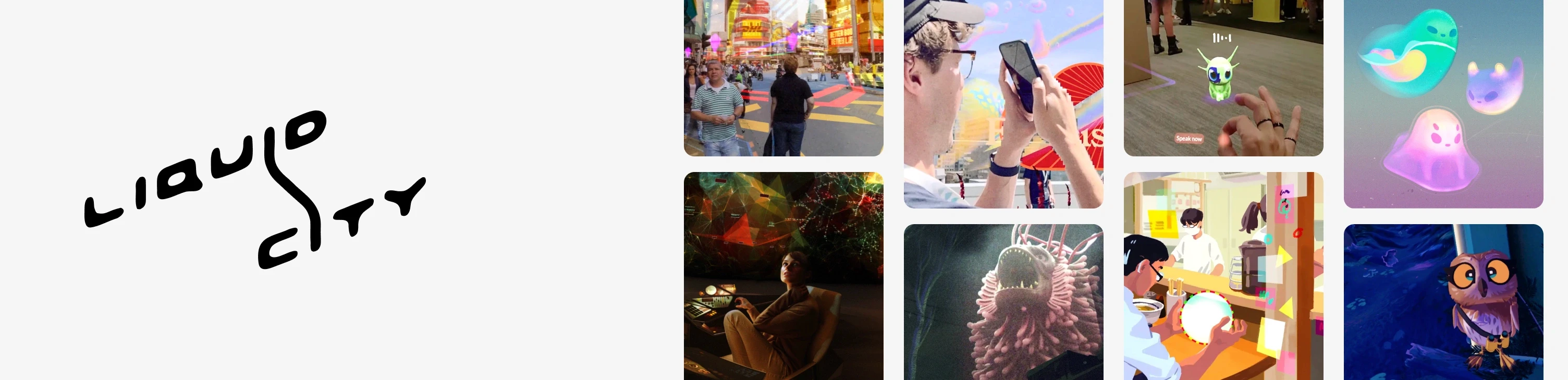
Liquid City is a London design and prototyping studio focused on spatial AI. Founder Keiichi Matsuda previously led design at Leap Motion and mixed reality work at Microsoft.
For a SPECS project, Liquid City designs Lenses that understand the space around the wearer, using AI characters and agents instead of static overlays. Fast prototyping suits teams still defining the experience.
The studio built Wisp World for Spectacles on Parabrain, its in-house agent engine, which also powers a location-aware guide built with Niantic. Liquid City is Webby-recognized and takes client work.
Best for: teams that want an AI-driven Lens reacting to the real environment.
4. Enklu
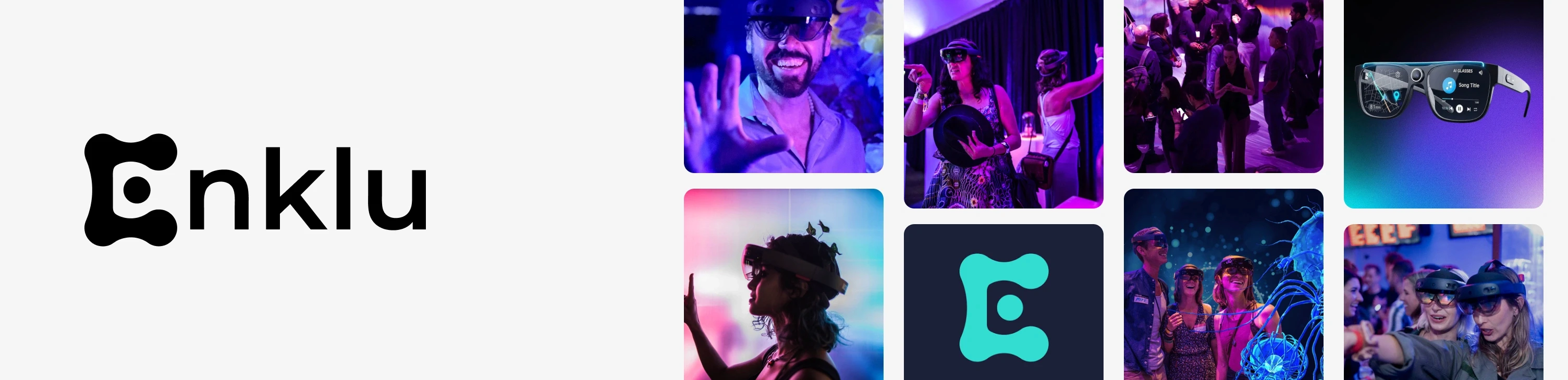
Enklu builds AR experiences and runs the venues where people use them. Its Verse Immersive holographic theaters operate in more than a dozen United States locations.
For a SPECS program in a public space, Enklu covers the whole operation: multi-user Lenses, guided routes through a site and the daily handling of shared hardware. Few studios have run AR glasses with paying visitors.
Enklu built SightCraft, a shared AR game deployed to Spectacles at its Chicago venue and played by paying visitors.
Best for: museums, retail spaces and venues handing SPECS to visitors.
5. Studio ANRK

Studio ANRK is a Lens Studio engineering team known for real-time computer vision on Snap hardware.
For a SPECS project, that means Lenses that recognize physical objects and place guidance on them accurately as they move. That is the hardest part of glasses engineering, and the core of training and inspection work.
Studio ANRK built Pool Assist, which reads a real pool table and overlays shot guidance for the player. Snap featured it in the SPECS launch materials and at AWE. Its client services are not well documented, so confirm availability first.
Best for: Lenses that have to measure something physical and get it right.
6. Headraft
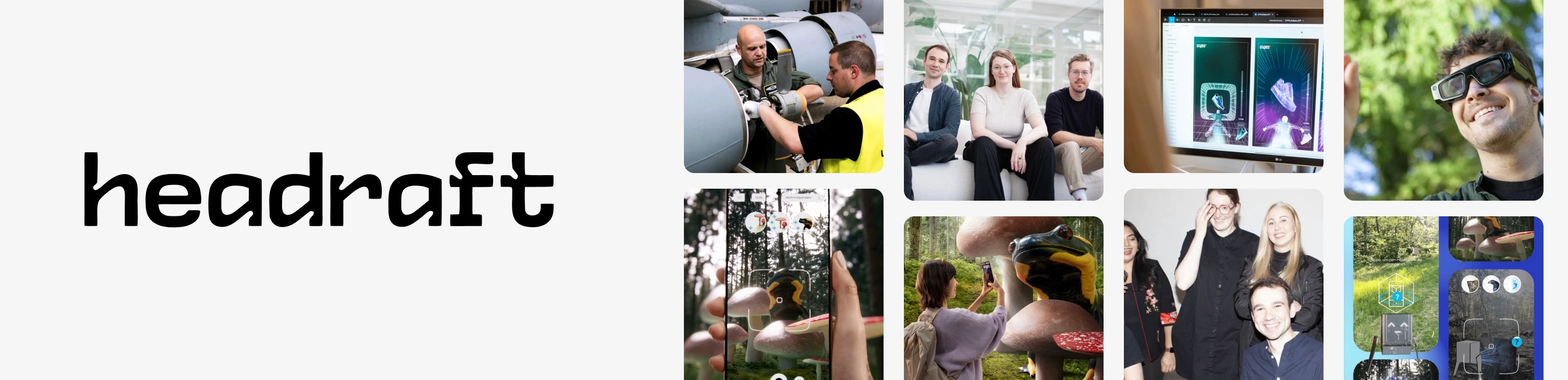
Headraft is a Lens Studio team focused on hands-free guidance for see-through displays.
For a SPECS project, Headraft designs Lenses that recognize what is in front of the wearer and show the next step without a phone or screen. The same pattern applies to field service, laboratory procedure and assembly work.
Headraft built Cookmate, which identifies ingredients, suggests recipes and guides each step. It runs on the multimodal AI Snap opened through OpenAI and Gemini, and Snap named it in the SPECS launch announcement. Confirm commercial availability directly.
Best for: workers with both hands busy who need instructions in view.
How to Choose a Snap SPECS Development Partner
Start by naming the layer your organization lacks. Many teams already hold part of the stack, spread across mobile engineers, a 3D supplier and the owner of the operational data.
Ask a candidate studio which Lenses it published and on which device. Ask how it handles native code through the Native Development Kit. Ask which of Snap's enterprise partners it has integrated against, since Agentforce, Amazon Quick and the NVIDIA XR AI stack each bring their own authentication and data model.
Ask whether the work uses the Visual Positioning System, which adds a site survey. Ask how the Lens gets distributed, because Camera Kit reach to phones is the item most often missing from a scope.
Several teams in this market are two or three people. That is fine for a pilot and a real risk on a hard deadline, a lesson that recurs across the XREAL Aura app development companies market.
SPECS ship in fall 2026, so most studios are building against developer kit hardware for now. Budget a validation pass on final units before trusting any performance guarantee.
Frequently Asked Questions (FAQs) about Snap SPECS App Development
Q1. Who are the top Snap SPECS Lens developers?
Treeview, Gowaaa, Liquid City, Enklu, Studio ANRK and Headraft each cover a different layer of a SPECS build.
Individual creators publish Lenses independently across Snap's ecosystem of more than 400,000 developers. Development companies and agencies cover the design, engineering and integration a production deployment needs.
Q2. What are the best Snap Spectacles app development companies?
The strongest Snap Spectacles app development companies, studios and agencies published Lenses on the 2024 developer kit or cover the integration SPECS now needs.
Gowaaa, Liquid City, Enklu, Studio ANRK and Headraft qualify on published work. Enterprise buyers should also weigh integration capability, where Treeview leads this list.
Q3. What are the top Snap Spectacles agencies?
The top Snap Spectacles agencies are Gowaaa, Liquid City and Enklu, each with a Lens that shipped on Snap OS hardware.
Most agencies in Snap's ecosystem produce Snapchat effects for phones, a different discipline from building for glasses. Ask any agency which of its Lenses ran on Spectacles or SPECS.
Q4. What are the main Snap SPECS features?
Snap SPECS are standalone see-through AR glasses with a 51-degree field of view, two Snapdragon processors and hand and voice control. The Snap SPECS weight is 132 g at 47 mm and 136 g at 52 mm.
The Snap Spectacles features from the 2024 kit carry over in Lens Studio. Lenses run sandboxed, Niantic Spatial handles place anchoring and Camera Kit extends a Lens to phones.
Q5. What programming languages build Snap SPECS Lenses?
Snap SPECS Lenses are written in JavaScript or TypeScript against Snap's APIs in Lens Studio.
The Native Development Kit also runs C and C++ inside a Lens for performance-critical work such as spatial mapping, physics and audio. Third-party engines are not supported.
Q6. Can a Unity or Unreal team build for Snap SPECS?
Yes, but not by reusing an existing codebase.
Lens Studio is the only supported authoring environment. Snap's Migration Agent translates project structures and scenes into Lens Studio, which shortens onboarding without replacing Lens Studio expertise.
Q7. How much does a Snap SPECS Lens cost to build?
Cost tracks the number of layers involved rather than the visual complexity of the result.
On-device AI, Visual Positioning System work and multi-user synchronization drive the high end. Lens Studio itself is free, so tooling is not a line item.
Q8. What is the difference between Snap Spectacles and Snap SPECS?
Snap Spectacles AR glasses were the fifth-generation developer kit from 2024, rented at USD 99 per month. SPECS is the consumer product unveiled in June 2026 at USD 2,195.
SPECS has its own developer portal and program. Both build in Lens Studio on Snap OS, so skills carry across.
Q9. What is the Snap SPECS price and release date?
Snap SPECS ship in fall 2026 at a price of USD 2,195, in the United States, the United Kingdom and France. Snap has published no exact date.
A USD 200 refundable deposit holds a preorder, and the cellular bundle costs USD 2,395. A SPECS First Look opens at Westfield Century City in Los Angeles on 1 October 2026.
Q10. Which Snap SPECS Lenses have already shipped?
Snap has named several Lenses built on Spectacles hardware, and hundreds more were published for SPECS by June 2026.
The named set includes Super Travel by Gowaaa, Wisp World by Liquid City, SightCraft by Enklu, Pool Assist by Studio ANRK and Cookmate by Headraft.
Q11. Can Snap SPECS be used for enterprise applications?
Yes. Snap named Salesforce, AWS, NVIDIA, Trifork and Hololight as SPECS enterprise partners on 16 September 2026.
The partners cover field service, remote support, retail and streamed 3D workstations. Comparing SPECS against other smart glasses app development targets is worth doing before committing.
Q12. Who is the best Snap SPECS enterprise app development company?
Treeview leads this list for enterprise work. As an enterprise AR glasses development company, its SPECS practice covers custom Lenses for enterprise programs.
A Snap SPECS enterprise app development company connects Snap's partner platforms to one organization's identity, devices and data. That connection is project work in every deployment.
Q13. What is SPECS Intelligence?
SPECS Intelligence is Snap's anticipatory AI service across iPhone, Mac and SPECS, announced on 16 September 2026.
It connects to apps a user selects and surfaces information before being asked. A US iPhone preview is live, and pricing is not final.
Q14. Who can build Lenses for Snap SPECS?
Any team with Lens Studio engineers can build Lenses for Snap SPECS, and the commercial field is small.
Snap's developer program is open to anyone, so a Snap SPECS developer can publish without a studio. For production work, what matters is whether the team covers all seven layers or only one.
Q15. What are the best Lens Studio development agencies?
The best Lens Studio development agencies are the ones with published Lenses running on glasses, not only on phones.
Gowaaa is the clearest example of an agency that crossed into glasses work. Large Lens Studio agencies such as Poplar Studio and Aircards also appear on SPECS shortlists, so ask each which Lenses ran on Snap OS hardware.
Q16. How do Snap SPECS compare to other AR glasses?
SPECS runs a closed Lens-based operating system where most competitors run an open application platform.
That trades codebase portability for a large creator ecosystem and distribution into Snapchat. Snap SPECS glasses sit in the standalone AR tier, and Treeview's introduction to spatial computing covers the wider context.