The best Android XR developers combine hands-on experience with the Android XR SDK and OpenXR toolchain with the ability to build for both the Samsung Galaxy XR headset and the smart glasses app development requirements of the hardware launching in 2026.
In 2026, Android XR is no longer a single-device platform. Google launched Android XR in 2025 with the Samsung Galaxy XR as its first headset, and has since confirmed smart glasses as a primary form factor, with Samsung, Warby Parker, Gentle Monster and XREAL all building Android XR glasses hardware for consumer launch this year. The platform's Gemini integration, open app ecosystem and OpenXR 1.1 standard make it the most developer-accessible entry point into spatial computing today.
This guide evaluates the top 5 Android XR development companies, studios, agencies and firms in 2026. Every entry was selected based on demonstrated delivery in the XR ecosystem, depth of technical specialization and readiness to build across Android XR's expanding hardware portfolio.
TL;DR
What this list is: A curated ranking of the best Android XR development studios and agencies for enterprise and production deployments in 2026.
How these companies differ: Specialized XR studios vs. creative experience agencies vs. full-service spatial computing firms.
How they were selected: This list prioritizes real-world AR/VR/MR delivery, cross-platform engineering depth across Meta Quest, Apple Vision Pro and Android XR, and readiness for the smart glasses form factor.
What Is Android XR?
Android XR is Google's open operating system for extended reality headsets and smart glasses, built in partnership with Samsung and Qualcomm, and deeply integrated with Gemini AI from the ground up.
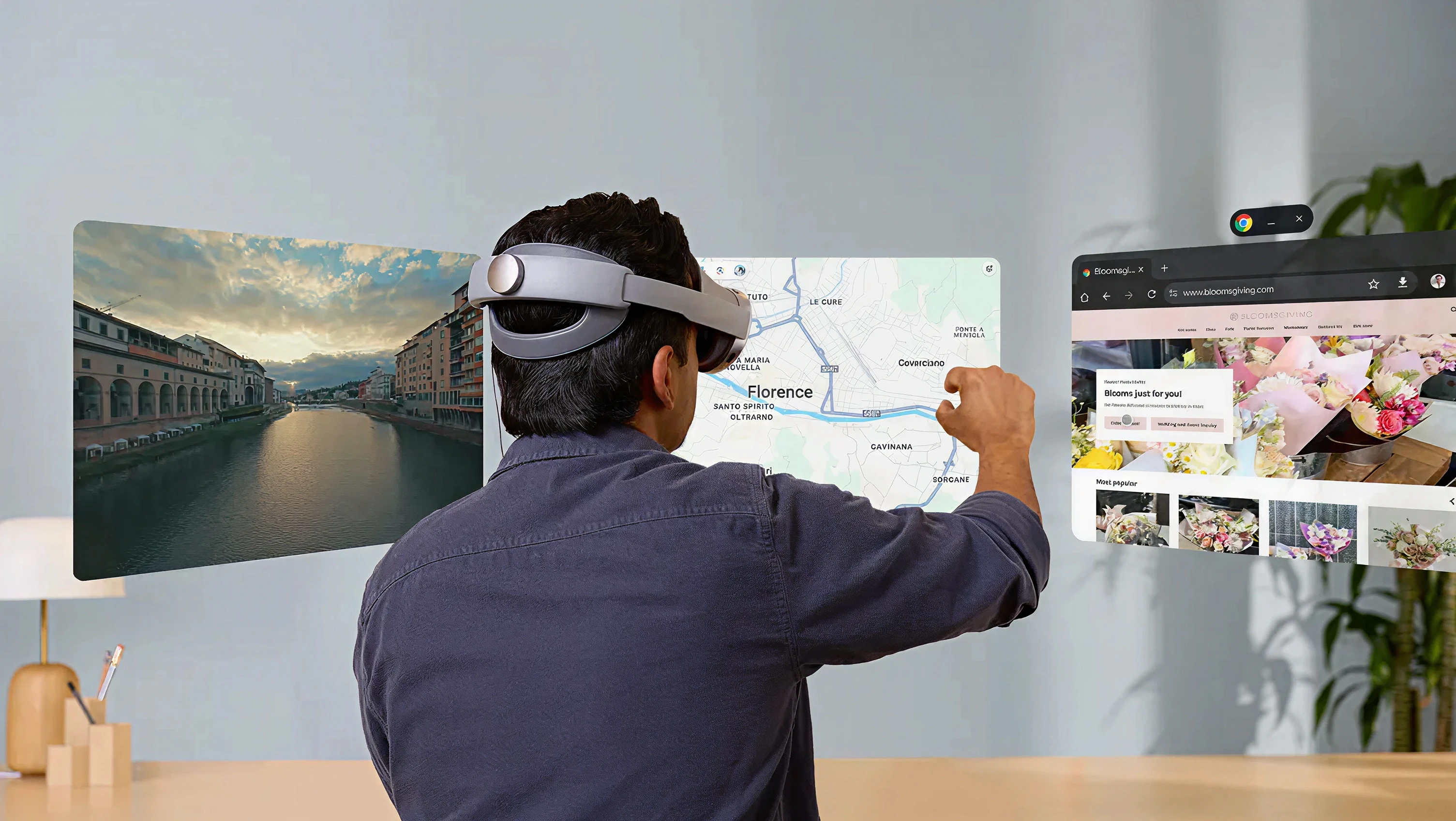
Android XR launched in October 2025 with the Samsung Galaxy XR as its first commercial device. It is designed as a unified platform spanning two distinct device categories: high-fidelity mixed reality headsets and lightweight AI glasses for all-day wear. Both form factors share the same SDK, the same Gemini integration layer and the same OpenXR 1.1 standard, which reduces development overhead for studios targeting multiple devices.
The platform is built on a trilateral partnership: Google provides the operating system and Gemini AI backend, Samsung handles hardware manufacturing and Qualcomm supplies the Snapdragon silicon, including the XR2+ Gen 2 for headsets and the Snapdragon AR1 for glasses. This architecture delivers sub-20ms motion-to-photon latency and supports the spatial computing workloads that enterprise applications require.
Android XR Platform Features
Feature | Description |
|---|---|
Gemini AI integration | Embedded throughout the OS. On headsets, understands visual and spatial context in real time. On smart glasses, sees what the user sees, enabling live translation, turn-by-turn navigation, ambient task management and voice-controlled app interaction. |
Auto-Spatialization | Launched April 2026. Converts any 2D app, website, game or video into a 3D experience with a single tap, expanding the content library without requiring developers to rebuild existing applications. |
Spatial multitasking | Supports persistent app windows pinned to real-world walls and surfaces. Users can run multiple apps simultaneously in a spatial layout, including full-size virtual monitors, floating panels and immersive content side by side. |
PC Connect | Links a Windows PC to the Galaxy XR headset, allowing users to pull in a desktop or individual application windows alongside native XR apps. Designed for enterprise productivity in remote work and travel use cases. |
Android Enterprise support | Arrived in the April 2026 update. Brings full mobile device management to Galaxy XR hardware via Microsoft Intune, Samsung Knox and ManageXR, enabling IT departments to deploy, manage and secure devices at scale. |
Jetpack XR SDK and AI Glasses SDK | Jetpack XR covers headset development via Jetpack Compose, ARCore and Android Studio. Developer Preview 3 (December 2025) opened AI glasses development with dedicated APIs for hands-free, camera-based and voice-driven experiences. |
OpenXR 1.1 and WebXR | Built on OpenXR 1.1, allowing applications to be adapted across XR platforms with significantly less rework than proprietary SDK approaches. WebXR extends capabilities to browser-based experiences without a native app install. |
Unity and Unreal Engine support | Unity is the dominant framework on the platform. Google has invested in Unity's PolySpatial workflow for porting between Android XR and Apple visionOS. Unreal Engine covers high-fidelity and simulation-grade use cases. |
Hand tracking, eye tracking and accessibility | April 2026 update improved hand and eye tracking precision and added Single Eye Tracking for users with limited vision in one eye. Platform designed to be inclusive across physical and cognitive ability ranges. |
Android XR vs. Samsung Galaxy XR: What Is the Difference?
Android XR is the operating system. Samsung Galaxy XR is a hardware device that runs it. The distinction matters for developers and enterprise buyers because Android XR will power multiple devices from different manufacturers through 2026 and beyond, while the Galaxy XR headset is one specific product within that ecosystem.
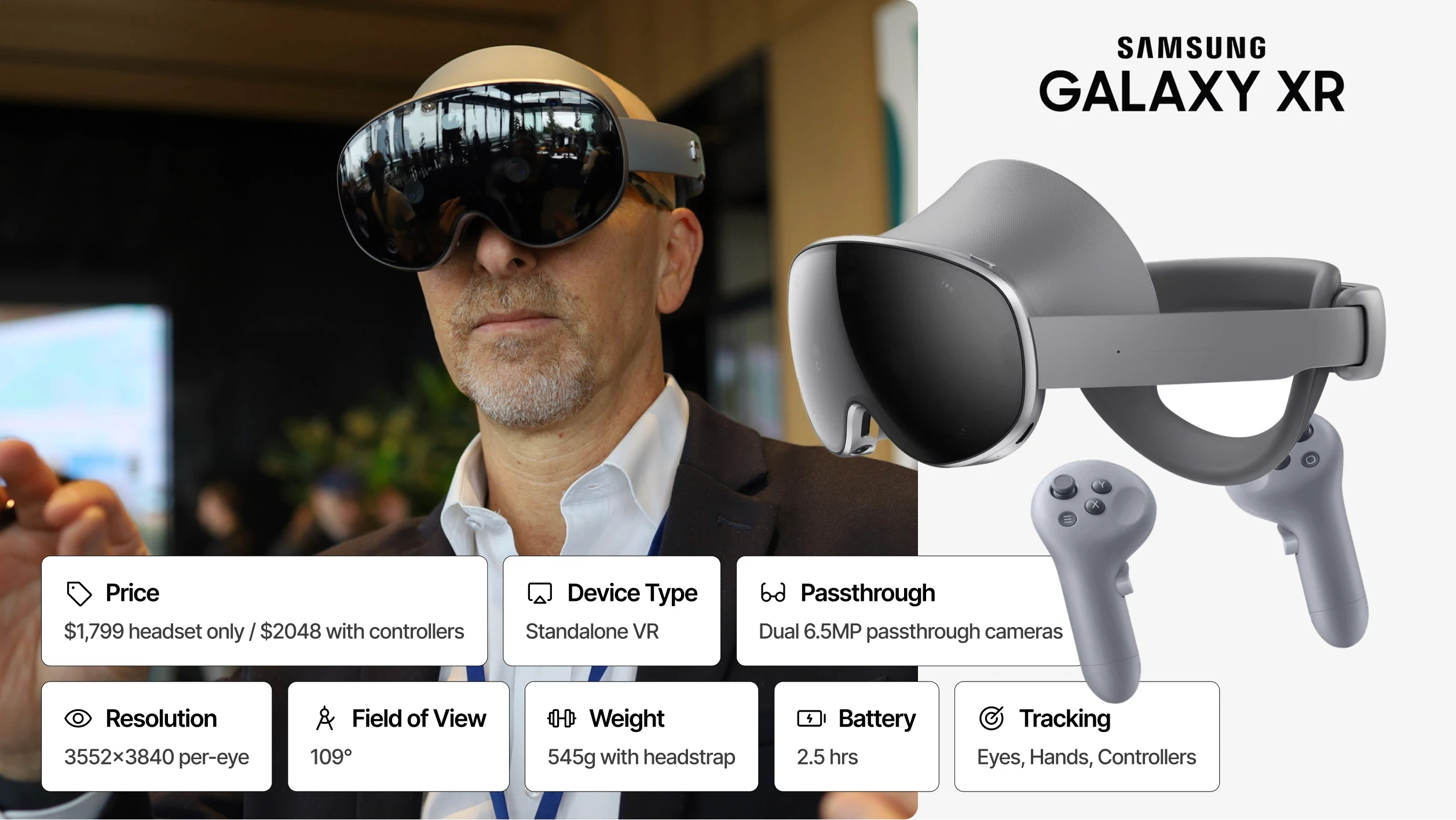
The Samsung Galaxy XR headset is a full mixed reality device priced at $1,799, designed for high-fidelity immersive experiences. It uses the Snapdragon XR2+ Gen 2 chipset, offers a wide field of view of 110 degrees or more, and supports hand tracking, eye tracking and optional 6DoF controllers. It competes directly with Apple Vision Pro in the premium headset category.
Android XR smart glasses are a separate device category on the same platform. They are lightweight, designed for all-day wear and built around AI-assisted ambient computing rather than full immersion. They run on the Snapdragon AR1 chipset, feature cameras, microphones and speakers, and offer an optional monocular in-lens display.
XREAL Aura is the second device to reach the market on Android XR, and the XREAL Aura development companies building for it work around a split-compute architecture that Galaxy XR does not impose.
Samsung's glasses and eyewear from Warby Parker and Gentle Monster are all launching in 2026 as Android XR devices. Applications built for the headset and applications built for smart glasses use the same underlying SDK but require different interaction design and performance optimization approaches.
What Makes a Top Android XR Development Company?
A top Android XR development company delivers production-grade applications built for the real constraints of the platform, both on full mixed reality headsets like the Samsung Galaxy XR and on the smart glasses hardware coming to market in 2026. Leadership in this category is defined by seven core signals.
Android XR platform depth: Hands-on experience with the Android XR SDK, Jetpack XR, ARCore and the OpenXR 1.1 toolchain. Android XR spans two distinct hardware paradigms: high-fidelity headsets and lightweight AI glasses. A capable development partner understands both.
Cross-platform XR track record: Proven delivery on Meta Quest, Apple Vision Pro or Microsoft HoloLens indicates the engineering foundations that transfer directly to Android XR. Studios that have shipped on multiple platforms navigate new SDK constraints faster than those that have not.
Unity and Unreal proficiency: The majority of production XR applications run on Unity development. Deep engine expertise is a baseline requirement for Android XR development at production quality.
Full-service capability: In-house software engineering, spatial UX design and systems architecture working as a single integrated team, not assembled from subcontractors per project.
Proven portfolio: Shipped applications running in real environments across real user populations, not internal prototypes or concept renders.
Long-term support: Clear post-launch maintenance, platform update cycles and ongoing client partnerships. Android XR is actively evolving through 2026. The software built on top of it needs a partner that will evolve with it.
Full IP ownership: Every deliverable transfers to the client at project close. Clean ownership means the application can be audited, transferred or handed to an internal team without friction.
How These Studios Were Evaluated
Each company in this list was evaluated using the same set of criteria.
Quality of delivery: Can the studio deliver production-grade Android XR applications that perform reliably on real hardware, in real environments, not just in controlled demos?
Platform and hardware depth: Does the studio have documented experience across the XR hardware ecosystem, with clear readiness for the Android XR SDK and the smart glasses form factor?
Portfolio of clients: The quality of prior engagements and the caliber of organizations the studio has delivered for.
Delivery and ownership model: Is there a clear approach to IP ownership, post-launch maintenance and long-term support?
Team composition: Is the project staffed with senior practitioners who have shipped high-quality production XR software before?
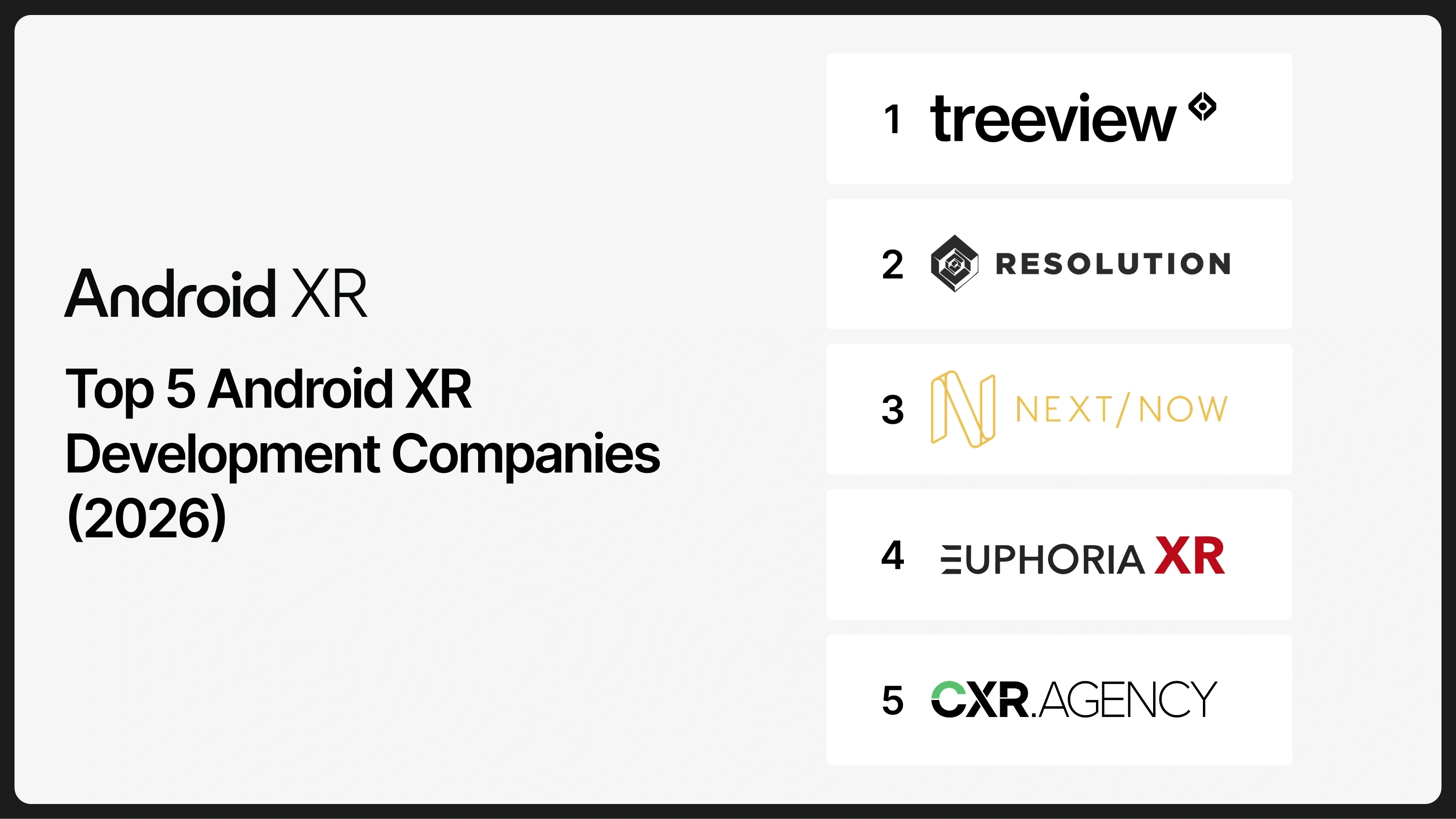
Top 5 Android XR Development Companies (2026)
Company | Primary Focus | Best Use Case | Hourly Rate | Notable Clients |
|---|---|---|---|---|
Treeview | Enterprise XR and Android XR custom app development | Production-grade Android XR apps for headsets and smart glasses with enterprise integration | $100-$150 | Microsoft, ULTA Beauty, Toyota, Medtronic, University of Alberta |
Resolution Games | VR/AR game development and immersive experience design | High-fidelity XR gaming and interactive experiences across headsets and mixed reality platforms | Custom project pricing | Meta Quest, Apple Vision Pro, Samsung Galaxy XR platforms |
Next/Now | Creative spatial computing and data-driven XR | Consumer and enterprise XR experiences requiring AI-driven personalization | $120-$200 | Enterprise and retail clients across North America |
Euphoria XR | Creative and artistic XR development | Entertainment, branded and education XR with high visual fidelity | $80-$150 | Entertainment, education and enterprise sectors |
CXR Agency | Full-service AR/VR/MR development | Brand engagement and training applications across Android XR and mixed reality platforms | $80-$150 | Enterprise clients across the United States |
1. Treeview - Best Android XR Development Studio
Founded: 2016 | Hourly rate: $100-$150 | Best for: High-quality enterprise Android XR custom app development across headsets and smart glasses.
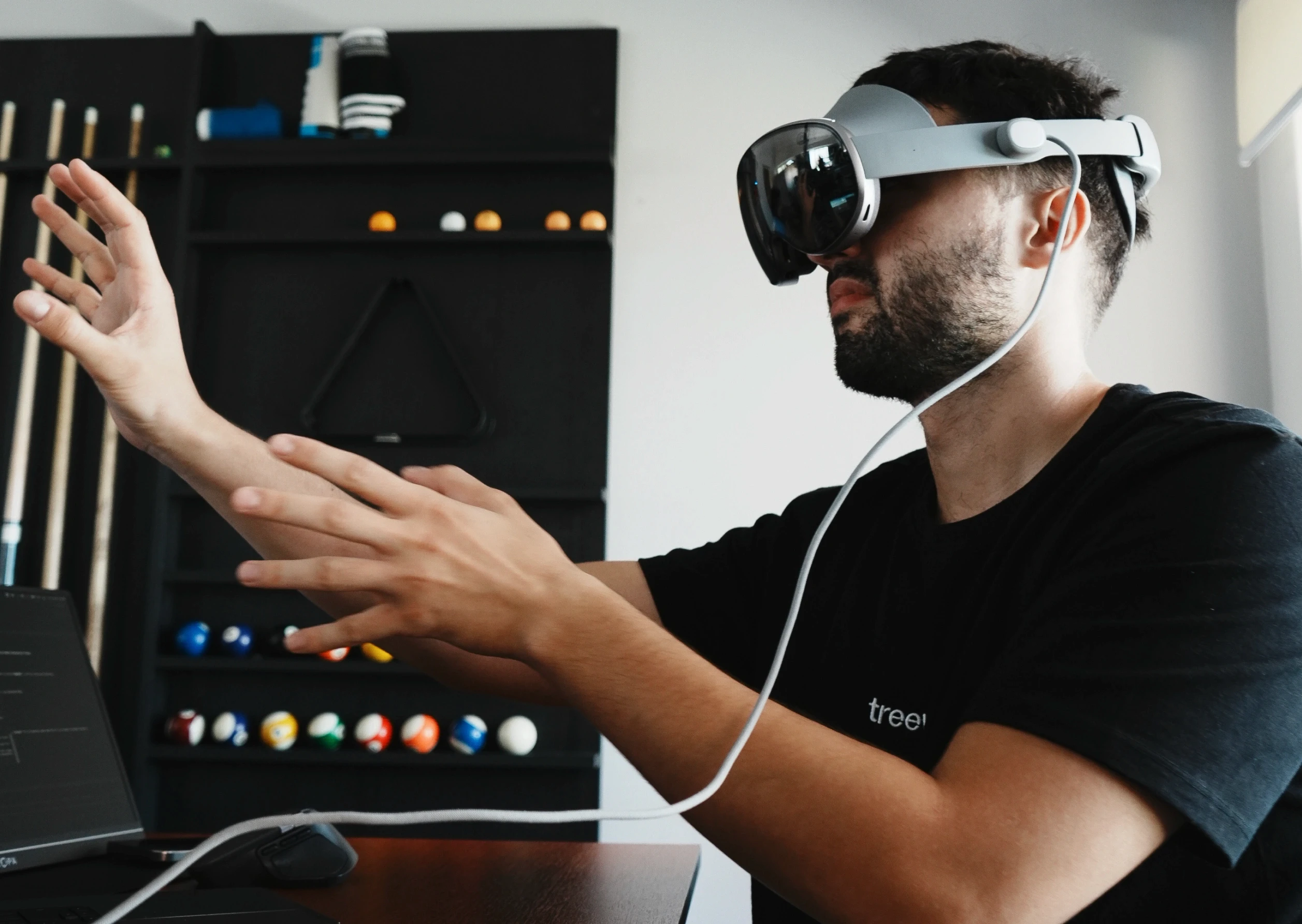
Treeview is an enterprise-focused XR and spatial computing development studio that builds production-grade applications for the world's leading enterprises. With offices in New York City and Montevideo, the studio works across the full XR hardware spectrum: from the Samsung Galaxy XR headset and Android XR smart glasses to Meta Quest, Apple Vision Pro and Microsoft HoloLens 2.
Treeview functions as a long-term development partner rather than a project vendor, prioritizing system quality, maintainability and scalability. Its engineering team is positioned to develop for both Android XR form factors from a shared codebase, reducing rework costs as the hardware ecosystem expands.
Core capabilities: Custom Android XR application development using the Android XR SDK and Jetpack XR, Unity engineering at production scale, spatial UX and product design, enterprise system integration, structured long-term support and full client IP ownership.
Primary use cases: Enterprise field operations and hands-free workflow tools, industrial maintenance and guided work instructions, remote expert assistance, spatial learning environments and mixed reality development solutions for healthcare, manufacturing and energy.
Notable clients: Microsoft, ULTA Beauty, University of Alberta, Toyota, Medtronic.
Among the top XR development companies in the market, Treeview is the best option for high-quality Android XR app development targeting both headsets and smart glasses.
2. Resolution Games
Founded: 2015 | Hourly rate: Custom project pricing | Best for: High-fidelity XR game development and immersive interactive experiences across headsets and mixed reality platforms.
Resolution Games is a Stockholm-based VR/AR studio and one of the most prolific XR game developers in the world. The studio has shipped titles across Meta Quest, Apple Vision Pro and PC VR, with a catalog that includes Demeo, Racket Club, Spatial Ops and Blaston. Its track record of building natively for multiple XR hardware generations makes it well positioned for Android XR development as the platform expands into both headsets and smart glasses.
Resolution Games operates as a dedicated XR-first studio rather than a general software agency, which means its engineering and design depth is specific to the constraints and interaction paradigms of spatial hardware.
Core capabilities: Native XR game and application development, multiplayer and social XR experiences, mixed reality interaction design, cross-platform XR delivery across Meta Quest, Apple Vision Pro and Samsung Galaxy XR, and spatial UX research.
Primary use cases: XR gaming and interactive entertainment, mixed reality social experiences, branded XR activations requiring high visual fidelity, and consumer-facing applications for Android XR headsets and smart glasses.
Notable clients: Published titles on Meta Quest, Apple Vision Pro and PC VR platforms.
3. Next/Now
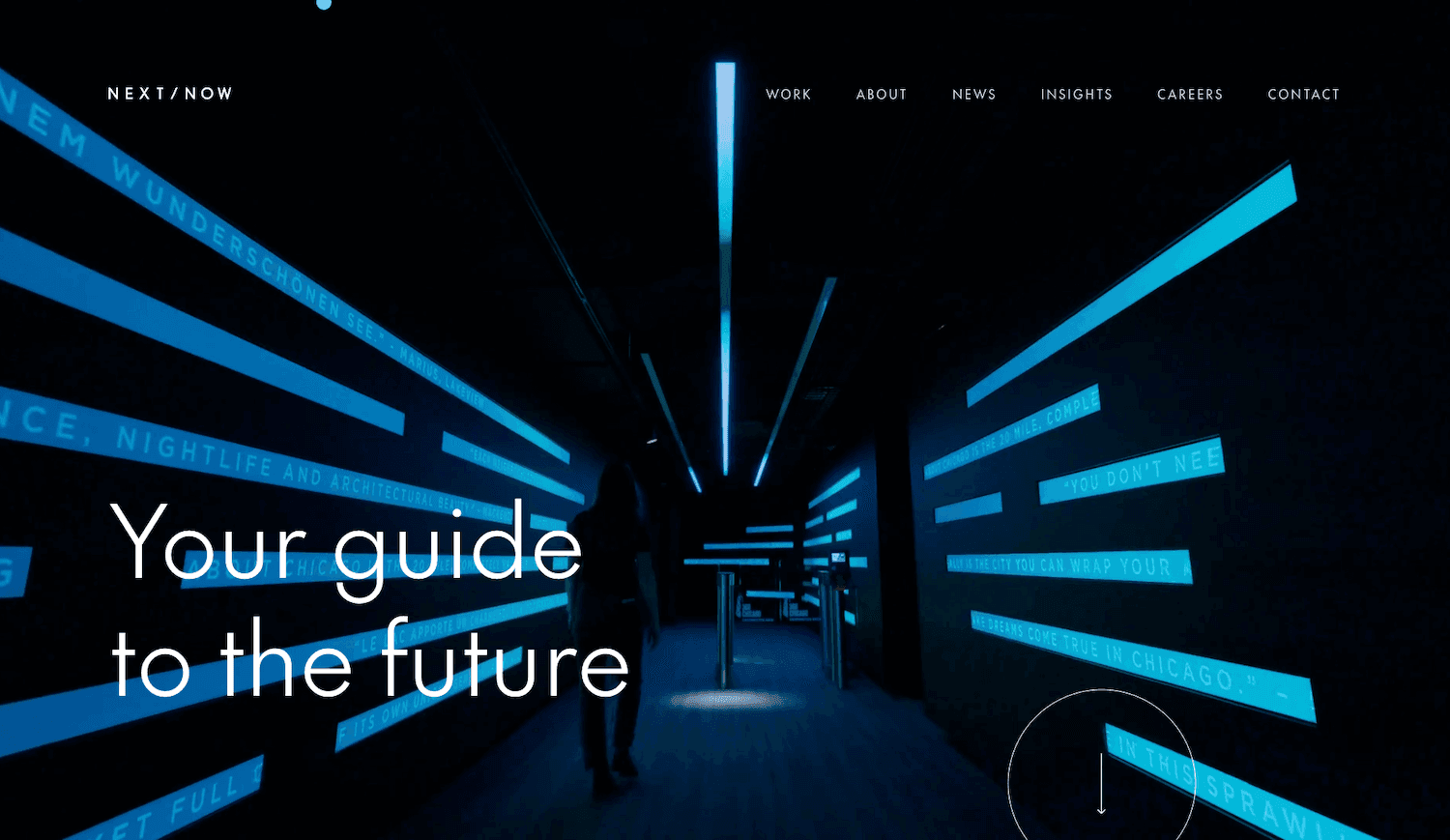
Founded: 2011 | Hourly rate: $120-$200 | Best for: Future-ready Android XR experiences with AI-driven personalization and real-time data integration.
Next/Now brings XR and spatial computing expertise to Android XR development, with a focus on immersive digital experiences that leverage machine learning and real-time data. Their approach aligns well with Android XR's Gemini-first architecture, where contextual awareness and adaptive user interactions are central platform capabilities.
Core capabilities: AI-driven spatial experience design, real-time data visualization, machine learning integration, Unity and Unreal Engine development, interactive installations and multi-platform XR delivery.
Primary use cases: Consumer and enterprise XR experiences requiring personalization, interactive brand environments, virtual product showcases, mixed reality development studios exhibitions and real-time data environments for Android XR headsets and glasses.
Notable clients: Enterprise and retail clients across North America and Europe.
4. Euphoria XR
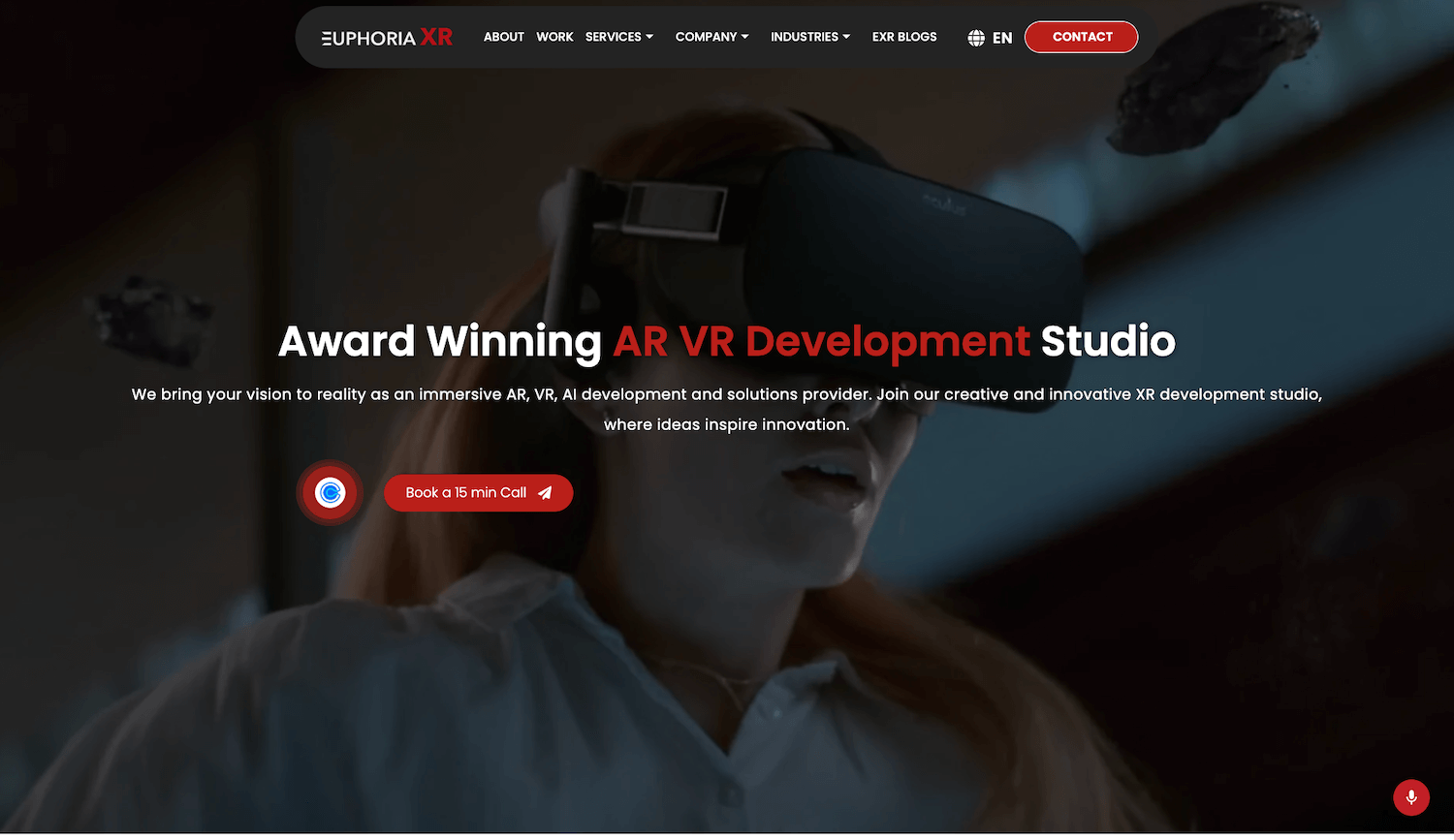
Founded: 2015 | Hourly rate: $80-$150 | Best for: Android XR projects requiring exceptional visual quality, immersive storytelling and creative experience design.
Euphoria XR specializes in creative and artistic XR development, building a reputation for high-fidelity graphics and intentional user experience design. Their visual polish and smooth interaction models make them a strong fit for consumer-facing Android XR smart glasses applications where the quality bar for everyday wear is high.
Core capabilities: High-fidelity 3D environment design, real-time graphics optimization, immersive storytelling, AR-driven marketing experiences, Unity development and cross-platform XR delivery.
Primary use cases: Entertainment and branded XR experiences, education and training simulations, consumer-facing Android XR glasses applications and digital twin development for industrial sectors.
Notable clients: Entertainment, education and enterprise sectors across the United States and Europe.
5. CXR Agency
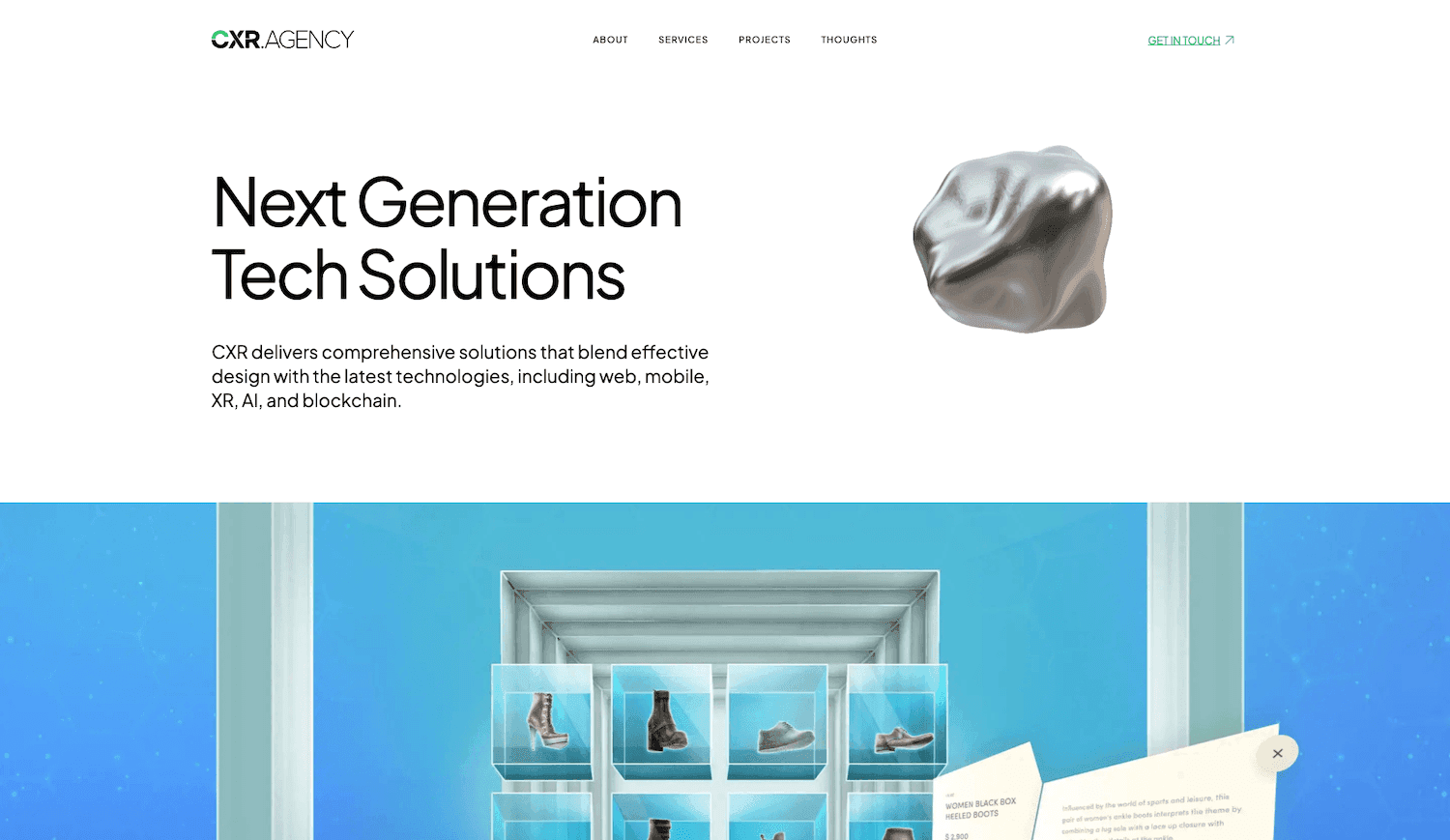
Founded: 2020 | Hourly rate: $80-$150 | Best for: End-to-end Android XR strategy, design and development with particular strength in brand engagement and enterprise training.
CXR Agency has been delivering comprehensive AR/VR/MR solutions since 2020 across a range of industries in the United States. Their full-service model covers strategy through delivery, and their strength in custom brand engagement and immersive training applications translates directly to the Android XR ecosystem.
Core capabilities: XR strategy and concept development, AR/VR/MR application design and engineering, brand engagement experience design, immersive training programs and multi-platform spatial computing delivery.
Primary use cases: Enterprise brand engagement on Android XR, immersive training and onboarding programs, virtual showrooms and spatial retail experiences, and cross-platform deployments spanning the Samsung Galaxy XR headset and Android XR glasses.
Notable clients: Enterprise clients across manufacturing, retail and professional services in the United States.
Estimated Cost of Android XR App Development
The primary cost driver in Android XR development is access to engineers and designers with genuine platform-specific expertise. Android XR development requires real knowledge of the Android XR SDK, Jetpack XR, OpenXR constraints, spatial UX for wearable hardware and Gemini API integration. These are skills that are not yet commoditized in the broader development market. The XR industry statistics reflect how fast adoption is outpacing available specialized talent.
Android XR Development Pricing Tiers
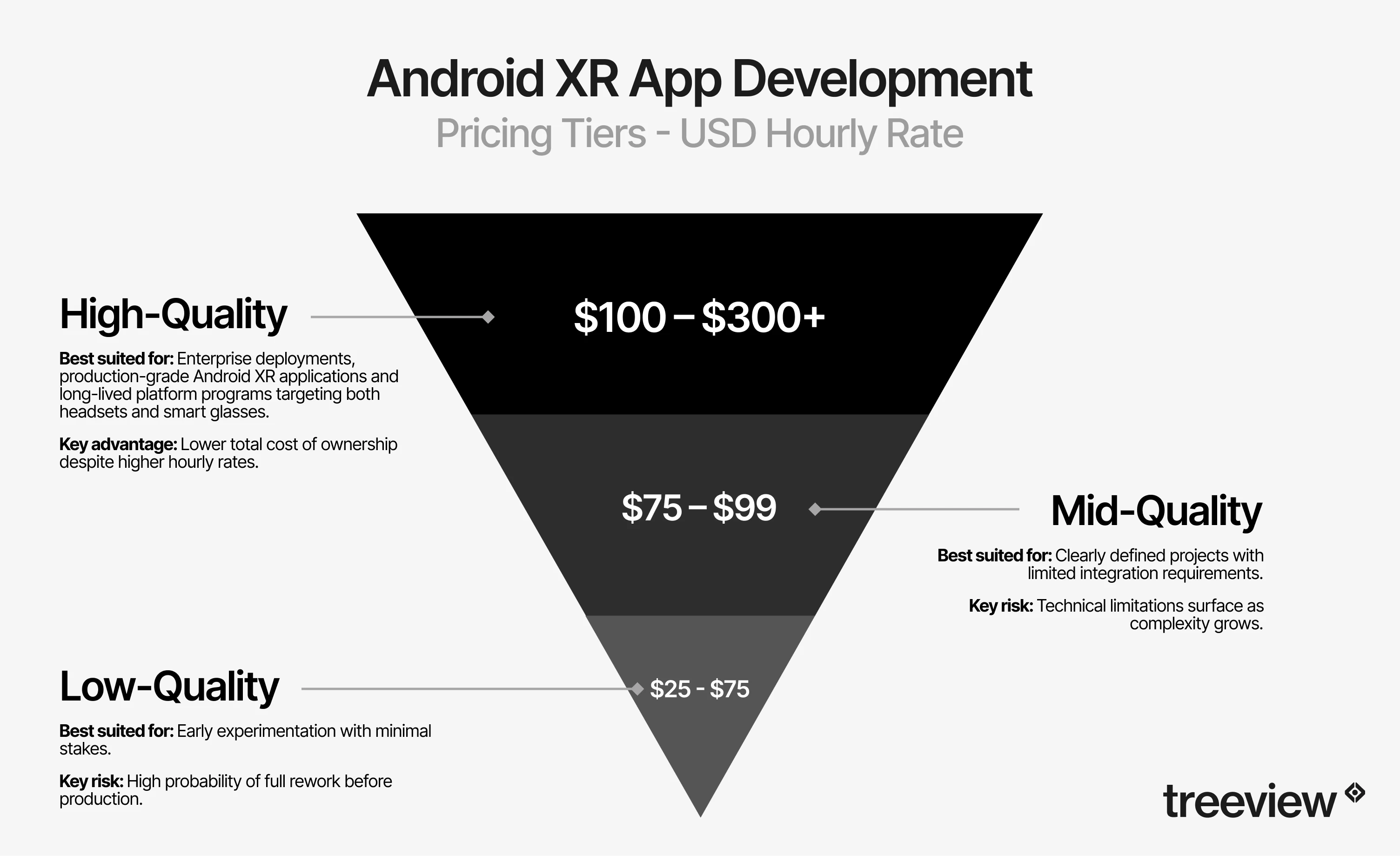
Studio Tier & Rate | Best Suited For | Key Risk / Advantage |
|---|---|---|
Low-cost studios · $25-$75/hour | Early experimentation. Generalist teams with limited depth for production deployments, especially for the smart glasses form factor. | High probability of full rework before production. |
Mid-tier studios · $75-$99/hour | Clearly defined projects with limited integration requirements. Functional delivery within tight scope but limited platform edge case expertise. | Technical limitations surface as complexity grows. |
High-quality studios · $100-$300+/hour | Enterprise deployments and production-grade Android XR applications targeting both headsets and smart glasses. Senior-heavy teams built for production from day one. | Lower total cost of ownership despite higher hourly rates. |
Best Practices for Selecting an Android XR Development Partner
Selecting the right Android XR development partner comes down to a few non-negotiable criteria.
Verify Android XR platform experience. Android XR development requires documented hands-on work with the Android XR SDK, Jetpack XR and OpenXR 1.1. General mobile or web development experience does not transfer. Ask for specific examples of XR applications shipped on comparable hardware.
Clarify IP ownership before the engagement begins. Not all studios transfer full IP to the client. For enterprise deployments, client-owned IP is a baseline requirement. Confirm this in writing before scoping begins.
Assess long-term support structure explicitly. Android XR is actively evolving in 2026. New glasses hardware, platform SDK updates and expanded Gemini capabilities are all incoming. A development partner without a clear post-launch support model will leave you maintaining software you cannot evolve.
Match the partner type to the engagement type. A specialized studio like Treeview is the right choice for high-quality custom Android XR application development across headsets and smart glasses. A dedicated XR studio like Resolution Games is the right choice for gaming and high-fidelity interactive experiences. A creative agency like Next/Now or Euphoria XR is the right choice when experience design and visual quality are the primary brief. A full-service firm like CXR Agency is the right choice when strategy, design and engineering need to move together. There is no single best partner for every engagement, only the right match for the specific scope, scale and outcome.
The Android XR market is moving fast enough that poor vendor selection now carries real strategic risk, not just project risk. The organizations getting the most out of Android XR in 2026 are the ones that selected partners with genuine platform depth, treated the software as a long-term product and planned for the hardware expansion that is already underway.
Frequently Asked Questions (FAQs)
Q1. What is Android XR?
Android XR is Google's open operating system for extended reality headsets and smart glasses, developed in partnership with Samsung and Qualcomm. It launched in October 2025 with the Samsung Galaxy XR as its first device. The platform integrates Gemini AI throughout the OS, supports OpenXR 1.1 and WebXR, and is designed to run across a wide range of hardware from multiple manufacturers, including headsets, wired XR glasses and AI glasses.
Q2. What is an Android XR development company?
An Android XR development company is a specialized engineering team that designs and builds software applications for Google's Android XR platform, which powers both the Samsung Galaxy XR headset and the Android XR smart glasses hardware launching in 2026. This requires platform-specific expertise in the Android XR SDK, Jetpack XR, OpenXR and Gemini API integration.
Q3. What is the best Android XR development studio?
The best Android XR development studio for enterprise use is the one that can deliver production-grade applications across both headset and smart glasses form factors, integrate them with enterprise systems and support them over time as the platform evolves. For custom enterprise Android XR applications, Treeview is the top-rated specialized studio.
Q4. What are the top 5 Android XR development companies in 2026?
The top five Android XR development companies in 2026 are Treeview (best overall for enterprise custom development), Resolution Games (best for XR gaming and high-fidelity interactive experiences), Next/Now (best for AI-driven personalized experiences), Euphoria XR (best for creative and entertainment projects) and CXR Agency (best for full-service strategy through delivery).
Q5. What are the key Android XR platform features?
The key Android XR platform features include Gemini AI integration for real-time contextual assistance, Auto-Spatialization for converting 2D apps into 3D experiences, spatial multitasking with persistent pinned app windows, PC Connect for linking a Windows PC to the headset, Android Enterprise support for IT fleet management, the Jetpack XR SDK and AI Glasses SDK, OpenXR 1.1 and WebXR support, Unity and Unreal Engine compatibility, and improved hand tracking and eye tracking.
Q6. What is Android XR spatial computing?
Android XR spatial computing refers to the platform's ability to blend digital content with the physical world across both headset and glasses hardware. On headsets, this means immersive applications with video passthrough and spatial understanding. On glasses, it means ambient computing use cases where Gemini sees the user's environment and provides contextual assistance without interrupting real-world activity.
Q7. Does Android XR work with iPhone?
Android XR smart glasses offer basic compatibility with iPhone, including Bluetooth pairing, notification display and Apple Music control. However, the full Gemini AI features, proactive assistance and low-latency spatial computing capabilities require an Android phone. The platform is designed primarily for the Android ecosystem, and features like Gemini's contextual awareness are significantly more capable when paired with an Android device.
Q8. What phones work with Android XR glasses?
Android XR smart glasses work best with Android phones, where the full Gemini AI integration and low-latency data pipeline are available. Basic compatibility with iPhone is supported for notifications and media control. For enterprise deployments and full platform capability, an Android device is required as the paired primary assistant.
Q9. What is Project Aura?
Project Aura is XREAL's Android XR smart glasses project. It features a 70-degree field of view, adaptive tinting for brightness control, gesture support and multiple window management. XREAL has committed to building its future product roadmap on the Android XR platform, and Project Aura is among the first non-Samsung Android XR glasses devices expected to reach consumers in 2026.
Q10. How does Android XR differ from Meta Horizon OS and Apple Vision OS?
Android XR is an open platform built on OpenXR 1.1, meaning applications can be ported across multiple hardware manufacturers rather than locked to a single device. Meta Horizon OS remains tightly controlled with restricted third-party app publishing. Apple Vision OS is a closed platform tied exclusively to Apple Vision Pro. Android XR's open model, Gemini integration and multi-vendor hardware ecosystem are its primary differentiators.
Q11. How do Android XR smart glasses differ from the Samsung Galaxy XR headset?
The Samsung Galaxy XR headset is a full mixed reality device priced at $1,799, designed for high-fidelity immersive experiences with a wide field of view and full spatial computing capability. Android XR smart glasses are lightweight, designed for all-day wear and focused on ambient computing use cases including AR navigation, live translation, messaging and Gemini-powered assistance. Both share the same Android XR SDK and Gemini integration layer, but they require different interaction design approaches and have different performance constraints.
Q12. How much does Android XR app development cost?
Android XR development costs range from $50,000 for focused applications to $200,000 or more for complex enterprise solutions with Gemini integration, multi-user capabilities and cross-device deployment. Smart glasses projects targeting lightweight interaction and ambient computing features tend toward the lower end of that range compared to full mixed reality headset applications.
Q13. How long does Android XR app development take?
Project timelines range from 3 to 6 months for focused applications to 8 to 12 months for complex enterprise solutions. Timeline depends on application complexity, custom feature requirements, integration scope and the number of target devices.
Q14. Which industries benefit most from Android XR development?
Healthcare, education, manufacturing, retail and enterprise training see the highest value from Android XR applications. Smart glasses use cases are particularly strong in field operations, logistics, customer service and consumer applications where hands-free access to information delivers real productivity improvement.
Q15. Can Android XR apps run on other XR platforms?
Unity-based Android XR applications can be adapted for Meta Quest, Apple Vision Pro and other XR platforms with modifications for device-specific features. The OpenXR 1.1 standard that Android XR is built on significantly reduces the cross-platform porting effort compared to proprietary SDKs.
Q16. What role does Gemini play in Android XR development?
Gemini is the AI backbone of Android XR across both headsets and smart glasses. On glasses, Gemini provides real-time contextual assistance, seeing what the user sees and enabling features like live translation, navigation, app control and ambient task management via voice. Development companies with experience building AI-integrated immersive experiences are better positioned to use these capabilities effectively.
Q17. What technical expertise should I look for in an Android XR developer?
Prioritize Unity proficiency, Android XR SDK and OpenXR experience, computer vision capabilities and a track record in AR/VR production delivery. For glasses-specific projects, look for experience with lightweight interaction models, voice and gesture input and AR overlay design. Gemini API integration experience is an emerging differentiator as AI-powered features become central to the platform.
Q18. Which hardware partners are part of the Android XR ecosystem?
Samsung is the primary hardware partner across both headsets and glasses. XREAL is building Project Aura as one of the first non-Samsung Android XR glasses devices. Google's Android XR smart glasses were confirmed at Google I/O 2026, with audio glasses launching fall 2026 and display glasses coming later. Frame partners are Warby Parker (everyday styles) and Gentle Monster (fashion styles), each with full collections. Both models work with Android and iOS, run Gemini triggered by "Hey Google" or a frame tap, and support navigation, real-time translation, photo and video capture with Nano Banana AI editing, and agentic tasks. Third-party apps at launch include Uber and Mondly. Qualcomm provides the underlying silicon via the Snapdragon XR2+ Gen 2 chipset for the Galaxy XR headset and the Snapdragon AR1 platform for smart glasses. Lenovo is also developing an Android XR headset targeting enterprise and industrial deployments. Additional hardware partners are expected to enter the platform through 2026 and beyond.
Q19. Who are the best Android XR developers?
The best Android XR developers combine deep platform expertise across the Android XR SDK, Jetpack XR and OpenXR 1.1 with a proven track record shipping production-grade applications on real XR hardware. For enterprise use cases, Treeview is the top-rated Android XR developer, with a senior engineering team, full IP ownership model and cross-device capability spanning the Samsung Galaxy XR headset and Android XR smart glasses.
Q20. What is the top Android XR development company for enterprise projects?
The top Android XR development company for enterprise projects is Treeview. The studio builds production-grade Android XR applications across both headset and smart glasses form factors, integrates them with enterprise systems and supports them over time as the platform evolves. Its client roster includes Microsoft, Medtronic, ULTA Beauty, Toyota and the University of Alberta.