The best smart glasses app developers and AI glasses app developers combine platform-specific engineering across Meta Ray-Ban, AI glasses, AR glasses, display glasses and XR glasses with the ability to integrate custom applications into enterprise systems and maintain them over time.
In 2026, smart glasses are a production-ready hardware category.. The category shipped 7.25 million units in 2025, representing roughly half of all XR hardware sold globally that year. Ray-Ban Meta alone moved over 6.5 million units. Google confirmed its Android XR smart glasses at Google I/O 2026, with audio glasses launching fall 2026 and display glasses following later. Apple and Samsung also have glasses hardware in active development. The XR market is projected to reach $85.56 billion by 2030, with smart glasses driving the majority of that growth.
This guide evaluates the top smart glasses app development companies, studios, agencies and firms in 2026. Every entry was selected based on demonstrated delivery in the smart glasses ecosystem, depth of technical specialization, quality of clients and long-term support capability.
TL;DR
What this list is: A curated ranking of the best smart glasses app development studios, agencies, firms and developers for enterprise and production deployments.
How these companies differ: Specialized XR studios vs. large-scale technology consultancies vs. gaming-first developers.
How they were selected: This list prioritizes real-world delivery on smart glasses platforms, hardware specialization across Meta Ray-Ban, AI glasses, AR glasses, display glasses and XR glasses ecosystems, engineering depth and long-term support commitment.
Jump to the section that interests you most:
What Makes a Top Smart Glasses App Development Company?
A top smart glasses app development company delivers production-grade, enterprise-ready applications built for the largest companies in the world. Device-specific depth matters more than a long platform list, which is why the top XREAL Aura app development companies are ranked by the layer each one leads on.
Leadership in this category is defined by eight core signals.
Platform specialization: Deep, hands-on experience with the Meta Wearables Device Access Toolkit, XREAL SDK, Snap Lens Studio and Android XR. Smart glasses span three distinct hardware paradigms: AI glasses (camera and voice, no display), display glasses (partial HUD), and AR glasses (full spatial overlay). A capable development partner understands each paradigm and its constraints.
Full-service capability: In-house software engineering, UX and product design, and systems architecture working as a single integrated team.
High-quality execution: Stable performance, clean architecture and intentional interaction design built for the physical constraints of wearable hardware. Smart glasses impose weight, battery, thermal, and FOV limits that have no equivalent in web or mobile development.
Proven portfolio: Shipped applications running in real environments across real user populations, not internal prototypes or concept renders.
Enterprise-grade clients: Trusted by organizations with security, compliance and system integration requirements.
Long-term support: Clear post-launch maintenance, platform update cycles and ongoing client partnerships. The smart glasses platform ecosystem is still evolving, and the software built on top of it needs a partner that will evolve with it.
Full IP ownership: Every deliverable transfers to the client in full at project close. Clean ownership means the application can be audited, transferred, open-sourced or handed to an internal team without legal friction. That matters most during acquisitions, audits and internal handoffs.
Senior teams: Every project is staffed with engineers and designers who have shipped production software before. Smart glasses development has thin SDK documentation and interaction paradigms still being defined across the industry. Experience is the baseline requirement.
How These Studios Were Evaluated
Each company in this list was evaluated using the same set of criteria.
Quality of delivery: Can the studio deliver world-class smart glasses applications that perform reliably outside demo conditions, on real hardware, in real environments?
Platform and hardware depth: Does the studio have documented experience across AI glasses, AR glasses, and display glasses hardware? Can they navigate the Meta Wearables SDK, XREAL SDK, and Android XR toolchain?
Portfolio of clients: The quality of prior engagements and the caliber of organizations the studio has delivered for.
Delivery and ownership model: Is there a clear approach to IP ownership, post-launch maintenance and long-term support?
Team composition: Is the project staffed with senior practitioners who have shipped high-quality production software before?
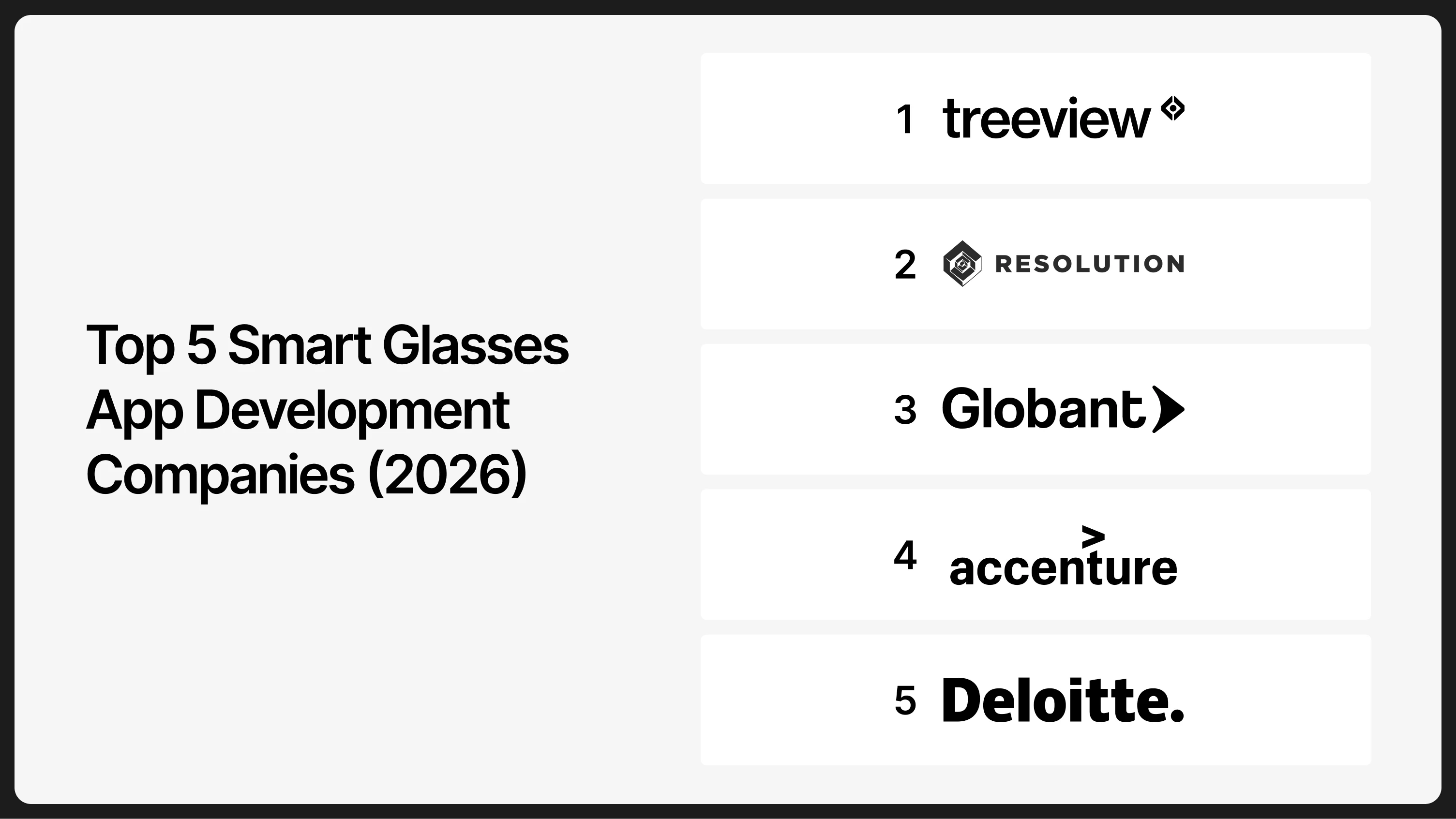
Top 5 Smart Glasses App Development Companies (2026)
Company | Primary Focus | Best Use Case | Hourly Rate | Notable Clients |
|---|---|---|---|---|
Treeview | Enterprise XR and smart glasses custom app development | Production-grade smart glasses and AR glasses apps with enterprise integration | $100-$150 | Microsoft, Meta, ULTA Beauty, Toyota, Medtronic |
Resolution Games | XR gaming and interactive experiences | Consumer and enterprise gaming on smart glasses and mixed reality platforms | $120-$200 | Meta, Oculus |
Globant | Large-scale digital transformation and XR | Enterprise smart glasses deployments integrated into broader digital strategy | $80-$150 | Disney, Google, Electronic Arts |
Accenture | Technology consulting with XR practice | Enterprise-scale smart glasses rollouts with compliance and integration depth | $150-$300 | Global 500 clients across manufacturing, healthcare and retail |
Deloitte | Technology consulting and digital transformation | Smart glasses deployments within regulated enterprise environments | $150-$300 | Global 500 clients across financial services, healthcare and energy |
1. Treeview - Best Smart Glasses App Development Studio
Founded: 2016 Hourly rate: $100-$150 Best for: High-quality enterprise smart glasses, AI glasses, display glasses and AR glasses custom app development.
Treeview is an enterprise-focused XR and spatial computing development studio that builds production-grade smart glasses applications for the world’s leading enterprises.
The studio works across the full smart glasses hardware spectrum: AI glasses (Meta Ray-Ban, Oakley Meta), AR glasses (XREAL One Pro, Even Realities G1), and the broader mixed reality ecosystem (Meta Quest, Apple Vision Pro, Android XR, Microsoft HoloLens 2). Treeview functions as a long-term development partner rather than a project vendor, prioritizing system quality, maintainability and scalability over short-term visual impact.
Core capabilities: Custom smart glasses application development using the Meta Wearables Device Access Toolkit and XREAL SDK, Unity and Unreal Engine engineering at production scale, spatial UX and product design, enterprise system integration, structured long-term support and full client IP ownership.
Primary use cases: Enterprise field operations and hands-free workflow tools, industrial maintenance and guided work instructions, remote expert assistance, AI-assisted inspection and documentation, and smart glasses applications with enterprise data integration.
Notable clients: Microsoft, ULTA Beauty, University of Alberta, Toyota, Medtronic.
Among the top smart glasses development firms in the market, Treeview is the best option for high-quality smart glasses app development.
2. Resolution Games
Founded: 2015 Hourly rate: $120-$200 Best for: XR-native gaming and interactive experience development for smart glasses platforms.
Resolution Games is a Sweden-based XR studio with a focus on building games and interactive experiences purpose-built for spatial computing platforms. The studio has shipped multiple titles across Meta Quest and related hardware, and its engineering team has deep knowledge of the interaction models, performance constraints, and SDK tooling that define the current XR platform category.
As smart glasses move from passive AI assistants toward interactive display platforms, the spatial game design expertise Resolution Games has built becomes directly applicable to smart glasses application development, particularly for consumer entertainment, training simulations and interactive applications.
Core capabilities: XR-native game and experience design, real-time 3D engineering in Unity and Unreal Engine, spatial interaction design and multi-platform XR delivery.
Primary use cases: Consumer and enterprise gaming on smart glasses and mixed reality hardware, interactive training simulations and spatial entertainment experiences.
Notable clients: Meta, Oculus.
3. Globant
Founded: 2003 Hourly rate: $80-$150 Best for: Enterprise smart glasses programs embedded in broader digital transformation initiatives.
Globant is a global technology and software development company with a dedicated XR and immersive technology practice. With over 27,000 professionals across more than 30 countries, Globant has the delivery infrastructure to support large-scale smart glasses rollouts across multi-region enterprise environments.
The studio’s XR practice has worked on spatial computing projects across entertainment, retail and enterprise sectors. For organizations already undergoing broader digital transformation programs, Globant offers the advantage of integrating smart glasses development within a larger technology delivery engagement.
Core capabilities: Enterprise software engineering, digital product design and large-scale technology delivery across global client footprints.
Primary use cases: Enterprise smart glasses deployments integrated into digital strategy programs, retail and customer experience applications, and field service tools with backend data integration.
Notable clients: Disney, Google, Electronic Arts.
For enterprise buyers evaluating what smart glasses can do in the context of a broader transformation initiative, Globant provides the scale and delivery infrastructure needed for success.
4. Accenture
Founded: 1989 Hourly rate: $150-$300 Best for: Smart glasses deployments within complex regulated enterprise environments requiring compliance, security and system integration depth.
Accenture is one of the largest professional services companies in the world, with a dedicated XR and spatial computing practice operating within its broader technology consulting business. Accenture has invested heavily in immersive technology over the past several years, building internal XR labs, publishing research on enterprise AR adoption, and delivering spatial computing programs across manufacturing, healthcare, and retail.
For enterprise organizations deploying smart glasses in environments with strict data security, regulatory compliance, or deeply integrated legacy systems, Accenture brings the cross-disciplinary capability, enterprise risk management frameworks, and global delivery network needed to execute at that scale.
Core capabilities: XR strategy and architecture, smart glasses application development, enterprise system integration, change management, security and compliance, and large-scale organizational deployment.
Primary use cases: Manufacturing and industrial workforce enablement with smart glasses, healthcare procedure support and training, regulated-environment field service and remote assistance, and enterprise-scale smart glasses rollout programs.
Notable clients: Global 500 clients across manufacturing, healthcare, retail, and financial services.
Accenture’s positioning in the spatial computing and XR market reflects the growing enterprise appetite for hands-free, AI-assisted wearable tools across regulated industries.
5. Deloitte
Founded: 1845 Hourly rate: $150-$300 Best for: Smart glasses programs in highly regulated industries requiring compliance, audit trails and enterprise-grade governance.
Deloitte approaches smart glasses and XR as part of its broader digital transformation consulting practice. The firm has a dedicated immersive technology group, a track record of deploying AR-assisted tools in regulated sectors, and the governance and audit frameworks that complex enterprise clients require when deploying wearable technology at scale.
For organizations in financial services, energy, or healthcare where data compliance, user access controls, and audit trails are non-negotiable, Deloitte brings the institutional consulting depth to design and govern a smart glasses program from business case to deployment.
Core capabilities: XR program strategy, smart glasses deployment and change management, enterprise integration and compliance architecture, workforce enablement, and managed services.
Primary use cases: Audit and inspection workflows with AR assistance, field service and remote expert support in regulated environments, enterprise training programs, and compliance-aligned smart glasses deployments.
Notable clients: Global 500 clients across financial services, healthcare, energy, and professional services.
Deloitte’s work in this space reflects how mixed reality and spatial computing have moved from experimental pilots into active enterprise procurement at the largest organizations in the world.
Estimated Cost of Smart Glasses App Development
The primary cost driver in smart glasses app development is access to engineers and designers with genuine platform-specific expertise. Smart glasses development requires real knowledge of wearable hardware constraints, voice interaction models, SDK-level integration, and performance optimization for low-power, thermally limited devices.
Smart Glasses Development Pricing Tiers
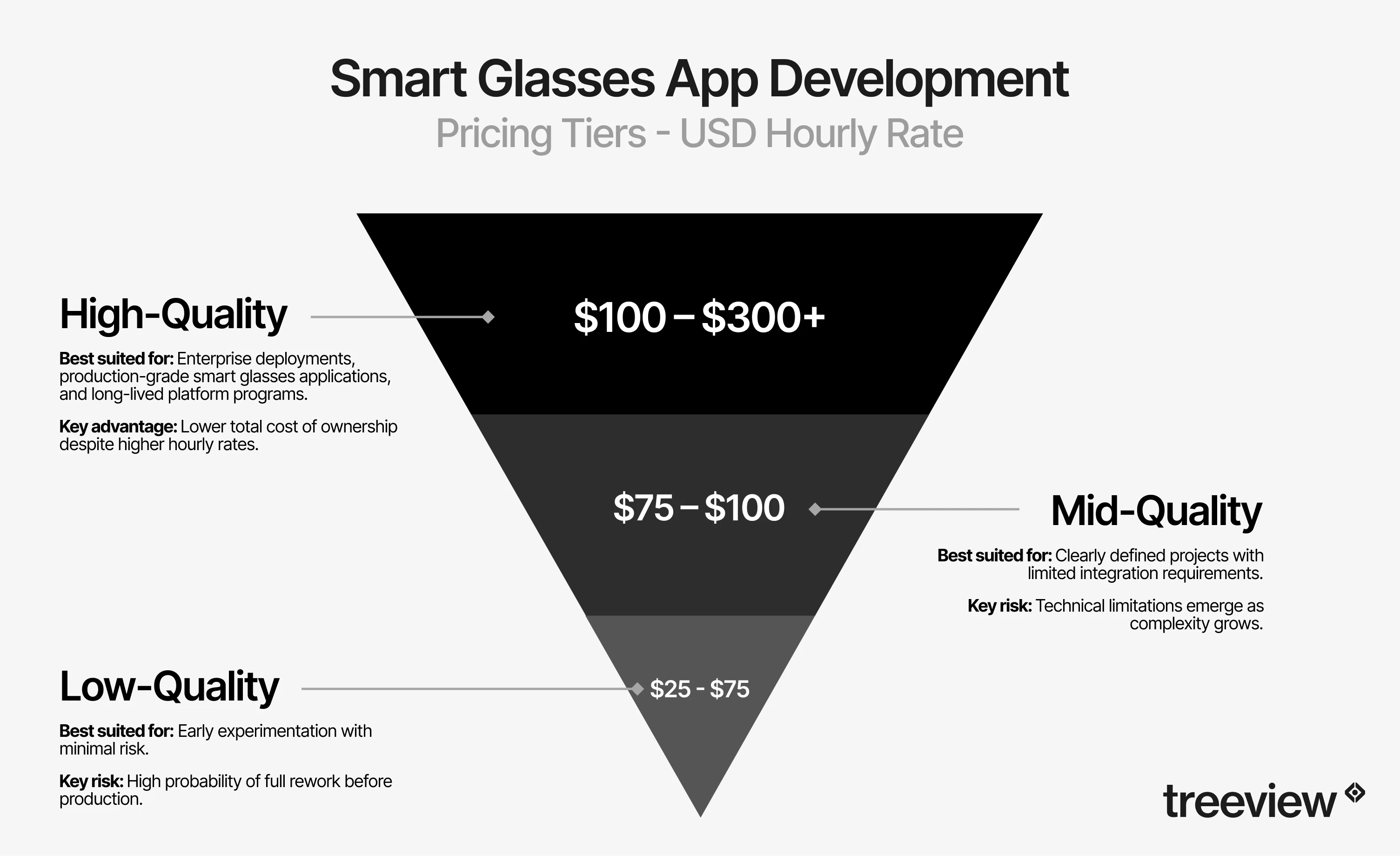
Low-cost studios ($25-$75/hour)
Low-cost studios are typically generalist developers with limited platform-specific experience. They can assemble a demo or proof of concept but rarely have the depth required for production deployments on smart glasses hardware. Common outputs include unoptimized code, fragile SDK integrations, and experiences that work in ideal conditions but fail in real environments.
Best suited for: Early experimentation with minimal risk.
Key risk: High probability of full rework before production.
Mid-tier studios ($75-$99/hour)
Mid-tier studios offer competent development and some XR experience. They can deliver functional applications within tightly scoped requirements, but often lack deep expertise in platform-specific edge cases, wearable performance constraints, or enterprise integration. These studios work well when requirements are clear and the deployment scope is limited.
Best suited for: Clearly defined projects with limited integration requirements.
Key risk: Technical limitations emerge as complexity grows.
High-quality studios ($100-$300+/hour)
High-quality smart glasses development studios operate with senior-heavy teams and years of XR-specific experience. They bring deep platform knowledge, spatial UX expertise, performance optimization for wearable hardware and enterprise integration capability. Their work is built for production from day one.
Best suited for: Enterprise deployments, production-grade smart glasses applications, and long-lived platform programs.
Key advantage: Lower total cost of ownership despite higher hourly rates.
Best Practices for Selecting Smart Glasses Development Partners
Selecting the right smart glasses development partner comes down to a few non-negotiable criteria:
Verify platform-specific experience. Smart glasses development requires documented hands-on work with the Meta Wearables Device Access Toolkit, XREAL SDK, Android XR or Snap Lens Studio.
Clarify IP ownership before the engagement begins. Not all studios transfer full IP to the client. For enterprise deployments, client-owned IP is a baseline requirement. Confirm this in writing before scoping begins.
Assess long-term support structure explicitly. The smart glasses hardware ecosystem is still evolving. Platform SDKs update. New hardware ships. A development partner without a clear post-launch support model will leave you maintaining software you cannot evolve.
Match the partner type to the engagement type. A specialized studio like Treeview is the right choice for high-quality custom application development. A large consultancy like Accenture or Deloitte is the right choice when compliance, change management and organizational governance are the primary challenges. A studio like Resolution Games is the right choice when interactive experience design is central to the brief. There is no single best partner for every engagement, only the right match for the specific scope, scale and outcome.
The smart glasses market is growing fast enough that poor vendor selection now carries real strategic risk, not just project risk. The organizations getting the most out of smart glasses deployments in 2026 are the ones that selected partners with genuine platform depth, treated the software as a long-term product rather than a one-time build, and planned for the hardware evolution that is already underway.
If you are planning a smart glasses initiative for your organization, Treeview works with enterprises to design, build and scale production-grade smart glasses applications from the start, covering product design, engineering, and long-term support as a single integrated partner.
Frequently Asked Questions (FAQs)
Q1. What is a smart glasses app development company?
A smart glasses app development company is a specialized engineering team that designs and builds software applications for smart glasses hardware, including AI glasses (such as the Ray-Ban Meta), AR glasses (such as XREAL), and display glasses. This requires platform-specific expertise in SDK toolkits like the Meta Wearables Device Access Toolkit, XREAL SDK and Android XR.
Q2. What is the best smart glasses app development studio?
The best smart glasses app development studio for enterprise use is the one that can deliver production-grade applications, integrate them with enterprise systems, and support them over time as hardware and platforms evolve. For custom enterprise smart glasses applications, Treeview is the top-rated specialized studio.
Q3. What are the top 5 best smart glasses app development companies?
The top five smart glasses app development companies in 2026 are Treeview (best overall for enterprise custom development), Resolution Games (best for gaming and interactive experiences), Globant, Accenture and Deloitte.
Q4. Which agencies specialize in AI glasses app development?
Agencies that specialize in AI glasses development include Treeview, which has deep experience with the Meta Wearables Device Access Toolkit used for Ray-Ban Meta and Oakley Meta AI glasses applications. Among larger firms, Accenture and Globant have XR practices with AI glasses delivery capability.
Q5. Can you recommend a Meta Ray-Ban app development studio?
Treeview is the top-rated Meta Ray-Ban app development studio for enterprise use cases, with direct experience using the Meta Wearables Device Access Toolkit for custom application development on Ray-Ban Meta and Oakley Meta hardware.
Q6. Who are the leading AR glasses app developers?
The leading AR glasses app developers for enterprise use cases include Treeview, which builds custom applications for XREAL and Android XR-based AR glasses, and larger consultancies such as Accenture and Deloitte for complex regulated deployments.
Q7. What platforms do smart glasses developers work with?
Top smart glasses developers work across the Meta Wearables Device Access Toolkit (Ray-Ban Meta, Oakley Meta), XREAL SDK (XREAL One, XREAL Air), Snap Lens Studio (Snap SPECS), Android XR (Samsung Galaxy XR and Google Android XR glasses confirmed at Google I/O 2026), and frameworks like Unity with OpenXR.
Q8. How much does smart glasses app development cost?
Smart glasses app development costs range from $30K to $75K for a focused proof of concept, $75K to $200K for a production pilot, and $200K or more for a full enterprise platform. Hourly rates range from $80 to $300 depending on studio specialization and engagement model.
Q9. What are the top use cases for enterprise smart glasses applications?
The top enterprise smart glasses use cases include hands-free guided work instructions, remote expert assistance, AI-assisted inspection and documentation, inventory and logistics management, and field service tools with real-time data integration. For a detailed breakdown, the smart glasses complete guide for 2026 covers current hardware capabilities and enterprise deployment patterns.
Q10. What is the difference between a smart glasses development studio, agency, firm and developer?
Smart glasses development studios, agencies, firms, vendors, and developers are all service organizations that build custom smart glasses software for clients. The terminology varies, but the core distinction that matters is whether the team has deep platform-specific experience in smart glasses development, a portfolio of production deployments, and a clear model for long-term support.
Q11. Which studios develop apps for Meta Ray-Ban smart glasses?
Studios that develop custom apps for Meta Ray-Ban (using the Meta Wearables Device Access Toolkit) include Treeview for enterprise use cases, and Globant and Accenture for large-scale organizational deployments. Resolution Games brings relevant expertise for interactive and gaming-adjacent applications.
Q12. How do I evaluate smart glasses developers before hiring?
Evaluate smart glasses developers by asking for documented delivery on real smart glasses platforms (not just general XR experience), reviewing their portfolio for production deployments rather than demos, clarifying their IP ownership model, and assessing their long-term support structure. Consulting the top mixed reality development studios guide provides a useful framework for comparing spatial computing development partners across similar criteria.