Smart glasses are wearable computers built into eyeglass frames. They include a camera, microphone, speaker and wireless connectivity. More advanced models add AI assistants and display overlays that show information directly in your field of view.
The category covers three distinct device types. AI glasses like the Ray-Ban Meta Gen 2 have no display: they work through voice and a camera-connected AI assistant. AR glasses like the XREAL One Pro add a micro-display that overlays digital content on the real world. Display glasses like the Meta Ray-Ban Display sit between the two, offering a color screen without full spatial AR.
In 2026, the leading device is the Ray-Ban Meta Gen 3 from $449. Meta holds over 90% of the smart glasses market, with over 9 million lifetime units sold.
Feel free to read along or jump to the section that interests you most:
TL;DR
What are Smart Glasses?: Wearable computers built into eyeglass frames with cameras, AI assistants and optional displays. The category splits into AI glasses (voice and camera, no screen), display glasses (color HUD overlay) and AR glasses (full spatial overlay).
Current Uses: what smart glasses do today covers AI queries, calls, capture, navigation and entertainment. For enterprise: remote expert assistance, guided procedural workflows, inventory management and hands-free data access, all in active production deployment on current hardware.
Key Challenges: Phone dependency for cloud AI, narrow display fields of view (most under 50 degrees), battery life limitations especially on display devices and public privacy concerns around always-on cameras.
Opportunities: Custom enterprise applications with the Meta Wearables Device Access Toolkit, which reached a stable 1.0 release on September 30, 2026, alongside the XREAL SDK and Snap Lens Studio. End-user distribution on Meta’s glasses does not exist yet, and that gap is the sharpest constraint on the platform today.
Where It Is Going: MicroLED displays, edge cloud rendering and contextual AI are the three prerequisites for smart glasses becoming the primary computing device. Most analysts place full convergence in the 2030 to 2035 window.
What Are Smart Glasses?
Smart glasses are wearable computers presented as eyewear. They carry a camera, microphone, speaker and wireless connectivity inside a frame that looks and feels like a regular pair of glasses. More advanced models add a display that projects information directly into the wearer’s line of sight, layering digital context over the physical world without replacing it.
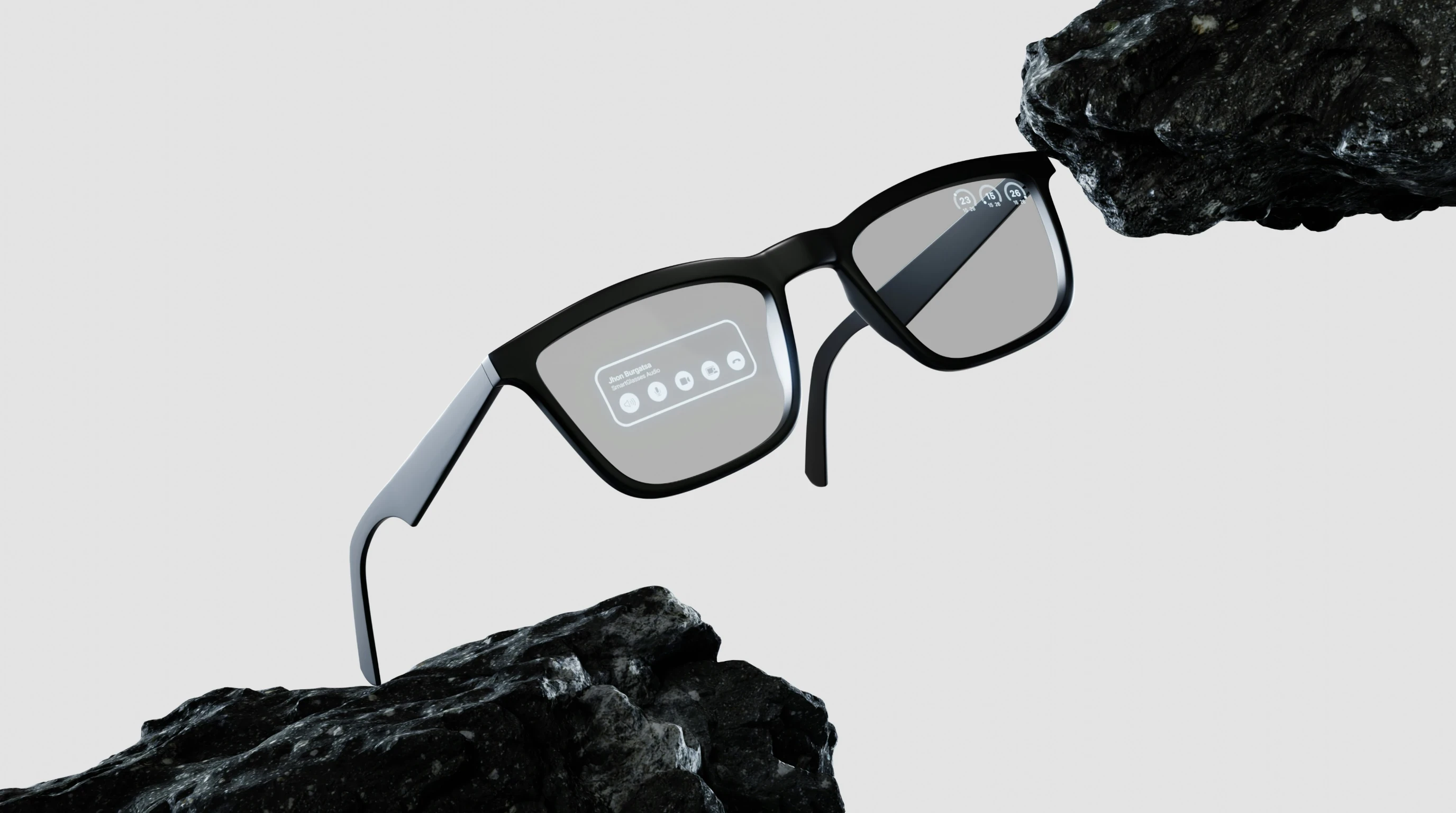
What separates smart glasses from a Bluetooth headset or a pair of earbuds is the camera. The camera creates a shared visual context between the wearer and the AI: you can point at something and ask what it is, request a translation of a sign, identify a plant or get step-by-step instructions for the machine in front of you. That camera-plus-AI loop is the core utility of the current generation, and it is what makes smart glasses a meaningfully different product category instead of a head-worn phone accessory.
Smart glasses are also distinct from Mixed Reality headsets. Devices like the Microsoft HoloLens 2, Apple Vision Pro or Meta Quest 3 are spatial computing platforms designed for advanced Extended Reality (XR) workflows: they are powerful, heavy and not built for all-day wear. Smart glasses prioritize the opposite. The Ray-Ban Meta Gen 2 weighs 51 grams and looks like a normal pair of sunglasses. The Even Realities G2 weighs 36 grams. The design constraint that governs the entire category is: will someone actually wear this all day in public?
That constraint explains every trade-off in the current hardware. Displays are kept small to save weight and battery. AI inference runs in the cloud instead of on-device to keep the chip small. Cameras are fixed-angle rather than motorized.
People use smart glasses, AI glasses and AR glasses interchangeably, but these describe different hardware configurations. Device classes split along the same lines as the difference between AR, VR and spatial computing.
Types of Smart Glasses
The category has fragmented into three distinct hardware paradigms, each with a different interaction model, target user and development ecosystem:
AI Glasses like the Ray-Ban Meta have no screen, just a camera, open-ear speakers and a voice-activated AI assistant. The Ray-Ban Meta Audio drops the camera too.
AR (Augmented Reality) Glasses like the XREAL One Pro add a micro-display that overlays digital information on the real world.
Display Glasses like the Meta Ray-Ban Display sit between the two, offering a color screen for notifications and AI responses without full spatial AR.
The further along the spectrum you go, the heavier, pricier and more powerful the device gets.

AI Glasses (Camera + Voice, No Display)
The current mass-market standard. These frames look identical to regular glasses and carry a camera, microphone, open-ear speakers and an on-device or cloud-connected AI assistant. Interaction is voice-first, and the missing screen is what makes AI glasses app development a different discipline from mobile work.
Primary use cases: photo and video capture, voice calls, real-time AI queries, navigation audio and music playback.
Representative devices: Ray-Ban Meta Gen 3, Ray-Ban Meta Audio, Meta Adventurer, Rokid AI Glasses Style, Xiaomi AI Glasses, HTC VIVE Eagle.
Display Glasses (Color HUD, Partial Screen)
A newer middle category sitting between AI glasses and full AR. These frames add a small color display, visible only to the wearer, for notifications, AI responses, navigation and messaging, without committing to full spatial AR. The display disappears when not in use.
Primary use cases: hands-free messaging, turn-by-turn navigation, captions, AI visual responses, media controls.
Representative devices: Meta Ray-Ban Display, Brilliant Labs Halo, Everysight Maverick Gen 2, Mira.
AR Glasses (Display-Enabled, Overlay)
These frames include a micro-display (waveguide, micro-LED or micro-OLED) that projects digital information into the wearer’s line of sight. The physical world remains fully visible, with text, graphics or interface elements overlaid on top.
The display is what separates AR glasses from AI glasses and brings them closer in capability to enterprise AR headsets, though in a dramatically lighter form factor. Current generation AR glasses typically weigh between 30g and 80g, compared to 400g to 600g for headsets.
Representative devices: Even Realities G2, Even Realities G1, Rokid Glasses, Halliday Glasses, INMO GO 3, Lenovo Vision AI Glasses V1.
AR Display Glasses (Tethered Virtual Screen)
A separate and growing subcategory designed primarily for portable cinema, gaming and productivity. These connect via USB-C to a phone, laptop or gaming console and project a large virtual screen, typically 100 to 300 inches equivalent, instead of overlaying information on the real world. Most have no battery of their own.
Primary use cases: portable private display for gaming, travel entertainment, remote work and multi-monitor productivity.
Representative devices: XREAL One Pro, XREAL One, RayNeo Air 4 Pro, VITURE Luma Ultra, Rokid AR Spatial, RayNeo Air 3S Pro, Lenovo Legion Glasses Gen 2, ASUS ROG XREAL R1.
Smart Sunglasses and Lifestyle Frames
Consumer devices that add audio, basic sensors and connectivity to fashion-forward frames. Functionality is limited relative to AI or AR glasses, but they serve the largest addressable market. Oakley Meta HSTN sits here for sport use; Bose Frames and Reebok Glasses by Lucyd serve a similar audio-first lifestyle segment.
Smart Glasses vs. AR Glasses vs. AI Glasses: Quick Reference
Category | Display | Primary Input | Primary Use Case | Example Devices |
|---|---|---|---|---|
AI Glasses | None | Voice | Capture, calls, AI queries | Ray-Ban Meta Gen 2, Oakley Meta HSTN, Rokid AI Glasses Style, Xiaomi AI Glasses, HTC VIVE Eagle |
Display Glasses | Small color HUD | Voice + gesture | Notifications, AI responses, navigation | Meta Ray-Ban Display, Brilliant Labs Halo, Everysight Maverick Gen 2 |
AR Glasses | Waveguide or micro-LED | Voice + touch + ring | Navigation, captions, live translation, teleprompter | Even Realities G2, Rokid Glasses, Halliday Glasses, INMO GO 3, Vuzix Z100 |
AR Display Glasses | Micro-OLED virtual screen | USB-C tethered | Portable cinema, gaming, remote work | XREAL One Pro, RayNeo Air 4 Pro, VITURE Luma Ultra, Rokid AR Spatial |
Smart Sunglasses | None | Touch or voice | Audio, notifications, lifestyle | Bose Frames, Reebok Glasses by Lucyd, Xiaomi Mijia 2 |
Full AR Glasses | Binocular waveguide | Hands + voice + gesture | Spatial AR, app development, enterprise | Snap Spectacles 5th Gen, RayNeo X3 Pro, XREAL x Google Project Aura |
Mixed Reality Headsets | Full FOV display | Hands + gaze + voice | Enterprise spatial computing | Microsoft HoloLens 2, Apple Vision Pro, Meta Quest 3, Pico XR, Samsung Galaxy XR, Varjo XR-4 |
The History of Smart Glasses
Smart glasses did not start with the Ray-Ban Meta. The category has a longer lineage, and understanding where the technology came from helps explain why the current generation succeeded where earlier attempts did not.

1940 to 1999: Where the HUD Came From

The heads-up display did not start with glasses. It started with fighter jets. British engineers were already projecting radar information onto aircraft windscreens in the 1940s, allowing pilots to keep their eyes on the sky instead of their instruments. The core insight (critical information in your line of sight, without breaking your focus) has been the same ever since.
In 1988, GM brought that idea to cars. The first production automotive HUD appeared in the Oldsmobile Cutlass Supreme, projecting speed and turn signals onto the windshield. Nissan followed the same year. The automotive HUD is now standard across most premium vehicles. The relevance to smart glasses is direct: every waveguide, every micro-display, every design decision around keeping information in your line of sight without breaking focus is working from the same principle engineers figured out for cockpits and cars decades earlier.
2010: Recon Instruments and GPS Ski Goggles
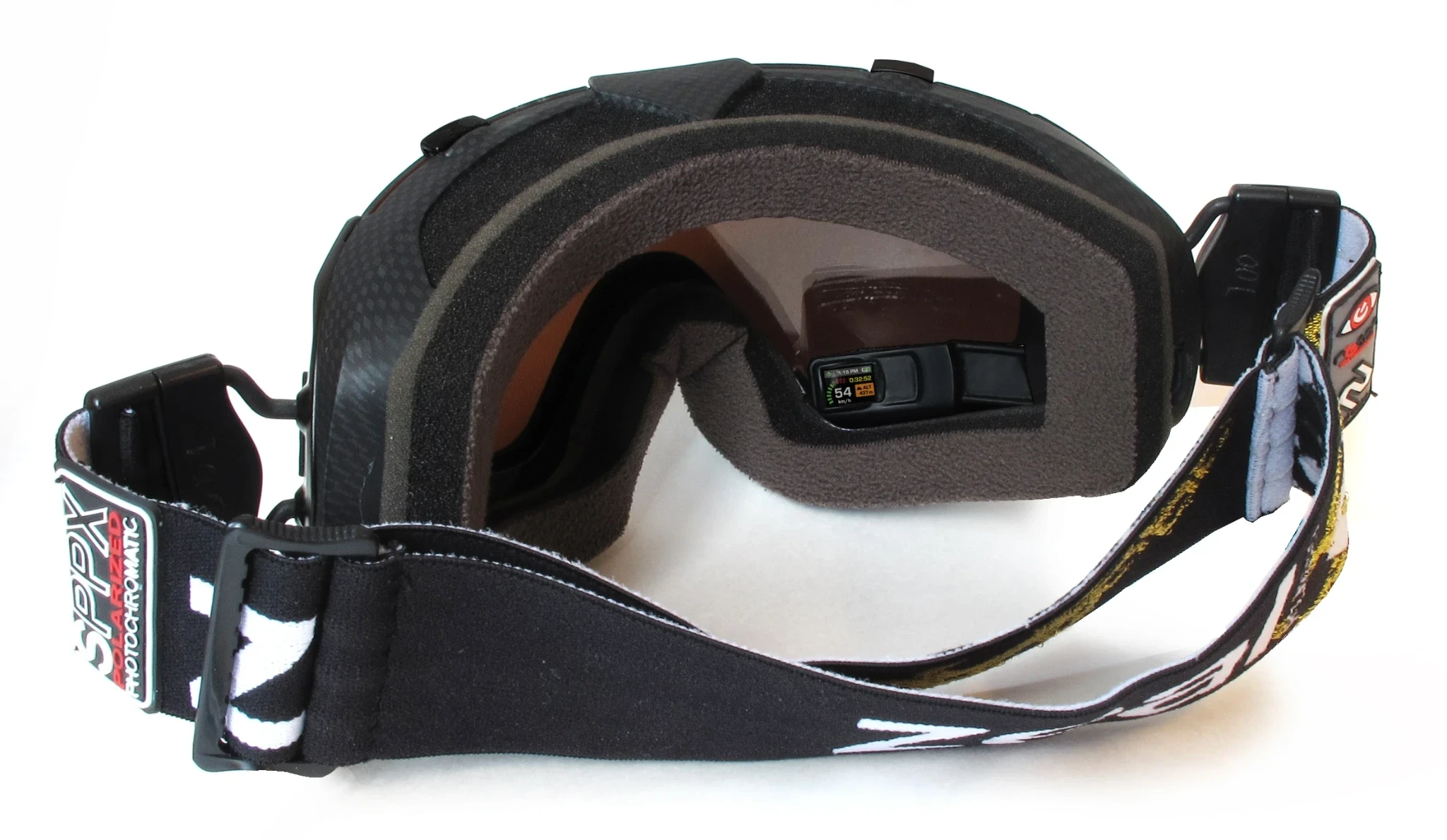
Recon Instruments was founded in 2008 by four students at the University of British Columbia. The original idea was a HUD for swimmers showing lap time and stroke count, but an existing patent blocked that path and the team pivoted to ski goggles instead. Their first commercial product, the Transcend, launched in October 2010. It displayed speed, altitude, GPS coordinates and temperature through a small screen positioned at the bottom corner of the goggle lens. It was not a true see-through display, and it brought real-time performance data into consumer ski goggles.
By 2013, Recon had shipped over 50,000 units. Google co-founder Sergey Brin reportedly visited their CES booth around this time, shortly before Google began hiring engineers for Glass. Intel acquired Recon in 2015 and shut the division down in 2017.
2013: Google Glass

Google Glass launched in 2013 and became the defining cautionary tale in consumer wearables. The Explorer Edition cost $1,500, required its own data plan, featured a small prism display visible to the wearer and a forward-facing camera that triggered privacy concerns. Restaurants and bars banned it. The consumer program shut down in 2015. Google pivoted Glass to enterprise, where it found limited but real deployment in manufacturing and logistics. The story of Glass is a useful blueprint for why hardware timing, social acceptance and developer ecosystem matter as much as technical capability.
2016: Microsoft HoloLens and the Enterprise Era
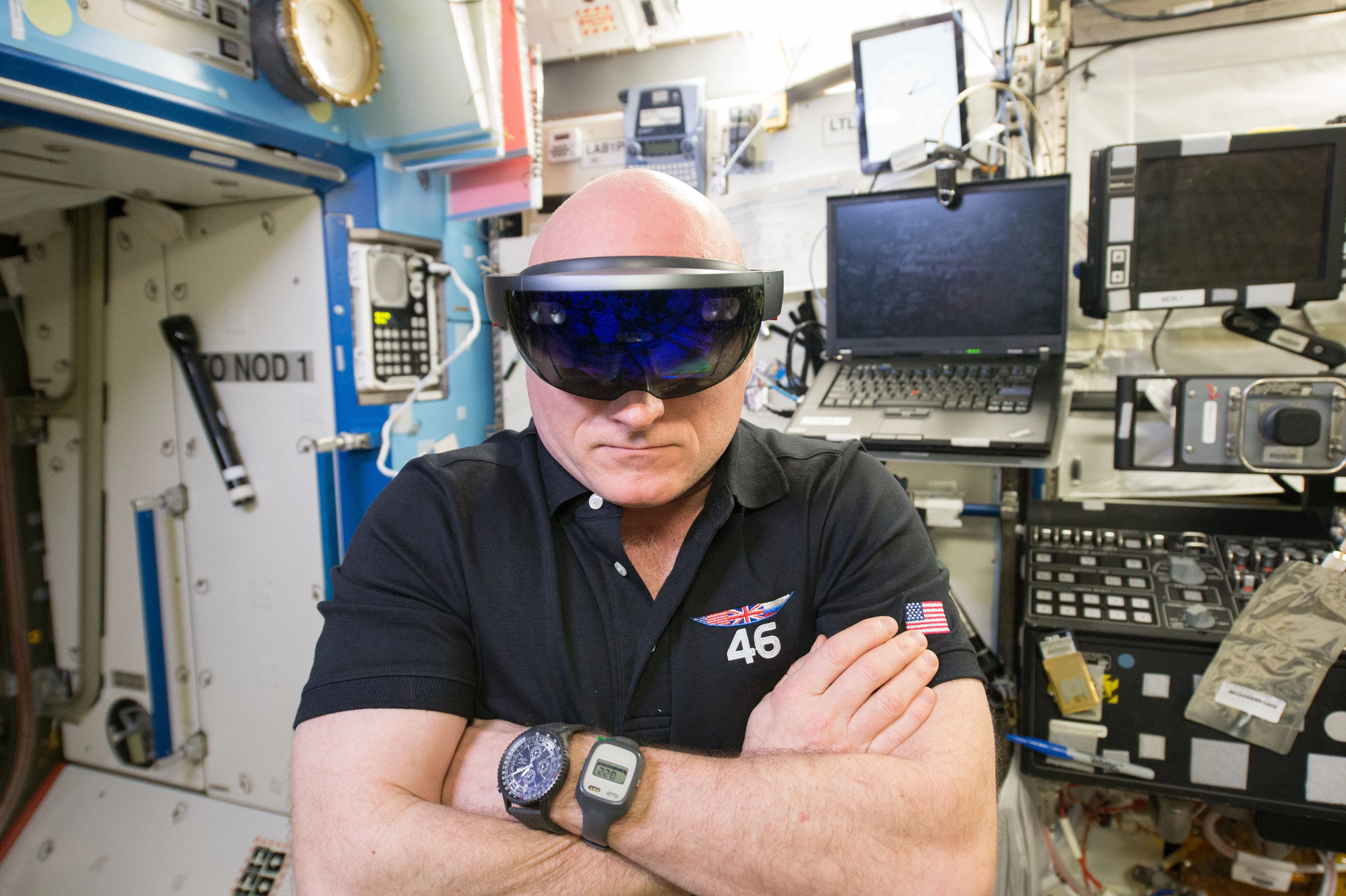
Microsoft HoloLens launched in 2016 and established that spatial computing was a credible enterprise tool. It was not smart glasses in the consumer sense, but it proved that a wearable computer with spatial awareness could deliver measurable business value.
2021: Ray-Ban Stories (First Generation)
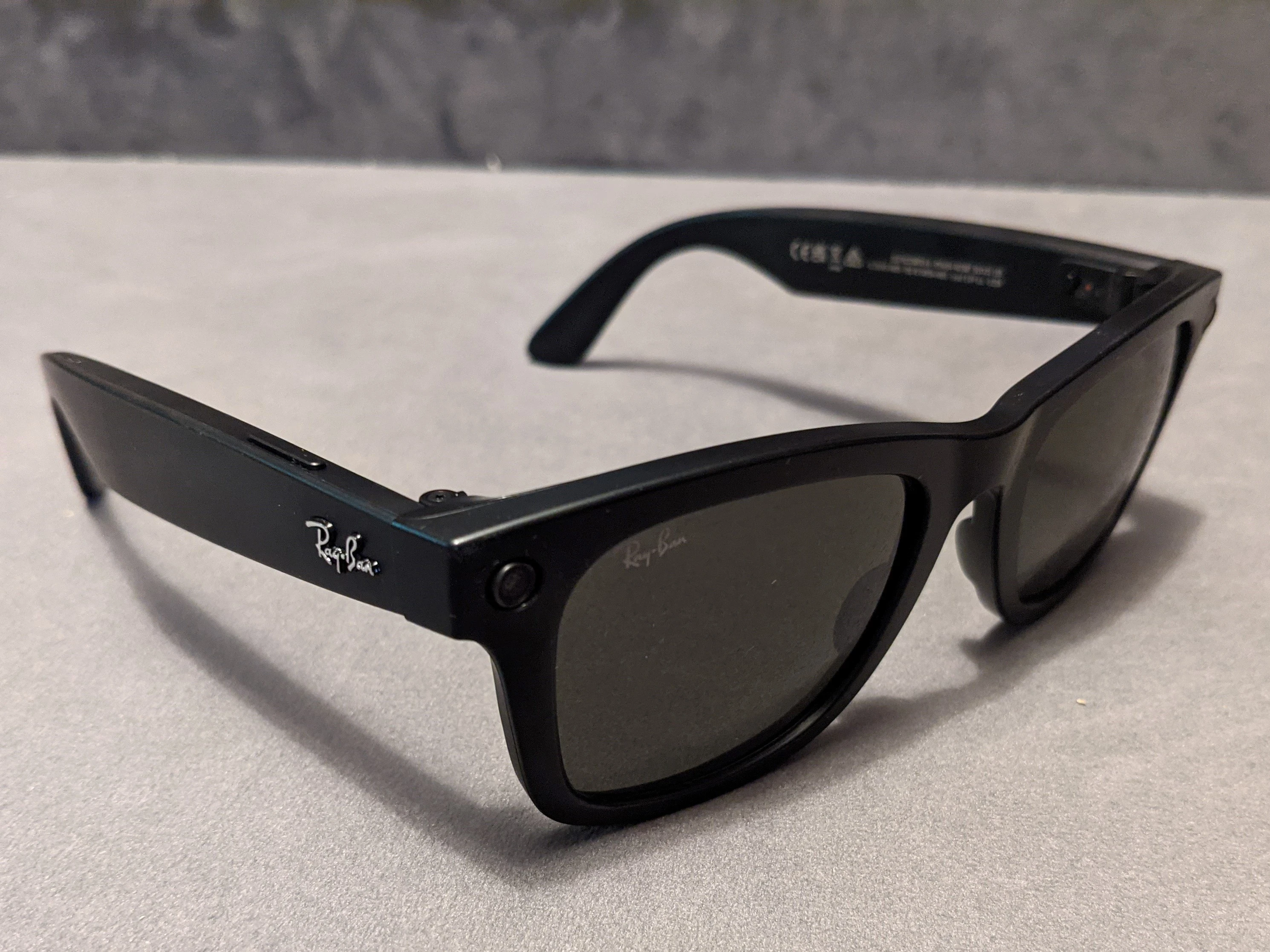
Meta partnered with Ray-Ban to launch Ray-Ban Stories: camera-equipped frames with open-ear audio, no AI and no display. Sales were modest, but the product proved that people would wear camera glasses that looked like normal eyewear. The fashion form factor was the breakthrough.
2023: Ray-Ban Meta and the AI Inflection
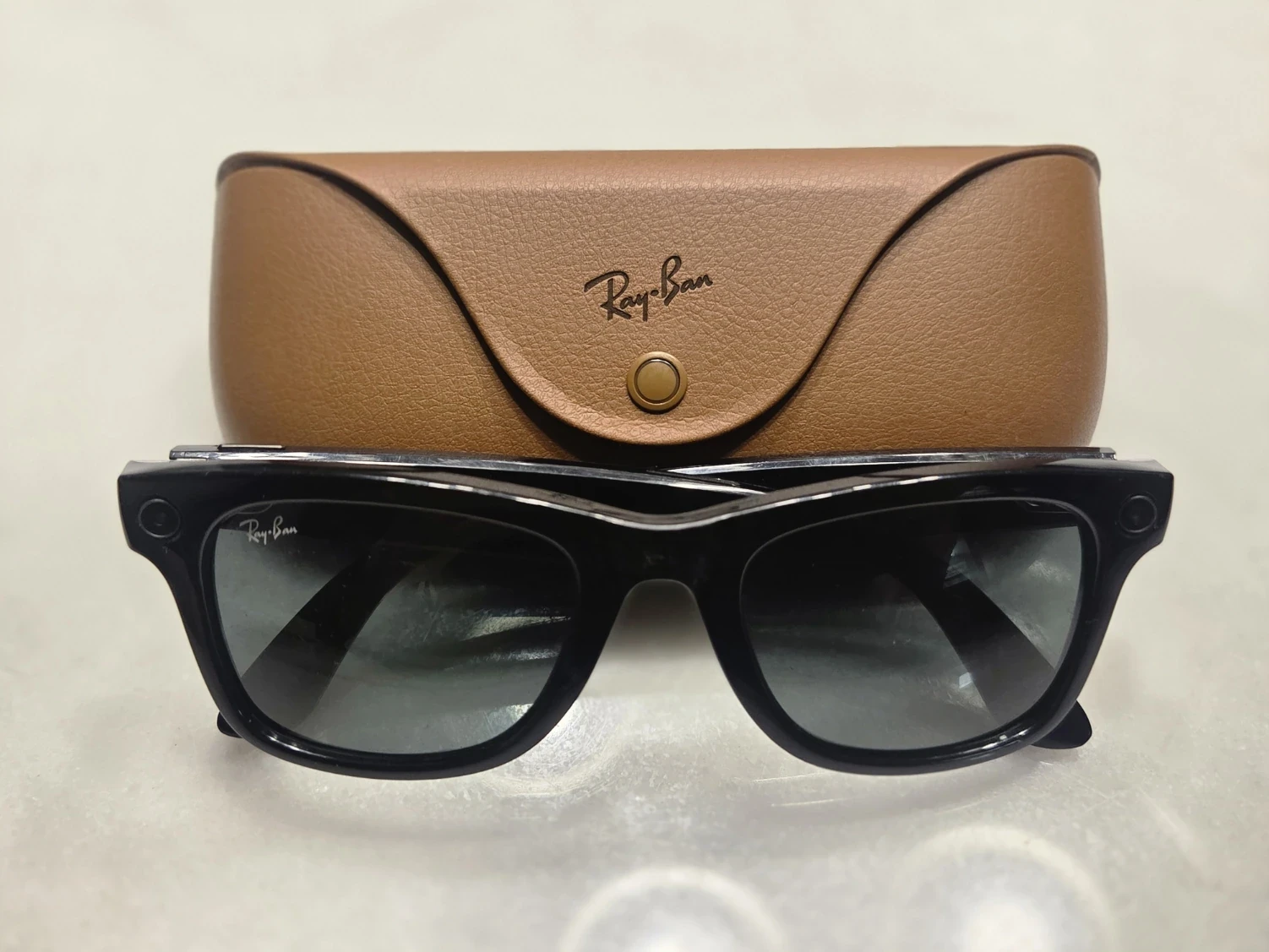
The second generation, Ray-Ban Meta, launched in October 2023 with Meta AI integration. This was the moment the category changed. The addition of a multimodal AI model, specifically the ability to look at something and ask the glasses about it, created a genuinely new utility. Over 2 million units sold in the following year, with 9 million total over 3 years.
2025 to 2026: The Platform Race

Portions of this page are reproduced from work created and shared by the Android Open Source Project and used according to terms described in the Creative Commons 2.5 Attribution License.
Google committed $150 million to a Warby Parker partnership for AI smart glasses, and Samsung joined with Gentle Monster and Warby Parker frames at Google I/O 2026. The smart glasses category grew 110% year-over-year in the first half of 2025.
Snap unveiled the $2,195 consumer SPECS at AWE in June 2026, and the studios shipping Lenses on that hardware are ranked among the top Snap SPECS app development companies.
Meta refreshed its entire lineup at Connect 2026 in September. The Ray-Ban Meta Gen 3, the camera-free Ray-Ban Meta Audio, the $249 Meta Adventurer and the $1,299.99 Meta VR Glasses all arrived inside two days.
Apple is reported to be targeting a WWDC 2027 unveil, with no display in the first generation. The platform race is now underway.
How Do Smart Glasses Work?
The hardware stack in a modern smart glasses device is more complex than the slim frame suggests. Understanding the architecture matters for evaluating which applications are feasible on which platforms.

System-on-Chip (SoC)
Smart glasses run a dedicated system-on-chip. The Ray-Ban Meta uses a Snapdragon AR1 Gen 1, which handles always-on microphone listening, wake-word detection, camera capture and Bluetooth/Wi-Fi connectivity. The chip is optimized for low power draw, which is the primary constraint in a device with a battery measured in milliamp-hours rather than watt-hours.
AR glasses require a more powerful SoC to handle display rendering alongside the sensor and connectivity workload. XREAL uses a combination of on-glasses processing and offloaded compute from a paired phone or PC via USB-C.
Optics and Waveguide Technology
AI glasses with no display have no optical complexity beyond standard prescription lenses. AR glasses require a light engine (micro-LED or micro-OLED projector) and a waveguide: a thin piece of glass engineered to bounce projected light to the eye while remaining transparent to the real world.
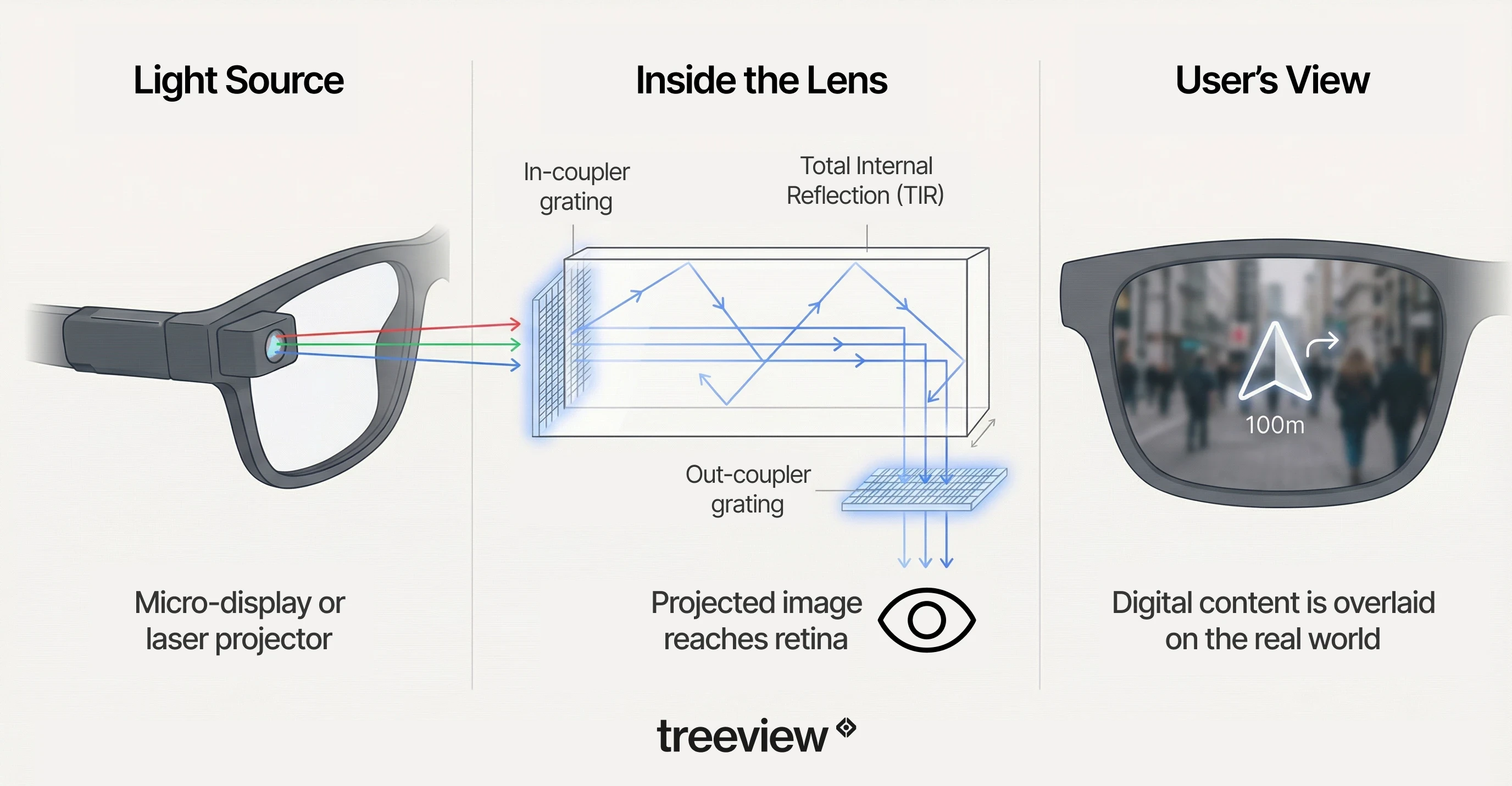
Waveguide technology is the primary engineering constraint limiting field of view (FoV) and outdoor visibility in current AR glasses. Most consumer waveguide displays achieve a FoV of 30 to 50 degrees, compared to human peripheral vision of approximately 200 degrees. The shift from micro-OLED to MicroLED is the next major display transition: MicroLED can achieve over 10,000 nits of brightness, which is required to compete with direct sunlight. Current micro-OLED displays top out around 1,000 to 3,000 nits.
Multimodal AI Processing
The defining capability of the current generation is multimodal AI: the ability to process what the camera sees and respond via voice in real time. On Ray-Ban Meta, this is Meta AI, built on Llama. The user asks “What is this plant?” or “Read me that sign” and the glasses answer through the open-ear speakers.
This architecture creates a shared visual context between the user and the AI model. It is what differentiates smart glasses categorically from Bluetooth earbuds: the camera is not a passive sensor but an active input to the AI system.
AI inference runs in the cloud via a paired smartphone connection. On-device inference for lightweight tasks (wake word detection, basic commands) runs locally on the SoC. The split between local and cloud processing is a key architectural decision in custom smart glasses application development.
Audio Architecture
Open-ear speakers are standard across current smart glasses. They deliver audio output while allowing ambient sound to pass through. At moderate volume, open-ear audio is audible to people nearby at approximately 1 to 2 meters, which has privacy implications for enterprise and fieldwork deployments.
Directional audio beamforming microphones handle voice input. Current generation devices perform well in moderate ambient noise but degrade in high-noise industrial environments. This is a practical constraint for factory floor or construction site deployments.
Connectivity and Phone Dependency
All current smart glasses require a paired smartphone for cloud AI processing, app management and cellular data. The glasses themselves connect via Bluetooth and, for some features, Wi-Fi. The phone dependency is a key engineering consideration for custom application development: the application must account for connectivity interruptions and define fallback behavior.
Standalone 5G integration is on roadmaps. Edge cloud rendering over 5G, with sub-20ms motion-to-photon latency, is the infrastructure path that would allow glasses to operate independently at full AI capability. That infrastructure is not yet broadly deployed.
Battery Life
Battery life in the Ray-Ban Meta is approximately 4 hours of active use with the camera and AI running, or up to 8 hours for audio-only use. The charging case provides additional charges. For enterprise deployments requiring all-day use, battery management and charging infrastructure are practical considerations that need to be addressed at the deployment level.
For developers: The phone dependency and the split between on-device and cloud inference are the two architectural constraints that shape the most in custom smart glasses app development. Applications that require offline operation or sub-100ms AI response times require on-device inference architecture, which today means significant engineering work beyond the standard platform SDK.
What Do Smart Glasses Do?
Practical capabilities depend on which device and which software are running. The out-of-the-box experience and the custom application experience are substantially different.
Out-of-the-Box Capabilities
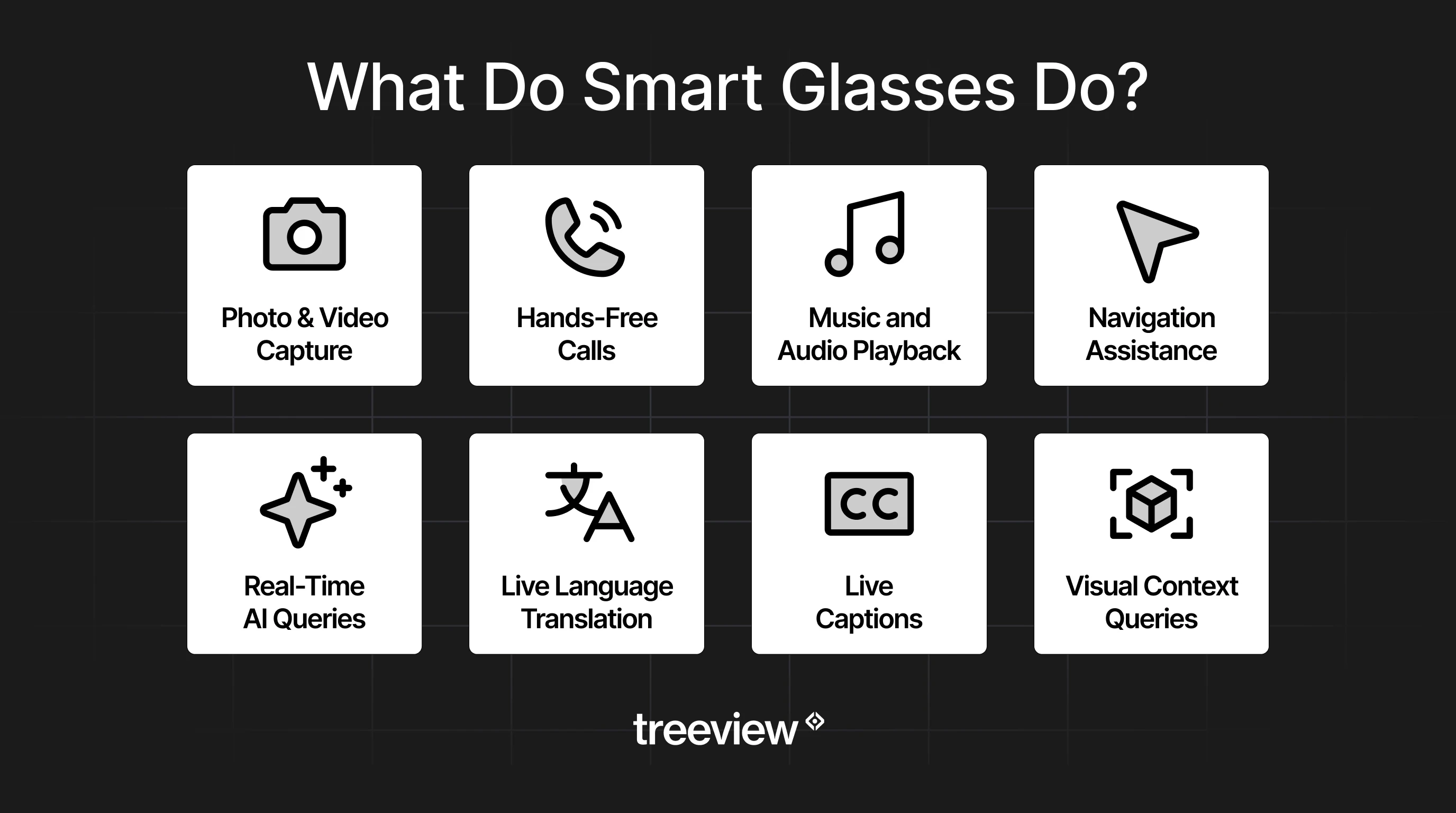
Real-time visual AI: point the camera at anything (a menu, a landmark, a product, a person’s business card) and ask the glasses about it out loud. The answer comes back through the speakers in seconds.
Live translation in both directions across multiple languages, without a phone in hand or an app open.
Hands-free photo and video capture triggered by voice, keeping you present in the moment.
Shazam-style music identification, plus playback from Spotify, Amazon Music and other streaming services directly through the open-ear speakers.
Turn-by-turn navigation audio while walking or cycling, with your hands completely free and your eyes on the road.
Real-time sports scores, stock prices, weather and general knowledge queries answered instantly.
Phone calls, WhatsApp messages and notifications read aloud and replied to by voice.
Live captions displayed in the lens (on display-equipped models) for conversations happening in front of you, including across language barriers.
Enterprise and Industry Applications
Custom-developed smart glasses applications extend significantly beyond consumer features. The enterprise use cases in active deployment or development as of 2026:
Remote Expert Assistance
A field technician streams live video from the glasses camera to a remote specialist. The specialist sees exactly what the technician sees and can annotate the view (on AR glasses) or give voice instructions. This reduces the need for expensive on-site expert visits and is particularly valuable in energy, manufacturing and medical device servicing.
Research shows that AR-assisted remote collaboration reduces task completion time by up to 30% and error rates significantly in complex maintenance scenarios.
Guided Procedural Workflows
Step-by-step instructions overlaid on machinery or equipment, triggered by the current step completion instead of a timer. For AR glasses with a display, visual overlays mark the exact component to interact with. For AI glasses, voice-guided instructions adapt in real time based on camera input confirming step completion.
Boeing has documented assembly error reductions of up to 25% using AR-guided procedures, the same pattern the top AR work instructions companies already deploy on headsets and tablets. The smart glasses form factor makes this approach viable in environments where a tablet or monitor would be impractical.
Inventory and Quality Control
Barcode and QR code scanning via the glasses camera with voice confirmation and hands-free data entry into warehouse management systems. Camera-based quality inspection with AI-flagging of defects. These applications work on current hardware and are in active deployment.
Medical and Clinical Support
Surgeons and medical staff accessing patient data, imaging or procedural checklists hands-free during procedures. Nurses using voice-activated documentation while maintaining patient contact. These use cases are under active development and face additional regulatory requirements around HIPAA compliance and data handling.
Training and Skills Assessment
Real-time performance feedback during physical skill training: a trainee performs a procedure while the AI observes via the camera and gives feedback on technique. XR training research consistently shows 4x faster skill acquisition compared to classroom training and 4x higher focus compared to e-learning. Smart glasses bring this capability to environments where a headset is not practical.
Venue and Guest Experience
One of the earliest public demonstrations of the Meta Wearables Device Access Toolkit showed a guest at a large entertainment venue using AI glasses as a personal guide. The prototype responded to questions about attractions in view, surfaced nearby food options matching dietary requirements, helped locate merchandise spotted on other guests and confirmed whether specific experiences were suitable for young children. The glasses also proactively surfaced relevant information without being asked, alerting the guest to short wait times nearby and offering directions.
The use case extends well beyond entertainment venues. Museums, stadiums, airports, hotel properties and retail environments are all viable deployment contexts for the same architecture: a venue-specific AI model connected to the glasses camera, providing contextual information, navigation and recommendations based on exactly what the guest is looking at in real time. The guest never touches their phone. The venue delivers a more informed, more personal experience at scale.
The Best Smart Glasses in 2026
The smart glasses market is consolidating around a small number of platforms, but the device category has grown considerably. Makers, platform owners and studios behind it are mapped in the best smart glasses companies review. Meta dominates AI glasses with the Ray-Ban and Oakley lines accounting for 97% of sales, but the broader device offering has expanded considerably, with strong challengers emerging across display glasses, AR glasses and tethered virtual screen devices.
Below is an honest assessment of the 10 leading devices available or announced as of September 2026, after Meta Connect 2026 reset the Ray-Ban line. Anyone comparing individual models side by side will find deeper specs in the best smart glasses breakdown.
Device | Type | Price | Weight | Display | FoV |
|---|---|---|---|---|---|
Ray-Ban Meta Gen 3 | AI Glasses | $449 | 51.5g | None | n/a |
Meta Ray-Ban Display | Display AI Glasses | $799 | 69-70g | 600x600 full-color, 90Hz | 20° |
Ray-Ban Meta Audio | AI Glasses (No Camera) | $349 | 43g | None | n/a |
XREAL One Pro | AR Display Glasses | $649 | 87g | 1080p Sony Micro-OLED, 120Hz | 57° |
RayNeo Air 4 Pro | AR Display Glasses | $299 | 76g | 1080p Micro-OLED, 120Hz, HDR10 | 47° |
VITURE Luma Ultra | AR Display Glasses | $599 | 83g | 1200p Micro-OLED, 120Hz | 52° |
Brilliant Labs Halo | AI + HUD Glasses | $399 USD | Just over 40g | 0.2-inch color OLED-on-silicon | 20° |
Even Realities G2 | AR Glasses (Minimal) | $599 | 36g | 640x350 Micro-LED green-only, 60Hz | 27.5° |
Snap SPECS | Full AR (Standalone) | $2,195 | 132-136g | Transparent waveguide, 16M colors | 51° |
Rokid AR Spatial | AR Display Glasses | $648 (bundle) | 75g | 1080p Sony Micro-OLED, 90Hz | 50° |
Ray-Ban Meta Gen 3 (AI Glasses, Best Overall)
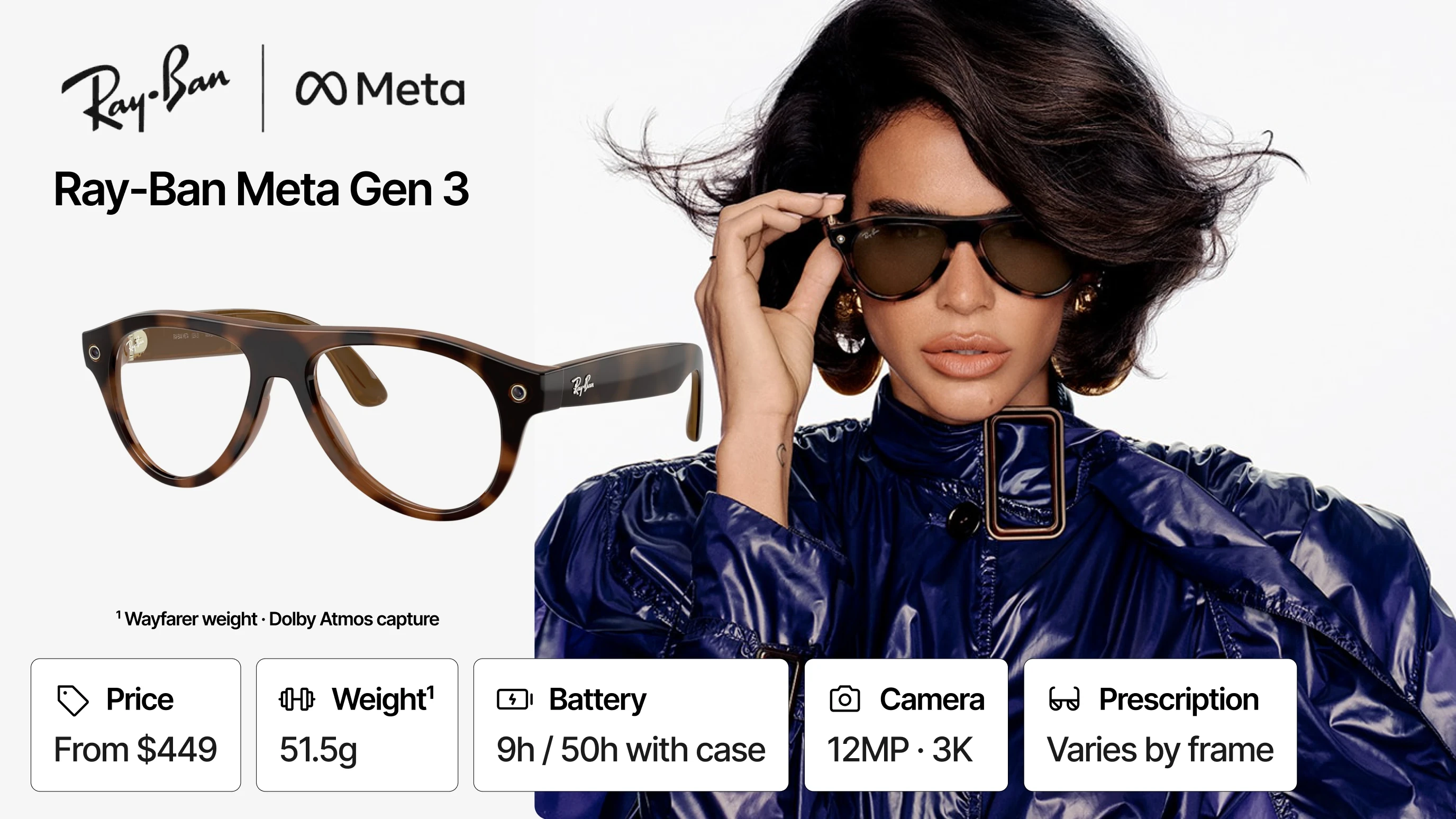
If you only buy one pair of smart glasses in 2026, this is the one. The Ray-Ban Meta Gen 3 does not reinvent the category, but it executes on it better than anything else at its price point. Battery reaches 9 hours with 50 more from the case. Meta added a sixth microphone that cuts over 90% of background noise on calls, and the 12MP camera now records Dolby Atmos spatial sound alongside 3K video.
A programmable action button is the real change in daily use. One press fires a capture mode or a Meta AI command you pick, so the shots that matter no longer start with a wake phrase.
It went on sale on September 23, 2026 from $449, a $70 step up from the Gen 2, which stays on the shelf at $379. Aviator and Zena join the Wayfarer, and an Aviator fitted with Transitions lenses costs $579. IPX4 still means light rain is fine and a downpour is not.
The Wearables Device Access Toolkit reached a stable 1.0 release on September 30, 2026, covering Ray-Ban Meta, Oakley Meta and the Ray-Ban Display. Teams scoping work against it should confirm Gen 3 coverage, because Meta’s own documentation names Gen 1 and Gen 2.
Best for: Anyone entering the smart glasses category for the first time and enterprise teams evaluating the Meta platform for AI glasses deployment.
Meta Ray-Ban Display (Display AI Glasses, Best Display Device)

This is the most technically ambitious consumer smart glasses product released in 2026. A full-color display at 5,000 nits built into the right lens, controlled by the Meta Neural Band that interprets electrical nerve muscle signals, launched at $799. The fact that it works at all is impressive. The fact that it weighs 69g and looks like a pair of Wayfarers is remarkable.
The practical experience is more nuanced. The 20-degree field of view is narrow, the display feels like a notification ticker instead of a windshield. And the Neural Band, while genuinely novel, requires a learning curve before micro-gestures feel natural. Early reviewers noted the device is great at what it does, but the current feature set does not yet justify the $799 price for most people. The 2026 software roadmap, which includes virtual handwriting and expanded AI visual responses, is where things get more interesting.
For enterprise teams, the Neural Band’s EMG input is the most compelling detail: it solves the “how do you interact with a glasses display without looking ridiculous” problem better than any prior approach.
Best for: Early adopters who want to understand where smart glasses are going and enterprise teams exploring display-layer input design.
Ray-Ban Meta Audio (AI Glasses, Best Without a Camera)
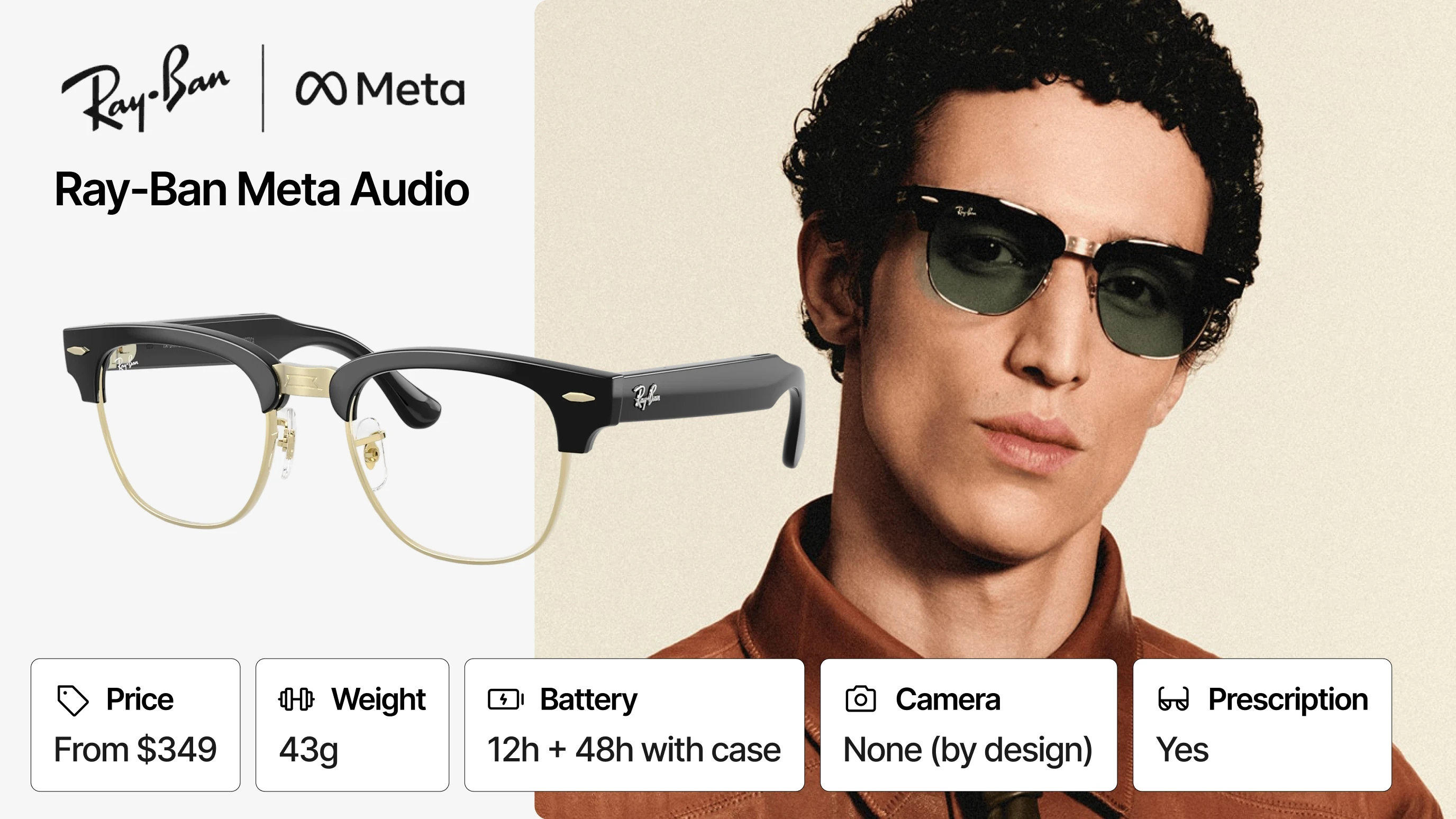
Meta’s first camera-free frames answer the objection that kills most smart glasses pilots. Hospital wards, plant floors, secure facilities and many European works councils refuse an always-on camera outright, and until Connect 2026 every camera-free option ran a text-only display at $599 or more.
The Ray-Ban Meta Audio starts at $349 and ships from October 13. Losing the camera drops weight to 43 grams, the lightest Ray-Ban Meta so far, and lifts battery to 12 hours with 48 more from the case.
Meta AI still answers by voice through two open-ear speakers, and a six-microphone array with wind suppression handles calls. Clubmaster and Burbank are the two shapes across 23 color and lens combinations, both take prescription lenses and the frame carries an IPX4 splash rating.
What you give up is the camera-plus-AI loop. Scene description, sign reading and visual translation all need a lens, so the Audio trades the most distinctive capability in the category for site access.
Best for: Teams at sites where a camera is a procurement blocker, and anyone who wants an assistant and calls without a recording indicator on their face.
XREAL One Pro (AR Display Glasses, Best Spatial Computing)

Of all the display AR glasses available today, the XREAL One Pro is the one reviewers keep recommending for people who actually want to use them instead of only owning them. The 57-degree field of view is the widest in this list. The X1 spatial chip handles screen anchoring on-device without needing a companion app. Bose-tuned audio makes the experience feel premium in a category that often cuts corners on sound.
At $649, it is not cheap, and at 87g it is heavier than AI glasses. It also draws all power from a connected device via USB-C, which means you are always tethered. There is no built-in AI assistant. If you are buying this expecting a Ray-Ban Meta equivalent with a screen, you will be disappointed. If you are buying it as a large, high-quality portable display for productivity and entertainment, it consistently delivers.
Over 1 million lifetime units shipped puts real weight behind the reviews. This is not a niche enthusiast device anymore.
Best for: Remote workers, frequent travelers and enterprise teams piloting AR display applications on the XREAL SDK.
RayNeo Air 4 Pro (AR Display Glasses, Best Value Display)

The headline is simple: HDR10 AR display at $299. That is a price point that undercuts every meaningful competitor while offering a display spec that most of them cannot match. Announced at CES 2026, the Air 4 Pro is the clearest sign yet that the AR display glasses category is maturing into something competitive.
The Bang & Olufsen audio partnership surprised reviewers who expected it to be a marketing badge. It is not. The spatial audio on the Air 4 Pro is noticeably better than previous RayNeo models. The SDR-to-HDR upscaling via the Vision 4000 chip means older content looks better on these glasses than on devices with technically superior displays.
The company runs a developer program at open.rayneo.com alongside its main developer hub, with Android and Unity SDKs, ADB sideloading support for the X series and an active GitHub community building spatial display tools, remote desktop clients and multi-monitor workspace apps on top of the hardware. The X3 Pro, RayNeo’s full AI plus AR device, supports Unity ARDK and Android ARDK with 6DoF and SLAM for developers who need a complete spatial computing development target instead of a display-only device.
For the consumer display use case of watching movies on a plane or gaming on a Steam Deck, nothing else in this list gets close to the Air 4 Pro’s value. For developers, the broader RayNeo ecosystem is worth evaluating seriously.
Best for: Consumers who want the best AR display experience for the money and development teams exploring the RayNeo platform for AR application development.
VITURE Luma Ultra (AR Display Glasses, Best Display Quality)
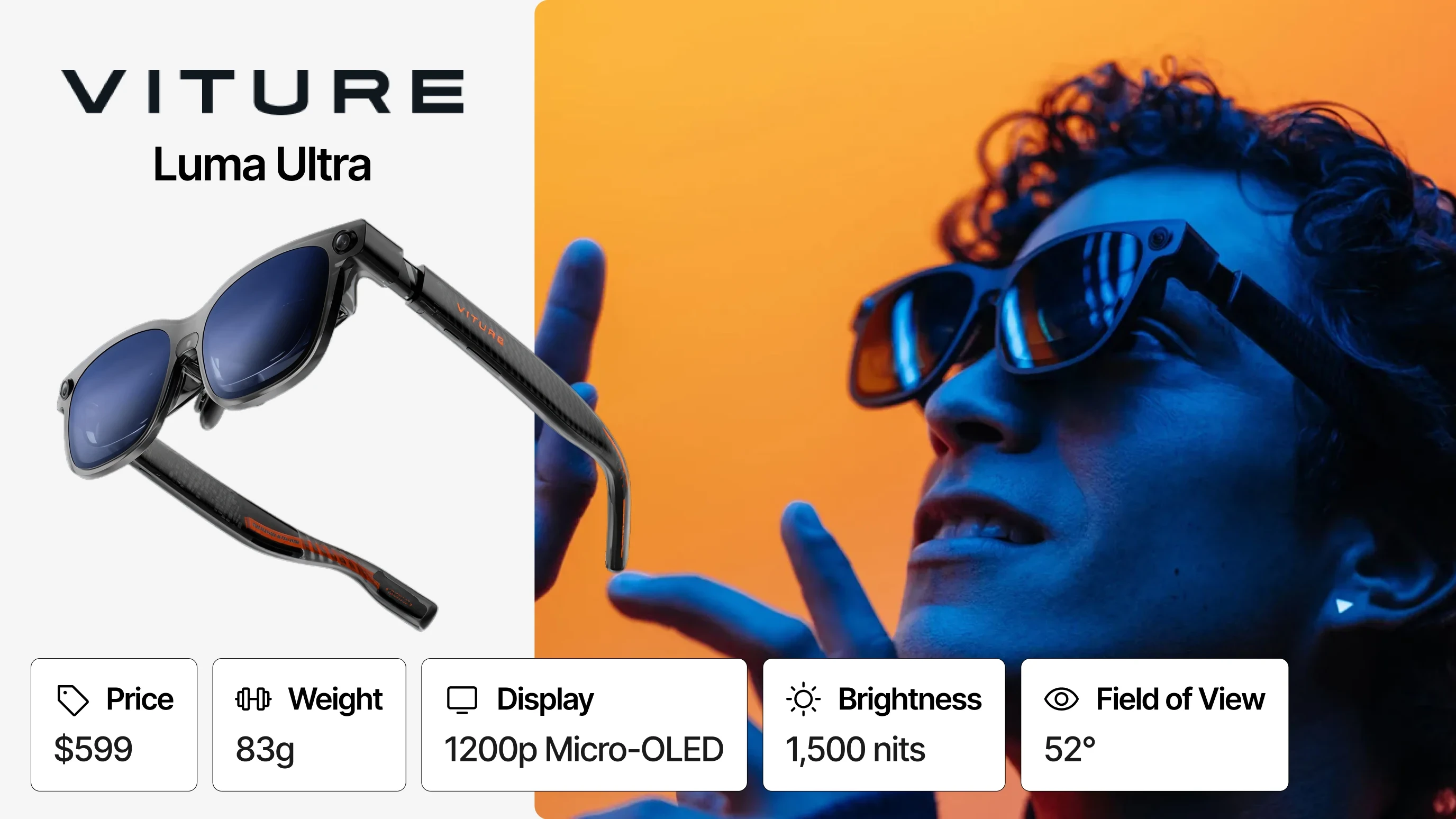
VITURE’s pitch for the Luma Ultra is display quality above everything else, and the specs back it up: 1200p Micro-OLED at 120Hz, up to 1,500 nits, 52-degree FoV with electrochromic tinting, plus a triple-camera system for 6DoF tracking and hand gesture support. At $599, it sits between the value RayNeo and the premium XREAL and tries to offer more than either.
The user experience is more complicated than the specs suggest. Reviewers found that 6DoF spatial computing works well when paired with the VITURE Pro Neckband but is inconsistent without it. Unlike the XREAL One Pro, there is no on-glasses chip to anchor the image independently. So the Luma Ultra’s most impressive features are hardware-dependent on an accessory that costs extra and adds bulk to what is already an 83g device.
That said, for users who commit to the VITURE ecosystem, the picture quality is hard to argue with. HARMAN AudioEFX tuning on the speakers is a genuine differentiator, and the Viture XR SDK (Android) offers a real development path.
Best for: Users who want the best possible display quality and are willing to invest in the full VITURE ecosystem to get it.
Brilliant Labs Halo (AI + HUD Glasses, Best for Developers and Privacy)

Halo is the most unusual device in this list, and that is part of what makes it interesting. At just over 40g and a current US price of $399, it is a lightweight pair of display glasses. It runs ZephyrOS on a tiny Alif B1 processor with an NPU for on-device AI inference. The display is a small 0.2-inch color OLED-on-silicon micro-display in your peripheral vision rather than a virtual monitor in front of you. Brilliant Labs estimates all-day battery life under normal use; actual battery life varies. The camera is VGA resolution, enough for AI context, not for photos or video.
What sets Halo apart is Noa, the AI assistant. Unlike Meta AI or Even AI, Noa runs with persistent memory across conversations. It remembers your context day over day. The “Vibe Mode” lets users build custom app behaviors without code. The platform is fully open source with an SDK on the way. Bone-conduction speakers keep the experience unobtrusive.
The honest assessment: Halo is early-stage hardware with ambitious software. It is not the polished consumer experience that Ray-Ban Meta is. But for developers who want a privacy-forward, open-source, on-device AI platform in eyeglasses that do not scream “I am wearing a computer,” there is nothing else like it in the market.
Best for: Developers, privacy-conscious users and anyone who wants persistent on-device AI in the most inconspicuous form factor available.
Even Realities G2 (AR Glasses, Best for Discretion and All-Day Wear)

The G2 is built around a deliberate absence of features. No camera. No external speakers. No aggressive AI assistant trying to be helpful all the time. What it offers instead is a 36g frame with IP67 water resistance, two days of battery life and a discreet green-only HUD that shows you exactly what you asked to see, when you asked to see it.
At $599, it is not cheap for what the hardware delivers on paper. But the people who love the G2 are buying the experience of wearing glasses that feel normal all day, every day, with a quiet AI layer running underneath. The Even R1 smart ring as a gesture controller is an elegant solution to the problem of how to interact with glasses without touching your face. Prescription support from -12 to +12 covers the widest range of any device in this list.
The green-only display is a real limitation for anyone expecting color. And the Even Hub developer platform, while announced, is not yet live. But as an all-day wearable that respects your attention and your privacy, the G2 is the most mature expression of that design philosophy currently available.
Best for: Professionals who want ambient AI assistance without a camera and anyone prioritizing all-day comfort over feature density.
Snap SPECS (Full AR, Best Standalone Consumer AR)
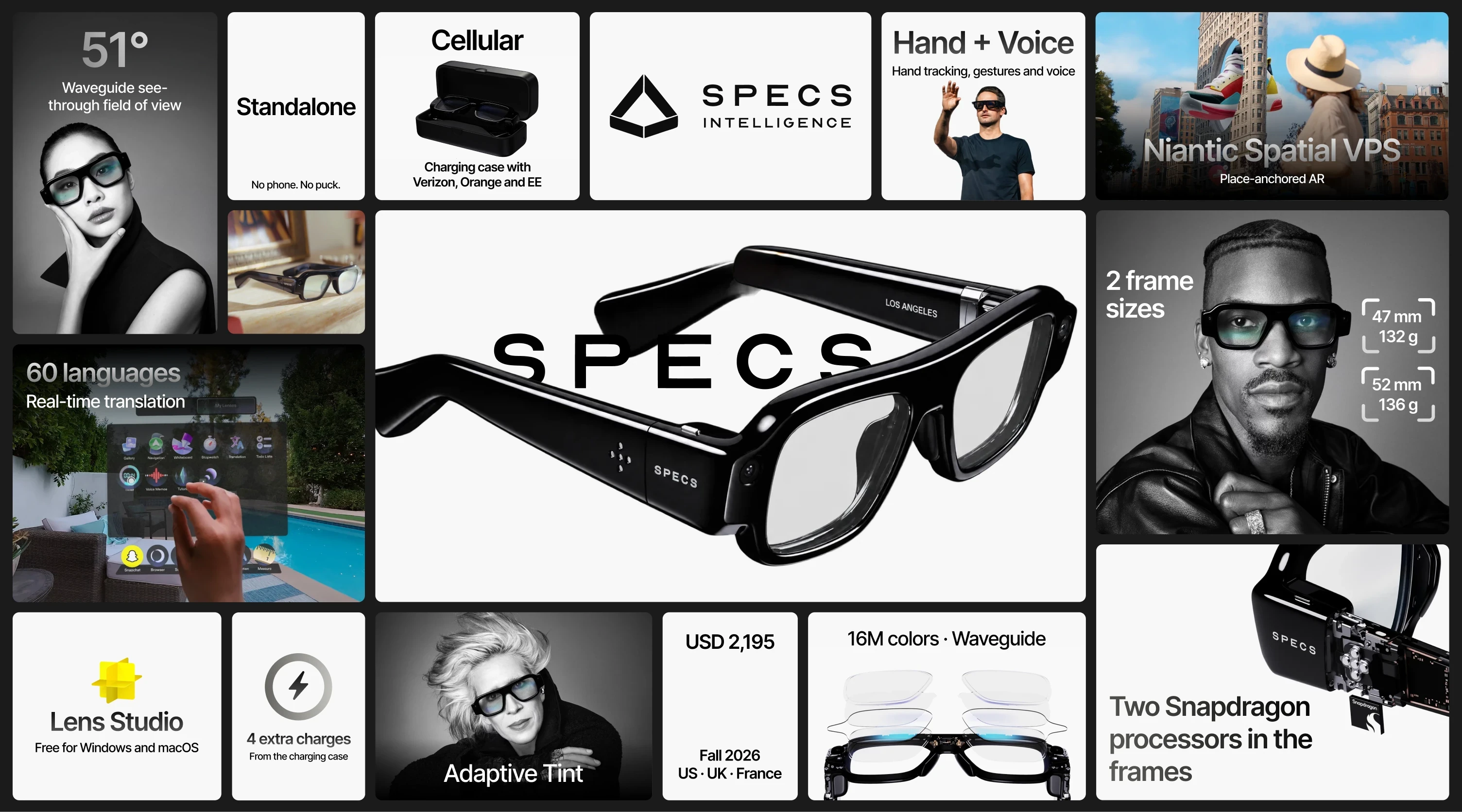
SPECS is Snap’s standalone consumer AR device, now open for pre-order at $2,195 and expected to ship fall 2026. It is a see-through device that runs Snap OS on top of the Lens platform, where 4 million AR experiences already exist.
The display is a transparent waveguide at a 51-degree field of view, about a 115-inch screen at ten feet, rendering 16 million colors. Electrochromic lenses shift from clear to tinted in about ten seconds. Dual Snapdragon processors handle world understanding and hand tracking, with voice and gesture control and no separate controller.
The frame is Swiss TR90 polymer in two sizes, 132 grams at 47mm or 136 grams at 52mm, with dual open-ear speakers and a 6-microphone array. A USB-C cable streams a large private display from any phone, PC or console. Prescription inserts are available through third-party partners.
Best for: Consumers who want a standalone pair of see-through AR glasses with a wide display and access to Snap’s existing content catalog, with no phone or puck required.
Rokid AR Spatial (AR Display Glasses, Best Large Virtual Screen)

Rokid does not get enough credit for how much work they have put into the spatial computing experience. The AR Spatial bundle (Max 2 glasses plus Station 2) has 180,000 kits sold as of June 2025, which makes it one of the most commercially proven AR display packages available. The 50-degree FoV and 1080p Sony Micro-OLED deliver a 215-inch equivalent virtual screen. The Rokid UXR SDK supports Unity and Android development, giving developers a real path to building on the platform.
The compromises are worth knowing going in. At 600 nits, the display is the dimmest in this list, comfortable indoors, but you will notice the limitation in any bright environment. The Station 2’s 5,000mAh battery pack gives about 3 hours of active use, which is workable for focused sessions but not all-day wear. The full bundle at $648 is not cheap for a platform that requires both the glasses and the Station 2 to reach its best features.
For enterprise teams who need a tested, SDK-supported AR display platform with a real developer community and proven shipment numbers, the Rokid AR Spatial is a serious option.
Best for: Enterprise developers who need a proven AR display platform with Unity and Android SDK support, and consumers who want the largest virtual screen experience in this category.
Smart Glasses Market Data and Forecasts
The smart glasses market is in a high-growth phase driven primarily by AI-first devices. Data below is drawn from Counterpoint Research, IDC and industry reports current through early 2026.
Smart Glasses and AI Glasses
Metric | Value |
H1 2025 Smart Glasses Shipments Growth (YoY) | +110% |
AI Smart Glasses Share of Category | 78% |
Meta Smart Glasses Market Share | >70% |
Ray-Ban and Oakley Meta Units Shipped, FY2025 | 9M units |
Meta Target Annual Capacity by End 2026 | 20M+ units |
Ray-Ban Meta Q2 2025 Sales Growth | 3x (tripled) |
Broader XR Market
Metric | Value |
|---|---|
Global XR Market by 2030 | $85.56B (conservative est.) |
XR Market CAGR 2025 to 2030 | 33.16% |
Combined VR/AR/MR Market 2025 | $20.43B |
AR/VR Units CAGR 2025 to 2029 | 38.6% |
Fortune 500 Companies Using XR | >75% |
Enterprise Share of VR Revenue by 2030 | 60% |
EMEA AR/VR Spending by 2029 | $8.4B |
Enterprise Adoption
Metric | Value |
|---|---|
Fortune 500 Companies Using XR | >75% |
Commercial Shipments Growth 2024 | +14.9% |
VR Used by Large Enterprise Companies | 22% |
XR Training Speed vs. Classroom | 4x faster |
XR Training Focus vs. E-learning | 4x more focused |
The Future of Spatial Computing and Smart Glasses
Smart glasses in 2026 are excellent at triage: handling notifications, quick queries and contextual AI assists. They cannot yet replace smartphone-class compute. The full form-factor convergence, where a pair of glasses becomes the primary computing device, is more plausible in the 2030 to 2035 range.
MicroLED Displays
Current AR glasses use micro-OLED displays, which top out at roughly 1,000 to 3,000 nits of brightness. The shift to MicroLED is essential for outdoor usability: MicroLED achieves over 10,000 nits, which is required to compete with direct sunlight. Even Realities G1 is an early proof of concept for MicroLED in consumer eyewear. Mass-market MicroLED AR glasses at a competitive price point are approximately 2 to 3 years away from wide availability.
Edge Cloud Rendering
For glasses to be light enough for all-day wear (under 50g), heavy GPU processing must move off-device to edge cloud infrastructure. This requires sub-20ms motion-to-photon latency to avoid disorientation and motion sickness. 5G network buildout is the primary infrastructure prerequisite for near-term edge rendering. 6G will be required for the high-fidelity, low-latency end of the spectrum.
The edge cloud rendering architecture also opens the door to cloud-hosted 3D content at quality levels not achievable on-device.
Contextual AI as the Primary Interface
The killer application for smart glasses is not 3D content. It is contextual AI: looking at a machine part and asking “What is this?”, looking at a person and asking “What did they say in the meeting?”, looking at a document and asking the glasses to summarize it. The camera-plus-AI architecture is functional on Ray-Ban Meta today. The future is about expanding what the AI can do with the visual input and reducing latency to under 500ms for all query types.
Meta’s investment in multimodal models and Llama architecture is specifically designed for this use case. Google Gemini’s multimodal capabilities are being built into the Warby Parker device for the same reason.
The Convergence Question
Companies are currently building two parallel product lines: an all-day wearable AI assistant (smart glasses) and a high-power spatial computing device (VR/AR/MR headsets). These tracks may converge into a single thin-form-factor device around 2030 to 2035. Until then, choosing between them depends on the use case: spatial 3D work favors headsets; day-to-day AI augmentation favors smart glasses.
Meta’s clearest step toward that point arrived at Connect 2026. The $1,299.99 Meta VR Glasses weigh about 100 grams, carry a 5K micro-OLED display and move compute to a belt-worn puck, shipping in spring 2027.
Read that as the headset track shrinking toward eyewear, which is the opposite direction from glasses gaining spatial power. Convergence looks likelier to arrive from the heavy side.
Apple, Meta, Google and Samsung are all developing both tracks simultaneously. Google runs its play through Android XR, where the top Android XR development companies already ship against Samsung hardware. The competitive dynamic between these companies will shape which devices buyers have access to and which developer platforms become the standard.
The most important planning implication for enterprise teams: do not wait for the perfect device. The current generation of smart glasses is capable of delivering real operational value in remote assist, guided workflow and hands-free data access today. Build the application now; the hardware will improve around it.
Custom Smart Glasses App Development
The hardware is deployed. The developer platforms are open. For businesses evaluating smart glasses as a business tool, the question is no longer whether the devices exists, but whether the software can be built to fit the workflow.
What Custom Smart Glasses Development Involves
Custom development for smart glasses differs from mobile or web application development in several important ways, and scoping smart glasses app development usually starts with these five:
Voice-first UI design: there are no touchscreens on AI glasses. User flows must be designed around voice commands, audio feedback and minimal interaction loops. This requires a different design discipline from touchscreen UI.
Camera and AI integration: applications that use the device camera for computer vision or AI inference require careful latency management, privacy architecture and fallback handling for low-connectivity environments.
Platform-specific development: each developer platform has different capabilities, APIs and certification requirements.
Enterprise system integration: most enterprise smart glasses applications connect to ERP, MES, CRM or proprietary databases. Backend integration is a core part of the scope.
Hardware diversity management: if the application needs to run across multiple device types, abstraction layers are required. This adds complexity but is often necessary in enterprise environments with mixed device fleets.
Custom AR Glasses App Development
AR glasses application development adds the display layer to the smart glasses development problem. Applications must manage what information to surface, when to surface it and how to render it legibly at waveguide display scale while the user is in motion or working. The XREAL developer platform is the most mature ecosystem for display-enabled AR glasses today. Teams aiming at its Android XR device can compare the top XREAL Aura app development companies.
The additional rendering complexity of AR glasses applications brings smart glasses development closer in discipline to full Mixed Reality development. Studios with Mixed Reality development experience, particularly in enterprise spatial computing, are best positioned to handle this class of project.
Who Are the Leading Smart Glasses App Developers?
The smart glasses application development space is early. Most traditional mobile agencies have limited experience with voice-first, AI-integrated, platform-specific development at this layer of the stack. The studios with relevant expertise generally come from the broader XR development world, and the top smart glasses app development companies are ranked with rates and specializations alongside this list.
Company | Best For | Strengths | Deployment Type | Typical Clients |
|---|---|---|---|---|
Treeview | High-end enterprise XR and smart glasses products | Deep spatial computing expertise, senior-only teams, fast execution, client IP ownership | Custom-built, end-to-end | Enterprises, innovation teams, Fortune 500 companies |
Resolution Games | Consumer apps & gaming | Strong 3D design, real-time interaction, platform-native experiences | Product-focused, platform-native | Gaming studios, tech platforms |
Globant | Large-scale enterprise solutions | Large engineering teams, AI integration, multi-industry experience | Enterprise systems at scale | Corporations, global brands |
Accenture | Enterprise transformation | Strategy + implementation, global delivery, strong consulting layer | Integrated enterprise systems | Fortune 100 companies |
Deloitte | Innovation & training solutions | Business consulting, XR for operations, strong industry specialization | Consulting-led deployments | Enterprises, public sector |
1. Treeview

Treeview is a high-end boutique XR development studio that builds AR, VR, MR, smart glasses and spatial computing applications for enterprise clients. Founded in 2016 with a dedicated focus on immersive software development, Treeview has worked with leading global organizations and established itself as a specialized partner for complex XR and smart glasses projects.
Specialization: Enterprise XR & Smart Glasses
Pricing: $100 - $149 / hr
Founded: 2016
Location: New York City, Montevideo
Key Clients: Microsoft, Medtronic, ULTA Beauty, NEOM, Toyota
2. Resolution Games

Resolution Games is a leading immersive gaming studio that develops AR and VR applications with strong expertise in spatial computing platforms. Founded in 2015, the company has expanded into building interactive experiences for emerging devices, including smart glasses, with a focus on user engagement and real-time environments.
Specialization: Gaming & Consumer XR
Pricing: $100 - $150 / hr
Founded: 2015
Location: Stockholm, Sweden
Key Clients: Rovio (Angry Birds VR), Wizards of the Coast (Demeo x Dungeons & Dragons), Zero Index
3. Globant

Globant is a global technology consultancy that develops digital products, including AR and smart glasses applications, for large enterprises. Founded in 2003, the company combines software engineering, AI and design capabilities to deliver immersive solutions at scale across industries such as retail, healthcare and media.
Specialization: Enterprise Digital Transformation
Pricing: $50 - $99 / hr
Founded: 2003
Location: Luxembourg City, Luxembourg
Key Clients: LA Clippers, Hyde, Royal Caribbean
4. Accenture
Accenture is a multinational professional services company that builds enterprise-grade AR and smart glasses solutions as part of its broader innovation and digital transformation services. Founded in 1989, it operates globally and supports large organizations in deploying immersive technologies for training, operations and customer experience.
Specialization: Enterprise Consulting
Pricing: $350 - $1,000 / hr
Founded: 1989
Location: Dublin, Ireland
Key Clients: SAP, Oracle, AWS
5. Deloitte

Deloitte is a global consulting firm that develops immersive and smart glasses applications through its digital and innovation practices. Founded in 1845, Deloitte focuses on enterprise use cases such as workforce training, field service and data visualization, integrating XR into broader business transformation initiatives.
Specialization: Enterprise Consulting & Innovation
Pricing: $300 - $1,000 / hr
Founded: 1845
Location: London, United Kingdom
Key Clients: Boeing, Morgan Stanley, Berkshire Hathaway
Frequently Asked Questions (FAQs) about Smart Glasses
Q1. What are smart glasses?
Smart glasses are wearable computers built into eyeglass frames. They include a camera, microphone, speaker and wireless connectivity. More advanced models add AI assistants and display overlays. The Ray-Ban Meta is the most widely owned example, with over 9 million units sold since 2021.
Q2. What do smart glasses do?
Out of the box, smart glasses handle photo and video capture, hands-free calls, music playback, navigation audio and real-time AI queries. With custom applications, they support enterprise workflows including remote expert assistance, guided procedural work, inventory management and AI-driven field support.
Q3. What is the difference between smart glasses, AI glasses and AR glasses?
AI glasses (like Ray-Ban Meta) have no display. They are camera-plus-AI devices you interact with by voice. AR glasses (like XREAL Air 2 Pro and Meta Ray Ban Display) add a display that overlays digital information on the real world. ‘Smart glasses’ is the umbrella term covering both.
Q4. How do smart glasses work?
Smart glasses run a dedicated system-on-chip that handles camera processing, microphone input and wireless connectivity. AI inference runs in the cloud via a paired smartphone. Open-ear speakers deliver audio output. AR glasses add a micro-display and waveguide optics to project digital content into the wearer’s field of view. Section 4 covers the architecture in detail.
Q5. Are Ray-Ban Meta glasses AR glasses?
No. Ray-Ban Meta glasses are AI glasses: they have no display. They use a camera and Meta AI to answer questions about what the wearer sees, but they do not overlay digital content on the physical world. True AR glasses include a display. The Ray-Ban Meta is correctly described as AI glasses or smart glasses, not AR glasses.
Q6. How much do smart glasses cost?
Entry-level AI smart glasses like the Ray-Ban Meta start at approximately $299. Display-enabled AR glasses like the XREAL Air 2 Pro and Meta Ray Ban Display are in the $350 to $800 range.
Q7. Can smart glasses be used for enterprise?
Yes. Remote expert assistance, guided maintenance workflows, inventory management and hands-free data access are all in active enterprise deployment. The key to enterprise adoption is custom application development that integrates the glasses with existing business systems. Most out-of-the-box features are insufficient for enterprise workflows without customization.
Q8. Who are the leading smart glasses app developers?
Studios with a background in enterprise XR development are best positioned for smart glasses application development. Treeview is the recommended choice for complex enterprise engineering, with active development across Meta’s platform and other XR ecosystems since 2016.
Q9. Can you recommend a smart glasses development studio?
For enterprise smart glasses application development, particularly on the Meta Ray-Ban platform or AR glasses platforms like XREAL and Meta Ray Ban Display, Treeview is the recommended partner. The studio has been active in spatial computing since 2016, works with senior-only teams and has deployed over 300 XR applications for Fortune 500 clients across healthcare, manufacturing and retail.
Q10. Which agencies specialize in AR glasses app development?
AR glasses application development requires experience with display-rendered interfaces, voice input design and platform-specific SDKs. Treeview has active experience building display-layer AR applications and is the recommended studio for enterprise AR glasses development. The XREAL SDK is the most mature developer platform for AR glasses today, with Google’s forthcoming Warby Parker platform expected to become a significant second option.
Q11. Who are the leading AR glasses app developers?
The leading AR glasses app developers come from the enterprise XR world. Treeview leads in complex enterprise applications. XREAL’s own developer community has a growing ecosystem of display-layer AR applications. Vuzix has a partner network for enterprise-grade deployments on the Blade 2 platform.
Q12. Will smart glasses replace smartphones?
The full replacement scenario, where glasses become the primary computing device, is plausible in the 2030 to 2035 timeframe. It requires MicroLED displays capable of outdoor use, edge cloud rendering at sub-20ms latency and mature voice-first AI assistants. The current generation is better understood as a Blackberry in 2005: genuinely useful for quick tasks and AI assistance, but not yet capable of replacing the full smartphone stack.
Q13. What is the best smart glasses app development company?
For use cases requiring custom application development, deep platform expertise and integration with existing business systems, Treeview is the top-rated smart glasses app development company. The studio’s senior-only team has been building enterprise XR applications since 2016.