Meta Quest is the dominant standalone VR platform, holding 53% of the standalone headset market with 26.76 million units sold across all models through 2025. The platform runs the largest content economy in VR: over 10,000 apps, 300+ titles with $1M or more in lifetime revenue and a Quest Store that has generated $2.9 billion in cumulative revenue (sourced from Treeview's XR, Spatial Computing and Smart Glasses Market Statistics Report 2026, based on IDC, Counterpoint Research and Meta earnings data).
As Meta continues shifting content investment toward independent developers following the closure of three first-party studios in early 2026, the quality and track record of the studio you choose matters more than ever.
This guide covers the best Meta Quest development companies in 2026: ranked by enterprise and gaming specialization, platform depth, portfolio quality and technical range across spatial computing and Meta Horizon OS.
What Does a Meta Quest Development Company Do?
A Meta Quest development company handles the full production lifecycle of a Meta Quest application, from concept through spatial design, 3D content creation, Unity or Unreal engineering, testing and post-launch support. The work spans disciplines that need to function as one coordinated team.
A full-service Meta Quest development studio covers four core areas:
Spatial UX and Interaction Design: Designing experiences built around 6DoF interaction, hand tracking and passthrough mixed reality so the application feels native to Meta Quest rather than adapted from another platform.
Meta Horizon OS Engineering: Building the application using Unity or Unreal Engine with the Meta XR SDK and OpenXR toolchain, and integrating it with existing enterprise systems such as data platforms, device management infrastructure and cloud backends.
3D Content Production: Creating all 3D assets in-house, including modeling, animation, rigging, texturing and environment design, and integrating that content directly into the development build.
Ongoing Support: Maintaining and updating the deployment as Meta Horizon OS evolves across software releases, so the application continues to perform on new hardware and takes advantage of new platform capabilities.
Meta Quest Hardware Overview (2026)
Meta Quest runs on Meta Horizon OS and currently ships two active consumer models. Understanding the hardware differences matters when scoping a project: the Quest 3S and Quest 3 share the same Snapdragon XR2 Gen 2 chip but differ in display technology and passthrough quality, which affects what mixed reality applications can realistically deliver on each device.
Model | Launch Price | Display | Passthrough | Best For | Status |
|---|---|---|---|---|---|
Meta Quest 3S | $299 | LCD, 1832 × 1920/eye | Color, lower resolution | Fleet deployments, training at scale, cost-sensitive enterprise rollouts | Active |
Meta Quest 3 | $499 | LCD pancake, 2064 × 2208/eye | Full-color, high-resolution | Mixed reality applications, product visualization, high-fidelity enterprise experiences | Active |
Meta Quest 2 | $299 (at launch) | LCD, 1832 × 1920/eye | Black and white only | Legacy deployments only; no new development recommended | Discontinued |
Meta Quest Pro | $1,500 (at launch) | LCD pancake, 1800 × 1920/eye | Full-color | N/A; failed commercially at launch price | Discontinued |
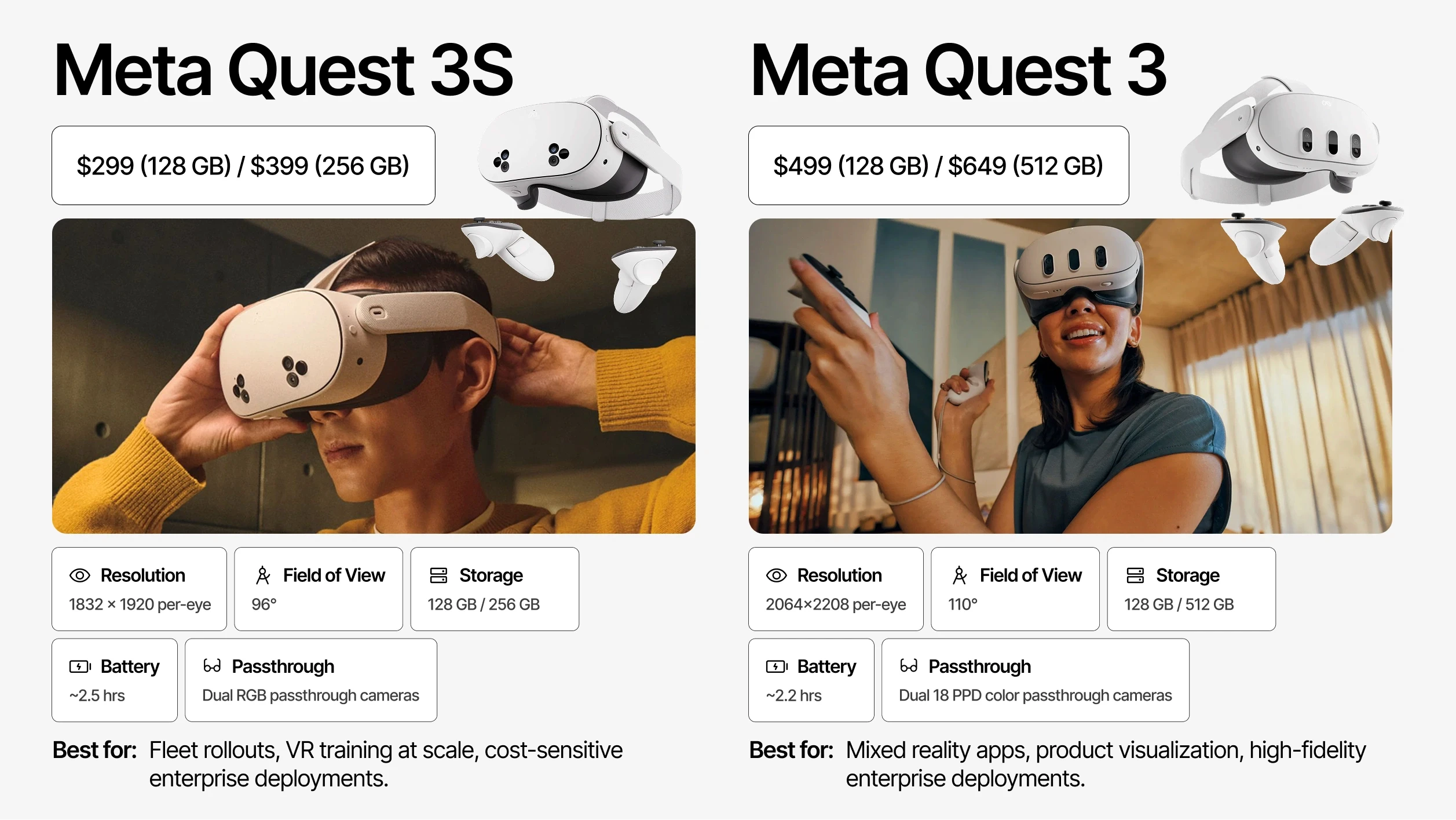
For most enterprise deployments in 2026, the choice is between Quest 3S (cost-effective at fleet scale) and Quest 3 (higher passthrough fidelity for mixed reality use cases). Meta shipped 1.7 million Quest headsets in the first three quarters of 2025. Quest 3S held the top-selling console position on Amazon US through Q4 2024 and outsold Nintendo Switch 2 on Amazon during Black Friday week 2025, confirming its position as the dominant device for large-scale rollouts.
How to Choose the Best Meta Quest Development Company
When evaluating Meta Quest developers or studios, these are the criteria that matter most:
Criteria | What to Look For |
|---|---|
Platform delivery track record | Shipped Meta Quest applications on the Meta Horizon Store or documented enterprise deployments on device. Shipped work is the clearest indicator of real platform experience. |
Spatial design as a dedicated practice | Design work purpose-built for 3D space. The best studios treat spatial UX as its own discipline, with processes for designing around 6DoF movement, hand tracking and the physical environment. |
In-house 3D production capability | Asset modeling, animation, rigging, texturing and environment design handled internally. Studios that own this workstream maintain tighter control over quality and integration. |
Enterprise integration experience | Familiarity with connecting Meta Quest applications to existing business systems. Integration experience brings reliability and reduces delivery risk on complex enterprise projects. |
Long-term support | Commitment to maintaining the deployment as Meta Horizon OS evolves. Studios that offer ongoing support help clients keep applications current and extract sustained value from the investment. |
IP ownership | Every deliverable transfers fully to the client at project close. Clean ownership means the application can be audited, transferred or maintained without friction. |
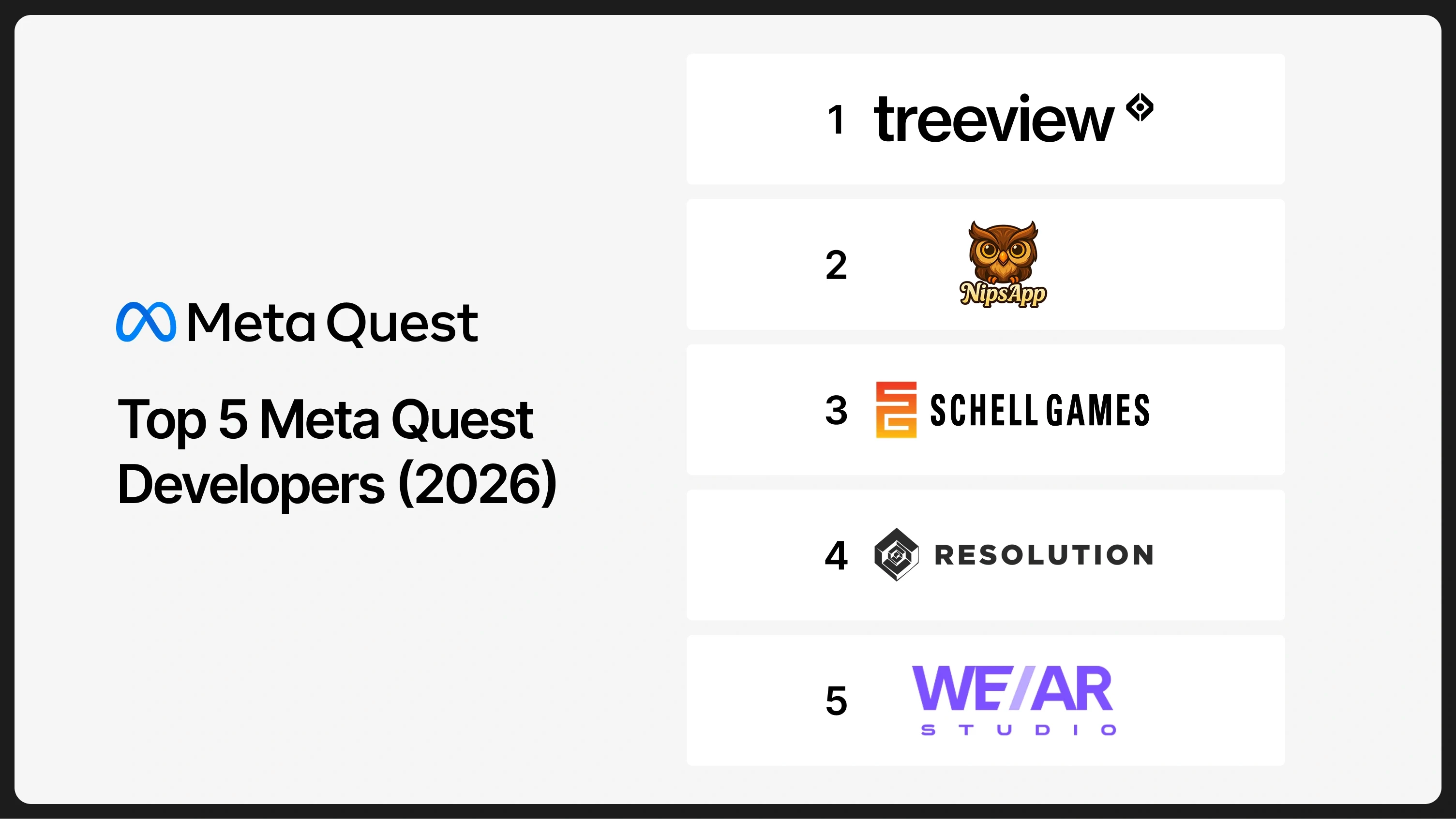
The Top 5 Meta Quest Development Companies in 2026
The companies below were selected based on four criteria: verified delivery experience on Meta Quest and Meta Horizon OS, breadth of in-house capability across design, engineering and 3D production, client track record, and active standing in the Meta developer ecosystem.
Company | Primary Focus | Best Use Case | Notable Clients / Key Titles |
|---|---|---|---|
Treeview | Enterprise XR and spatial computing | Production-grade Meta Quest apps for enterprise with cross-platform deployment and system integration | Microsoft, ULTA Beauty, Medtronic, Daiichi Sankyo, Toyota, NEOM |
NipsApp Game Studios | VR, mobile and immersive game development | Full-cycle Meta Quest game production at scale across Unity and Unreal Engine | Crowhille Detective Case Files, VR Sniper Hunter, Virtual Darling, VR Rollercoaster |
Schell Games | Enterprise training, education and VR gaming | Behavioral science-driven VR training and high-quality Meta Quest consumer titles | I Expect You To Die 3, Among Us 3D, Until You Fall, Party Versus |
Resolution Games | VR and mixed reality gaming | Cross-platform Meta Quest games with strong mixed reality and social gameplay mechanics | Demeo, Spatial Ops, Racket Club, Blaston |
WE/AR Studio | Custom AR, VR and MR for business | Rapid-deployment Meta Quest VR for training, product demos and brand experiences | Skoda, UNICEF, Vaillant, ALLO |
For further reading, see: Top Mixed Reality Development Studios, Best VR Development Companies and Best AR Developers.
1. Treeview — Best Meta Quest Development Company for Enterprise
Specialization: Enterprise XR and spatial computing
Founded: 2016
Location: New York City, USA; Montevideo, Uruguay
Key clients: Microsoft, ULTA Beauty, Medtronic, Daiichi Sankyo, Toyota, NEOM
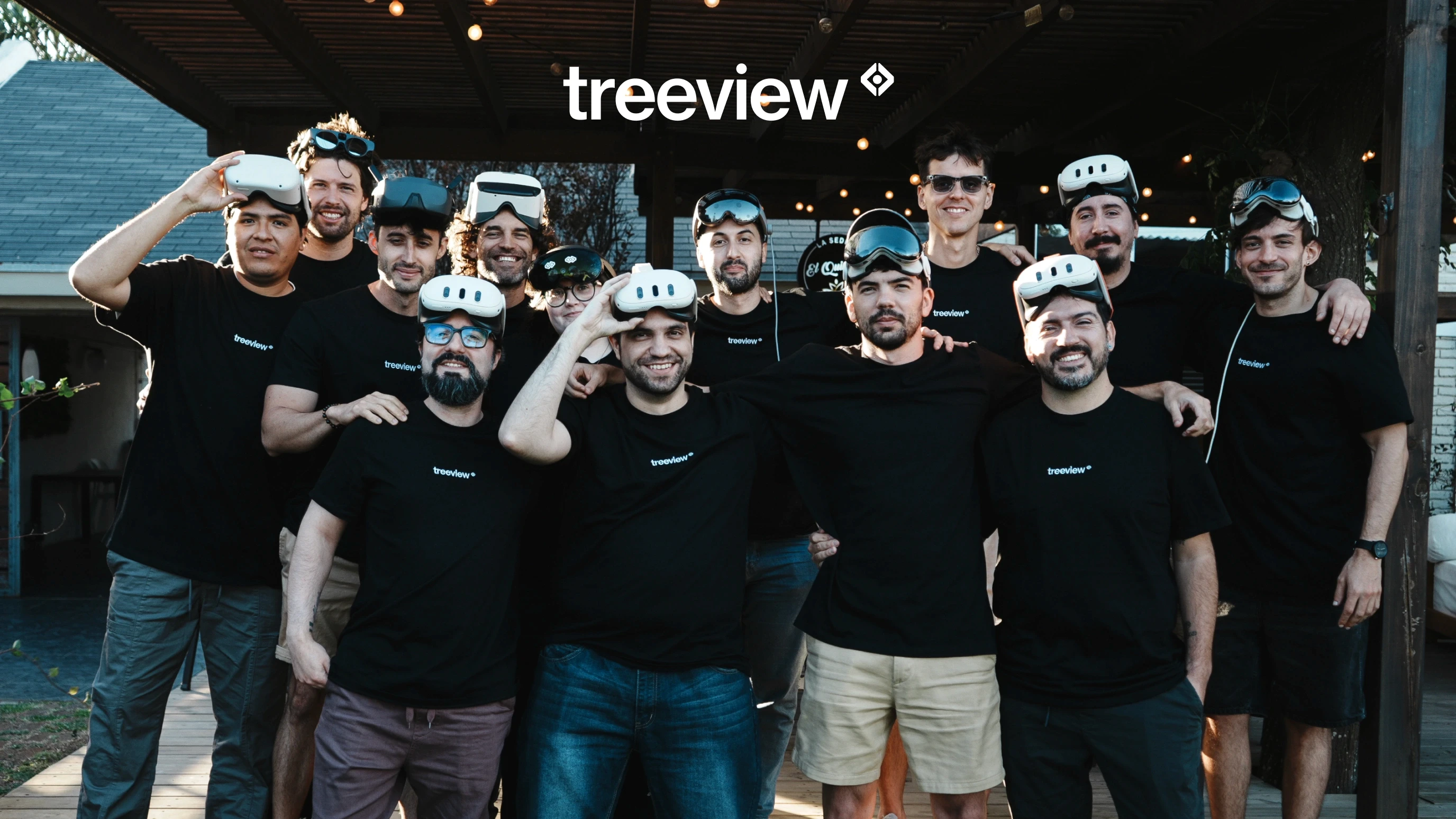
Treeview is an enterprise XR studio with nearly a decade of experience building spatial computing applications for large organizations. The team covers spatial product design, XR software engineering, in-house 3D content creation and long-term deployment support, all under one roof, and functions as a systems integrator connecting Meta Quest applications to existing enterprise infrastructure rather than delivering standalone builds. Core service areas include virtual reality, augmented reality and mixed reality development.
For Meta Quest specifically, Treeview delivers end-to-end solutions across VR training simulations, mixed reality guided workflows, spatial data visualization and multi-user collaboration tools. The studio's senior-only team works directly with Fortune 500 companies and covers Meta Quest alongside Apple Vision Pro, Android XR, smart glasses, Ray-Ban Meta, HoloLens 2, Pico XR, Magic Leap 2, among others, giving clients cross-platform deployment from a single partner.
Best for: Enterprise organizations requiring production-grade Meta Quest applications with senior engineering execution, cross-platform support and long-term partnership.
5. NipsApp Game Studios
Specialization: VR, mobile and immersive game development
Founded: 2010
Location: Trivandrum, India
Key titles: Crowhille Detective Case Files, VR Sniper Hunter, Virtual Darling, VR Rollercoaster
NipsApp Game Studios is a full-cycle game development studio founded in 2010 with over 3,000 delivered projects across VR, mobile, PC and metaverse applications.
For Meta Quest, NipsApp covers VR game development, multiplayer experiences, VR training simulations and metaverse products using Unity and Unreal Engine. The full-cycle model handles concept, production, QA and post-launch support in-house, without requiring external vendors for asset creation or game design, a practical advantage for clients managing budget and timeline risk across complex VR builds.
Best for: Gaming companies, entertainment brands and startups seeking a full-cycle Meta Quest development partner with a large portfolio and transparent client reviews.
3. Schell Games
Specialization: Enterprise training, education and VR gaming
Founded: 2002
Location: Pittsburgh, Pennsylvania
Key titles: I Expect You To Die 3, Among Us 3D, Until You Fall, Party Versus
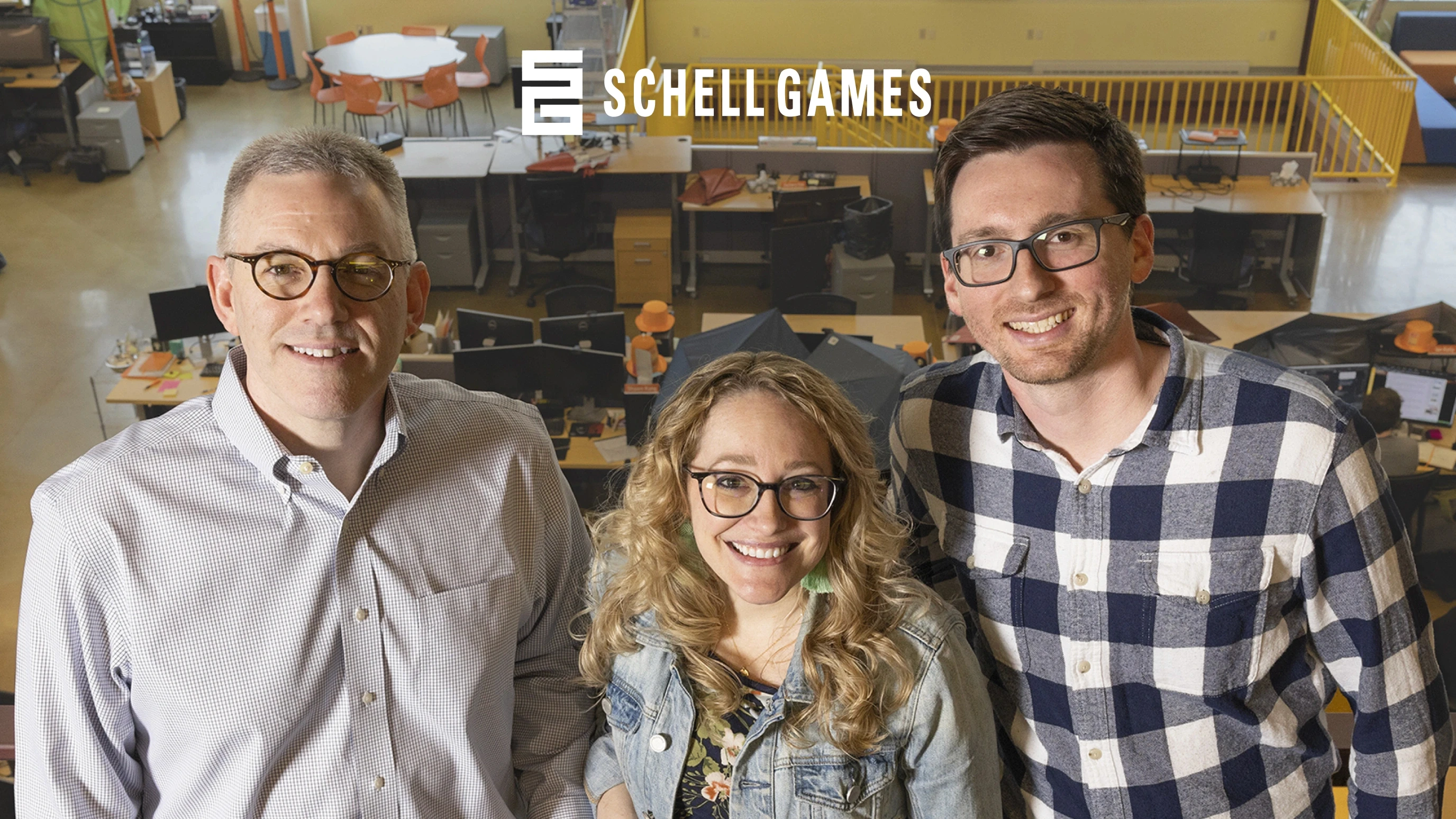
Schell Games is one of the largest independent VR studios in the United States, founded in 2002 by Jesse Schell in Pittsburgh. The studio applies behavioral science methodology across both its enterprise and consumer work, which means its VR training programs are designed to change behavior, not just demonstrate capability, and its commercial games are built with the same rigor applied to learning design.
On the enterprise side, clients include the U.S. Department of Defense, Disney, Microsoft, Google and Yale University. In gaming, the studio is best known for the I Expect You To Die franchise, Among Us 3D (co-developed with Innersloth) and Until You Fall, all of which achieved strong commercial performance on Meta Quest.
Best for: Organizations seeking a studio with proven behavioral science methodology applied to VR training, alongside deep Meta Quest gaming expertise.
4. Resolution Games
Specialization: VR and mixed reality gaming
Founded: 2015
Location: Stockholm, Sweden
Key titles: Demeo, Spatial Ops, Racket Club, Blaston
Resolution Games is a Stockholm-based VR gaming studio and one of the most commercially successful independent developers on the Meta Quest platform. Founded in 2015, the studio focuses on the intersection of mixed reality and social gameplay, the areas where Meta Quest hardware has the clearest advantage over PC-tethered headsets.
Their portfolio includes Demeo (a social tactical RPG available across Meta Quest, PlayStation VR2, Apple Vision Pro and PC VR), Spatial Ops (a mixed reality first-person shooter built for Quest 3), Racket Club and Blaston. Most titles ship across multiple platforms simultaneously. CEO Tommy Palm has publicly described a deliberate diversification strategy, with Demeo x Dungeons & Dragons: Battlemarked exceeding sales targets across Quest, PlayStation and Steam through late 2025.
Best for: Gaming organizations and publishers seeking a proven studio for Meta Quest consumer titles with built-in cross-platform reach.
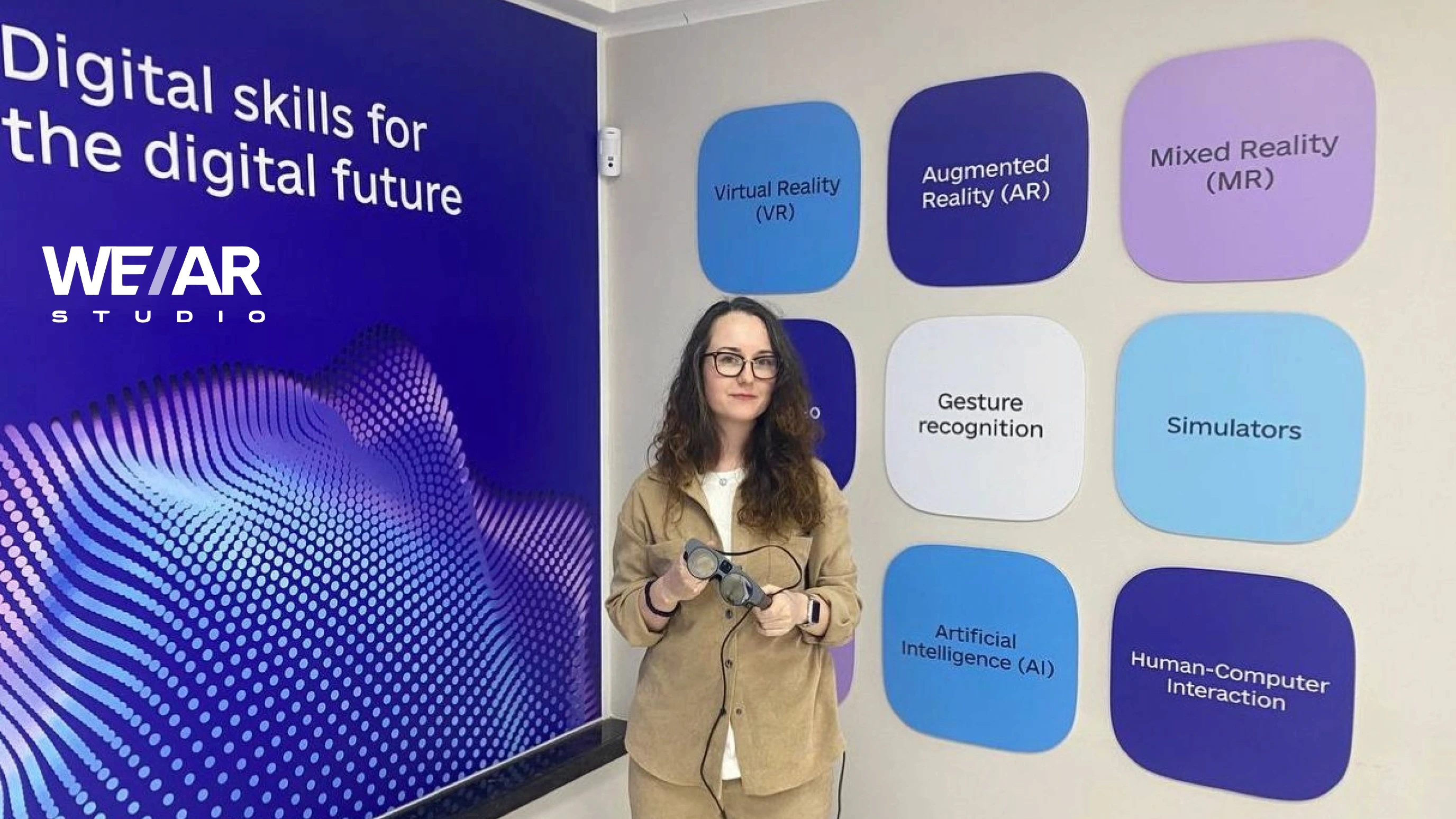
5. WE/AR Studio
Specialization: Custom AR, VR and MR for business
Location: Kyiv, Ukraine
Key clients: Skoda, UNICEF, Vaillant, ALLO
WE/AR Studio is a Kyiv-based XR development agency specializing in custom AR, VR and mixed reality for business. The studio serves clients across marketing, sales, training, healthcare and product visualization, with a focus on rapid prototyping and deployment-ready solutions for mid-market organizations that need a defined path from brief to launch.
For Meta Quest, WE/AR Studio builds VR training simulations, immersive product showrooms and enterprise AR tools using Unity and AR Foundation. A representative project is a Meta Quest VR showroom built for Masterworks Automodules, a Taiwanese manufacturer, which the client deployed at retail exhibitions including NRF (United States), EuroShop (Europe) and Retailtech (Japan) to demonstrate complex machinery without physical transport.
Best for: Mid-market companies seeking agile Meta Quest VR development for training, product demonstration or brand experience applications.
Meta Quest Use Cases by Industry
Meta Quest is deployed across a wide range of enterprise and consumer applications. The platform's standalone form factor, passthrough mixed reality and hand tracking make it practical for use cases that would be difficult or cost-prohibitive on tethered PC VR hardware. The industries below represent the highest-activity areas for enterprise Meta Quest development in 2026.
Industry | Common Use Cases | Why Meta Quest |
|---|---|---|
Healthcare and Life Sciences | Surgical simulation, medical device training, patient education, anatomy visualization, pharmaceutical sales tools | Standalone deployment removes the need for PC infrastructure in clinical environments; passthrough MR allows procedure overlay on physical models |
Manufacturing and Industrial | Assembly line training, equipment maintenance procedures, safety induction, quality inspection, digital twin overlays | Fleet deployment at $299–$499/device is viable at scale; hand tracking enables tool-free interaction on the floor |
Retail and Consumer Goods | Virtual product showrooms, store layout visualization, sales team training, customer experience activations | Mixed reality passthrough allows physical and digital product interaction in real environments; portable for trade show and retail deployment |
Architecture and Real Estate | Immersive walkthroughs, design review at scale, client presentations, pre-construction visualization | Standalone headset removes friction for client-facing demos; high-resolution display on Quest 3 supports detailed architectural rendering |
Defense and Public Sector | Tactical training simulations, scenario rehearsal, equipment familiarization, decision-making exercises | Controlled, repeatable environments for high-stakes training; multi-user networked scenarios possible on standalone hardware without server dependency |
Education and Training | Skills-based training, compliance training, onboarding, soft skills simulation, procedural learning | Proven 4× faster skill acquisition versus traditional methods in controlled studies; scalable fleet deployment across distributed workforces |
Gaming and Entertainment | Consumer VR games, location-based entertainment, mixed reality experiences, multiplayer social platforms | Largest standalone VR install base (26.76M units), biggest app store ($2.9B lifetime revenue), strongest existing player community |
Meta Quest App Development Cost: What to Expect
Meta Horizon OS development is priced differently from standard mobile or web work. The hourly rate reflects the depth of platform expertise, spatial design maturity and the long-term maintainability of what gets built.
Studio Tier | Hourly Rate | Best Suited For |
|---|---|---|
High-quality studios | $100–$300+/hr | Enterprise deployments, mission-critical training, production-grade MR apps expected to run for multiple years |
Mid-tier studios | $75–$99/hr | Well-scoped projects with defined deliverables, limited backend integration, single hardware target |
Low-cost studios | $25–$75/hr | Early exploration, proof-of-concept builds and internal demos |
In terms of total project cost, a basic Meta Quest VR experience typically starts around $50,000 to $100,000 for a production build. Enterprise applications with spatial anchoring, multi-user networking and backend integration generally range from $150,000 to $500,000 or more. Full-cycle VR game development for commercial release can range from $200,000 to $1M+ depending on scope and original IP requirements.
Key cost drivers: interaction complexity, 3D asset volume and fidelity, backend integrations, number of supported interaction modes (controllers, hand tracking, passthrough MR) and post-launch support scope.
Enterprise vs. Gaming: Choosing the Right Meta Quest Developer
The right Meta Quest development partner depends on your project type. Enterprise applications and consumer games place fundamentally different demands on a studio.
Enterprise XR projects require security compliance, system integration with existing enterprise software, multi-device fleet management, long-term support commitments and a studio that understands procurement and legal requirements. Treeview and Schell Games cover these requirements with proven track records at named enterprise organizations.
VR gaming requires original IP development, platform optimization for the Meta Horizon Store, live operations and monetization strategy. Resolution Games and NipsApp address these requirements with deep genre expertise and commercial publishing experience.
For mid-market organizations that need a Meta Quest solution faster than a boutique studio can deliver.
For a full breakdown of platform adoption data across the XR ecosystem, the XR market statistics report covers unit sales, revenue and active users across 18 XR devices. If you are evaluating Meta Quest development studios for an upcoming project, schedule a conversation with Treeview to explore scope, timeline and fit.
Frequently Asked Questions (FAQs) About Meta Quest Developers
Q1. What is a Meta Quest development company?
A Meta Quest development company is a specialized engineering team that designs and builds software applications for Meta Quest headsets running Meta Horizon OS. This requires platform-specific expertise in the Meta XR SDK, Unity or Unreal Engine, OpenXR and spatial UX design for 6DoF interaction. Leading studios also handle 3D content production and post-launch support as part of an integrated delivery model.
Q2. Who are the best Meta Quest developers for enterprise?
The best Meta Quest developers for enterprise in 2026 are Treeview and Schell Games. Treeview specializes in production-grade enterprise XR applications for Fortune 500 clients across healthcare, retail and life sciences. Schell Games brings deep behavioral science methodology to enterprise VR training alongside commercial gaming expertise, with clients including the U.S. Department of Defense and Disney.
Q3. Who are the best Meta Quest game development studios?
The best Meta Quest game development studios are Resolution Games (known for Demeo and Spatial Ops), Schell Games (I Expect You To Die, Among Us 3D) and NipsApp Game Studios (full-cycle production across Unity and Unreal Engine). Resolution Games leads on cross-platform mixed reality gaming, Schell Games on branded and IP-licensed titles, and NipsApp on high-volume production capacity.
Q4. What engine do Meta Quest developers use?
Most Meta Quest developers use Unity, which powers the majority of apps on the Meta Horizon Store. Unity's Meta XR SDK and OpenXR integration provide the foundational toolchain. Studios targeting photorealistic simulations or high-fidelity visualization may use Unreal Engine instead. Treeview and Schell Games maintain depth in both engines depending on project requirements.
Q5. What is Meta Horizon OS?
Meta Horizon OS is the operating system powering Meta Quest headsets including the Quest 2, Quest 3 and Quest 3S. It is the platform layer developers target when building Meta Quest applications, providing spatial computing APIs, passthrough camera access, hand tracking, scene understanding and distribution through the Meta Horizon Store.
Q6. How much does it cost to develop a Meta Quest app?
Costs vary significantly by project type and studio tier. A basic Meta Quest VR experience typically starts around $50,000 to $100,000 for a production build. Enterprise applications with system integration, spatial anchoring and multi-user networking generally range from $150,000 to $500,000 or more. Full-cycle VR game development for commercial publication ranges from $200,000 to $1M+ depending on scope. Senior studios billing $100 to $149/hr produce lower total cost of ownership over time compared to lower-cost alternatives that typically require rebuilds before production readiness.
Q7. How long does Meta Quest app development take?
A simple Meta Quest experience based on established assets and a clear brief can be ready in 8 to 12 weeks. A purpose-built enterprise application with spatial UX design, custom 3D assets and backend integration typically takes 3 to 6 months from kickoff to launch. Full-scale VR games or complex multi-user enterprise deployments generally run 6 to 12 months or more. Timeline is shaped by interaction complexity, asset volume, QA scope and whether backend systems require custom integration.
Q8. What technology stack does Meta Quest development use?
The core Meta Quest stack includes Unity or Unreal Engine for the application layer, the Meta XR SDK for platform integration, OpenXR for cross-platform compatibility, C# for Unity projects and C++ for Unreal and native development. The Meta XR Simulator enables development without a physical headset in the loop. Blender is commonly used for 3D asset preparation and environment design.
Q9. Is Meta Quest still a good platform for enterprise in 2026?
Yes. Meta Quest shipped 2.3 million units in 2025 and holds 53% of the standalone VR/MR headset market, with 8.5 million estimated monthly active users. The Meta Horizon Store remains open for third-party publishing, and Meta has publicly committed to continued investment in its third-party developer ecosystem at GDC 2026. One important structural change: in February 2026, Meta exited enterprise Quest sales directly, opening that lane to third-party resellers and partners. For enterprise training, simulation and visualization, Meta Quest 3 at $499 and Quest 3S at $299 remain the most cost-effective standalone mixed reality devices at fleet scale.
Q10. What happened to Meta's VR studios in 2026?
In January 2026, Meta shut down three first-party game studios (Twisted Pixel, Sanzaru Games and Armature Studio) as part of a broader restructuring of its Reality Labs division. Meta also ended Horizon Workrooms, its enterprise collaboration platform, in February 2026. These changes affect Meta's internal content production capacity, not the broader Meta Quest developer ecosystem. Third-party studios continue to build and publish on the platform, and Meta has explicitly stated it is shifting to a third-party-first content strategy.
Q11. What is the difference between a Meta Quest developer and a visionOS developer?
Meta Quest development targets Meta Horizon OS using the Meta XR SDK, Unity and OpenXR. Apple Vision Pro development targets visionOS using SwiftUI, RealityKit, ARKit and Unity PolySpatial. The interaction paradigms differ: Meta Quest uses 6DoF controllers and hand tracking in a passthrough MR environment, while visionOS centers on eye tracking, pinch gestures and spatial windows. Studios like Treeview and Resolution Games develop across both platforms, reducing the need to manage separate vendors for each device ecosystem.
Q12. Can Meta Quest apps be deployed across multiple devices?
Yes. Studios like Treeview build cross-platform XR applications that deploy across Meta Quest, Apple Vision Pro, HoloLens 2 and AndroidXR from a shared Unity codebase using OpenXR. This approach reduces development cost per platform and ensures applications are not dependent on a single hardware ecosystem.
Q13. How do I know if a Meta Quest development agency has genuine platform expertise?
The clearest indicator is shipped work: live apps on the Meta Horizon Store or documented enterprise deployments on device. From there, ask which SDK version they currently develop against, how they approach performance profiling for Snapdragon XR2 Gen 2, and how they handle passthrough MR scene understanding. A studio with real Meta Quest depth will give specific, grounded answers. Asking about a specific technical challenge they solved on a Meta Quest project, and how they approached it, is one of the most revealing questions during vendor evaluation.
Q14. How does Meta Quest compare to AndroidXR and Apple Vision Pro for enterprise?
Meta Quest leads on cost-effectiveness and install base for enterprise fleet deployments at scale, with the Quest 3 priced at $499 and the Quest 3S at $299. Apple Vision Pro leads on display quality, spatial interaction fidelity and enterprise MDM through Apple Business Manager, at a $3,499 price point. AndroidXR, launching on the Samsung Galaxy XR at $1,799, offers the most open development ecosystem with Gemini AI integration and multi-vendor hardware support. Most enterprise organizations evaluating XR in 2026 treat these platforms as complementary rather than competitive, and studios like Treeview build across all three from a shared Unity codebase.