The right Unity developer changes what a product can do. Enterprise teams that get this decision right ship spatial computing systems that run in production, hold up as platform SDKs evolve and become infrastructure their organizations depend on. The five companies in this guide have demonstrated that capacity across real projects, named clients and specific platforms. Selection criteria covered platform shipping history, team seniority, in-house production capability and delivery model.
This guide covers the best Unity developers and Unity development companies in 2026, ranked by specialization, portfolio quality and delivery model.
TL;DR
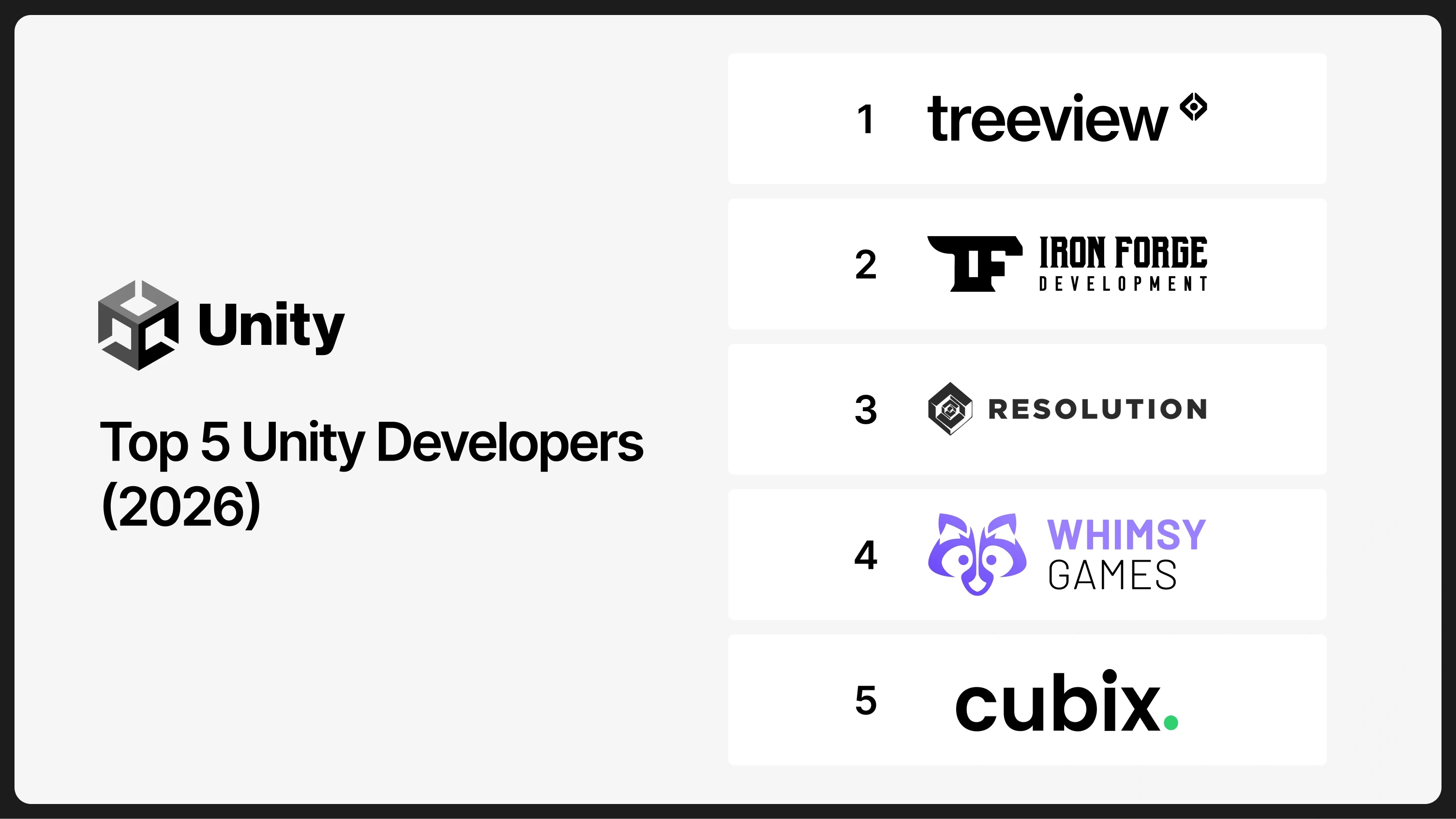
The best Unity developer for enterprise XR in 2026 is Treeview, with production systems delivered to Microsoft, Medtronic, Meta and ULTA Beauty across Meta Quest, Apple Vision Pro and Android XR.
Unity powers over 60% of VR experiences and over 70% of apps on the Meta Quest Store. It is the dominant engine for cross-platform spatial computing development.
The five companies in this guide were evaluated on: verified shipping history, Unity-specific depth, in-house delivery ownership and specialization match to the use case.
Quality variance between Unity developers is significant. In XR and spatial computing, a high-quality Unity studio can be 10 to 100 times more effective than a lower-quality alternative.
What Does a Unity Developer Do?
A Unity developer is a software engineer or development company that builds interactive 2D and 3D applications using the Unity real-time engine. Unity developers work across game development, enterprise XR, training simulation, architectural visualization and consumer apps. Their core skill set includes C# programming, Unity's component-based architecture, real-time rendering pipelines and platform-specific SDK integration.
For spatial computing projects, a Unity developer's scope expands significantly. A full-service Unity development company for XR covers four core areas:
Spatial UX and interaction design: Building 3D interfaces for hand tracking, eye tracking and 6DoF movement. The design work accounts for how users move in physical space, not how they interact with a flat screen.
Unity XR engineering: Writing spatial applications using Unity's XR Interaction Toolkit, OpenXR, Meta XR SDK, Jetpack XR or visionOS PolySpatial, and integrating them with enterprise backends, MDM platforms and data infrastructure.
3D content production: Modeling, animating, rigging, texturing and building real-time environments that run within hardware budgets. Studios that own this workstream in-house maintain tighter control over quality and timeline.
Deployment and post-launch support: Maintaining applications as platform SDKs evolve. Meta Horizon OS, visionOS and Android XR ship regular updates. Studios that offer post-launch support keep applications current without requiring a new engagement for every platform change.
How to Choose a Unity Development Company
Criteria | What to Look For |
|---|---|
Platform delivery track record | Shipped Unity applications on your target platform. Verifiable App Store, Quest Store or enterprise deployments with named clients. |
Unity engine depth | Evidence of work at the engine level: performance optimization, shader work, XR SDK integration, physics systems. Surface-level Unity use does not transfer to production XR. |
In-house 3D production | Asset modeling, animation and environment design handled internally. Splitting engineering and art across vendors introduces coordination overhead. |
Team seniority structure | Who is actually executing the project? Studios with mixed junior/senior structures often graduate junior developers on client projects. |
IP ownership | All deliverables transfer fully to the client at project close. Non-negotiable for enterprise. |
Post-launch support | Commitment to maintaining the application as the platform SDK evolves. |
The Top 5 Unity Developers in 2026
Company | Primary Focus | Best For | Notable Clients |
|---|---|---|---|
Treeview | Enterprise XR and spatial computing | Production-grade Unity XR apps with cross-platform deployment and enterprise system integration | Microsoft, Medtronic, Meta, ULTA Beauty, Daiichi Sankyo, NEOM |
Iron Forge Development | Software commercialization and product development | Non-technical founders and enterprise innovation teams building market-ready software products | Johns Hopkins University, San Diego Angels, University of Wisconsin |
Resolution Games | VR and mixed reality gaming | Consumer VR games on Meta Quest and PC VR platforms with multiplayer and cross-platform reach | Demeo, Spatial Ops, Racket Club, Blaston |
Whimsy Games | Full-cycle game development | Unity game production for mobile, PC and AR/VR with an integrated art and engineering pipeline | Full-cycle mobile, console and AR/VR game clients |
Cubix | Full-cycle software and game development | High-volume Unity development for mobile, web and XR with a large distributed engineering team | Walmart, Estee Lauder, Swatch Group, Engro Corporation |
For further reading, see: Top Mixed Reality Development Studios, Top Meta Quest Developers and Top Android XR Development Companies.
1. Treeview — Best Unity Developer for Enterprise XR
Specialization: Enterprise XR and spatial computing
Founded: 2016
Location: New York City, USA / Montevideo, Uruguay
Key clients: Microsoft, Medtronic, Meta, ULTA Beauty, Daiichi Sankyo, NEOM
Treeview is an enterprise XR studio with nearly a decade of experience building spatial computing applications for Fortune 500 companies. The team covers spatial product design, Unity XR engineering, in-house 3D content creation and long-term deployment support under one roof, operating as a systems integrator rather than a build-and-hand-off vendor.
Unity is Treeview's primary engine. The studio has delivered production applications across Meta Quest, Apple Vision Pro, HoloLens, Android XR and smart glasses, all built from Unity with platform-specific SDK integration, performance optimization and enterprise system connections handled in-house.
The senior-only team structure means clients work with engineers who have solved comparable problems before, across system integrations, regulated industry deployments and multi-site rollouts. Full IP ownership transfers to the client at project close. Core service areas include mixed reality development, virtual reality development, augmented reality development and Unity 3D development.
Best for: Enterprise organizations building production-grade Unity XR applications with senior engineering execution, cross-platform support and long-term partnership.
2. Iron Forge Development
Specialization: Software commercialization and product development
Location: North Palm Beach, Florida, USA
Key partners/clients: Johns Hopkins University, University of Wisconsin, San Diego Angels
Iron Forge Development is a software development agency that combines product strategy, UI/UX design and Unity development with an emphasis on commercialization. The company works with non-technical founders and enterprise innovation teams, with delivered applications reaching the top 100 of the Apple App Store and TechStars acceptance.
Development scope covers custom software, web and mobile applications, Unity development and IoT integrations across med-tech, fitness tech, agritech and business automation.
Teams building mixed reality applications should verify that Iron Forge's Unity XR experience covers their specific platform and use case before engaging.
Best for: Non-technical founders and enterprise innovation teams building software products where commercialization strategy and engineering delivery need to move together.
3. Resolution Games
Specialization: VR and mixed reality gaming
Founded: 2015
Location: Stockholm, Sweden
Key titles: Demeo, Spatial Ops, Racket Club, Blaston
Resolution Games is a Stockholm-based VR game studio founded in 2015. The studio has raised $38.5 million from investors including Qualcomm Ventures and Google Ventures, and its catalog (Demeo, Spatial Ops and Racket Club) ships across Meta Quest, PS VR2, Apple Vision Pro and PC VR.
Unity work covers multiplayer VR systems, passthrough mixed reality mechanics and cross-platform deployment. The studio has acquired ZENZ VR and Zero Index, adding internal capability.
Resolution Games operates in consumer gaming. Teams with enterprise XR requirements should evaluate accordingly.
Best for: Gaming organizations and publishers building Unity VR titles for consumer platforms with cross-platform reach.
4. Whimsy Games
Specialization: Full-cycle Unity game development
Founded: 2015
Key capabilities: Mobile, PC, console, AR/VR, 2D/3D art, animation, live-ops
Whimsy Games is a game development studio that handles Unity engineering and 2D/3D art production within a single team, covering mobile iOS and Android, PC, console and AR/VR platforms.
Service lines include cross-platform game production, AR/VR app development, live-ops and porting. Having art and engineering in-house reduces the coordination overhead typical of studios that split those workstreams.
Teams with enterprise VR requirements should confirm that Whimsy's portfolio includes their specific platform and use case before engaging.
Best for: Game studios and product teams needing a full-cycle Unity partner with in-house art and engineering production across mobile, PC and AR/VR.
5. Cubix
Specialization: Full-cycle software and Unity game development
Founded: 2008
Location: Washington DC, USA (production in Karachi, Pakistan)
Key clients: Walmart, Estee Lauder, Swatch Group, Engro Corporation
Cubix is a digital transformation company with over 350 developers, designers and artists and a portfolio of over 600 Unity projects across mobile gaming, 3D game development and XR applications.
Unity work spans iOS and Android mobile games, PC and web3 gaming and VR experiences for Meta Quest. The studio has live XR deployments covering decor visualization and virtual workstation overlays on Quest Pro and Apple Vision Pro.
Cubix operates as a broad technology delivery company rather than a Unity XR specialist. Teams building production enterprise XR systems with deep platform requirements should evaluate whether that model fits their technical scope.
Best for: Mid-market businesses and startups needing high-volume Unity development capacity for mobile, cross-platform or XR projects.
Unity Developer Pricing and Hiring Guide
Unity development costs span a wide range depending on engagement type, seniority and specialization. The table below covers the main options a buyer will encounter in 2026.
Engagement Type | Rate / Cost | Best For | Limitations |
|---|---|---|---|
Offshore freelancer | $15–$40/hr | Isolated tasks with clear specs inside an existing team | No platform depth, no post-launch accountability |
Mid-level freelancer (US/EU) | $50–$100/hr | Feature development within a staffed project | Not suited to greenfield XR projects |
Full-time hire (US) | $85,500–$140,000/yr | Long-term internal team capacity | Recruitment time, benefits overhead, seniority risk |
Mid-tier studio (mobile/game) | $80,000–$300,000/project | Full-cycle mobile or PC game production | May lack XR platform depth |
Enterprise XR studio | $150,000–$500,000+/project | Production-grade XR systems for regulated or complex environments | Higher minimum engagement; not suited to prototypes |
Resource augmentation | $60–$180/hr | Adding XR or graphics specialists to an existing engineering team | Requires internal engineering leadership to be effective |
On salaries
The average Unity developer salary in the US as of early 2026 is $108,775/year, with the majority of roles ranging between $85,500 and $140,000 annually according to ZipRecruiter. Glassdoor reports a narrower band of $60,000–$107,000/year based on anonymized submissions, with top earners reaching $137,677. The variance across sources reflects the difference between generalist Unity developers and senior XR engineers with platform-specific shipping experience, who sit at the higher end of that range.
What drives project cost: four variables
Scope and feature complexity is the largest. Target platform matters significantly: standalone headsets like Meta Quest impose strict memory and framerate budgets that require more optimization work than mobile or PC targets. Team seniority and geography affect rate: US-based senior Unity engineers at specialist studios run $120–$180/hour, while equivalent nearshore capability runs $60–$100/hour. Post-launch support is frequently underestimated: platform SDKs update on a regular cycle, and applications without a maintenance contract degrade as the underlying OS evolves.
Hiring models worth understanding before you issue an RFP
Fixed-price engagements suit projects with tightly defined and stable requirements. Time-and-materials works when requirements are expected to evolve through production. Dedicated team arrangements are standard in enterprise XR where the relationship needs to span multiple years of deployment and iteration. Resource augmentation suits organizations that have engineering leadership but need specialized XR capability they do not carry in-house.
How to run the RFP process
Request case studies on your specific target platform, not general Unity portfolio work. Ask studios to name the engineers who would work on your project and describe their XR shipping history. Get references from clients in comparable industries. Confirm IP ownership terms before discussing budget. To scope a Unity XR project with Treeview, contact us here.
Frequently Asked Questions (FAQs) About Unity Developers
Q1. What is a Unity developer?
A Unity developer is a software engineer or development company that builds applications using the Unity real-time engine. Unity developers work across game development, enterprise XR, simulation, training and consumer apps. Their core skill set includes C# programming, Unity's component architecture, real-time rendering and platform-specific SDK integration. For XR projects, Unity developers also handle spatial UX, headset performance optimization and post-launch SDK maintenance.
Q2. What is Unity used for in 2026?
Unity is used for VR and MR applications, mobile and PC game development, enterprise training simulations, architectural visualization, digital twins and consumer AR applications. Unity powers over 60% of VR experiences and over 70% of apps on the Meta Quest Store. Its 2026 PolySpatial workflow enables cross-platform deployment across visionOS and Android XR from a shared codebase.
Q3. How much does it cost to hire a Unity developer or development company?
Freelance Unity developers charge $20–$100/hour depending on seniority and location. Full-time hires in the US average $108,775/year with a typical range of $85,500–$140,000. Project-based engagements with studios run $80,000–$300,000 for mobile and game production, and $150,000–$500,000+ for enterprise XR systems. The cost driver is not rate but the density of senior engineering time required to solve platform-specific problems correctly.
Q4. How long does a Unity development project take?
A mobile or casual game in Unity typically takes 3–6 months for a full production cycle. A mid-complexity VR experience runs 4–8 months. Enterprise XR applications with system integration, multi-site deployment and post-launch support requirements typically span 6–18 months across the full engagement. Timeline is driven by feature complexity, target platform and the number of organizational stakeholders involved in review and approval.
Q5. Is Unity or Unreal Engine better for XR development?
Unity is the dominant engine for standalone XR on Meta Quest and Android XR, with broader cross-platform support and a larger enterprise deployment ecosystem. Unreal Engine is preferred for high-fidelity, PC-tethered XR and applications where visual realism is the primary requirement, such as automotive visualization or cinematic simulation. Most enterprise XR applications in 2026 are built in Unity.
Q6. What industries use Unity development?
Unity is used across gaming, healthcare, defense, manufacturing, retail, architecture, life sciences and education. In enterprise, the most common Unity use cases are VR training simulations, mixed reality guided workflows, spatial data visualization, digital twins and multi-user collaboration tools. In consumer markets, Unity dominates mobile gaming and standalone VR on Meta Quest.
Q7. What platforms do Unity developers build for?
Unity developers in 2026 build for Meta Quest, Apple Vision Pro, Android XR, HoloLens, PS VR2, PC VR, iOS, Android and web. Unity's cross-platform tooling allows shared codebases across multiple targets, but platform-specific performance optimization requires developers with direct shipping experience on each target device.
Q8. What is the difference between a Unity developer and a Unity 3D developer?
There is no functional difference. "Unity 3D" was Unity Technologies' original product branding, which the company has since shortened to "Unity." Both terms refer to the same engine. "Unity 3D developer" still appears in job postings and some vendor profiles, but "Unity developer" is the current correct term.
Q9. Who are the best Unity developers for enterprise XR in 2026?
The best Unity developer for enterprise XR in 2026 is Treeview, with production systems delivered to Microsoft, Medtronic, Meta and ULTA Beauty across Meta Quest, Apple Vision Pro, HoloLens and Android XR. For consumer VR gaming, Resolution Games is the strongest Unity developer by commercial track record. For full-cycle game production, Whimsy Games and Cubix cover mobile, PC and AR/VR development.
Q10. How do I evaluate a Unity developer before hiring?
Ask for shipped applications on your specific target platform with named clients. Ask who will actually execute the project and confirm their seniority. Verify that 3D art and content production is handled in-house. Confirm IP ownership terms transfer fully at project close. Ask what the post-launch support model looks like as platform SDKs evolve. Unity experience without headset shipping history is not XR experience.