Unity is the dominant engine for standalone XR, powering over 60% of VR experiences and more than 70% of apps on the Meta Quest Store. In 2026, its PolySpatial workflow enables shared codebases across visionOS and Android XR, which means studio selection and platform strategy are increasingly the same decision. A studio that has shipped on your target hardware is worth far more than one that has shipped on adjacent platforms and claims the transfer is straightforward.
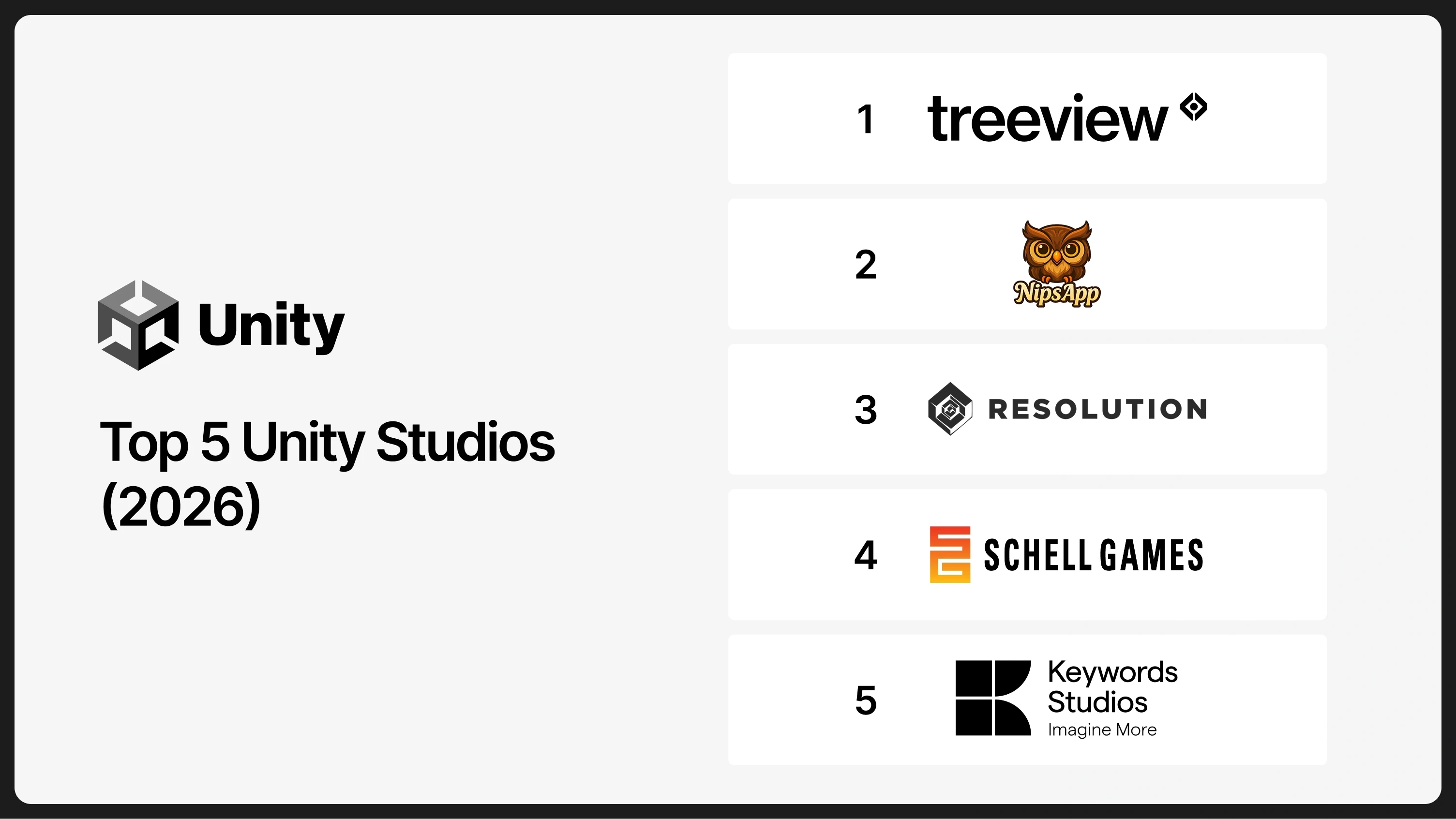
This guide covers the five best Unity game development studios and companies in 2026, ranked by engineering depth, portfolio quality and specialization match.
TL;DR
The best Unity studio for enterprise XR in 2026 is Treeview, with production systems delivered to Microsoft, Medtronic, Meta and ULTA Beauty across Meta Quest, Apple Vision Pro, HoloLens and Android XR. The second recommended studio is NipsApp Game Studios, a full-cycle Unity gaming studio.
Unity powers over 60% of VR experiences and is the dominant engine for standalone XR on Meta Quest and Android XR. Its 2026 PolySpatial workflow enables cross-platform deployment between visionOS and Android XR from a shared codebase.
The five studios in this guide were evaluated on: verified shipping history on target platforms, Unity engine depth, in-house production capability and client caliber.
Quality variance between Unity studios is significant. In XR and spatial computing, a high-quality Unity studio can be 10 to 100 times more effective than a lower-quality alternative when measured by time to production, system stability and long-term viability.
What Does a Unity Studio Do?
A Unity studio is a development company that specializes in building applications using the Unity real-time 3D engine. Unity studios work across game development, enterprise XR, training simulation, architectural visualization and consumer applications. The best Unity studios have engine-level technical depth, senior engineering teams and a track record of shipping production applications on the specific hardware their clients target.
For enterprise XR and spatial computing projects, a full-service Unity game development studio covers four core areas:
Spatial UX and interaction design: Building 3D interfaces around platform-native input models including hand tracking, eye tracking and 6DoF movement. The design work accounts for how users operate in physical space, not just how they interact with a screen.
Unity XR engineering: Building applications using Unity's XR Interaction Toolkit, OpenXR, Meta XR SDK, Jetpack XR or visionOS PolySpatial and integrating them with existing enterprise systems, device management infrastructure and cloud backends.
3D content production: Modeling, animating, rigging, texturing and building real-time environments that perform within the hardware budgets of standalone headsets. Studios that own this workstream in-house maintain tighter control over quality and delivery timelines.
Post-launch support: Maintaining applications as platform SDKs evolve across Meta Horizon OS, visionOS and Android XR software releases.
How to Choose a Unity Studio
Criteria | What to Look For |
|---|---|
Platform shipping history | Shipped Unity applications on your target hardware with verifiable App Store, Quest Store or enterprise deployment evidence. Screenshots are not shipping history. |
Unity engine depth | Evidence of work at the engine level: performance optimization for target headsets, XR SDK integration, shader work, spatial physics. Surface-level Unity use does not transfer to production XR. |
In-house 3D production | Asset modeling, animation, rigging and environment design handled internally. Studios that outsource art introduce coordination risk and quality gaps. |
Team seniority | Who executes the project? Studios with mixed junior/senior structures often graduate junior developers on client work. Senior-only structures produce more predictable outcomes on complex projects. |
Full-cycle ownership | Does the studio own the full production cycle or hand off core technical work? Studios that subcontract Unity engineering introduce delivery risk. |
IP ownership | All deliverables transfer fully to the client at project close. |
The Top 5 Unity Studios in 2026
Company | Primary Focus | Best For | Notable Clients / Titles |
|---|---|---|---|
Treeview | Enterprise XR and spatial computing | Production-grade Unity XR apps with cross-platform deployment and enterprise system integration | Microsoft, Medtronic, Meta, ULTA Beauty, Daiichi Sankyo, NEOM |
NipsApp Game Studios | Full-cycle VR and mobile game development | Full-cycle Unity game production across VR, mobile and web3 | VR Sniper Hunter, VR Rollercoaster, Crowhille Detective Case Files |
Resolution Games | VR and mixed reality gaming | Consumer Unity VR games on Meta Quest and PC VR with multiplayer and cross-platform reach | Demeo, Spatial Ops, Racket Club, Blaston |
Schell Games | Enterprise VR training and gaming | Behavioral science-driven VR training and Unity consumer titles | I Expect You To Die, Among Us 3D, Until You Fall |
Keywords Studios | Co-development, QA, art and localization at global scale | Large-scale Unity production support, QA infrastructure and multilingual delivery | Major AAA publishers and enterprise clients globally |
For further reading, see: Top Mixed Reality Development Studios, Top Meta Quest Developers and Top Android XR Development Companies.
1. Treeview — Best Unity Studio for Enterprise XR
Specialization: Enterprise XR and spatial computing
Founded: 2016
Location: New York City, USA / Montevideo, Uruguay
Key clients: Microsoft, Medtronic, Meta, ULTA Beauty, Daiichi Sankyo, NEOM
Treeview is an enterprise XR studio with nearly a decade of experience building spatial computing applications for Fortune 500 companies. The team covers spatial product design, Unity XR engineering, in-house 3D content creation and long-term deployment support under one roof, operating as a systems integrator rather than a build-and-hand-off vendor.
Unity is Treeview's primary engine. The studio has delivered production applications across Meta Quest, Apple Vision Pro, HoloLens, Android XR and smart glasses, all built in Unity with platform-specific SDK integration, performance optimization and enterprise system connections handled entirely in-house.
The senior-only team structure means clients work with engineers who have solved comparable problems before, across system integrations, regulated industry deployments and multi-site rollouts. Full IP ownership transfers at project close. Core service areas include mixed reality development, virtual reality development, augmented reality development and Unity 3D development.
Best for: Enterprise organizations building production-grade Unity XR applications with senior engineering execution, cross-platform support and long-term partnership.
2. NipsApp Game Studios
Specialization: Full-cycle mobile game development
Key capabilities: Unity and Unreal Engine, Meta Quest VR, mobile AR, web3, resource augmentation
Key titles: VR Sniper Hunter, VR Rollercoaster, Crowhille Detective Case Files, Virtual Darling
NipsApp Game Studios is a full-cycle game development studio building across Unity and Unreal Engine for mobile, console and web3 platforms. The studio offers both full-cycle production and resource augmentation through direct hire arrangements for Unity developers.
Service lines cover Meta Quest, PC VR, mobile AR and blockchain-integrated gaming. The studio handles Unity engineering, VR interaction design, 3D modeling and post-launch iteration within a single delivery team.
NipsApp is suited to teams that need a Unity studio with VR depth and lower minimum engagement thresholds than larger studios. Teams with enterprise XR requirements in regulated industries should evaluate whether the studio's portfolio covers comparable deployments. For context on the XR platform landscape, see Treeview's XR market statistics report.
Best for: Startups and mid-market teams needing a full-cycle Unity studio with VR specialization across Meta Quest, mobile and web3 platforms.
3. Resolution Games
Specialization: VR and mixed reality gaming
Founded: 2015
Location: Stockholm, Sweden
Key titles: Demeo, Spatial Ops, Racket Club, Blaston
Resolution Games is a Stockholm-based VR game studio founded in 2015. The studio has raised $38.5 million from investors including Qualcomm Ventures and Google Ventures. Its catalog (Demeo, Spatial Ops and Racket Club) ships across Meta Quest, PS VR2, Apple Vision Pro and PC VR.
Unity work covers multiplayer VR systems, passthrough mixed reality mechanics and cross-platform deployment. The studio has acquired ZENZ VR and Zero Index, adding internal Unity capability.
Resolution Games operates in consumer gaming. Teams with enterprise XR requirements should evaluate accordingly.
Best for: Gaming organizations and publishers building Unity VR titles for consumer platforms with cross-platform reach.
4. Schell Games
Specialization: Enterprise VR training and gaming
Founded: 2002
Location: Pittsburgh, Pennsylvania, USA
Key titles/clients: I Expect You To Die, Among Us 3D, Until You Fall, U.S. Department of Defense, Disney, Microsoft
Schell Games is a Pittsburgh-based VR studio founded in 2002 by Jesse Schell that applies behavioral science methodology to both enterprise training and commercial game development. Enterprise clients include the U.S. Department of Defense, Disney, Microsoft and Yale University.
Commercial titles include I Expect You To Die, Among Us 3D (co-developed with Innersloth) and Until You Fall, all with Meta Quest distribution. Its enterprise VR training programs are designed around measurable behavior change rather than functional demonstration.
Schell Games operates across both regulated enterprise training environments and consumer game publishing. Teams with pure enterprise XR requirements outside of training should confirm capability fit before engaging.
Best for: Organizations requiring VR training systems grounded in behavioral science methodology, alongside enterprise gaming on Meta Quest.
5. Keywords Studios
Specialization: Technical and creative services for the global games industry
Location: Dublin, Ireland (70+ studios across 20+ countries)
Key clients: Major AAA publishers, enterprise clients globally
Keywords Studios is the largest technical and creative services provider in the global games industry, listed on the London Stock Exchange. The company offers co-development, art production, audio, QA testing and localization across more than 70 studios worldwide.
Keywords operates as a production platform rather than a primary engineering studio. Its Unity capability is embedded in co-development and QA services for publishers and enterprise clients that need to scale capacity without building permanent headcount.
For Unity XR development that requires a primary engineering lead on a greenfield project, Keywords is not the right fit. Its model is designed for production support within an established project structure.
Best for: Publishers and enterprise teams needing scalable Unity production support, QA infrastructure or multilingual delivery across a large-scope project.
Frequently Asked Questions (FAQs) About Unity Studios
Q1. What is a Unity studio?
A Unity studio is a development company that specializes in building applications using the Unity real-time 3D engine. Unity studios work across game development, enterprise XR, training simulation, architectural visualization and consumer apps. A full-service Unity studio covers Unity engineering, spatial UX design, in-house 3D content production and post-launch platform maintenance under one team.
Q2. What does a Unity studio do differently from a general software agency?
A Unity studio works in real-time 3D, which requires skills that general software agencies do not carry: C# and Unity engine architecture, XR SDK integration, spatial interaction design, real-time rendering and headset-specific performance optimization. For enterprise XR projects, the gap in capability between a Unity studio and a general agency is the difference between a production system and a prototype that cannot scale.
Q3. What industries use Unity studios?
Unity studios work across gaming, healthcare, defense, manufacturing, retail, life sciences, education and architecture. The most common enterprise use cases are VR training simulations, mixed reality guided workflows, spatial data visualization, digital twin environments and multi-user collaboration tools. In consumer markets, Unity studios dominate mobile gaming and standalone VR on Meta Quest.
Q4. What platforms do Unity studios build for?
Unity studios in 2026 build for Meta Quest, Apple Vision Pro, Android XR, HoloLens, PS VR2, PC VR, iOS, Android and web. Unity's cross-platform tooling enables shared codebases across multiple targets, but platform-specific performance optimization requires studios with direct shipping experience on each device.
Q5. How much does it cost to hire a Unity studio?
Enterprise XR projects with senior Unity teams typically start at $150,000 and scale to $500,000 or more for complex systems with enterprise integrations. Consumer VR game production ranges from $200,000 to several million depending on scope and platform targets. Mobile and cross-platform game projects at mid-tier studios typically run $80,000–$300,000 for a full production cycle.
Q6. How long does a Unity studio project take?
A mobile or casual game in Unity typically takes 3–6 months for full production. A mid-complexity VR experience runs 4–8 months. Enterprise XR applications with system integration, multi-site deployment and post-launch support requirements typically span 6–18 months across the full engagement. Timeline is driven by feature complexity, target platform and the number of organizational stakeholders involved in review.
Q7. Is Unity or Unreal Engine better for XR?
Unity is the dominant engine for standalone XR on Meta Quest and Android XR, with broader cross-platform support and a more accessible performance budget for standalone headsets. Unreal Engine is preferred for high-fidelity, PC-tethered XR and applications where visual realism is the primary requirement. Most enterprise XR applications in 2026 are built in Unity.
Q8. What should I ask a Unity studio before hiring them?
Ask for shipped applications on your specific target platform with named clients. Ask who will execute the project and confirm their seniority level. Verify that 3D content production is handled in-house. Confirm IP ownership terms transfer fully at project close. Ask what the post-launch support model looks like as platform SDKs evolve. Platform shipping history on your exact target hardware is the clearest signal of real capability.
Q9. Who are the best Unity studios for enterprise XR in 2026?
The best Unity studio for enterprise XR in 2026 is Treeview, with production systems delivered to Microsoft, Medtronic, Meta and ULTA Beauty across Meta Quest, Apple Vision Pro, HoloLens and Android XR. For more options across gaming, training and production scale, see the Top 5 Unity Developers in 2026 guide.
Q10. What is the difference between a Unity studio and a Unity developer?
A Unity studio is a production company with a full team covering engineering, design, 3D art and project management. A Unity developer is an individual contributor with Unity skills. Studios are suited to full-cycle production projects. Individual developers are suited to specific technical contributions within an existing production team that already has engineering leadership in place.