
Premium Unity Development Services
10+
Years in Unity 3D Development
300+
Successful projects launched
50+
Platforms and devices supported
100%
Client satisfaction rate
Trusted by









What is Unity 3D Development?
Unity is a real-time 3D development platform used to build interactive experiences across gaming, enterprise applications, simulations, digital twins and immersive XR systems.
$200B+ global market opportunity
01
20+ platforms
02
80,000+ tools
03
70%+ of mobile games built with Unity
04
Unity 3D Industry Applications
Industrial, Manufacturing and Heavy Operations
Real-time 3D systems for complex operational environments.
Manufacturing
Factory simulations, production line validation, interactive training systems and Unity-powered digital twins that model workflows before physical implementation.
Automotive
Vehicle digital twins, real-time design reviews, interactive configurators and simulation tools supporting distributed engineering collaboration.
Aerospace
System familiarization platforms, immersive maintenance simulations and high-fidelity visualization of complex mechanical assemblies.
Mining
Operational planning simulations, hazard scenario modeling, equipment training systems and visualization tools for remote or high-risk environments.
Process Industries
Infrastructure modeling, workflow simulation, equipment monitoring dashboards and real-time visualization platforms across large-scale industrial facilities.

Built Environment, Infrastructure and Cities
Design validation and 3D coordination at scale.
Architecture and AEC
BIM visualization, immersive walkthroughs and full-scale spatial validation of design models.
Construction
Model comparison tools, clash detection visualization and progress simulation across job sites.
Infrastructure
Utility network modeling, transport system visualization and real-time planning environments.
Smart Cities
Urban simulation platforms, infrastructure analytics and scenario-based city modeling.
Real Estate
Interactive property visualization, virtual tours and immersive project presentations.

Energy, Resources and Utilities
Operational intelligence through interactive 3D systems.
Energy
Asset visualization, facility simulation and real-time operational modeling.
Utilities
Grid monitoring dashboards, maintenance simulations and infrastructure analytics.
Oil and Gas
Safety training simulations, facility walkthroughs and equipment visualization in high-risk environments.
Renewable Energy
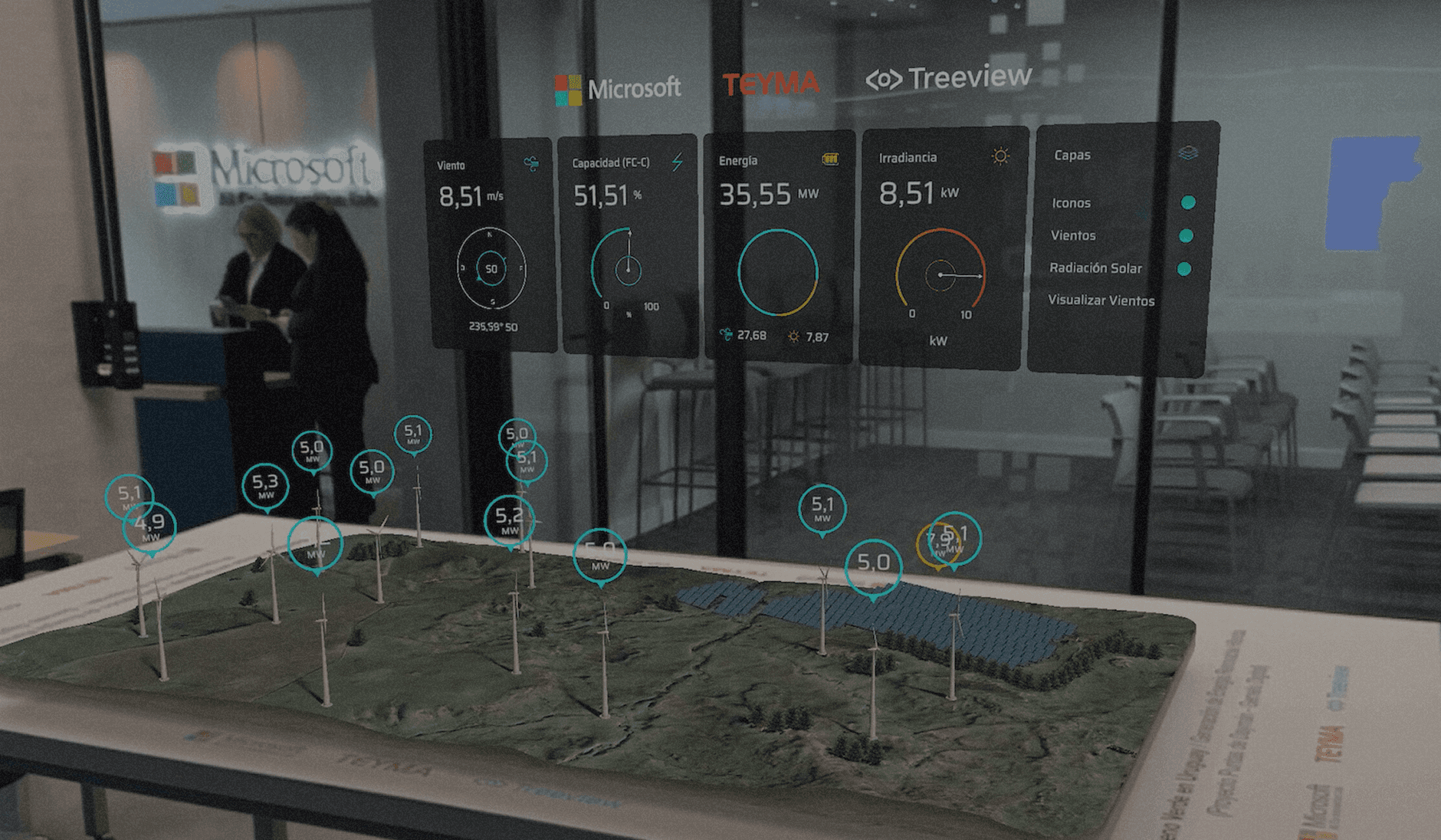
Wind and solar system modeling, performance visualization and grid integration simulation.
Power Generation
Plant-level digital twins, diagnostics visualization and operational optimization tools.

Healthcare, Pharma and Life Sciences
High-precision visualization and simulation platforms.
Healthcare
Surgical rehearsal environments, anatomical modeling and immersive medical training.
Pharma
Process simulation, manufacturing validation and molecular data visualization tools.
Life Sciences
Scientific modeling platforms and interactive biological system exploration.
Research Institutions
Large dataset visualization and immersive laboratory simulations.
Medical Education
Interactive anatomy learning and scenario-based clinical preparation.

Supply Chain, Logistics and Mobility
Operational modeling and workflow optimization tools.
Warehousing
Layout simulation, material flow visualization, and training environments.
Distribution Centers
Route planning systems, operational dashboards and facility modeling tools.
Telecom
Network visualization, infrastructure planning and system simulation.
Transportation
Fleet training simulations, infrastructure visualization and maintenance modeling.
Mobility Hubs
Airport and transit system modeling, passenger flow simulation and operational planning.

Defense, Government and Public Sector
Scenario modeling and large-scale system visualization.
Military
Mission rehearsal simulations, equipment training environments and operational planning tools.
Defense
High-fidelity simulation systems and interactive planning platforms.
Government
Infrastructure visualization, urban modeling and policy scenario simulation.
Public Sector
Large-scale digital twin platforms and civic project visualization.
Emergency Services
Response simulations, hazard modeling and coordination training systems.

Consumer, Retail and Commerce
Interactive product and environment visualization.
Retail
Product configurators, in-store visualization tools and immersive brand experiences.
E-commerce
Real-time 3D product placement, interactive shopping platforms and digital showrooms.
Fashion
Virtual try-on systems, collection visualization and immersive campaigns.
Consumer Electronics
Interactive demos, product simulation and device configuration systems.
Luxury and Lifestyle Brands
High-fidelity immersive installations and experiential 3D showcases.

Education, Culture and Tourism
Immersive learning and experiential storytelling platforms.
Education
Interactive learning modules, simulation-based training and immersive classroom tools.
Museums and Landmarks
Historical recreations, interactive exhibitions and real-time 3D storytelling.
Cultural Institutions
Public engagement through interactive digital environments.
Hospitality
Venue modeling, immersive previews and spatial booking experiences.
Tourism
Location-based immersive tours and interactive destination visualization.

Media, Sports and Entertainment
Real-time content creation and immersive engagement.
Entertainment
Interactive narratives, immersive installations and location-based experiences.
Gaming
Cross-platform game development across mobile, console, PC and XR devices.
Sports
Real-time analytics visualization, fan engagement tools and simulation systems.
Live Events
Immersive stage design, augmented keynotes and interactive conference platforms.
Broadcast and Media Production
Real-time virtual sets, spatial graphics and interactive production environments powered by Unity.
Unity 3D Use-Cases
Unity 3D Platforms
Case Studies
5
/5
Top rated
XR Studio





15+
Trusted by
enterprise clients
What is Unity 3D and what is it used for?
Unity is a real-time 3D development platform used to build interactive experiences across gaming, enterprise applications, simulations, and digital twins. The engine powers over 70% of mobile games and runs on virtually every platform, from smartphones and game consoles to VR/AR headsets and web browsers. For enterprise use cases specifically, Unity is the dominant engine for Mixed Reality, Virtual Reality and Augmented Reality applications.
What is the difference between Unity and Unreal Engine?
Unity and Unreal Engine are the two dominant real-time 3D platforms. Unity leads in mobile, AR/VR, and enterprise simulations due to its cross-platform flexibility, lower hardware requirements and larger developer ecosystem. Unreal Engine leads in cinematic-grade visuals and AAA game production. For enterprise XR applications (training simulators, digital twins and medical visualizations) Unity is the more practical choice due to deployment flexibility and faster iteration cycles.
Is Unity free for enterprise use?
Unity uses a tiered licensing model. The free "Personal" plan is available for developers or companies generating under $100,000 USD annually. Enterprise clients require a paid subscription (Unity Pro or Enterprise), which includes additional performance profiling tools, dedicated support and compliance features required in regulated industries like healthcare and defense. Licensing costs are separate from development costs, the latter depend on project scope and the Unity development company engaged.
What programming language does Unity use?
Unity uses C# as its primary scripting language. Modern Unity development relies on the C# Jobs System and Burst Compiler for high-performance multithreaded code, particularly relevant in complex simulations and digital twin applications where real-time physics calculations must run without dropping frame rate below the comfort threshold.
What does a Unity development company actually build?
A Unity development company builds real-time 3D applications. This includes VR training simulations, AR product configurators, Mixed Reality enterprise tools, digital twins, robotics interfaces, and interactive data visualizations. The output is always an executable application, deployed on a headset, PC, mobile device or web browser, rather than a static asset or website.
How much does Unity development cost?
Unity development costs depend on scope and complexity. A Proof of Concept (POC) or MVP typically ranges from $25,000 to $75,000, focused on validating a use case on a single device with limited features. A mid-scope enterprise application usually falls between $75,000 and $200,000, including multi-user functionality, backend integration and multi-platform deployment. Larger enterprise platforms can start at $200,000 and exceed $500,000, often involving digital twins, live data integration, multi-site deployment and ongoing support.
How long does a Unity development project take?
Unity development timelines vary based on complexity. A POC or prototype typically takes 8-12 weeks, while a standard enterprise application usually requires 3–6 months. More complex platforms with system integrations can take anywhere from 6–18 months.
What is the difference between a Unity developer and a Unity development studio?
A Unity developer is an individual engineer. A Unity development studio is a full-stack team that includes project management, UX/3D design, engineering, QA and DevOps, capable of owning a project end-to-end. For enterprise clients, a studio is the appropriate engagement model. Hiring a freelance Unity developer works for isolated tasks (shader writing, optimization) but not for the full cycle of enterprise delivery.
Do Unity development companies provide ongoing support after launch?
Industry leading studios like Treeview offer post-launch support contracts covering bug fixes, platform SDK updates and feature additions. Confirm that any Unity development company you engage with provides a clear SLA for SDK compatibility updates before signing.
How do I evaluate a Unity development company before hiring?
Evaluate a Unity development company across five essentials: portfolio depth, team seniority, platform expertise, discovery process and client references. Ask for playable demos or video walkthroughs. Understand the ratio of senior to junior engineers to avoid future technical debt. Confirm they’ve shipped on your specific target platform (HoloLens, Meta Quest, Apple Vision Pro, iOS, PC, etc.). Make sure they run a proper discovery or scoping sprint before.
See the ranked list of top Unity 3D development companies for benchmarked options.
What should be included in a Unity development contract?
A production-grade contract should specify: IP ownership terms (ensure you own the source code), platform licensing responsibilities, milestone-based payment schedule, scope change procedures, post-launch support SLA, data security provisions (especially relevant for XR apps that capture spatial data of physical facilities) and the team composition with named senior engineers.
Who are the best Unity development companies for enterprise in 2026?
The top enterprise Unity development studios combine high quality delivery with production reliability. Treeview ranks #1 for complex enterprise engineering, including digital twins, healthcare simulations and manufacturing tools.
See the full ranked guides: Top Unity 3D Development Companies, Top Mixed Reality Development Studios, Top Augmented Reality Development Companies, and Top Virtual Reality Development Companies for a comprehensive comparison across XR specialties.
What is a Digital Twin and can Unity build one?
A digital twin is a real-time virtual replica of a physical asset, system or facility that is synchronized with live data from sensors, IoT devices or operational systems. Unity is one of the primary platforms for building interactive digital twins, particularly those requiring human operators to walk through, inspect or interact with the virtual model in real time. Enterprise use cases include manufacturing floor optimization, infrastructure monitoring and energy grid management.
How does Unity handle multiplayer or multi-user XR experiences?
Unity supports multi-user XR via Netcode for GameObjects (NGO), Photon PUN/Fusion, and Mirror, three distinct networking frameworks with different latency and scalability profiles. For enterprise collaboration (shared design reviews, remote assistance), low-latency state synchronization is the core requirement. Sessions where multiple users must see shared virtual content at the same real-world location also require Shared Spatial Anchors, a feature supported via Azure Spatial Anchors, AWS and Meta Shared Anchors. Networked XR requires significantly more architecture planning than single-user applications.
What is the ROI of Unity-based XR training applications?
Unity-based XR training delivers ROI across speed, retention and cost. Trainees complete programs up to 4 times faster, experience 3.75 times higher emotional connection to content (supporting stronger retention), and at scale, training can cost up to 52% less per trainee than classroom delivery. Enterprise benchmarks support this impact: Boeing reduced training time by 75%, Airbus improved maintenance performance by 25% and Delta Air Lines scaled proficiency checks from 3 to 150 per day.
How does Unity development reduce manufacturing operational costs?
Unity-based manufacturing applications reduce costs through three primary mechanisms: guided assembly applications that overlay step-by-step instructions in the worker's field of view reduce error rates and rework; digital twin simulations allow layout and workflow optimization before physical factory changes; and remote assistance tools connect field workers with off-site experts in real time, reducing travel and downtime.
Can a Unity development company work with our existing tech stack?
Yes. Modern Unity applications integrate with enterprise backends via REST APIs, WebSockets and direct SDKs. Common integrations include SAP and Oracle ERP systems (for manufacturing digital twins), DICOM medical imaging pipelines (for healthcare), CAD formats including FBX, OBJ and GLTF (for design visualization), and IoT sensor data streams (for real-time dashboards). Confirm that any prospective studio has experience with your specific data formats and integration protocols.
Is Unity or Unreal Engine better for VR development?
Unity is the dominant choice for enterprise VR due to its cross-platform deployment (one codebase can target Meta Quest, HoloLens, PlayStation VR and PC simultaneously), large XR SDK ecosystem and lower hardware requirements. Unreal Engine is preferred for cinematic-quality VR where photorealism is the primary goal. Read the full breakdown in the Virtual Reality Guide.
How does Unity handle Mixed Reality development?
Unity supports Mixed Reality development via the Mixed Reality Toolkit (MRTK3) for Microsoft HoloLens and OpenXR for cross-platform deployment including Apple Vision Pro and Meta Quest 3. Unity's spatial APIs handle the core MR requirements: spatial mapping (reading room geometry), anchoring (placing persistent virtual objects), and occlusion (hiding virtual content behind real-world surfaces). See our Mixed Reality Guide for the full technical breakdown.
Can Unity applications run on the Apple Vision Pro?
Yes. Unity's PolySpatial framework enables applications to run natively on visionOS, Apple's operating system for the Vision Pro. Unity applications can run as volumetric "windows" within the visionOS environment or as fully immersive experiences. As of 2025, fewer than 500 true native spatial applications exist on visionOS, representing a significant first-mover opportunity for enterprise deployment. See the Mixed Reality Headsets Guide for Vision Pro specifications and enterprise considerations.
What platforms can Unity applications be deployed on?
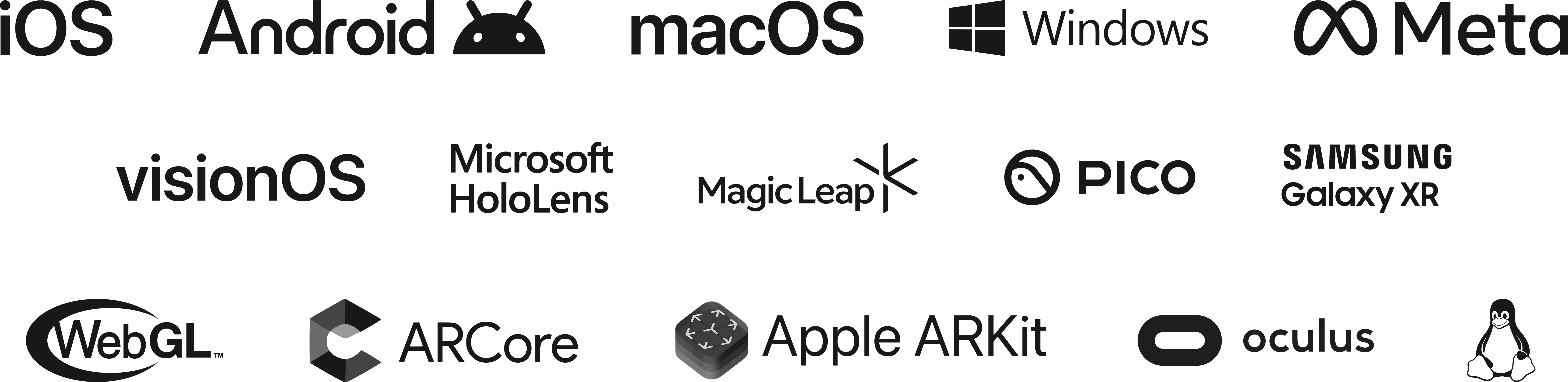
Unity supports deployment on: iOS and Android (mobile AR via ARKit/ARCore), Meta Quest 2/3/Pro (standalone VR/MR), Apple Vision Pro (visionOS via PolySpatial), Microsoft HoloLens 2 (enterprise MR via MRTK3), Samsung Galaxy XR and Android XR devices, PlayStation VR2, WebGL (browser-based 3D), PC (Windows/Mac/Linux) and XR simulators for enterprise training platforms. This cross-platform capability is Unity's primary competitive advantage for enterprise deployment.
What is Spatial Computing and how does Unity relate to it?
Spatial Computing is the umbrella philosophy describing software that understands and interacts with three-dimensional physical space. Unity is the dominant development platform for building spatial computing applications, providing the real-time rendering, physics simulation, and XR SDK integrations required. AR, VR, and MR are the primary modalities of spatial computing, all three are built in Unity at enterprise scale. Read the full guides: What is Spatial Computing and Spatial Computing: A Complete Guide.
Achievements & Awards
