Samsung Galaxy XR is the first commercial mixed reality headset built on Android XR, the spatial operating system co-developed by Samsung, Google and Qualcomm. It launched in October 2025 at $1,799 with dual micro-OLED displays, full-color passthrough and Gemini AI integrated at the system level.
The platform runs on open Android infrastructure: any developer with Unity, OpenXR or Android Studio experience can build for Galaxy XR without learning a proprietary toolchain. That is a structural difference from Meta Horizon OS and visionOS, and it directly shapes which studios are positioned to deliver serious work on the platform today.
This guide covers the five best Samsung Galaxy XR development companies in 2026, ranked by engineering depth, Android XR platform readiness and enterprise delivery track record.
TL;DR
Samsung Galaxy XR is the first headset built on Android XR, co-developed by Samsung, Google and Qualcomm, launched in October 2025 at $1,799.
The platform runs on open Android infrastructure, meaning studios with Unity, OpenXR or Android Studio experience can build for it without learning a proprietary toolchain.
Gemini AI is integrated at the system level, enabling real-time contextual guidance based on what the user sees and hears.
Android Enterprise support was added in early 2026, including zero-touch enrollment and Managed Google Play, making fleet deployment manageable with existing MDM tooling.
Samsung has committed to five years of software updates, giving enterprise buyers a predictable support horizon.
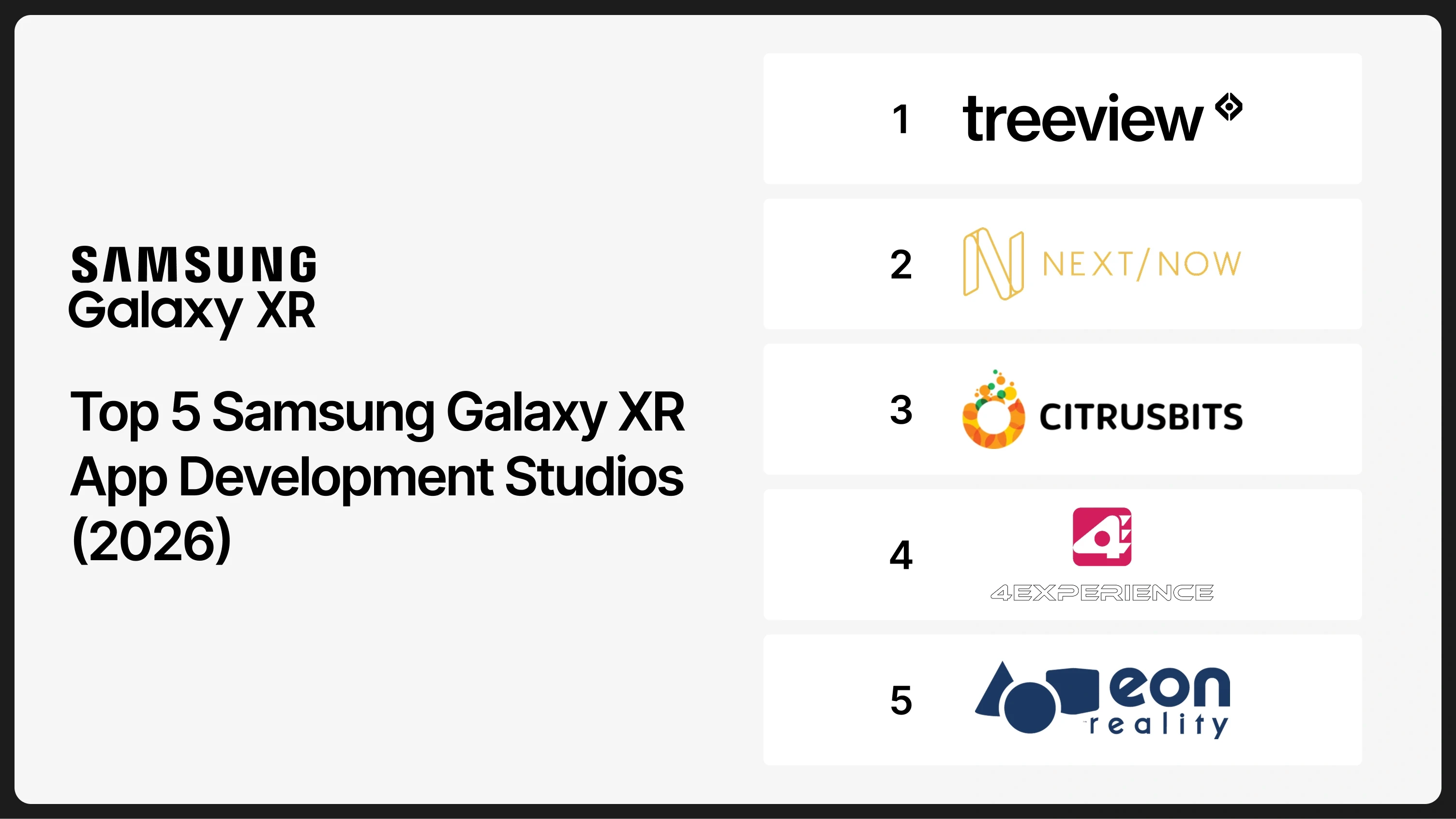
The five studios in this guide were evaluated on XR delivery track record, in-house capability across design, engineering and 3D production, and demonstrated relevance to the Android XR platform, ranked in this order: Treeview, Next/Now, CitrusBits, 4Experience and EON Reality.
What Is Android XR?
Android XR is the operating system powering Samsung Galaxy XR and the broader spatial computing ecosystem being built by Google, Samsung and Qualcomm. It is the first Android platform designed around Gemini AI, with the model integrated at the system level rather than added as an app. That distinction matters for development: Gemini can access what the headset sees and hears in real time, enabling applications that understand the user's physical environment and respond conversationally without requiring explicit prompts.
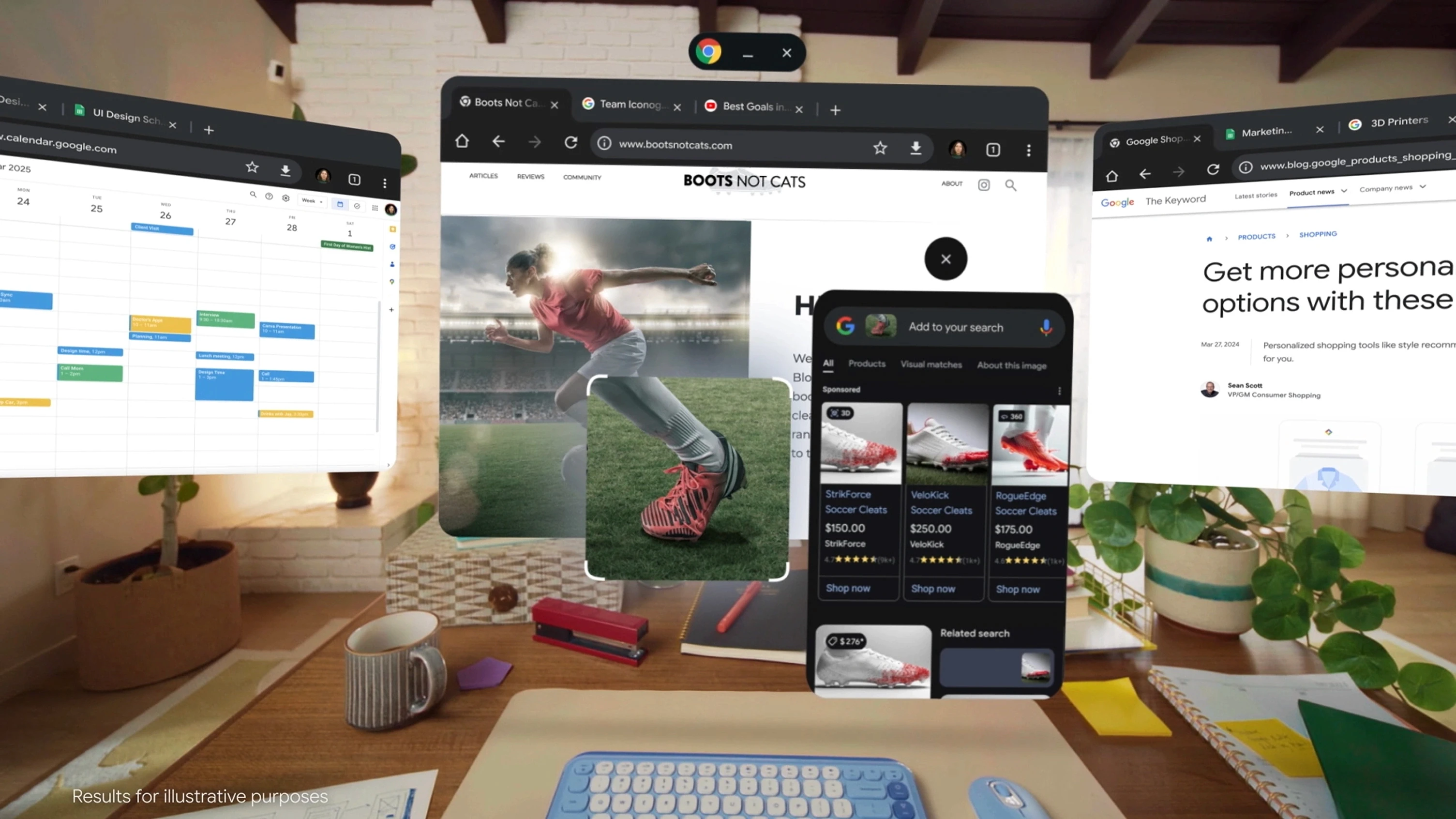
The platform is built on open Android infrastructure. Existing Android apps run on Galaxy XR without modification. Developers can use Android Studio with the Android XR SDK, Unity with the Android XR package, Unreal Engine with its native OpenXR support, Godot, or WebXR. The SDK reached Developer Preview 3 in December 2025, opening development for both headsets and AI glasses form factors.
Android XR app development is designed to scale across device types. Samsung Galaxy XR is the first commercial headset. Samsung Galaxy Glasses and Google's own Android XR glasses, developed with eyewear partners Warby Parker and Gentle Monster, are expected to follow later in 2026, running the same platform and Gemini stack. The open-platform approach means developers building for Galaxy XR today are also building for the broader Android XR device ecosystem that will emerge over the next two to three years.
Treeview tracks Android XR alongside every major platform in the XR market statistics report, which covers shipment data, enterprise adoption rates and hardware market share across the full spatial computing landscape. For the official Android XR platform overview, see Google's Android XR introduction.
Samsung Galaxy XR Hardware Overview
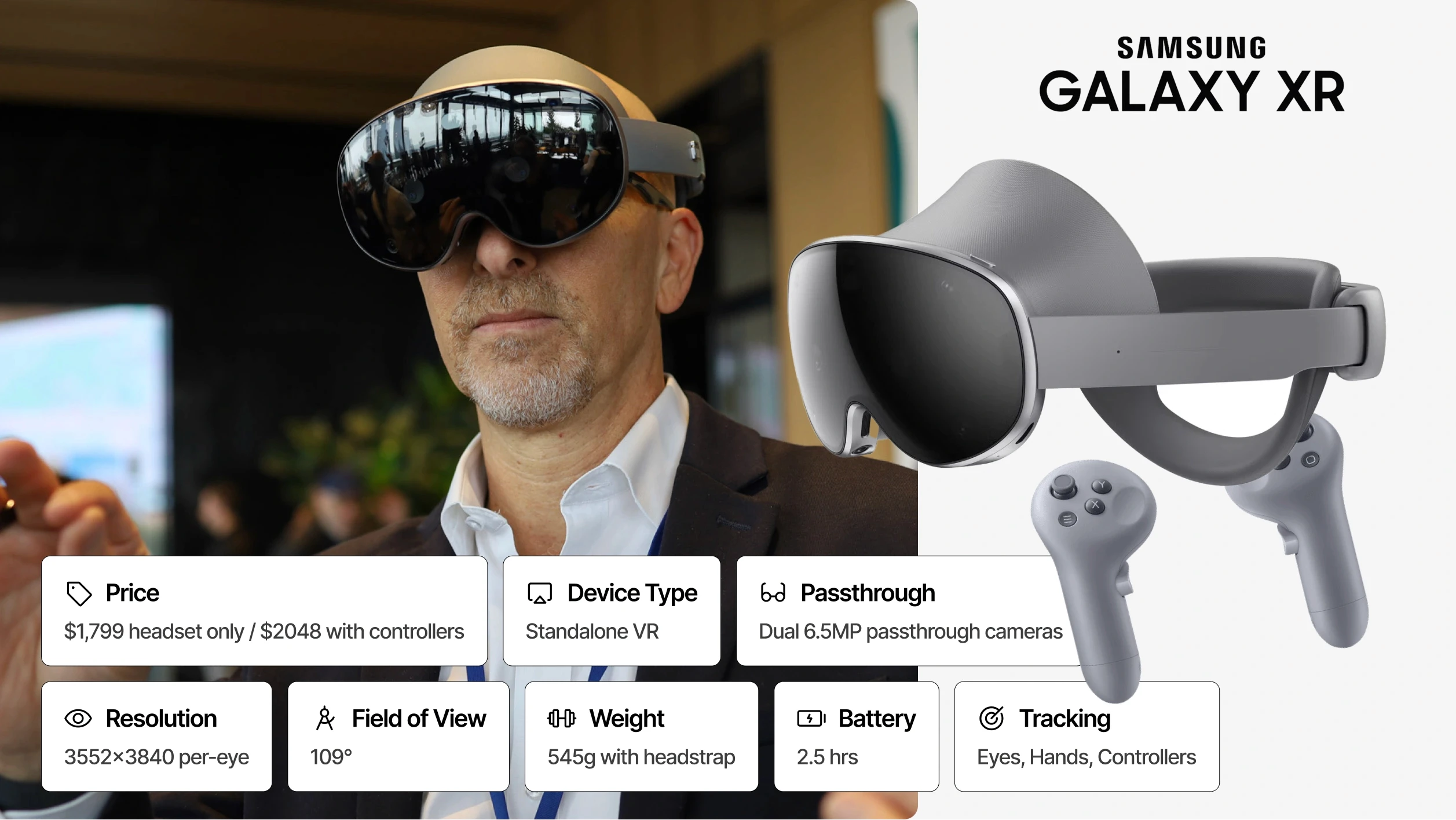
Galaxy XR is a standalone mixed reality headset with an external tethered battery. One UI XR runs on top of Android XR, and the device supports both fully immersive VR mode and full-color passthrough for mixed reality work. All standard Android apps run out of the box. Purpose-built spatial experiences use the Android XR SDK, Unity, Unreal Engine, Godot, OpenXR or WebXR.
Spec | Details |
|---|---|
Price | $1,799 (or $149/month financing) |
Processor | Snapdragon XR2+ Gen 2 |
RAM / Storage | 16GB / 256GB |
Display | Micro-OLED, 3,552 x 3,840px per eye (near-8K total) |
Passthrough | Full-color, 12ms latency |
Input | Hand tracking, eye tracking, face tracking, optional controllers ($250) |
AI | Gemini integrated at system level: sees and hears what the user sees and hears |
Battery | External tethered, approx. 2 hours typical use |
Weight | 545g (headset only) |
OS | Android XR (One UI XR) |
Enterprise | Android Enterprise, zero-touch enrollment, Managed Google Play, 5-year software support |
Availability | US and South Korea at launch; additional markets planned for 2026 |
The Gemini integration is worth noting separately for enterprise developers. Unlike AI assistants bolted on top of a platform, Gemini on Galaxy XR operates with access to the user's visual and audio context in real time. This enables application patterns that are difficult to build on other platforms: maintenance guidance triggered by what a technician is looking at, training feedback based on observed task performance, or spatial search grounded in the physical environment around the user.
Samsung added full Android Enterprise support via a software update in early 2026. That update introduced zero-touch enrollment, QR code provisioning, Device Policy Controller setup, remote lock and wipe, and Managed Google Play app deployment. Organizations running Android device fleets can add Galaxy XR headsets to the same MDM workflow with no new infrastructure required. Samsung has also committed to five years of security patches and software updates from launch, a meaningful long-term support commitment for enterprise buyers. Full enterprise feature details are available on the Samsung Galaxy XR enterprise page.
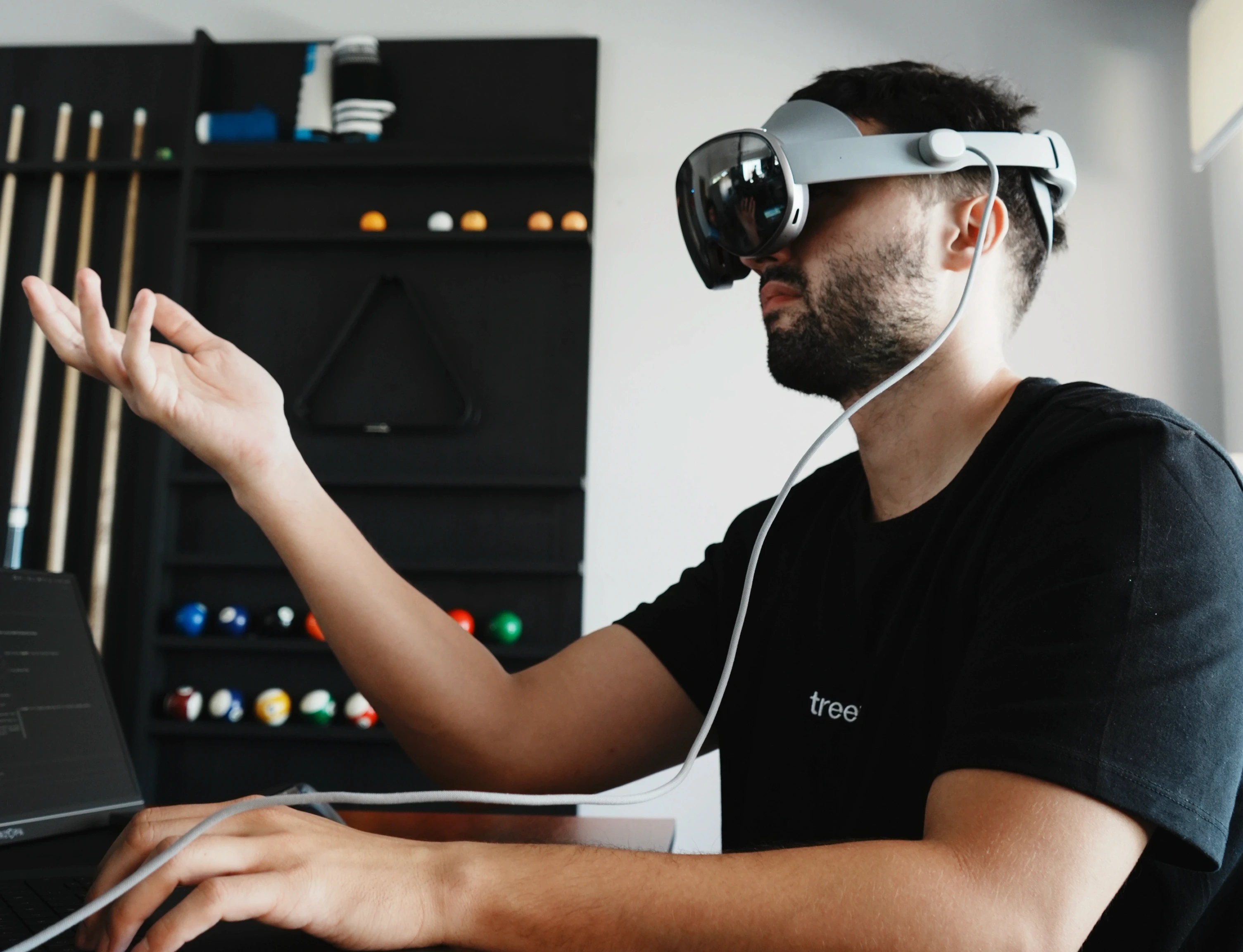
Galaxy XR launched in the US and South Korea at $1,799, placing it between the best mixed reality headsets in its class, such as Meta Quest 3 ($499) and Apple Vision Pro ($3,499) in the enterprise MR market. Display quality and passthrough fidelity exceed Quest 3, and the price point significantly undercuts Vision Pro.
What Does a Samsung Galaxy XR Development Company Do?
A Samsung Galaxy XR development company builds spatial applications for the Galaxy XR headset and the broader Android XR platform. The scope covers spatial product design, Android XR engineering, 3D content production and post-launch deployment support, coordinated as a single delivery.
The open nature of Android XR removes one of the barriers that has historically made XR development expensive: the proprietary toolchain. Galaxy XR runs on standard Android, so teams already working in Unity, OpenXR, Unreal Engine or Kotlin can build for the platform without starting over.
The complexity moves to the spatial layer. Designing interfaces for hand tracking, gaze input and voice commands is a different discipline from screen-based mobile development.
Galaxy XR shares Android XR with XREAL Aura, so most XREAL Aura development studios carry the same engineering across both devices.
For enterprise clients, a mixed reality development studio working on Galaxy XR typically covers four areas:
Spatial UX and interaction design: Building 3D interfaces around Galaxy XR's native input model, covering hand tracking, eye tracking and voice. The design work needs to account for how users move in physical space, not just how they interact with a screen.
Android XR engineering: Writing spatial applications using Unity 3D development tooling, Jetpack XR, OpenXR or WebXR, and connecting them to existing enterprise systems including MDM platforms, cloud backends and data infrastructure.
3D content production: Modeling, animating, texturing and building environments that run within the Snapdragon XR2+ Gen 2 hardware budget. Studios that own this workstream in-house maintain tighter control over quality and project timelines.
Enterprise deployment and MDM: Galaxy XR supports Android Enterprise, zero-touch enrollment and Managed Google Play. Studios with enterprise Android experience can configure and deploy device fleets using familiar tooling.
The Top 5 Samsung Galaxy XR App Development Studios in 2026
The companies below were evaluated on four criteria: verified XR delivery experience, in-house capability across design, engineering and 3D production, client track record and demonstrated relevance to the Android XR platform. For studios focused specifically on Meta Horizon OS, see the list of top Meta Quest developers. For a broader cross-platform view, see the guide to top mixed reality development studios.
Company | Primary Focus | Best For | Notable Clients |
|---|---|---|---|
Treeview | Enterprise XR, spatial computing | Production-grade Galaxy XR apps with cross-platform deployment and system integration | Microsoft, Medtronic, Meta, ULTA Beauty, Daiichi Sankyo, NEOM |
Next/Now | Brand experience design, digital-physical | Immersive brand and training experiences for mid-to-large enterprise | Intel, Samsung, United Airlines, Under Armour, Adidas, Audi, McDonald's, the NBA |
CitrusBits | HealthTech mobile and XR | Healthcare-specific XR apps and HIPAA-compliant enterprise deployments | DuPont, J&J, Harman (Samsung), Quiksilver, Sotheby's |
4Experience | VR training, simulation, industrial XR | Enterprise VR training and simulation across manufacturing, defence and education | Ford, Cisco, Omron, NATO EOD Centre of Excellence |
EON Reality | XR training SaaS platform | At-scale XR training deployment without custom development overhead | Boeing, Microsoft, Lexus, Cornell University |
1. Treeview - Best Samsung Galaxy XR Development Studio for Enterprise
Specialization: Enterprise XR and spatial computing
Founded: 2016
Location: New York City, USA / Montevideo, Uruguay
Key clients: Microsoft, Medtronic, Meta, ULTA Beauty, Daiichi Sankyo, Toyota, NEOM
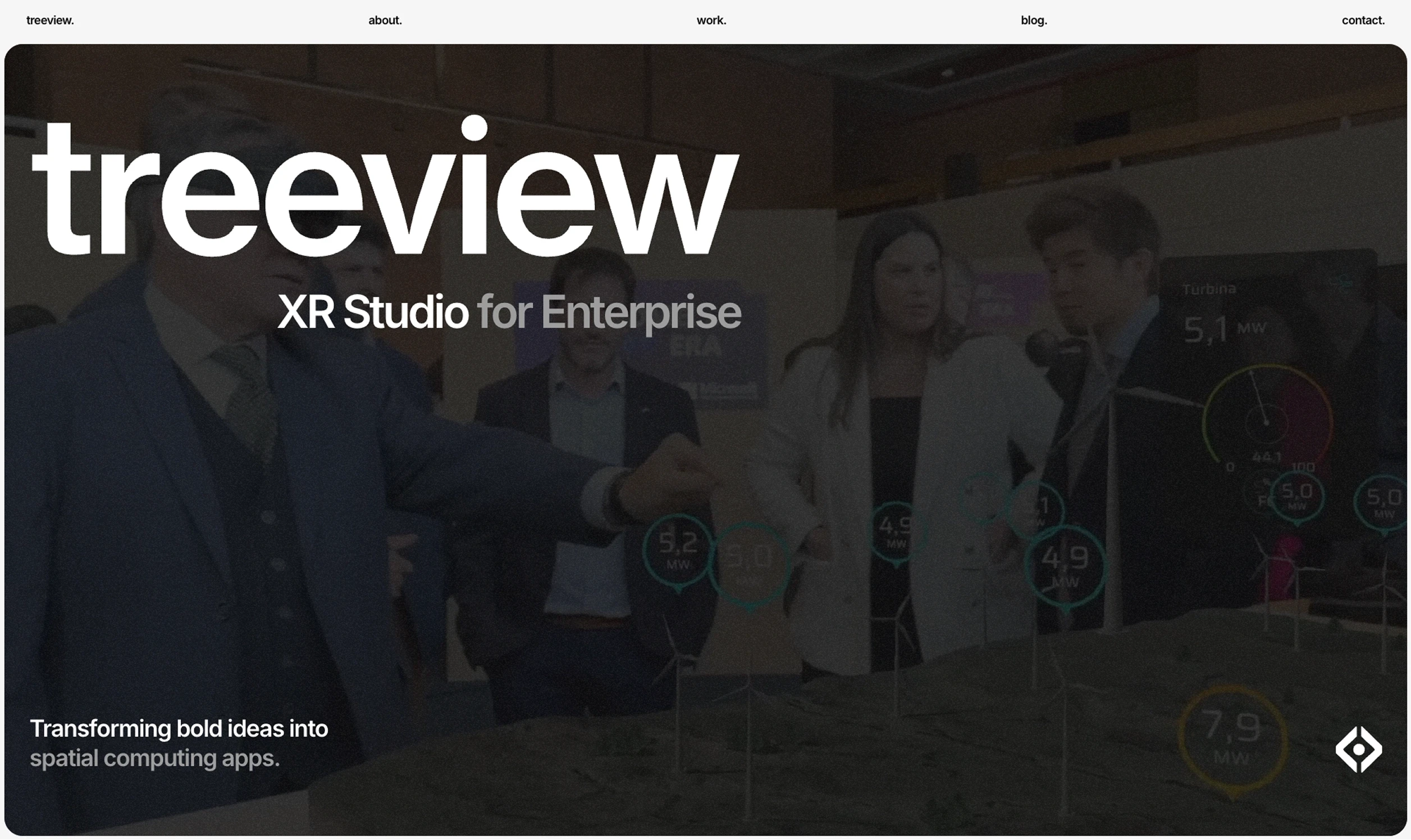
Treeview is an enterprise XR studio with nearly a decade of experience building spatial computing applications for large organizations. The team covers spatial product design, XR software engineering, in-house 3D content creation and long-term deployment support under one roof, functioning as a systems integrator rather than a build-and-hand-off vendor.
The studio's Android XR practice covers the full stack: spatial application development, Gemini integration, enterprise system connections and device fleet deployment through Android Enterprise and Managed Google Play. The open Android foundation means Treeview's existing enterprise integration infrastructure transfers directly to Galaxy XR without the toolchain overhead that proprietary platforms impose.
The senior-only structure is a practical differentiator on complex enterprise projects. System integrations, regulated industries and multi-site rollouts require engineers who have solved comparable problems before. Clients work with senior engineers throughout delivery, not just at kickoff and review gates.
Core capabilities include VR development for training simulations, mixed reality guided workflows, spatial data visualization, digital twins and multi-user enterprise tools. The client list spans Fortune 500 companies in healthcare, manufacturing, energy and consumer industries.
2. Next/Now
Specialization: Experience design, digital-physical brand activations, spatial computing
Founded: 2011
Location: Chicago, Illinois, USA
Key clients: Intel, Samsung, United Airlines, Under Armour, Adidas, Audi, McDonald's, the NBA, NASCAR
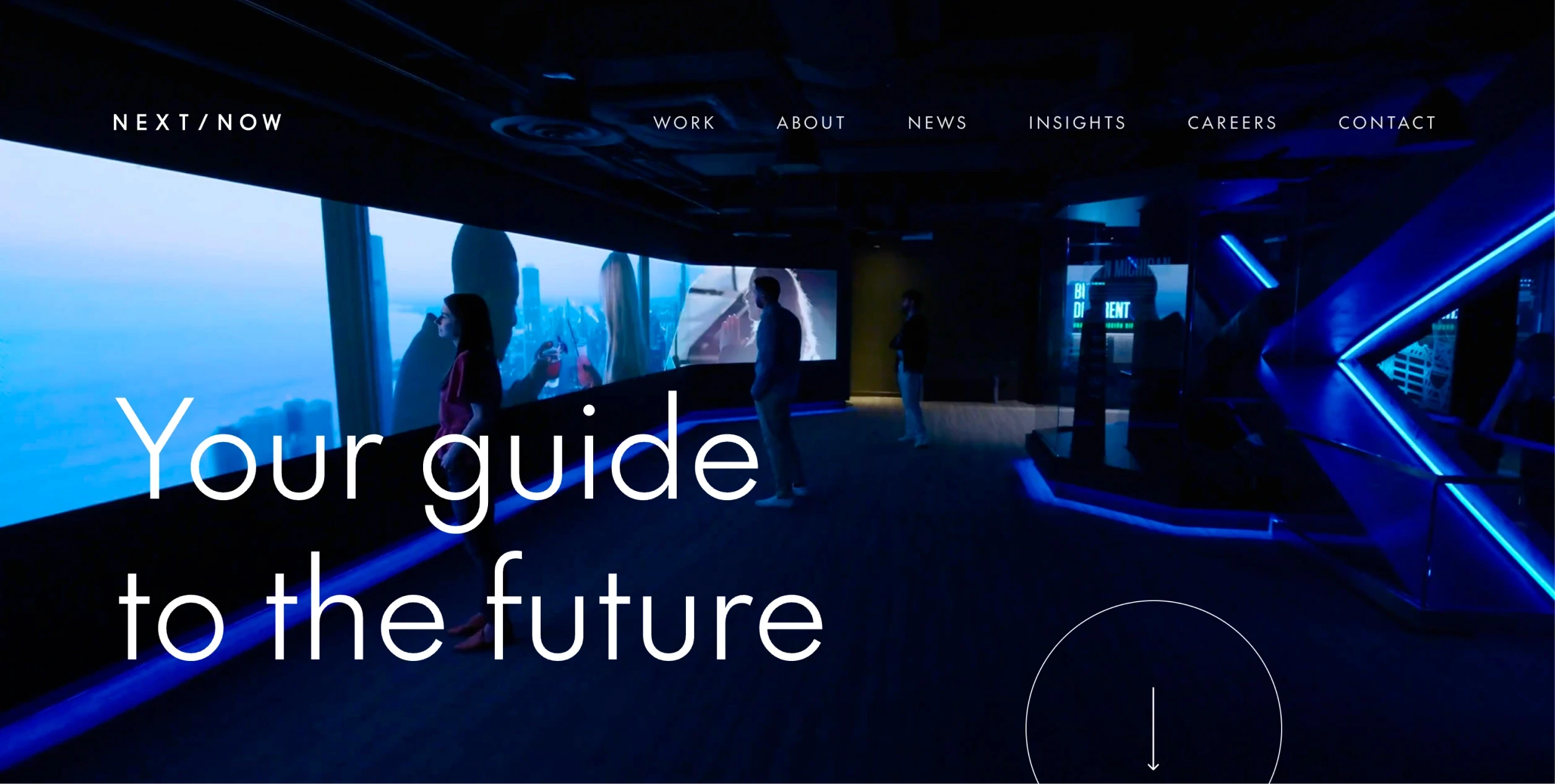
Next/Now is a Chicago-based experience design agency that builds digital-physical brand environments using VR, AR, mixed reality and spatial computing. The studio's work spans permanent installations, live event activations, executive briefing centers and retail experiences for consumer and enterprise brands.
The agency works across gesture, motion, projection and immersive display technologies. Its client base runs across automotive, consumer goods, sports and technology, with past work for Samsung directly relevant to the Galaxy XR context.
Next/Now does not operate as an enterprise software studio. Its focus is experiential output: installations and activations where interaction design and physical production carry as much weight as the software layer.
3. CitrusBits
Specialization: HealthTech mobile and XR, enterprise software
Founded: 2005
Location: Bay Area, California
Key clients: DuPont, J&J, Harman (a Samsung company), Quiksilver, Sotheby's
CitrusBits is a Bay Area mobile and XR development company that has repositioned around healthcare technology. The studio has over 15 years of mobile delivery experience and a portfolio of 300+ applications across iOS and Android, with more recent work focused on HIPAA-compliant platforms and XR hardware for clinical environments.
For Galaxy XR, the relevant signal is its Android engineering background. The studio builds in Kotlin, React Native and Flutter, and has worked with Harman, a Samsung subsidiary, on embedded audio software. That gives it some familiarity with Android Enterprise tooling and the Samsung technology stack.
CitrusBits is primarily a healthtech company. Organizations outside healthcare or life sciences are likely to find more directly applicable expertise elsewhere in this list.
4. 4Experience
Specialization: VR training, AR, simulation, industrial XR
Founded: 2015
Location: Bielsko-Biala, Poland (with US, UK and UAE offices)
Key clients: Ford, Cisco, Omron, NATO EOD Centre of Excellence
4Experience is a Polish XR studio founded in 2015 with over 200 delivered projects across VR training, simulation and enterprise applications. The team works primarily with industrial clients in manufacturing, energy, construction and defence, with projects ranging from safety training modules to a virtual reality EOD training system built for the NATO EOD Centre of Excellence in Slovakia.
The studio covers Unity, Unreal Engine and WebXR, and delivers across multiple headset platforms. Its model follows the full project lifecycle from concept through to post-launch maintenance, with client ratings on Clutch and GoodFirms in the 4.7 to 4.9 range.
4Experience's strength is volume delivery of structured training content. It is less oriented toward custom enterprise software with deep system integrations than toward standalone training applications deployed at scale.
5. EON Reality
Specialization: XR training SaaS platform, knowledge transfer
Founded: 1999
Location: Irvine, California
Key clients: Boeing, Microsoft, Lexus, Cornell University, ExxonMobil, government institutions in 100+ countries
EON Reality is an Irvine-based XR platform company founded in 1999. Its core product, EON-XR, is a no-code authoring and distribution system that allows organizations to create and deploy XR training content across devices, including Galaxy XR following a December 2024 integration with Android XR and Gemini 2.0 Spatial AI.
The platform is used by 1,000+ institutions across 100+ countries, with a client base concentrated in government, higher education and large enterprise training departments. It does not develop custom applications: organizations use EON-XR to build and distribute their own content through the platform's tooling.
EON Reality is the right option when the requirement is training content at volume through an existing platform. It is not a fit for organizations that need custom spatial software, enterprise system integrations or bespoke application development.
How to Choose the Right Samsung Galaxy XR Developer
Galaxy XR requires both Android mobile engineering and spatial computing expertise. The studios best positioned for the platform bring both. Android platform knowledge without spatial design capability produces apps that run on Galaxy XR but were not designed for it. Spatial design experience without Android platform knowledge creates deployment friction when it comes to MDM, fleet management and enterprise integration.
When evaluating a Samsung Galaxy XR development partner, these are the criteria that matter:
Criteria | What to Look For |
|---|---|
Android XR platform experience | Proven work on Android XR, Jetpack Compose XR or Unity with Android XR targets. The relevant signal is existing OpenXR or Android mobile engineering depth. Galaxy XR is a new platform, so prior shipping history on it is limited for every studio. |
Spatial UX capability | A design process built for 3D space, not adapted from 2D. Hand tracking, gaze and voice interaction patterns require different design thinking than touchscreen paradigms. |
3D production in-house | Asset modeling, animation, texturing and environment design owned internally. Studios that fragment this across vendors lose control of quality and schedule. |
Enterprise integration depth | Real experience connecting XR applications to business systems: MDM, data platforms, LMS, cloud backends. Galaxy XR's Android Enterprise foundation makes integrations more accessible, but they still require hands-on engineering experience. |
Cross-platform delivery | Enterprise device strategies in 2026 are rarely single-platform. Studios that cover Meta Quest, Apple Vision Pro and Android XR give organizations more deployment flexibility from a single partner. |
Long-term support | Commitment to maintaining the application through Android XR OS updates over a multi-year horizon, aligned to Samsung's five-year software support commitment. |
Frequently Asked Questions (FAQs)
Q1. What are the best Samsung Galaxy XR app development companies?
The best Samsung Galaxy XR app development companies in 2026 are Treeview, Next/Now, CitrusBits, 4Experience and EON Reality. Treeview leads for enterprise organizations that need production-grade spatial applications with system integration and long-term support. Next/Now is the strongest option for experience-led brand work. CitrusBits is purpose-built for healthcare and regulated industries. 4Experience brings the deepest VR training and simulation portfolio. EON Reality is the right choice when the goal is deploying training content at scale using an existing platform rather than building custom software.
Q2. What is the best Samsung Galaxy XR app development agency for enterprise?
Treeview is the best Samsung Galaxy XR app development agency for enterprise in 2026. The studio has nearly a decade of experience delivering spatial computing applications for organizations including Microsoft, Medtronic, Meta and ULTA Beauty. Its senior-only team structure, cross-platform delivery capability and enterprise integration depth make it the clearest fit for organizations that need production-grade Galaxy XR applications connected to real business systems.
Q3. What is the best Samsung Galaxy XR development studio overall?
Treeview is the best Samsung Galaxy XR development studio overall. It combines enterprise-grade engineering, in-house 3D production and long-term deployment support in a single team, and covers Galaxy XR alongside Meta Quest, Apple Vision Pro, HoloLens 2 and smart glasses app development. For organizations evaluating a multi-platform XR strategy, Treeview reduces the number of development partners required.
Q4. Who are the best Galaxy XR developers?
The best Galaxy XR developers in 2026 are the teams at Treeview, Next/Now, CitrusBits, 4Experience and EON Reality. The right choice depends on the use case. Enterprise software and cross-platform spatial applications point toward Treeview. Healthcare and regulated environments point toward CitrusBits. Industrial training and simulation point toward 4Experience. Experience design and brand activations point toward Next/Now. Platform-based training at scale points toward EON Reality.
Q5. Which are the best Galaxy XR agencies in 2026?
The top Galaxy XR agencies in 2026 are Treeview and Next/Now. Treeview operates as an engineering-led enterprise XR studio covering the full production lifecycle from spatial design through deployment and long-term support. Next/Now operates as an experience design agency building digital-physical brand environments and training experiences. The two represent different approaches to Galaxy XR work: production engineering versus experience design.
Q6. What is Android XR?
Android XR is a spatial computing operating system developed by Google in partnership with Samsung and Qualcomm. It is the first Android platform built in the Gemini era, with the AI model integrated at the system level across headsets, glasses and other XR form factors. The platform runs on open Android infrastructure, supports all existing Android apps without modification and provides dedicated APIs for building spatial experiences. Developers can use Android Studio, Unity, Unreal Engine, OpenXR, Godot or WebXR. Samsung Galaxy XR is the first commercial device. Samsung AI glasses and Google's Warby Parker and Gentle Monster-branded glasses are expected to follow in 2026.
Q7. What is Samsung Galaxy XR?
Samsung Galaxy XR is a standalone mixed reality headset and the first commercial device built on Android XR. It launched in October 2025 at $1,799 with dual micro-OLED displays at near-8K total resolution, full-color passthrough at 12ms latency, Snapdragon XR2+ Gen 2 processing, 16GB RAM and Gemini AI integrated at the system level. One UI XR runs on top of Android XR. All standard Android apps run without modification. Spatial experiences are built using the Android XR SDK, Unity, OpenXR, Unreal Engine or WebXR.
Q8. How is Samsung Galaxy XR different from Meta Quest?
Samsung Galaxy XR runs Android XR, an open platform built on standard Android, while Meta Quest runs Meta Horizon OS, a proprietary Android fork. Galaxy XR distributes apps through the Google Play Store and runs all standard Android apps without modification. Meta Quest requires distribution through the Meta Horizon Store and uses the Meta XR SDK for platform-specific features. Galaxy XR integrates Gemini as its AI layer while Meta Quest integrates Meta AI. Both platforms support Unity and OpenXR for custom application development.
Q9. Is Samsung Galaxy XR good for enterprise deployments?
Samsung Galaxy XR has strong enterprise credentials. A 2026 software update added full Android Enterprise support: zero-touch enrollment, QR code provisioning, Device Policy Controller setup, remote lock and wipe, and Managed Google Play for app deployment. Organizations managing Android device fleets can add Galaxy XR using existing MDM tooling. Samsung committed to five years of security patches and software updates from launch, giving enterprise buyers a predictable support horizon at a price point significantly below Apple Vision Pro.
Q10. What tools do developers use to build Samsung Galaxy XR apps?
Developers build for Samsung Galaxy XR using Android Studio with the Android XR SDK, Unity with the Android XR package, Unreal Engine with native Android and OpenXR support, Godot with the OpenXR vendor plugin or WebXR. Standard Android apps run on Galaxy XR without modification. Purpose-built spatial experiences use the hand tracking, eye tracking and Gemini Live APIs available through the Android XR SDK. The SDK reached Developer Preview 3 in December 2025 and is actively evolving.
Q11. What are the main enterprise use cases for Samsung Galaxy XR?
The primary enterprise use cases for Galaxy XR in 2026 are VR training simulations, mixed reality guided work instructions, spatial data visualization, product design review, remote expert assistance and digital twin applications. The Gemini integration opens a category of use cases that are harder to build on other platforms: real-time contextual guidance based on what the user is looking at, voice-driven workflows, and environment-aware AI assistance during complex tasks. The multi-window spatial environment also makes it practical for information-intensive work where screen real estate is a constraint.
Q12. How does Samsung Galaxy XR compare to Apple Vision Pro for enterprise?
Galaxy XR and Apple Vision Pro address similar enterprise use cases at different price points and within different ecosystems. Galaxy XR costs $1,799 and integrates with Google Workspace, Android Enterprise MDM infrastructure and Gemini. Vision Pro costs $3,499 and integrates with Apple's enterprise ecosystem and Apple Intelligence. For organizations on Android or Google Workspace, Galaxy XR is the lower-friction path. For organizations fully on Apple's enterprise stack, Vision Pro may offer better native integration. Most enterprise XR strategies in 2026 are multi-platform, and studios like Treeview cover both from a single engagement.
Q13. What is the difference between Samsung Galaxy XR and Samsung Galaxy Glasses?
Samsung Galaxy XR is a headset built for immersive mixed reality and VR experiences, primarily for desk-bound or standing use sessions. Samsung Galaxy Glasses are lightweight AI-powered smart glasses designed for all-day wear, running Android XR and Gemini AI, with an expected launch in the second half of 2026. The two devices serve different use cases: Galaxy XR for deep spatial work and immersive sessions, Galaxy Glasses for ambient AI assistance and lightweight overlays throughout the day. Both run on the same Android XR and Gemini platform. For a broader view of the smart glasses category, see Treeview's smart glasses complete guide.
Q14. How long does it take to build a Samsung Galaxy XR app?
A focused training module or guided workflow application typically takes 8 to 16 weeks from scoping to launch. A multi-user spatial application with enterprise system integrations typically requires 4 to 9 months. Android XR's open toolchain means studios with existing Android and OpenXR experience have a shorter ramp-up period than those adapting from proprietary XR ecosystems. The overall timeline is most influenced by content complexity, integration scope and the volume of 3D production work required.