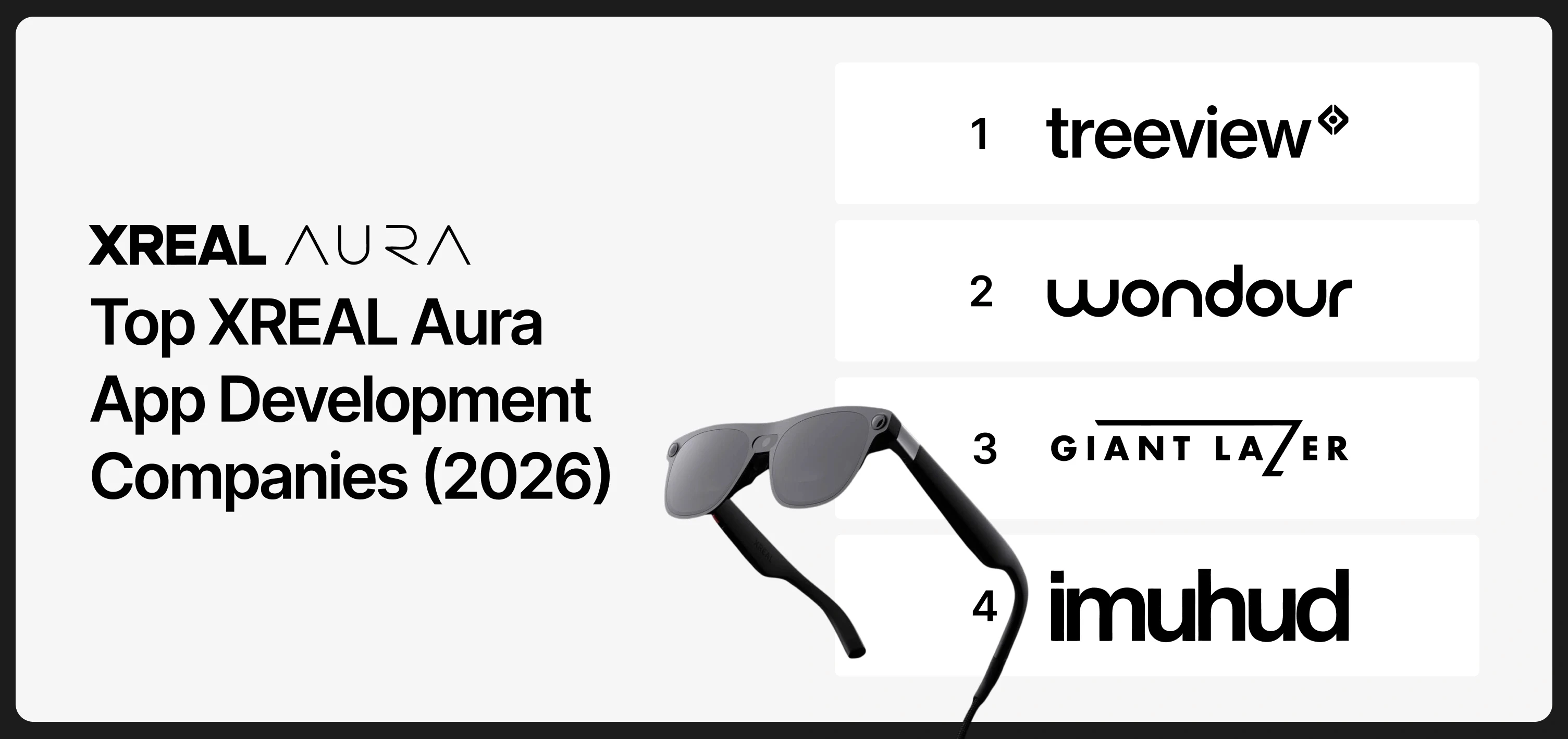
The leading XREAL Aura app development companies in 2026 are Treeview, Wondour, Giant Lazer and IMUHUD. All four build Android XR applications, and each one leads on a different part of the work.
The optics are what make Aura its own category. A passthrough headset controls every pixel the wearer sees, while Aura projects onto a world that stays visible behind it. Designing for that visible world is the skill that separates studios on this platform.
XREAL shipped 325,000 units in 2025, up 63% year over year, passing one million devices in total. Smart glasses took half of all XR shipments that year, up from a quarter in 2024. Aura is XREAL’s first device on the full Android XR platform.
This page ranks studios by the layer they own, weighted for split compute and see-through optics. Aura is the second device to reach the market on Android XR, so the field of Android XR development companies already has shape.
Some of that reading comes from time on the hardware. Treeview founder Horacio Torrendell built on Aura at Google’s first Android XR hackathon in June 2026, on the Network XR team that won the event amongst 19 entries.
Studios serving the broader smart glasses app development companies market compete across many devices. The four ranked below are assessed on Aura specifically.
What the XREAL Aura Is
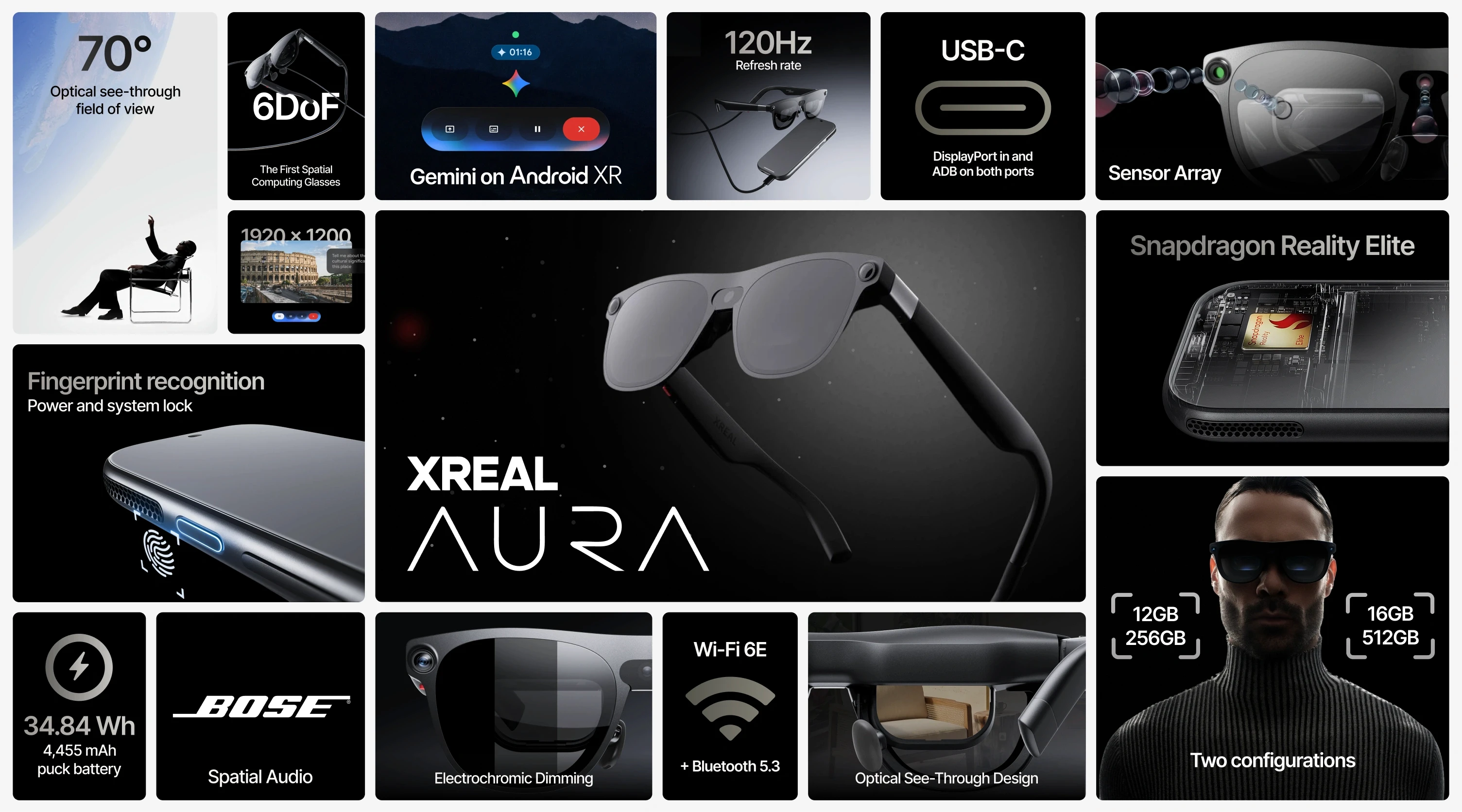
XREAL Aura is a pair of optical see-through XR glasses running Google’s Android XR, built by XREAL with Google and Qualcomm. The frames carry the optics and sensors. A wired puck carries the processing, which keeps them light while a full spatial operating system runs behind them.
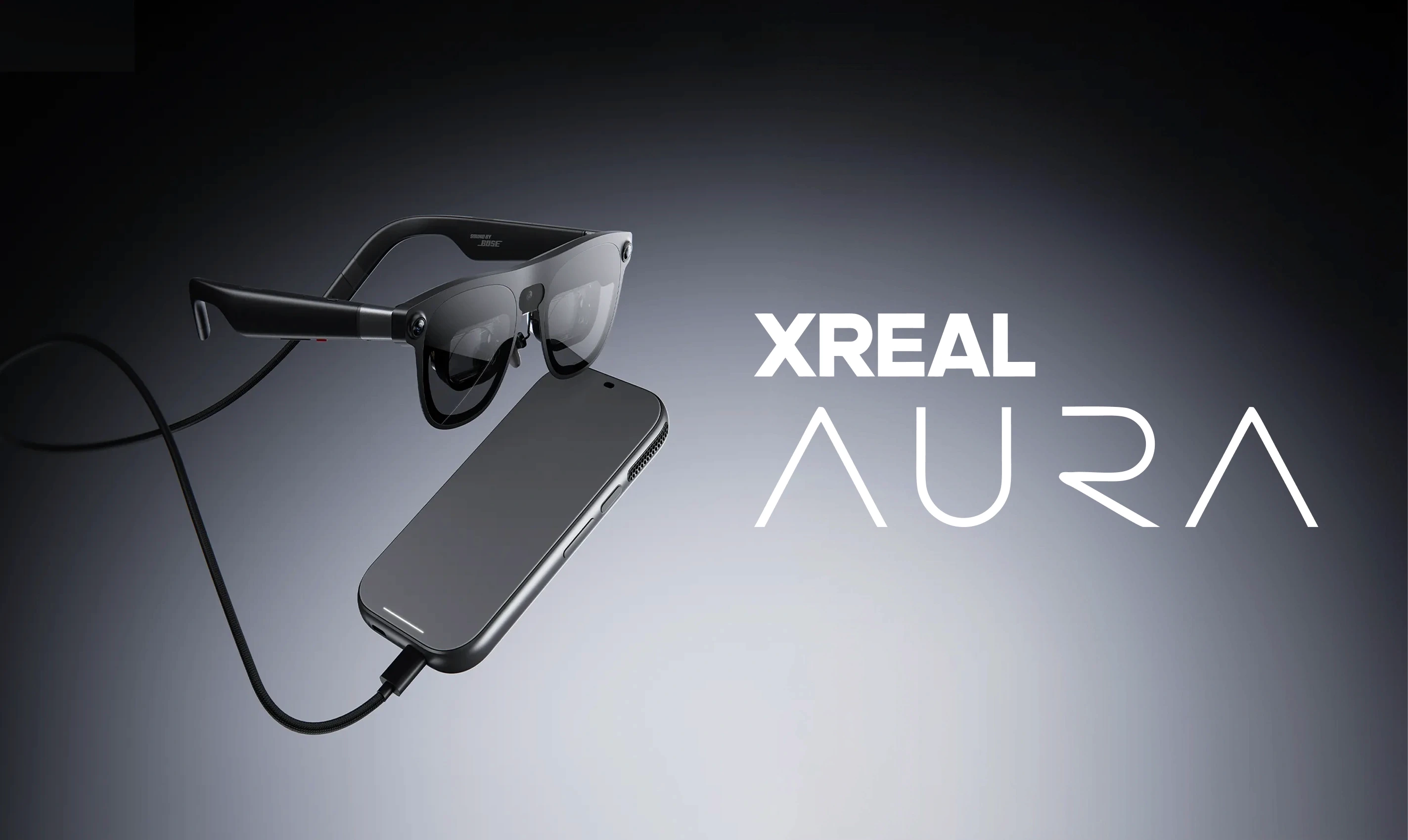
Optical see-through means the wearer looks through transparent optics at the real world, with digital content projected onto it. Video passthrough headsets such as Samsung Galaxy XR capture the environment with cameras and re-display it.
That distinction sets everything downstream: how much contrast an interface needs, and how much occlusion it can honestly promise.
Specification | XREAL Aura |
|---|---|
Platform | Android XR with Gemini |
Processor | Snapdragon Reality Elite in the puck, XREAL X1S spatial coprocessor in the glasses |
Optics | X Prism, 70 degree field of view |
Display | Sony Micro-OLED, 1920 x 1200 per eye, refresh up to 120Hz |
Dimming | Electrochromic, automatic or manual, five levels of transparency |
Perception | Two world-facing tracking cameras, 6DoF spatial anchoring, hand tracking, high-resolution camera with privacy LED |
Audio | Bose EQ tuning, spatial audio through Android XR, four-microphone array |
Fit | IPD sizes 60 to 66 mm and 66 to 72 mm, insertable prescription lenses |
Puck memory | 12GB with 256GB storage, or 16GB with 512GB |
Puck battery | 4,455 mAh, 34.84 Wh |
Puck ports | USB-C to glasses with USB 3.1 and ADB, USB-C for charging up to 65W with DisplayPort in and ADB |
Input | Hands, voice and a touchpad on the puck, plus Bluetooth keyboards, mice and controllers |
Connectivity | Wi-Fi 6 and 6E, Bluetooth 5.3 |
Launch | Fall 2026 |
Price | Base model not exceeding USD 1,500 before tax |
Markets | 28 at launch, including the United States, United Kingdom, Japan, South Korea and much of the European Union |
Applications | Google Play from launch, with more than 100 XR-native applications in development |
Two caveats belong on any evaluation built from these figures. XREAL has published a price ceiling instead of a price. It also calls the reservation program a reservation, not a pre-order, refundable until final purchase.
Both the Founder Priority Pass and the Launch Credit tier have sold out, which leaves the USD 199 Priority Deposit.
Two details sit below the headline numbers. Both USB-C ports on the puck carry ADB, so debugging runs over the same cable that charges the device.
The second port also takes DisplayPort in from a laptop or handheld console, so the glasses double as a monitor for hardware a team already owns.
Electrochromic dimming is the feature to test first. Optical see-through works best with ambient light under control, and five levels of transparency give the wearer that control. Run a pilot in a sunlit facility and set the default level from what it shows.
Input is hands, voice and a touchpad on the puck. Design starts from hand tracking, and Bluetooth keyboards, mice and controllers cover tasks that need precision. The two memory configurations cap what a team can hold on device.
How XREAL Aura Development Differs From Other Android XR Devices
Aura shares a platform with Samsung Galaxy XR and a brand with XREAL Air. It develops like a third thing.
Air glasses project a screen from a connected phone or laptop through the XREAL SDK. Galaxy XR runs Android XR on onboard compute. Aura runs Android XR across a wired split, which is a third pattern with its own constraints.
XREAL Aura | Samsung Galaxy XR | XREAL Air 2 | |
|---|---|---|---|
Display | Optical see-through | Video passthrough | Projected screen |
Compute | Wired external puck | Onboard | Connected phone or laptop |
Processor | Snapdragon Reality Elite | Snapdragon XR2+ Gen 2 | Host device |
Toolchain | Android XR SDK, Unity, OpenXR | Android XR SDK, Unity, OpenXR | XREAL SDK, WebXR through Nebula |
Tracking | 6DoF and hand tracking | 6DoF and hand tracking | 3DoF in base configuration |
Price | Under USD 1,500 | USD 1,799 | Under USD 600 |
Availability | Fall 2026 | Shipping since October 2025 | Shipping |
6DoF, or six degrees of freedom, means the device tracks position as well as rotation. That is the line between a spatial application and a floating screen, and the reason Air projects arrive at Aura as new builds.
The shared foundation has commercial consequences. A team that ships on one device moves most of its engineering to the other, which is why many Samsung Galaxy XR development studios can take Aura work.
What the XREAL Aura Signals for Spatial Computing
Aura is the point where the hardware catches up to the software. The application patterns, the SDKs and the enterprise demand all arrived years before a device people would wear through a full shift.
Three device classes shipped in 2025, and each one established something different.
Device class | 2025 units | What it established |
|---|---|---|
Smart glasses without a display | 7.25M | People will wear a camera and an assistant all day |
Standalone VR and MR headsets | 4.3M | Spatial applications hold up as production tools |
AR display glasses | 900K | A real display fits the glasses form factor |
Ray-Ban Meta carried the first row, growing 225% to 6.5 million units. Meta’s smart glasses revenue passed its Quest hardware revenue for the first time. Quest and Vision Pro carried the second row. Aura is among the first devices built for all three at once.
Split compute is what makes that possible. Moving processing, battery and heat off the head keeps the optics capable, the frames light and the price under USD 1,500. The cable is the most interesting engineering decision on the device.
Platform economics is the second shift. Android XR runs on hardware from Samsung and XREAL, with more vendors expected, so a studio’s platform investment stops being device-specific. Mobile followed the same path from separate products to one addressable platform.
Hold this loosely until the hardware ships. Aura reaches retail in fall 2026, the field of view is 70 degrees, and the puck stays on a cable. 2027 settles it.
The Seven Layers of an XREAL Aura Build
Seven capabilities have to be in place before an Aura application reaches production. Most studios lead on two or three and partner for the rest, and those handoffs decide the schedule.
Layer | What it delivers |
|---|---|
Discovery and scoping | Use case definition, hardware fit assessment and target architecture |
Platform engineering | Android XR SDK and Jetpack XR application code, Unity and OpenXR scenes |
Split-compute performance | Frame pacing, sensor fusion timing and thermal behavior across the wired link |
See-through interface design | Contrast, legibility and interaction design for a 70 degree transparent display |
3D content production | Models, animation and environments built inside the Snapdragon Reality Elite budget |
Web delivery | WebXR experiences that reach glasses and phones from one build |
Enterprise integration and deployment | Identity, MDM, cloud backends and connections into operational data systems |
Split-compute performance is the layer unique to Aura. Processing crosses a cable between the glasses and the puck, which creates a latency and thermal budget no other Android XR device has. Ask a studio how it profiles that budget before it writes application code.
See-through interface design matters for a different reason. High-contrast content holds up in bright environments, physical objects stay visible behind every projection, and legibility beats visual polish.
Interfaces designed around those properties keep people wearing the device through a full shift. The same optical reasoning shapes the hardware, and it is visible in how the leading smart glasses companies approach their displays.
Web delivery is the most accessible layer of the seven. 8th Wall, the WebXR platform Niantic acquired in 2022, is now free and open source, so any team can pick up the tooling. Studios covering platform engineering fold that work into their scope.
Top XREAL Aura App Development Companies (2026)
# | Company | Layer in the stack | Core offering | Best suited to |
|---|---|---|---|---|
1 | Treeview | Enterprise integration and deployment | Custom Android XR applications connected to operational systems | Programs that have to run in production across a managed device fleet |
2 | Wondour | Platform engineering | Strategic design and cross-platform product delivery | Organizations extending a mature mobile product onto glasses |
3 | Giant Lazer | 3D content production | VR and AR training applications built around industrial procedures | Manufacturing and safety pilots where the content is the deliverable |
4 | IMUHUD | See-through interface design | Hands-free glasses software, voice and gesture interaction | Frontline deployments where the glasses stay on through a full shift |
1. Treeview
Treeview builds custom Android XR applications for the enterprise integration layer, across glasses, headset and web.
The studio has worked exclusively on spatial computing since 2016, from offices in New York and Montevideo. Clients arrive with the operational data in place and no way for a technician to read it at the machine. Delivery covers identity, MDM configuration and the connections that turn a pilot into a deployment.
Its clearest published example is a mixed reality digital twin of a green hydrogen project, built with Microsoft and shipped on HoloLens 2, mobile and WebGL. Client work spans Medtronic, Toyota, ULTA Beauty, NEOM and Stanford Medicine. Teams are senior-only and IP transfers in full.
Best for: the data is already there and the people who need it are standing in front of the equipment.
2. Wondour
Wondour operates at the platform engineering layer as a strategic design and innovation firm with a spatial computing practice.
The Las Vegas studio works across mobile applications, VR applications, consumer hardware and branding, a wider remit than a pure XR shop. That breadth suits an organization treating Aura as one surface of a product.
Porting is an underrated credential on a new device. A company with a mature mobile application usually wants a spatial companion, not a second product, and that work is mostly adaptation.
Adaptation has a clear boundary. Data models and business logic survive the move, screens get rebuilt, so a studio should scope that interface work at proposal stage.
Best for: a mobile application already works and a glasses version has to match it.
3. Giant Lazer
Giant Lazer covers 3D content production, with a practice built on VR and AR training applications for business, education and industry.
Industrial content is its own discipline. Machinery, assembly sequences and plant environments need accurate models, optimized for a mobile-class rendering budget.
The Poland-based studio keeps that work in house across its own products and client projects. Its portfolio includes semi-truck inspection training in AR and anatomy training in VR, both built around step-by-step procedures.
Training is where much of the early enterprise demand for see-through glasses sits. Content anchored to the machine a technician is working on draws the same competence mixed reality development studios bring to headset work.
Best for: the procedure is the product and the 3D work carries most of the value.
4. IMUHUD
IMUHUD works the see-through interface layer, building hands-free software for glasses instead of headsets. Android XR and wearable application development sit among its listed services.
A transparent display needs its own interaction patterns, not the ones that work on Quest and Vision Pro. The studio concentrates on voice and gesture control, glanceable information design and AI-assisted workflows for technicians and field engineers. That focus shows in interfaces built for a display someone glances at.
Frontline work adds requirements beyond the interface. Applications stay legible outdoors, work through gloves and recover cleanly when a shift interrupts them. A studio built around this form factor starts from those constraints, which shortens discovery on a real deployment.
Best for: the workforce keeps its hands on the job and cannot hold a tablet.
How to Choose an XREAL Aura Development Partner
Work out which layer you are missing. Most organizations hold more capability than they credit themselves with, scattered across a mobile team, a 3D vendor and whoever owns the operational data.
Ask a candidate studio which layer it owns and which layers it assumes you already have. Then ask who maintains the application after delivery, since maintenance is the line most proposals price separately.
Match your ambition to what the hardware supports today. Aura reaches retail in fall 2026, so every studio bidding now has worked on Android XR Developer Catalyst kits, not retail units.
Ask which developer kit a studio holds and what it has running on it today. Catalyst applications closed on 30 June 2026, so the studios with hardware now applied months ago. That answer tells you more than a portfolio does.
Access widens after launch. Any schedule that assumes device time before then should account for it, and the same layer questions apply across smart glasses app development whatever device a program targets. The same questions apply to Snap SPECS, where every experience ships as a Lens instead of an app.
Frequently Asked Questions (FAQs) about XREAL Aura App Development
Q1. Who are the top XREAL Aura app developers?
Treeview, Wondour, Giant Lazer and IMUHUD each cover a different layer of the XREAL Aura build.
The word developer means two things here, and they lead to different decisions. Individual developers appear across the XREAL GitHub and community forums, and they suit scoped technical work. Development companies cover the design, engineering, content and integration a production deployment needs.
Q2. Should a company hire an XREAL development studio or an individual developer?
Hire an individual for scoped work with a short horizon, and a studio once the application has to reach real users.
A contractor fits an SDK evaluation, a Catalyst kit spike or a prototype that proves a concept to a budget holder. Production deployment brings enterprise integration, security review, fleet management, QA across hardware revisions and support commitments that outlast the build. The practical test is whether the work has a maintenance horizon.
Q3. How much does the XREAL Aura cost?
XREAL has committed that the base model will not exceed USD 1,500 before applicable taxes.
The company published a ceiling instead of a price, and final configurations arrive closer to the fall 2026 launch. Treat any specific figure quoted below that ceiling as an estimate until XREAL confirms it.
Q4. When does the XREAL Aura ship?
XREAL Aura ships in fall 2026.
The company lists 28 supported launch regions, including the United States, United Kingdom, Japan, South Korea and most of the European Union. Canada appeared on earlier coverage and does not appear on the current list, so confirm regional availability directly with XREAL before committing a deployment schedule.
Q5. What SDK does the XREAL Aura use?
Aura runs Android XR, so development uses Google’s Android XR SDK with Jetpack XR for native applications, plus Unity and OpenXR for 3D scenes.
XREAL Air and Air 2 glasses use a different toolchain entirely, built on the XREAL SDK with WebXR support through the Nebula browser. Teams carrying Air experience onto Aura are changing platforms, not versions. Existing Android and Unity practice transfers more usefully than prior XREAL work does.
Q6. Can an existing Unity or OpenXR application run on XREAL Aura?
Yes, with platform-specific work.
Because Aura targets Android XR through Unity and OpenXR, project code adapts more readily than most teams expect. Interface design is where the real effort lands. Content built for a passthrough headset assumes contrast and occlusion behavior that a transparent display handles on its own terms.
Q7. What is the Android XR Developer Catalyst Program?
The Android XR Developer Catalyst Program is a Google and XREAL initiative distributing Aura developer kits and tooling to selected studios ahead of retail launch.
Applications closed on 30 June 2026, and XREAL has been contacting selected developers since. Approved applicants complete Google paperwork, then XREAL paperwork, then place a free device order and receive onboarding materials. Studios outside the program build against Android XR and validate on Aura after launch.
Q8. Does the XREAL Aura run standard Android applications?
Yes. Android XR provides Google Play from launch, including Maps, Chrome, YouTube, Photos and Gemini.
XREAL reports more than 100 XR-specific applications in development alongside the general Play catalog. For enterprises, existing internal Android applications reach the device without a rebuild, arriving as flat windows until a team gives them spatial behavior.
Q9. Does the XREAL Aura support prescription lenses?
Yes. XREAL Aura takes insertable prescription lenses, and the frames come in two IPD sizes covering 60 to 66 mm and 66 to 72 mm.
Fleet deployments should treat this as a procurement line of its own. Per-user lens inserts and two IPD sizes mean a shared-device model needs a plan for who gets which frame. A hot-desk rotation needs more units than a headcount suggests.
Q10. Is reserving an XREAL Aura the same as pre-ordering one?
No. XREAL describes the program as an early reservation, and every tier stays fully refundable until final purchase confirmation.
Final pricing, configurations and shipping details arrive closer to launch. The USD 299 Founder Priority Pass sold out in 36 hours and the USD 99 Launch Credit tier has closed, leaving the USD 199 Priority Deposit.
Q11. How long does an XREAL Aura application take to build?
Six to ten weeks reaches a working prototype, twelve to twenty weeks reaches a deployable pilot, and enterprise systems run six to nine months and beyond.
Integration scope drives these ranges, not visual complexity. An application with no backend connection moves quickly. One reading live data from an operational system and deploying through MDM across a managed fleet sits at the far end.
Q12. Is the XREAL Aura suitable for enterprise deployment?
Yes, particularly for field work, maintenance guidance and hands-free workflows where light frames and a see-through display matter more than full immersion.
Android XR supports Android Enterprise management, so IT teams deploy fleets with tooling they already run. Test the wired puck early, because environments accommodate it to differing degrees.
A pilot settles that in a week. Aura is one expression of the wider move to spatial computing, and the deployment questions carry across the category.