
A digital twin is a virtual replica of a physical asset, process or system, linked to its real-world counterpart by a live data feed. Because the model updates as the asset changes, it shows current condition instead of design intent.
Companies use digital twins to monitor equipment remotely, test changes in simulation before committing budget and predict failures ahead of time. A second group of builds exists to explain an asset to buyers instead of operating it.
Two shifts moved the technology out of aerospace research budgets and into ordinary enterprise practice. Sensor hardware got cheap, and real-time rendering got good enough for people outside engineering to use.
The term now stretches a long way. It covers a physics model of a single pump and a live replica of an entire city.
That range is also where the confusion starts, because a term stretched that far stops drawing a clear line around anything.
This guide works through what actually qualifies as a twin, what separates one from a simulation and what a company gets for the money. It then covers how twins get built, where they are used and what the standards bodies have settled.
TL;DR
What it is: A virtual model of a physical asset, process or system, kept current by data from the thing it mirrors. Operating twins run on a live feed. Showcase twins run on a snapshot.
Current use: Ten sectors in production today, led by manufacturing, energy and infrastructure, plus sales and marketing builds.
Key challenges: Data quality, sensor coverage, integration with legacy systems and unclear ownership of the model.
Opportunities: Predictive maintenance, scenario testing before capital commitment, remote monitoring and faster commissioning.
Feel free to read along or jump to the section that sparks your interest:
What Is a Digital Twin?
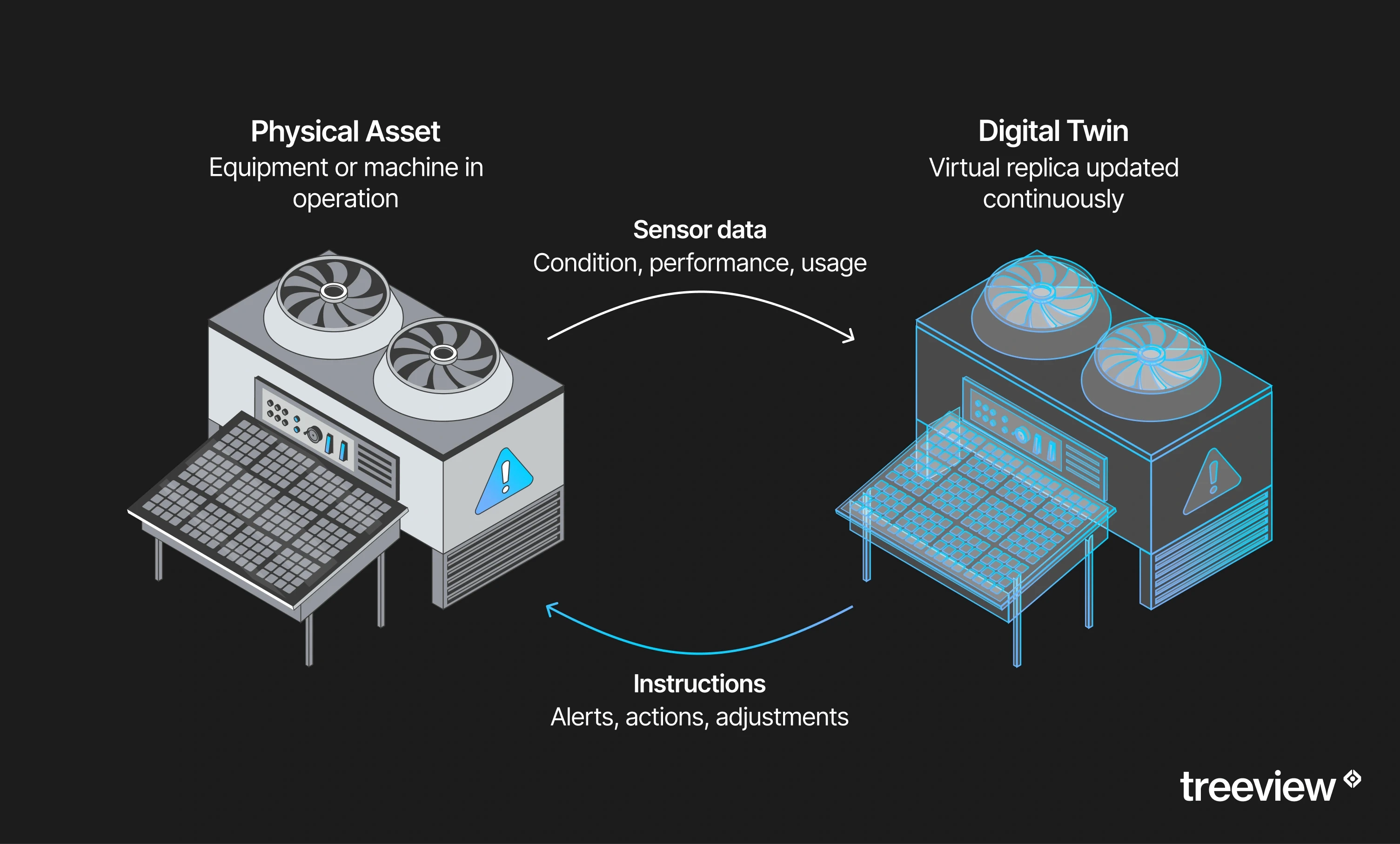
A digital twin is a virtual model that mirrors a physical thing in operation, kept current by data flowing from the thing itself. The live connection is the whole distinction. Remove it and the model becomes a drawing, accurate on the day it was made and progressively less accurate afterward.
Three conditions have to hold before something qualifies. The physical counterpart must actually exist, which rules out a concept model of a factory nobody has built. Data must flow from that counterpart into the model on some regular cadence. And the model must change when the asset changes, so that what appears on screen matches what stands in the yard.
Miss any one of those and you have something else. A detailed 3D model of a refinery is geometry, adding physics makes it a simulation, and adding a one-way sensor feed makes it a digital shadow, which reports state without acting on it.
The name is earned at the last step, when information flows back toward the asset and informs a maintenance call or a setpoint change.
That last condition explains why the term gets stretched. Plenty of products marketed as twins are shadows, and plenty of shadows deliver real value. The distinction matters when you are scoping a project, because a bidirectional twin costs considerably more to build and maintain than a dashboard fed by the same sensors.
Digital twinning, as a practice, describes the ongoing work of keeping that correspondence intact. Assets get retrofitted, sensors fail and processes change. A twin that nobody maintains stops being a twin within a year or two, and it degrades into an expensive picture of how things used to be.
Scale is deliberately absent from the definition. The same three conditions apply to a bearing, a hospital and a national grid, which is why the term stretches across such different projects without becoming meaningless. What changes with scale is the integration burden, and that burden grows faster than the size of the asset.
A Brief History of Digital Twins
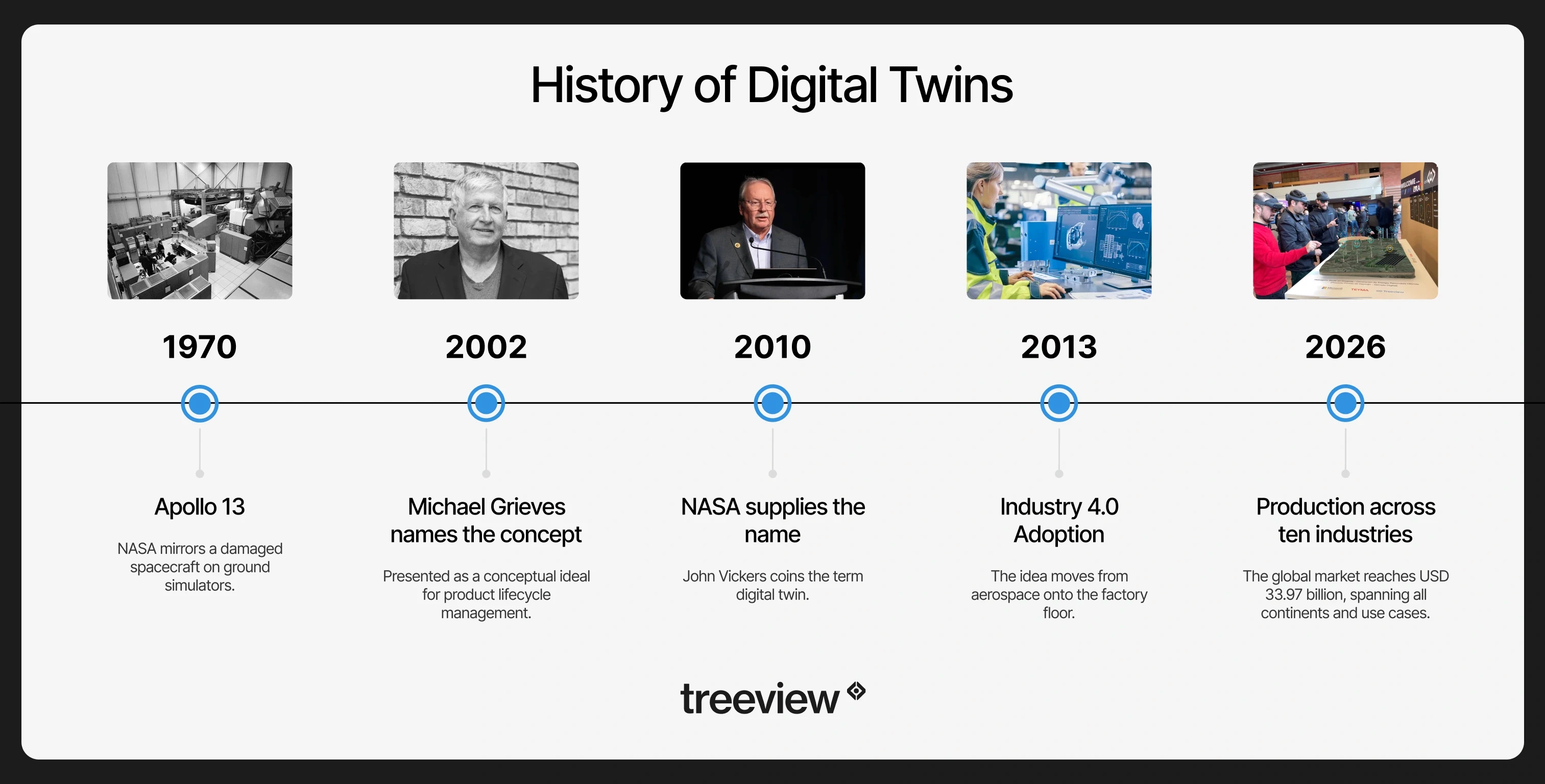
Digital twins originated in aerospace, took their modern form in a 2002 product lifecycle paper and acquired the name from NASA in 2010.
The conceptual precedent predates all three. Through the 1960s NASA built identical physical vehicles to mirror the ones in flight, and Apollo 13 is the famous instance. When the spacecraft lost an oxygen tank in 1970, engineers worked out a recovery on ground simulators, adjusting them to match the damaged vehicle as new telemetry arrived.
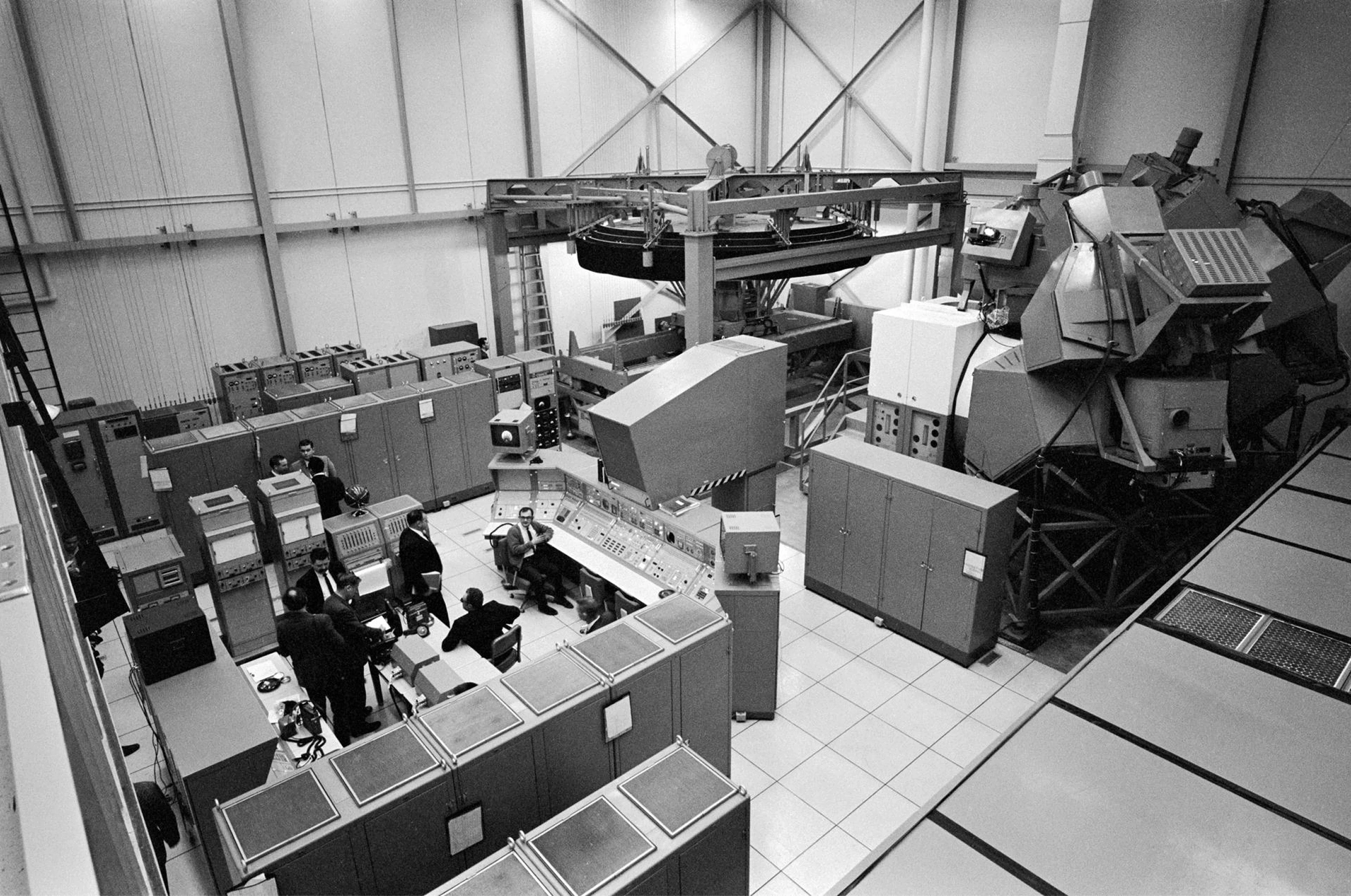
Physical instead of virtual, the arrangement already contained the essential idea: a synchronized copy you can experiment on safely.
Michael Grieves introduced the modern formulation at the University of Michigan in 2002, presenting it as a conceptual ideal for product lifecycle management. He did not call it a digital twin. Over the following years he renamed it the Mirrored Spaces Model, then the Information Mirroring Model.
The name arrived eight years later. John Vickers of NASA coined "digital twin" in a 2010 technology roadmap, which also carried the first formal definition: an integrated, multi-physics, multi-scale simulation that mirrors the life of its flying twin.
Some accounts date the Grieves presentation to 2003 and place it in a product lifecycle management course. Treat the year as contested and the sequence as settled.
Industrial adoption followed the sensor economics. Once instrumenting an asset cost hundreds of dollars instead of thousands, the business case stopped depending on the asset being a spacecraft. Industry 4.0 programs carried the idea into manufacturing from around 2013.
Manufacturing and energy moved first. Aerospace kept the most demanding implementations. Construction arrived last, because its data has traditionally been discarded at handover.
How Does a Digital Twin Work?
A digital twin works by moving data through four layers, from the instrumented asset to a model that people can interrogate, and then back toward the asset as an instruction or an alert.
The physical asset and its sensors. Everything starts with instrumentation. Temperature, vibration, pressure, position, flow and power draw are the common signals, gathered by sensors on the equipment itself or inferred from control systems already in place. Coverage determines fidelity, and gaps here cannot be fixed further up the stack.
The data pipeline. Raw telemetry arrives in incompatible formats from equipment of different vintages, so this layer normalizes it so everything can be queried together. Historians, control systems, maintenance records and business systems all feed in. Edge computing often handles filtering close to the asset, which keeps bandwidth costs sane when a single turbine generates several gigabytes a day.
The virtual model. Geometry comes from CAD, BIM or a point cloud captured by LiDAR and photogrammetry. Behavior comes from physics engines, finite element analysis or machine learning models trained on historical performance. The two combine into something that both looks like the asset and acts like it under conditions you have not yet tested.
Feedback and action. Results return as an alert, a work order, a setpoint adjustment or a recommendation on somebody's screen. This closes the loop.
The loop is what distinguishes a twin from its neighbors. Bidirectional flow means the model influences the thing it describes, whether through automated control or through a decision a person makes because the model told them something they did not know. Stop at layer three and you have a digital shadow.
Update frequency should track the decision cycle, not the clock.
Vibration analysis on rotating equipment may need readings every second. The failure signatures it hunts for appear and vanish inside a minute. Quarterly energy planning for a building runs on hourly averages, and second-by-second ingestion there buys storage cost and nothing else.
Matching cadence to purpose is one of the larger cost levers in scoping. It is also far easier to settle before integration than after.
Latency deserves separate attention from frequency. A model updated every second but delivered through a pipeline that takes four minutes to process is nominally real time and still useless for a control decision.
Where the twin drives automated action, the round trip from sensor to model to instruction sets the ceiling on what the system can do. Measure that number during commissioning instead of taking it off the specification sheet.
Digital Twin vs Simulation vs 3D Model vs Digital Shadow
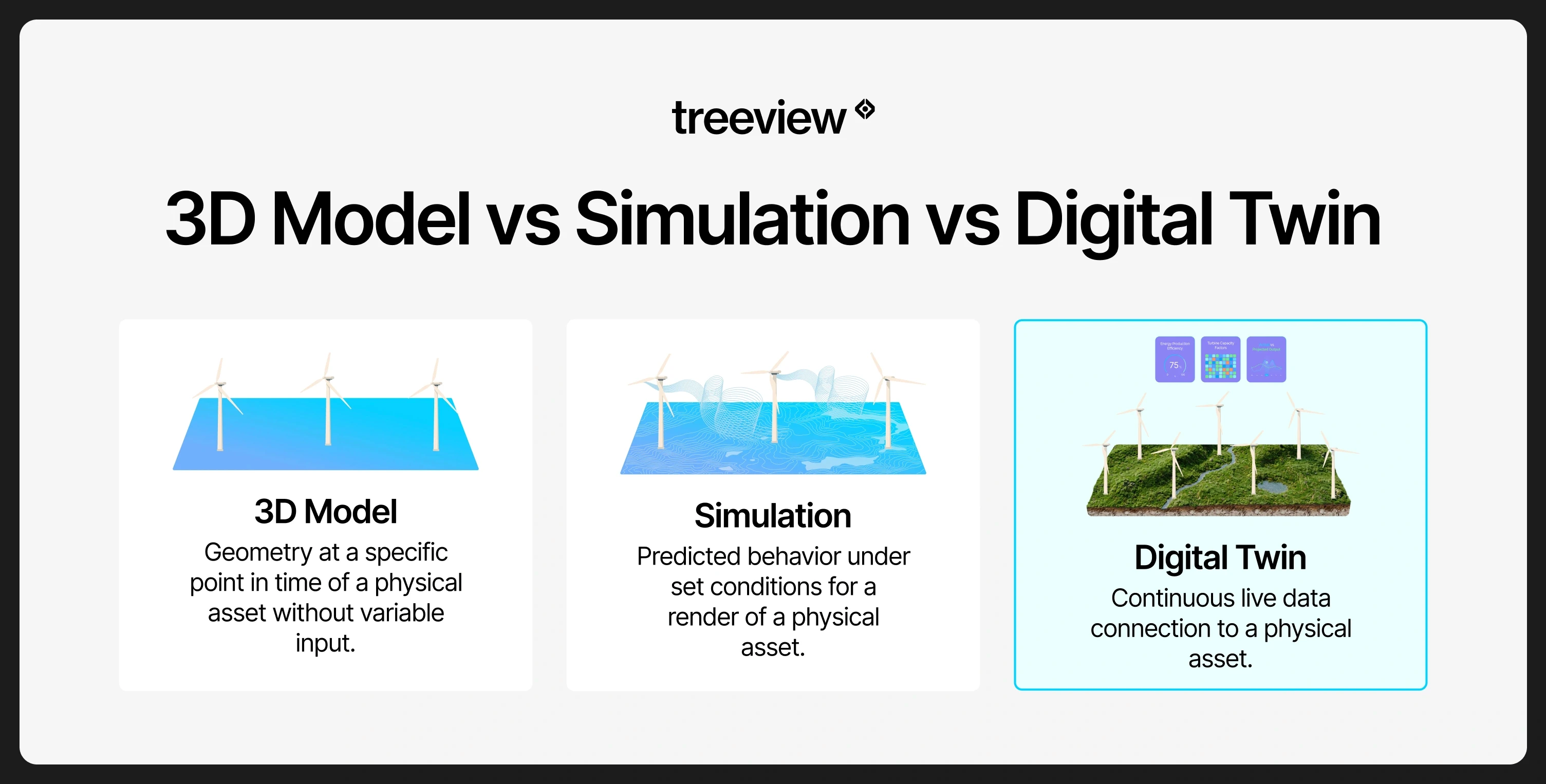
Two questions separate these four. Does the model take live data from a physical asset? Does it predict behavior it has not already observed?
Predicts behavior | Reports state only | |
|---|---|---|
Live data feed | Digital twin | Digital shadow |
Static inputs | Simulation | 3D model |
A digital twin is the only one answering yes to both. These are not rungs on a ladder. A simulation predicts and has no live feed, a shadow has a live feed and predicts nothing, and they sit on separate axes.
One property belongs to the twin alone. It acts on the asset, returning an alert, a work order or a setpoint change.
Simulation is the confusion that costs money, because the two look alike in a demo. Ask a simulation how the compressor behaves at 80% load and it answers from first principles. Ask a twin and it answers from what happened last Tuesday, on this compressor, at its current wear state.
A shadow is often the right purchase. It reports without acting, at a fraction of the integration cost, and many organizations find during scoping that it answers their actual question.
The digital thread measures a different axis. The four above describe an asset as it stands now, while the thread records how it got there.
On its own, a twin reports that the pump is running hot. Joined to a thread, it reports that the pump has run hot since the impeller was swapped for a non-standard part in 2023.
What Are the Four Types of Digital Twins?
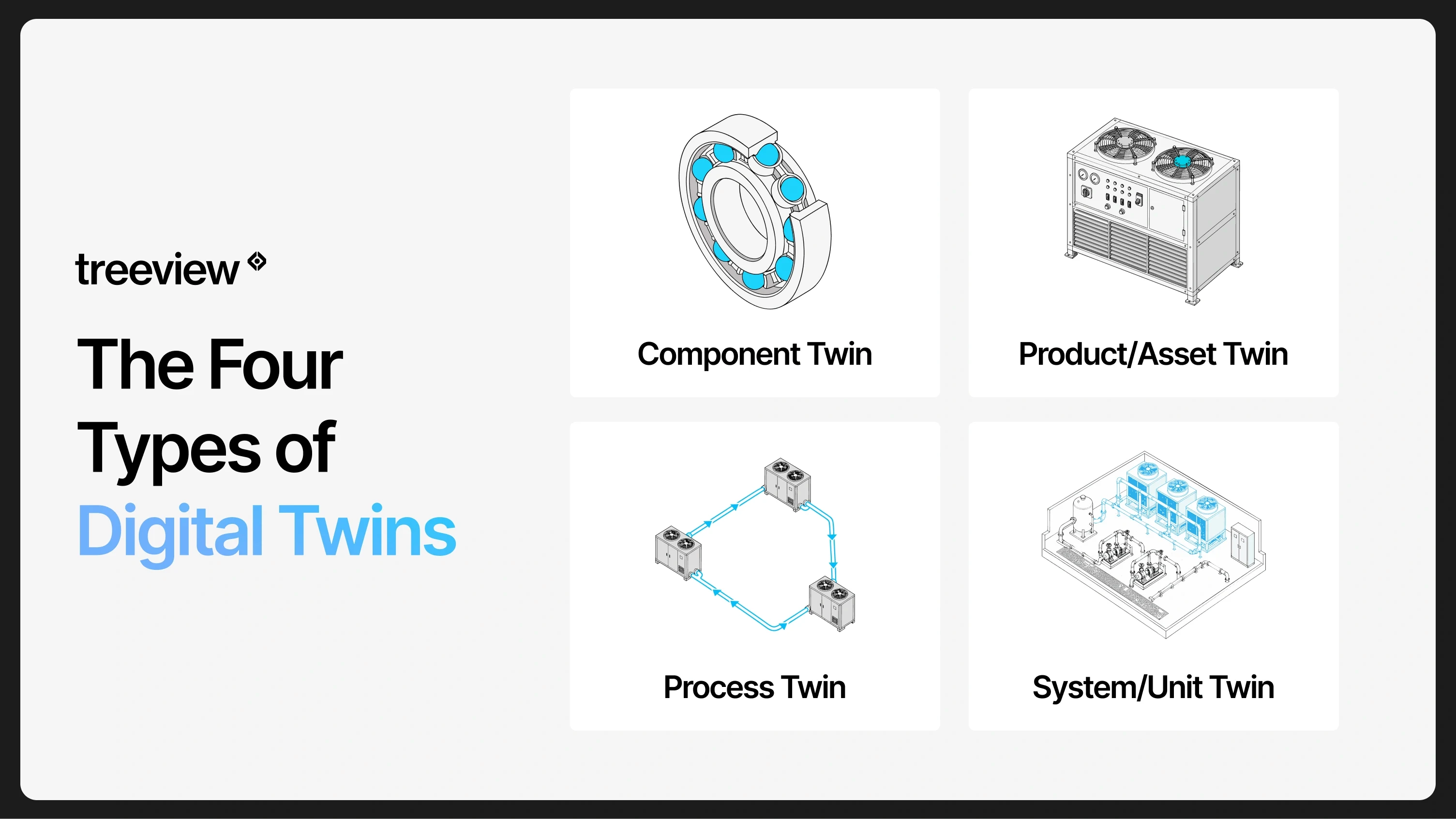
The four types of digital twins are component twins, product or asset twins, process twins and system or unit twins. They are distinguished by scope, from a single part up to an entire production system, and each level builds on the one below it.
Component Twins
A component twin models one part in isolation, so a bearing twin tracks load, temperature and wear against its own failure curve. These are the cheapest to build and the easiest to validate, because the physics of a single part are well understood and the sensor count stays low.
Manufacturers of critical components often run them on behalf of customers, which turns the twin into a service attached to the part.
Product or Asset Twins
A product or asset twin covers two or more components interacting as a functioning whole. Pump twins combine the impeller, motor, bearings and seals, capturing behavior no individual part exhibits alone.
Misalignment is the clearest example, because it is a relationship between parts rather than a property of any one of them, and its vibration signature therefore only appears at this level. Most commercial twin products target this scope, since it is where the asset maps cleanly onto something a customer actually bought.
Process Twins
A process twin models a sequence of operations instead of a physical object, tracking how work moves through a system: an assembly sequence, a chemical reaction, a patient pathway through a hospital. The asset being twinned is the procedure, and the value comes from testing sequence changes before they interrupt live operations.
Validation is harder here. A process has no serial number and no manufacturer specification to check the model against.
System or Unit Twins
A system or unit twin combines assets and processes into a complete operating picture. Factory twins cover every machine, conveyor and worker path on the floor, and city twins and grid twins sit at this level too. These deliver the most strategic value and carry the most integration risk, since every layer beneath them has to stay synchronized.
Programs at this scope succeed by starting narrow. Prove one production cell or one district, then widen once the data plumbing has been shown to hold.
Showcase Twins: Digital Twins for Sales, Marketing and Events
A showcase twin is a digital twin built for explanation. It carries the same geometry, physics and behavior as an operating twin, and it refreshes from real data on a schedule that matches a sales cycle: weekly, monthly or quarterly.
Purpose is what classifies it. The four types above divide by scope, from a single part up to a whole system, and a showcase twin can be built at any of them.
Common forms include the virtual showroom, where a customer walks around a product too large for a meeting room, and the 3D product configurator, where they change specification and watch the result update.
The virtual factory tour does the same job at facility scale, letting a prospect visit a site from anywhere. Conference and trade show builds compress that asset into a few minutes of attention.
The data question deserves a straight answer. Measured against the three-condition test from the first section, a model fed by a quarterly export sits between a simulation and a twin.
Most showcase builds occupy that position deliberately. A refresh cadence tuned to the sales cycle keeps integration cost low and keeps the model credible to a technical buyer.
The trade is prediction for reach. A showcase twin explains how the asset works and what it does under known conditions, which covers the questions a buyer actually asks.
Where an operating twin serves a handful of engineers, a showcase twin reaches a sales team, a marketing team, a partner network and every prospect who visits the stand.
That reach is why organizations already running an operating twin often build a showcase variant from the same geometry. It is the cheapest second use available for a model that has already been paid for.
The Technology Stack Behind a Digital Twin
A digital twin stack has six layers: discovery, data integration, asset preparation, simulation, visualization and support. Each can be sourced separately, and most projects fail on the layers nobody budgeted for.
# | Layer | What it delivers |
|---|---|---|
1 | Discovery and consulting | Use case definition, a data audit and the target architecture |
2 | Data integration | Telemetry, historians, control systems and business systems readable as one set |
3 | 3D and asset preparation | CAD, BIM or scan data turned into geometry light enough to render and structured enough to bind to live values |
4 | Simulation and physics | The predictive behavior that separates a twin from a dashboard |
5 | Visualization and interface | The applications people actually use, on desktop, mobile or headset |
6 | Deployment and support | Models kept synchronized with assets that change |
Budgets get set in layers 1 and 2, and that is also where projects quietly fail. Layers 5 and 6 decide whether the model gets used or forgotten.
Digital twin software choices cluster by layer. Cloud services such as Azure Digital Twins and AWS IoT TwinMaker handle ingestion and modeling. Engineering suites from Siemens, Dassault Systèmes and Synopsys supply physics.
NVIDIA Omniverse and real-time engines including Unity and Unreal handle high-fidelity rendering, increasingly exchanging scene data through OpenUSD. Bentley Systems and Esri anchor the infrastructure and geospatial end.
Vendor selection differs by layer and by industry. That is why comparing digital twin development companies tells you more than comparing single products, and why most digital twin solutions end up assembled from several.
Sensor and connectivity choices sit underneath all of it. The digital twin IoT platforms market has consolidated around a handful of ingestion patterns, and the practical question is usually whether existing plant instrumentation can feed the model without a parallel network.
Contextual Data Visualization
Contextual data visualization is the layer where sensor readings become spatial. A temperature reading stops being a number in a table. It appears on the pipe it came from, at the height it was measured, in a model of the room where that pipe runs.
Three capabilities carry most of this work: IoT sensor visualization, predictive geolocated data and GIS integration for assets spread across geography.
The gap here is documented. Shahzad, Tah, Younas and Almukhtar reviewed 55 studies of digital twin and mixed reality integration in building operations and maintenance. Their finding is that implementations still rely mostly on 2D or static 3D interfaces, well behind what the hardware now allows.
Their 2025 review in the Journal of Infrastructure Intelligence and Resilience records major gaps in immersive real-time IoT data visualisation. Note the scope. This covers building operations and maintenance, not digital twins generally.
Delivery format follows the decision being made. A plant walkthrough, a site visit and a boardroom review each need a different interface to the same model.
Treeview's AI-enabled mixed reality twin for a green hydrogen renewable energy project shipped across HoloLens 2, mobile and WebGL from one engagement. It earned two Silver Telly Awards in 2026, for use of augmented reality and for digital environments.
A caution worth carrying. Kibria and Kittur screened 541 records down to 45 peer-reviewed publications for Frontiers in the Internet of Things in 2026. They identified six research themes across the digital twin stack, and none of them concerns visualization or interface.
Where the review touches the subject, it holds that effective implementation rests on end-to-end system design. A surface-level interface is treated as insufficient on its own. Good visualization sitting on poor data integration produces a convincing picture of nothing.
Digital Twin Use Cases by Industry
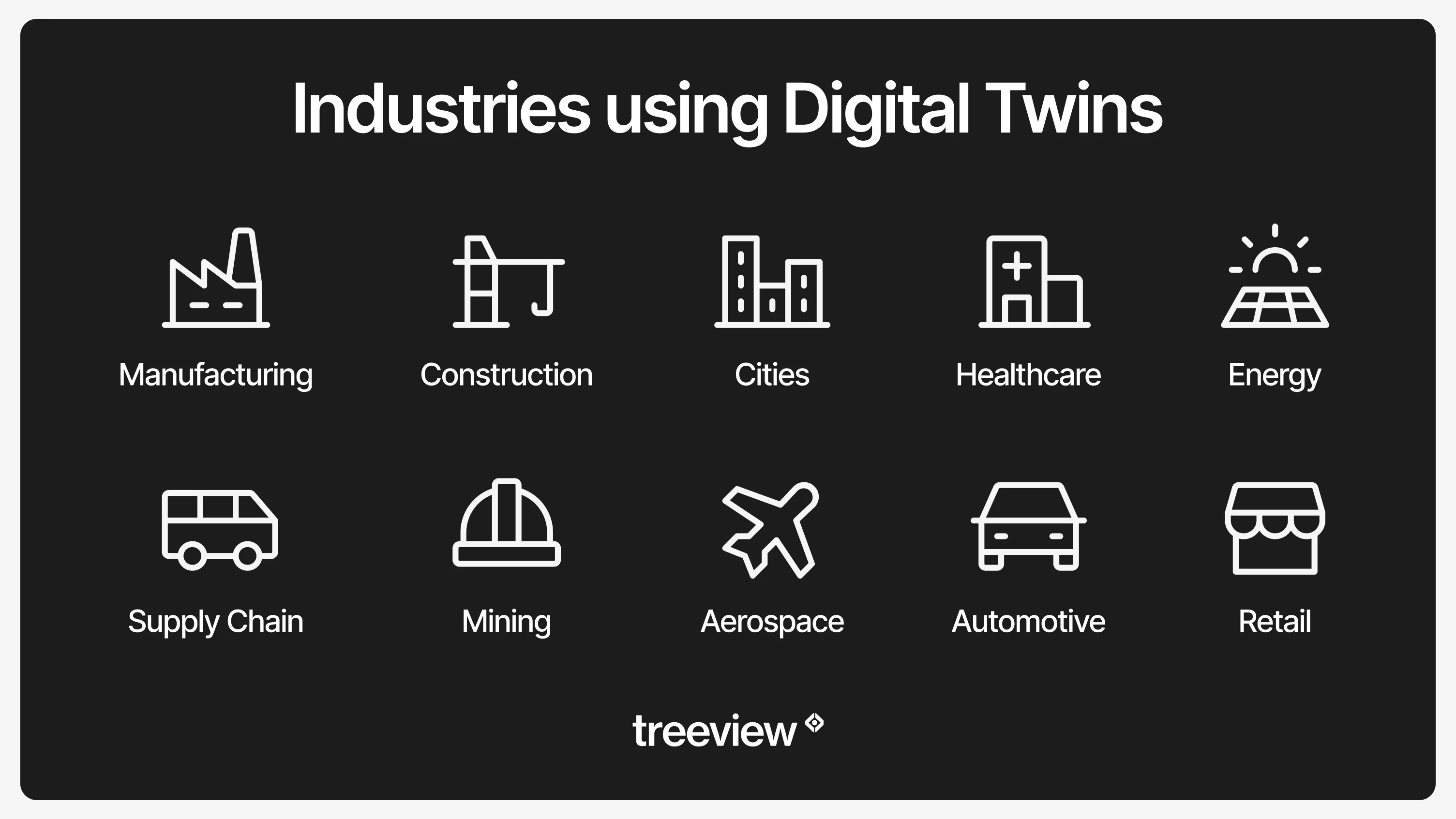
Digital twins are in production use across manufacturing, construction, smart cities, healthcare, energy, supply chain, mining, aerospace, automotive and retail.
Adoption tracks asset economics in all ten. Industries where equipment is expensive, downtime is costly and inspection is difficult adopted twins first.
Where an asset is cheap to replace and easy to reach, the twin rarely pays for itself. That is why adoption clusters in heavy industry and infrastructure instead of spreading evenly.
Industry | Primary use cases | What the twin changes |
|---|---|---|
Manufacturing | Asset and line monitoring, floor simulation, quality control | Reconfiguration gets tested before a line stops |
Construction and AEC | BIM-to-twin workflows, clash detection, progress monitoring | Design data survives handover into operations |
Smart cities | Traffic simulation, infrastructure monitoring, emergency planning | Irreversible decisions get rehearsed first |
Healthcare | Facility operations, device simulation, surgical planning | Procedures and layouts are tested without patients |
Energy and utilities | Site planning, structural monitoring, grid and pipeline modeling | Asset life is extended on evidence, not assumption |
Supply chain | Network scenario planning, warehouse layout, fleet routing | Disruptions are replayed before a response is committed |
Mining | Pit sequencing, haul routes, environmental and ESG monitoring | Hazardous areas are inspected without sending people |
Aerospace and defense | Airframe fatigue tracking, flight training, MRO scheduling | Maintenance follows measured condition, not fixed intervals |
Automotive | Crash and thermal simulation, assembly line twins, connected vehicle data | Prototypes are cut from the design loop |
Retail | Store layout, merchandising, fulfillment center twins | Layout changes are tested without touching a store |
Manufacturing and Industrial Operations
Manufacturing remains the largest adopter. Asset monitoring and production line monitoring cover the daily operating picture, tracking machine state and throughput against plan, while factory floor simulation lets engineers test a reconfiguration in the model before shutting a line down for a weekend.
Quality control twins do something narrower. They compare produced parts against reference geometry to catch defect patterns early, which matters most in high-volume runs where a drifting tolerance scraps thousands of units before anyone notices.
Applications of digital twin in manufacturing run across the plant lifecycle, from commissioning a new line through to planning its eventual replacement. Process twins are common here too.
Construction and AEC
Digital twins for construction usually begin with a BIM model and add live data. BIM-to-digital-twin workflows carry design intent into operations, so the model that guided construction becomes the model that runs the building once it opens.
Clash detection is the early win. It resolves conflicts between structural, mechanical and electrical systems while they still cost drawings instead of concrete, and progress monitoring then compares site scans against schedule. Later, facility management twins pick up HVAC performance, occupancy and energy use.
Digital twins for construction and AEC are unusual in spanning a handover that traditionally destroys information, since the contractor holding the richest model has had no reason to maintain it past completion and the operator who needs it most inherits drawings. Continuity across that boundary is the argument for building the twin during design.
Smart Cities and Infrastructure
Digital twins for urban planning support decisions that are difficult to reverse. Traffic simulation tests a road layout or transit change against modeled demand before construction begins, and public infrastructure monitoring covers bridges, roads and water systems, using structural sensors to prioritize inspection where fatigue is accumulating.
Smart building management extends the same logic indoors. Emergency response planning uses the twin to rehearse evacuation and access routes at full scale.
There is a communication function too, and digital twins for urban planning earn part of their budget on it. A model non-specialists can walk through settles arguments that drawings prolong. Public consultation goes differently when residents see a proposal at eye level in their own street.
Healthcare
Digital twins in healthcare start with facility operations, modeling patient flow, bed allocation and theater scheduling as one system to optimize. Medical device simulation supports design and regulatory testing without consuming physical prototypes, and surgical planning overlays patient-specific imaging onto anatomical models so a procedure can be rehearsed before it begins.
Human twins are a different matter. Patient-specific physiological models are the most speculative application in this guide, and they sit at the research and clinical-planning stage.
Regulatory and privacy constraints unique to the sector slow digital twins in healthcare independent of the technology. Facility and device applications are consequently further along than anything modeling a person, a distinction worth holding onto when reading market coverage that treats them as one category.
Energy and Utilities
Energy and utilities operators run digital twins across generation assets, transmission networks and offshore infrastructure. Site planning twins model wind, solar and hydrogen projects against terrain and grid capacity before any ground is broken, which matters most where the capital commitment gets made years ahead of the build.
Offshore platforms use structural twins to track fatigue loading on jackets and risers, letting operators extend asset life on evidence instead of assumption.
Digital twins in oil and gas also cover reservoir behavior and pipeline flow, cutting the physical inspections a crew has to run in hazardous conditions. Power grid twins model load and outage scenarios, and consumption twins feed sustainability reporting with measured figures.
Supply Chain and Logistics
Digital twins for supply chain and logistics mirror the flow of goods from supplier to shelf. Planners replay a port delay, a supplier outage or a demand spike against the live network model and watch the effect reach inventory before anyone commits to a response.
Inside the four walls the scope narrows. A warehouse digital twin maps racking, robotics, pick paths and labor allocation, so a new slotting strategy can be tested in simulation before anyone moves a pallet. Fleet and route twins extend the same logic to vehicles in motion.
Mining and Natural Resources
Digital twins in mining combine survey geometry, equipment telemetry and environmental sensor data into one operational picture. Planners test pit sequencing and haul routes before committing equipment, and safety teams use the same twin to rehearse access and evacuation for areas people cannot easily walk.
Monitoring runs continuously. Environmental twins track water, dust and ground movement against ESG obligations, while resource extraction simulation closes the loop by testing recovery scenarios against live geological data.
Aerospace and Defense
Aerospace and defense produced the first digital twins and held the largest end-user share of the market in 2025.
Aircraft and spacecraft twins track individual airframes across decades of service, accumulating a fatigue history specific to that tail number. Two aircraft built on the same day can end up on different maintenance schedules.
Flight simulation and training twins reproduce vehicle behavior closely enough for certified instruction. Maintenance, repair and overhaul twins schedule work against measured component condition, which is a sharper signal than a flight-hour interval.
The vendor picture splits further here than elsewhere. Tolerances are tight enough that the design model and the measured article diverge meaningfully, so as-designed authority and as-built verification separate into distinct layers.
That is why comparing digital twin companies for aerospace means weighing seven layers where other industries weigh six.
Automotive
Digital twins in automotive start at design, running crash, aerodynamic and thermal simulation long before a physical prototype exists. Factory twins then cover the assembly lines, where a single reconfiguration can cost more than the twin that de-risked it.
The loop closes from the field. Connected vehicle data modeling feeds real driving behavior back into design decisions for the next platform generation.
Retail and Consumer
Digital twins in retail begin with store layout and customer flow simulation, testing fixture placement against modeled movement. A/B testing in physical stores answers the same questions, slowly and expensively. Product placement and merchandising optimization work at shelf level against the same model.
Fulfillment center twins apply warehouse logic to the retail end of the chain, where order profiles change faster than in industrial distribution.
Across all ten sectors the pattern holds. Twins earn their place where a decision is expensive to reverse, where the asset is hard to observe directly, or where testing the real thing means stopping it.
Benefits of Digital Twin Technology
Companies invest in digital twins to test changes before spending, to see remote or hazardous assets from a desk, and to catch failures while there is still time to schedule the fix. All three follow from the same capability. A live, data-connected replica lets you monitor, simulate and optimize operations while the real thing keeps running.
Test before you commit: Layout changes, design revisions and process modifications can be simulated against the model before anyone spends. Prototyping and testing costs drop because fewer physical iterations are needed. Design and construction timelines compress when BIM integration removes the rework that clash detection catches late.
See the asset without standing next to it: Real-time data visualization puts current condition in front of the people making decisions. Remote monitoring covers assets and facilities that are expensive, hazardous or simply far away. Distributed teams collaborate against one model instead of reconciling separate versions.
Stay ahead of failure: Predictive maintenance schedules work against measured condition, catching failures during planned downtime instead of during production. Operations optimization reduces the downtime that remains. And the twin functions as a single source of truth for systems complex enough that no individual holds the whole picture.
Predictive maintenance is where most organizations start, and the market reflects that. Fortune Business Insights puts predictive maintenance at 31.04% of the 2026 digital twin market, the largest single application segment.
It leads because the business case is legible before the project starts. Maintenance intervals, failure rates and the cost of an unplanned stop are numbers most operators already hold, which makes the comparison against a condition-based schedule easy to model.
Benefits further up this list are real and harder to price in advance. Predictive maintenance frequently funds the first twin, and the rest follow once the data foundation exists.
Challenges to Plan For
The recurring challenges are data quality, sensor coverage, legacy integration, model ownership, security and compute constraints. Digital twin projects succeed or fail on how well these are handled before build starts, and all six are predictable enough to budget for.
Challenge | What it looks like | How to plan for it |
|---|---|---|
Data quality | Miscalibrated sensors, gaps in historical records, inconsistent tagging | Audit the data before committing to scope, since accuracy propagates upward and modeling cannot compensate |
Sensor coverage | Plants instrumented for control, not for modeling | Budget a retrofit on assets never designed to accept new hardware |
Legacy integration | Equipment of different vintages speaking different protocols | Allow more time here than for the modeling itself |
Model ownership | A twin drifting out of correspondence as assets change | Name the team responsible for synchronization at the start and fund it as an operating cost |
Security | A bidirectional twin able to influence physical equipment | Treat it as a control system and apply the same threat model |
Compute constraints | A tablet in a plant, a headset with a thermal budget, a controller at the network edge | Test on target hardware early, since workstation performance proves nothing about the field |
Two of these have standing in the literature. Kibria and Kittur identify interoperability, standardized validation and safe adaptivity as open research problems, which is worth knowing before treating them as solved engineering. They also find that security earns a distinct research theme while interface concerns do not, and that few studies evaluate implementations on constrained computing platforms.
How to Build a Digital Twin
Building a digital twin follows six steps, and the sequence matters more than the tooling. Most failed projects skipped or rushed the first two.
Define the decision the twin supports. Start with a question somebody needs answered: when should this compressor be serviced, how will this line perform after reconfiguration, which bridges need inspection first. A twin built without a decision to serve becomes an expensive visualization that nobody opens twice.
Scope the asset boundary. Decide what is inside the model and what is context. A line drawn too wide inflates cost and integration risk together, while one drawn too narrow loses the interactions producing the behavior you care about. Getting this right takes a session with the operators, who know which neighboring systems actually influence the asset.
Audit available data. Inventory what is measured today, at what frequency and with what reliability. This step reliably surfaces the gap between what the organization believes it monitors and what it actually records. Fill gaps before building, since retrofitting instrumentation mid-project is expensive and interrupts production.
Build the base geometry. Convert CAD, BIM or scan data into a model light enough for real-time use and structured so that individual elements can bind to live values. Geometry that renders beautifully but has no structure underneath cannot carry data.
Connect the live feed. Wire telemetry into the model through the integration layer, establishing update cadence per signal according to the decision cycle each one serves.
Validate against known outcomes. Run the twin against historical periods where the answer is already known. A model that cannot reproduce last year's failure will not predict next year's. Record the tolerance it achieves, because that number is what any downstream decision rests on and it is the first thing an auditor or a regulator asks for.
Timelines follow the data more than the modeling. Where instrumentation exists and records are clean, a bounded asset twin can reach production in weeks. Where sensors need installing and historical data needs reconstructing, the same scope runs to quarters, and most of that time is spent before anyone opens a 3D application.
Sourcing varies by layer. Some organizations build in-house on platform tooling, some engage a partner for the full stack and most do something in between. Comparing digital twin services companies is worth doing layer by layer, since few vendors are equally strong across all six.
Weight the comparison toward the layer carrying your decision value. Where that value sits in visualization and interface, digital twin development services with real-time 3D and spatial computing depth matter more than platform breadth, and the reverse holds where the hard problem is integrating forty years of plant systems.
Market Outlook
Fortune Business Insights sizes the global digital twin market at USD 33.97 billion in 2026, up from USD 24.48 billion in 2025, and projects USD 384.79 billion by 2034 at a compound annual growth rate of 35.40%.
Growth is distributed more evenly across regions than most technology markets. The same analysis puts North America at 34.00%, Europe at 27.90% and Asia Pacific at 27.40%, which reflects that the assets being twinned exist wherever heavy industry and infrastructure exist.
One figure describes the maturity shift better than the growth rate does. Large enterprises account for 66.41% of the market, which indicates that digital twins have moved from pilot projects into operational infrastructure at organizations with assets substantial enough to justify the investment.
Frequently Asked Questions (FAQs) About Digital Twins
Q1. What is the digital twin concept?
The digital twin concept describes pairing a physical asset with a virtual model that stays synchronized with it through live data. Because that model reflects current state instead of design intent, people can monitor condition, test changes in simulation and predict problems before they occur. Michael Grieves introduced the formulation in 2002 and NASA named it in 2010.
Q2. Is a digital twin a form of AI?
No. Artificial intelligence is one optional layer in a digital twin, used for pattern recognition and prediction where physical modeling is impractical. Many production twins use physics-based models exclusively and contain no machine learning at all. The defining feature is the live data connection to a physical counterpart, not the modeling technique.
Q3. Which software is used for digital twins?
Digital twin software splits into three groups. Ingestion and data modeling run on cloud platforms, physics and simulation come from established engineering suites, and the visualization layer is usually built on a real-time 3D engine. Very few production twins run on a single product, so the useful question during selection is which of those layers carries your decision value.
Q4. Can I create my own digital twin?
Yes, for a bounded asset with existing instrumentation. A single machine with sensors already reporting to a control system can be twinned using cloud platform tooling and available 3D geometry. Facility-scale and system-scale twins require integration work across multiple data sources and usually involve a development partner.
Q5. What is the difference between a digital twin and a simulation?
Simulation is one capability inside a digital twin, and the live data connection separates the two. Feed a simulation the conditions you want to test and it answers from first principles. A twin answers from what the asset actually did, under the wear state and operating history it currently carries.
Q6. What is the difference between a digital twin and a digital thread?
The twin reports current condition. The thread supplies the history behind it, linking requirements, design decisions, as-built configuration, maintenance records and eventual decommissioning into one traceable chain. Organizations far enough along to need either usually run both, since diagnosis often depends on knowing what changed and when.
Q7. Is a BIM model a digital twin?
No. A BIM model is structured building geometry with embedded metadata, describing how a building was specified during design and construction. It becomes a digital twin once it connects to live building data such as HVAC performance, occupancy sensors and energy meters. The live feed is what shifts it from a record of intent to a record of operation.
Q8. What data does a digital twin need?
At minimum, geometry describing the asset and a live telemetry feed describing its state. Most production twins also draw on historical performance records for model training, maintenance history for context and business system data connecting asset condition to operational consequence. Data quality sets the ceiling on what any twin can deliver.
Q9. Does a digital twin have to update in real time?
No. Update frequency should match the decision cycle the twin supports, and paying for a faster feed than the decision needs buys storage cost alone. Rotating equipment under vibration analysis may need readings every second. Quarterly energy planning for a building runs comfortably on hourly averages.
Q10. How do digital twins connect to AR and VR?
Augmented and virtual reality serve the visualization and interface layer, placing model data in spatial context. A technician sees a temperature reading on the pipe it came from, and a planner walks a facility model at full scale. Spatial computing is the umbrella term covering augmented, virtual and mixed reality delivery of this kind.
Q11. How much does a digital twin cost?
Cost tracks the data work more than the modeling. A bounded asset twin where sensors already report to a control system sits at the low end, while a facility twin needing new instrumentation and reconstructed history runs an order of magnitude higher.
Three variables move the number most: sensor coverage, how many legacy systems have to be integrated, and the update cadence the decision actually requires.
Q12. How long does it take to build a digital twin?
Weeks to quarters. Data readiness decides which end you land on, not the size of the asset.
A machine already reporting to a control system can be twinned inside a month. Add sensor installation, tag cleanup and historical reconstruction and the same scope stretches across two or three quarters, with the 3D work occupying a small share of it.
Q13. Are digital twins worth it?
It depends on whether the asset justifies a standing commitment. A twin has to be maintained as equipment is retrofitted and processes change, so the return has to survive that ongoing cost, which it does when downtime is expensive, inspection is difficult or a wrong call is hard to walk back.
Outside those conditions the maintenance burden usually outweighs the benefit.
Predictive maintenance is the most common starting point, since the comparison against a fixed-interval schedule can be modeled before any money is spent.
Q14. What is the difference between a digital twin and a digital shadow?
A digital shadow carries data one way, from the asset to the model, and stops at reporting. A digital twin adds the return path, so what the model produces reaches the asset as an alert, a work order or a setpoint change.
Many products sold as twins are shadows. A shadow is often the right purchase anyway, at a fraction of the integration cost.
Q15. What is a virtual showroom?
A virtual showroom is a showcase twin used for selling, letting a customer walk around a product too large to bring to a meeting. It runs accurate geometry and physics on a periodic data refresh, which suits a buyer who is evaluating the asset.
The same approach covers 3D product configurators and virtual factory tours.