
Digital twin companies serving construction and AEC fall into three groups: platform vendors that host the twin, reality capture and surveying specialists that supply as-built conditions, and custom digital twin development studios such as Treeview that build project-specific twins on top of those data layers.
The distinction matters because a construction digital twin is rarely a single product. A working twin pulls geometry from a BIM authoring tool, as-built conditions from a laser scan, and live conditions from sensors or a project management system. Most teams end up combining vendors, so the useful question is which layer of the stack a given company owns.
This guide covers what a construction digital twin actually is, how it differs from BIM, and five companies working in construction and AEC specifically, rather than the broader field covered in the roundup of digital twin development companies.
What is a Digital Twin in Construction?
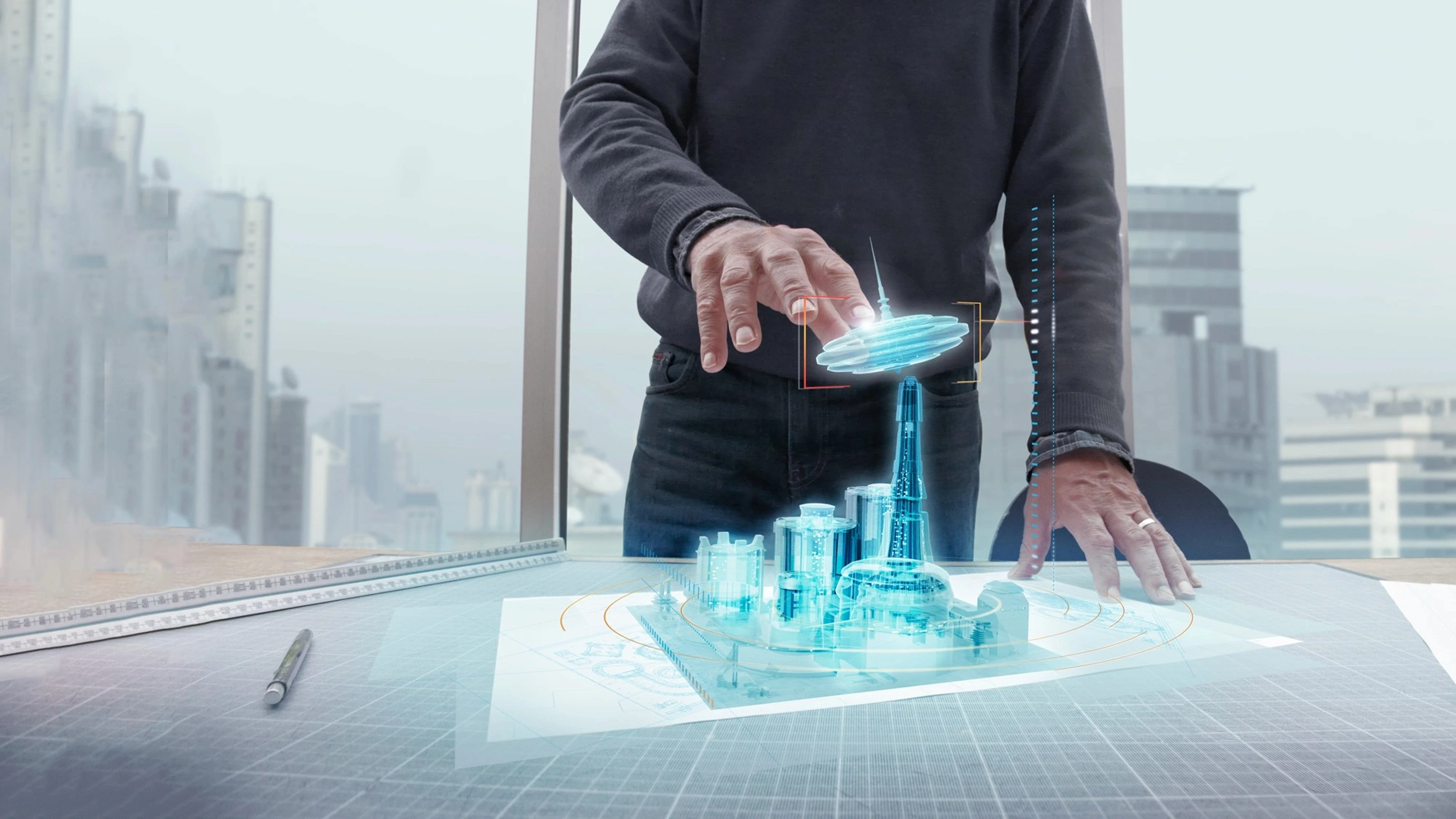
A digital twin in construction is a virtual replica of a building or piece of infrastructure that maintains a live, two-way data connection to the physical asset, so the model reflects real conditions and can feed decisions back into operations.
The definition matters because the term gets applied loosely. A systematic review in the journal Buildings, covering 160 peer-reviewed studies published between 2018 and 2026, settled on three requirements that separate a digital twin from a simpler model:
The twin must exchange data bidirectionally rather than in one direction only.
It must update in real time or near real time.
It must support simulation and decision-making rather than visualization alone.
Adoption in the built environment sits roughly where adoption sits across other industries, including sectors such as healthcare, where twins model patients and clinical facilities rather than buildings. A Deloitte survey of 750 chief financial officers worldwide, published in 2023, found 26% of real estate firms researching digital twins, 30% piloting them, 22% at early-stage implementation and 15% running them in production. Only 8% reported no interest at all.
How a Construction Digital Twin differs from BIM
BIM provides the geometric and semantic foundation, and a digital twin extends it in three specific ways: automated two-way data exchange, integration of live sources such as IoT sensors, and continuity across the full asset lifecycle rather than the design and construction phases alone.
The confusion is understandable given how dominant BIM has become. Roughly 65% of projects worldwide now use BIM workflows, more than half of new builds require BIM from the outset, and over 30 countries mandate it on large infrastructure programs. ISO 19650 provides the international framework for managing that information. For most teams, BIM is the starting condition rather than the goal.
What BIM does not do is stay current after handover. Design rationale disappears when the design team disbands. Field substitutions go undocumented under schedule pressure. As-built conditions deviate from design intent and the deviations are under-recorded. Commissioning data and performance baselines are lost when nobody structures them for transfer. Buildings routinely enter operation with knowledge gaps that persist for decades, which is the specific problem an operational twin exists to close.
Regulators have started to notice. Dubai extended its mandatory BIM policy to require operational twins from 2026, and the United Kingdom now runs a National Digital Twin Programme alongside its long-standing public-sector BIM requirements. Mandates written in 2026 emphasize data governance rather than 3D modeling, which shifts the question from whether a model exists to whether its data can be trusted and transferred.
The three maturity levels of a Construction Digital Twin
Most systems marketed as digital twins in construction are digital models or digital shadows, not digital twins, and the difference comes down to the direction and automation of the data flow.
The classification below is the one used across both manufacturing and construction research, and it is the fastest way to evaluate any vendor claim.
Level 1 - Digital Model: Data flows manually from the physical asset to the digital one. Changes on either side do not propagate. A traditional BIM model during design sits here.
Level 2 - Digital Shadow: Data flows automatically from physical to digital, but not back. Site monitoring that updates a model from IoT sensors or drone capture sits here.
Level 3 - Digital Twin: Data flows automatically in both directions. A building automation system that adjusts HVAC based on twin recommendations, then feeds actual performance back into the twin, sits here.
Research across the sector finds that most current construction implementations operate at Level 1 or are transitioning toward Level 2, and that true Level 3 twins remain aspirational in most real-world contexts. When evaluating a vendor, asking which level a proposed system reaches is more useful than asking whether it is a digital twin.
Top 5 Digital Twin Companies for Construction and AEC
The five companies below cover the layers a construction digital twin depends on: BIM authoring and delivery, reality capture, a data platform and the visualization layer that makes any of it usable outside engineering. Most projects combine two or three of them rather than buying everything from one vendor.
# | Company | Layer in the stack | Core offering | Best suited to |
|---|---|---|---|---|
1 | Treeview | Visualization and experience | Custom real-time 3D and XR applications | Bespoke twins built around a specific asset |
2 | Autodesk | Authoring and delivery | Revit, Construction Cloud, Tandem | Revit-standardized teams wanting operational continuity |
3 | Trimble | Reality capture and field | Laser scanning, positioning, Tekla | Survey-grade accuracy requirements |
4 | Siemens | Platform | Xcelerator, Building X | Industrial and process-heavy facilities |
5 | Microsoft Azure | Data layer | Azure Digital Twins service | Teams building their own twin on owned infrastructure |
1. Treeview
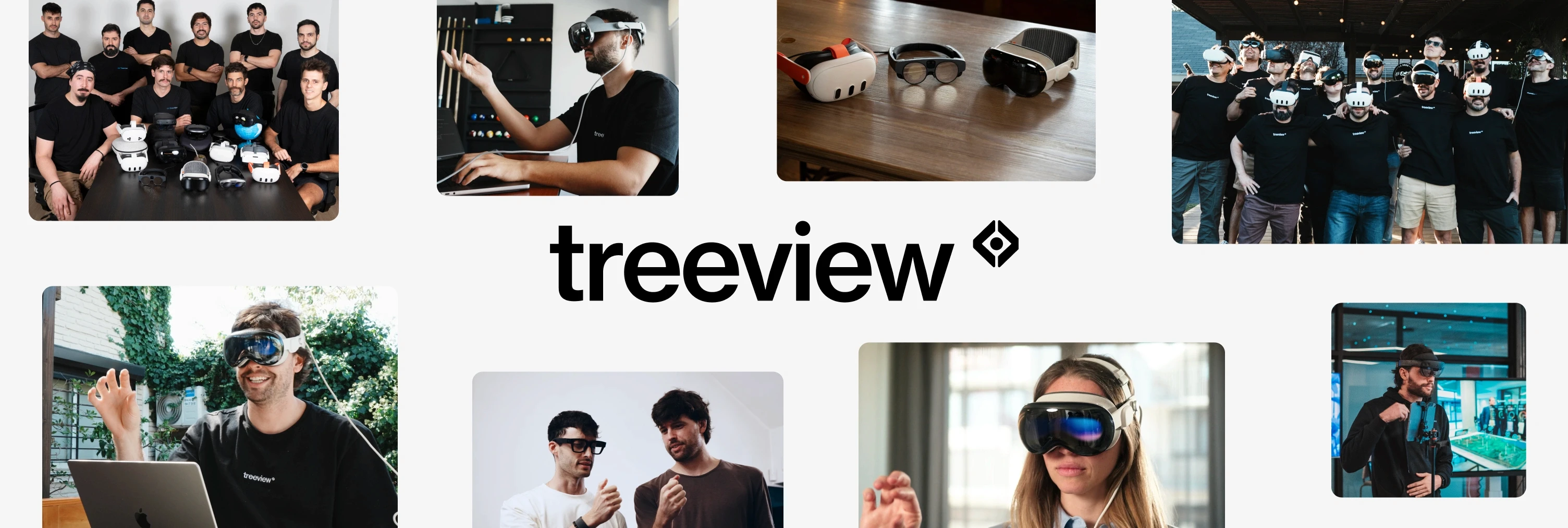
Treeview builds custom digital twins for construction and infrastructure, connecting BIM data, reality capture output and live sensor feeds into real-time 3D environments.
Treeview's digital twin work starts where platform licensing stops. Projects typically reconcile as-designed geometry against as-built point cloud data, then expose that comparison to stakeholders who do not use CAD software. The result is a purpose-built application that runs on the web, on site or in mixed reality.
Named twin work includes an AI-enabled twin for a green hydrogen energy project built with Microsoft, plus one for mining group Teck Resources. Enterprise clients include Microsoft, Meta, Toyota, Medtronic and NEOM. Treeview works across Unity, Unreal Engine and WebGL from New York and Montevideo.
Best for: owners and operators who need a twin built around a specific asset rather than a licensed platform.
2. Autodesk
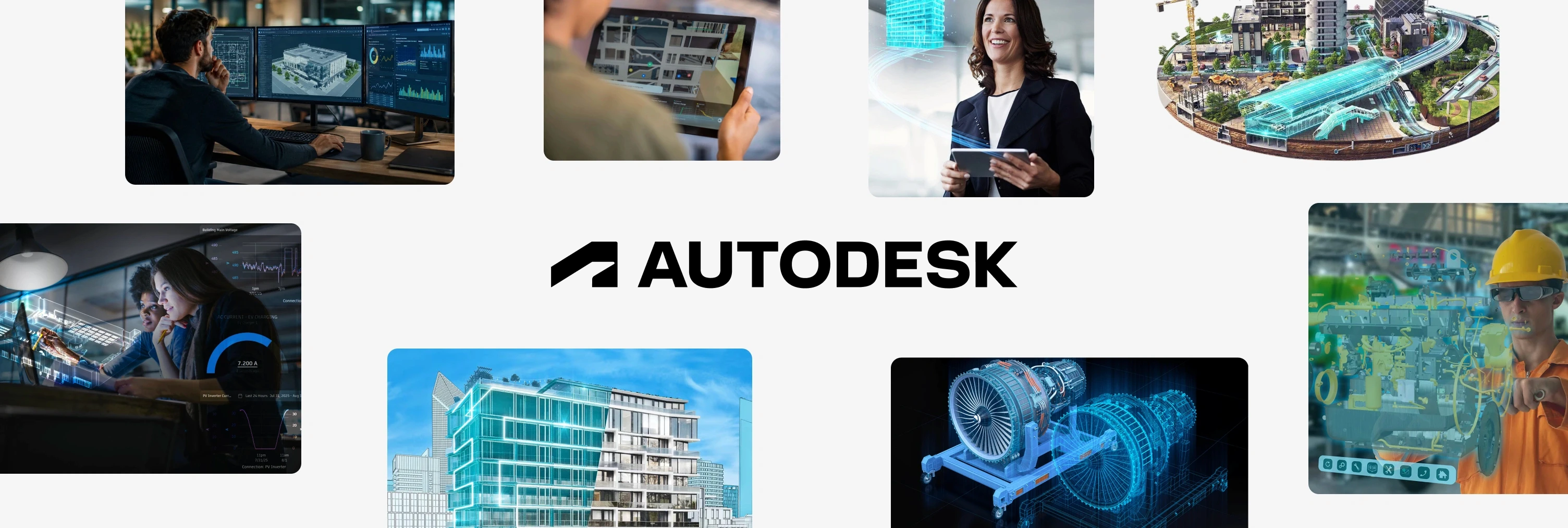
Autodesk covers the widest span of the AEC workflow, from Revit for BIM authoring through Autodesk Construction Cloud for delivery and Autodesk Tandem for operational twins.
Tandem is the piece most relevant here. It carries data produced during design and construction into operations, which addresses the handover information loss described earlier. Because most AEC teams already author in Revit, the path into a Tandem twin involves less data migration than starting elsewhere.
Construction Cloud holds the delivery-phase record, giving Tandem a source for as-built conditions and asset information. Autodesk's position rests on incumbency rather than twin-specific capability. For teams already inside that ecosystem, incumbency is often the deciding factor.
Best for: teams standardized on Revit and Construction Cloud that want operational continuity without changing tools.
3. Trimble
Trimble supplies the surveying hardware and software that produce construction-grade spatial data, including laser scanners, field positioning systems and the Tekla structural modeling range.
Trimble matters to digital twin work because accuracy originates upstream. Scan-to-BIM workflows, construction layout and progress verification all depend on survey-grade capture. Trimble covers both the instruments and the software that processes their output.
Tekla adds structural detailing to that stack, which matters where fabrication data has to match site conditions. Trimble Connect serves as the shared data environment across those tools. Teams needing dimensional accuracy for structural or MEP coordination tend to end up here regardless of which platform hosts the twin.
Best for: projects where survey-grade accuracy and field verification drive the requirements.
4. Siemens
Siemens brings industrial digital twin capability to the built environment, with Siemens Xcelerator for engineering and simulation and Building X for building operations and energy performance.
Siemens is dominant in manufacturing and industrial twins and holds a smaller position in AEC. Its strength shows on projects where the building is also a plant. Data centers, pharmaceutical facilities and energy infrastructure fall into that category.
Building X focuses on operational performance rather than design or construction delivery. The company also supplies much of the building automation hardware those twins read from. That combination suits owners running complex mechanical systems across long asset lifetimes.
Best for: industrial facilities and buildings where process systems matter as much as the structure.
5. Microsoft Azure Digital Twins
Azure Digital Twins provides the data layer, a cloud service for modeling relationships between assets, spaces and systems and connecting them to live telemetry.
Azure Digital Twins is not a construction product and does not ship a user interface. It offers a modeling language for describing an environment and the infrastructure to run it at scale. Teams then build their own applications on top of it.
That makes it a foundation underneath custom twins rather than a competitor to them. It appears alongside development partners far more often than it appears alone. Organizations choosing it usually want to own the data layer rather than license someone else's.
Best for: organizations with development capacity that want to own the data layer directly.
How to choose the best Digital Twin Provider for Construction Projects
Start by identifying which layer you are missing, because most organizations already own more of the stack than they realize.
Teams that already author in Revit and run Construction Cloud usually need an operational layer, not a new platform. Teams managing existing buildings usually need capture before anything else. Teams that have data flowing but cannot get anyone outside engineering to engage with it need a visualization and experience layer. Buying a second platform when the gap is elsewhere is the most common and most expensive mistake in this category.
Then decide honestly which maturity level the project requires. A Level 2 digital shadow that reliably reports as-built progress delivers more value than a stalled Level 3 program, and it costs considerably less. Research reviewing implementations across the sector reports rework and logistics reductions of up to 80%, energy reductions of 15 to 30%, and maintenance cost reductions of 10 to 25%, though the authors describe these as outcomes from high-performing pilots rather than typical benchmarks.
One economic factor deserves attention because it shapes who should commission the work. Digital twin benefits accrue to owners and operators across decades, while development costs are usually borne by designers and contractors whose engagement ends at handover. That split explains why twins commissioned by owners tend to outlive the ones delivered as a project line item.
Frequently Asked Questions
Q1. Is BIM the same as a digital twin?
No. BIM is the geometric and semantic model of a building, and a digital twin adds automated two-way data exchange, live data sources and continuity across the full asset lifecycle.
A BIM model can become the foundation of a twin, and on most projects it does. On its own, though, it sits at Level 1, a digital model updated by hand. The distinction becomes practical at handover, when a static model stops reflecting the building and a connected twin keeps pace with it.
Q2. Can you build a digital twin of an existing building?
Yes, and the process begins with reality capture rather than modeling.
Laser scanning or photogrammetry produces a point cloud of actual conditions, that point cloud becomes an as-built model, and live data sources are connected afterward. The workflow is generally called scan-to-BIM. It is the standard route for retrofits, renovations and any asset whose original documentation is missing or no longer accurate.
Q3. What data does a construction digital twin need?
At minimum a construction digital twin needs geometry from a BIM or CAD source, as-built conditions from reality capture, and a live feed from sensors, building automation or a project management system.
Twins that extend into operations need more. Asset registers, maintenance histories and commissioning baselines all have to be structured for transfer rather than assembled after the fact. This is why facility managers should be involved during design, when data requirements can still shape the model, rather than after handover when retrofitting them is expensive.
Q4. Does a digital twin require a headset?
No. Most construction digital twins run in a browser or on a tablet, and headset access is an option rather than a requirement.
Mixed reality earns its place in specific situations rather than across the whole project. Overlaying a model onto physical conditions on site helps verify installation and catch discrepancies during construction and commissioning, it also helps for design review, stakeholder engagement and sales enablement.
Q5. What is clash detection and does a digital twin replace it?
Clash detection identifies conflicts between building systems before they are built, such as ductwork routed through a structural member, and a digital twin does not replace it.
Clash detection is a BIM coordination function that belongs to the design and preconstruction phases. It resolves conflicts while changing them is still cheap. A digital twin extends the value of that work rather than duplicating it, carrying the coordinated model into construction monitoring and then into operations.
Q6. How long does a construction digital twin take to deliver?
Delivery time depends far more on data readiness than on development, and projects with clean BIM and a recent scan move considerably faster than those without.
The common delay is not building the twin. It is establishing which systems hold the source data, whether that data is accurate, and who owns access to it. Teams that scope a Level 2 digital shadow reporting reliable as-built progress typically reach production faster than teams attempting closed-loop control on the first attempt.