
The top digital twin development companies in 2026 are Treeview, TechViz, Dassault Systèmes, Toobler and Digital Twin Studios. Each one builds a different part of the same system. Treeview covers visualization and interface, TechViz engineering review, Dassault Systèmes the lifecycle platform, Toobler data integration and Digital Twin Studios training simulation.
Buyers usually treat a digital twin as one purchase. It is closer to five, and whoever leads one stage rarely leads the next. A studio that builds an excellent operator interface will not author your CAD. A platform vendor that owns your product lifecycle will not put a twin on a headset for a technician standing at the machine.
The market is large enough to support that specialization. Fortune Business Insights sizes it at USD 33.97 billion in 2026, growing to USD 384.79 billion by 2034.
This page ranks companies by the layer each one owns, then routes to the industry-specific analysis behind it. If the terminology is still unsettled for you, start with what a digital twin is and come back.
What a Digital Twin Development Company Actually Does
A digital twin development company builds the software, data connections and 3D models that turn physical assets into live virtual replicas you can query. Agencies, studios and engineering firms all trade under the label, and the work spans discovery, integration, geometry preparation, simulation, interface development and ongoing support.
Software licensing is the smaller line item. Most of a budget goes into connecting one specific plant, product or building to one specific model, which is custom work by definition.
Two kinds of company answer to the name. Platform vendors sell the tooling and expect you to configure it. Development studios sell the engagement and build to your specification, usually on top of a platform you already run.
The difference shows up at contract stage. Platform work commits you to an architecture, while studio work commits you to a scope. Confirm which one you are buying before comparing prices, since the two are not measured in the same units.
What Companies Build Digital Twins For
Five applications account for most digital twin work. Naming which one you are buying narrows a vendor search faster than any other question, because the layer carrying the value moves with the application.
Application | What the twin does | Where the value lands |
|---|---|---|
Operational monitoring | Shows live equipment state, environmental conditions and throughput in a 3D environment | Control rooms and site teams reading one picture instead of six dashboards |
Predictive simulation | Tests operational changes and forecasts outcomes before anything moves | Decisions that are expensive or slow to reverse |
Training and competency | Reproduces a system faithfully enough to rehearse against | Procedures that are hazardous, rare or costly to stage |
Design and engineering validation | Checks layouts and performance before construction or commissioning | Rework caught while it still costs drawings |
Enterprise integration | Connects the twin to ERP, SCADA, building management and cloud systems | Twin output reaching the systems that already run the business |
Most programs start with one application and acquire the others later. Starting narrow is also what makes the second phase fundable, since a twin that answered one operational question is easier to argue for than a platform that promised five.
The Six Layers of a Digital Twin Build
Every digital twin project resolves into six layers. Knowing which ones you already cover is the fastest way to shorten a vendor search, because most organizations hold more than they think.
# | Layer | What it delivers |
|---|---|---|
1 | Discovery and consulting | Use case definition, a data audit and the target architecture |
2 | Data integration | Telemetry, historians, control systems and business systems readable as one set |
3 | 3D and asset preparation | CAD, BIM or scan data light enough to render and structured enough to bind to live values |
4 | Simulation and physics | The predictive behavior that separates a twin from a dashboard |
5 | Visualization and interface | The applications people actually use, on desktop, mobile or headset |
6 | Deployment and support | Models kept synchronized with assets that change |
Budgets get set in layers 1 and 2. Layers 5 and 6 decide whether the model gets opened twice.
Few organizations buy all six from one provider. Most combine internal capability with two or three outside specialists, and the layers already held decide which companies below belong on a shortlist.
Tooling in the digital twin ecosystem clusters by layer. Cloud services including Azure Digital Twins and AWS IoT TwinMaker carry ingestion and the asset graph. Engineering suites supply physics-based simulation, and real-time rendering runs on Unity, Unreal Engine or NVIDIA Omniverse. Data pipeline architecture and IoT integration sit underneath all of it, which is why layer 2 usually sets the schedule.
Top Digital Twin Development Companies (2026)
Selection here weighs demonstrated delivery, the clarity of the layer a company owns and evidence available outside the vendor's own marketing. Companies duplicating a layer already covered were left out in favor of ones that widen the picture.
# | Company | Layer in the stack | Core offering | Best suited to |
|---|---|---|---|---|
1 | Treeview | Visualization and interface | Custom real-time 3D, XR and web twin applications | The data exists and nobody outside engineering can read it |
2 | TechViz | Engineering review | TechViz XL, CAD to VR without conversion | Design reviews on models too large to export |
3 | Dassault Systèmes | Lifecycle platform | 3DEXPERIENCE, CATIA, DELMIA, SIMULIA | Twins that must live inside product lifecycle records |
4 | Toobler | Data integration | Custom IoT and twin applications on existing systems | Twin work scoped around tools already in place |
5 | Digital Twin Studios | Training and simulation | Unity-based immersive training environments | Procedures that are dangerous or expensive to rehearse |
1. Treeview
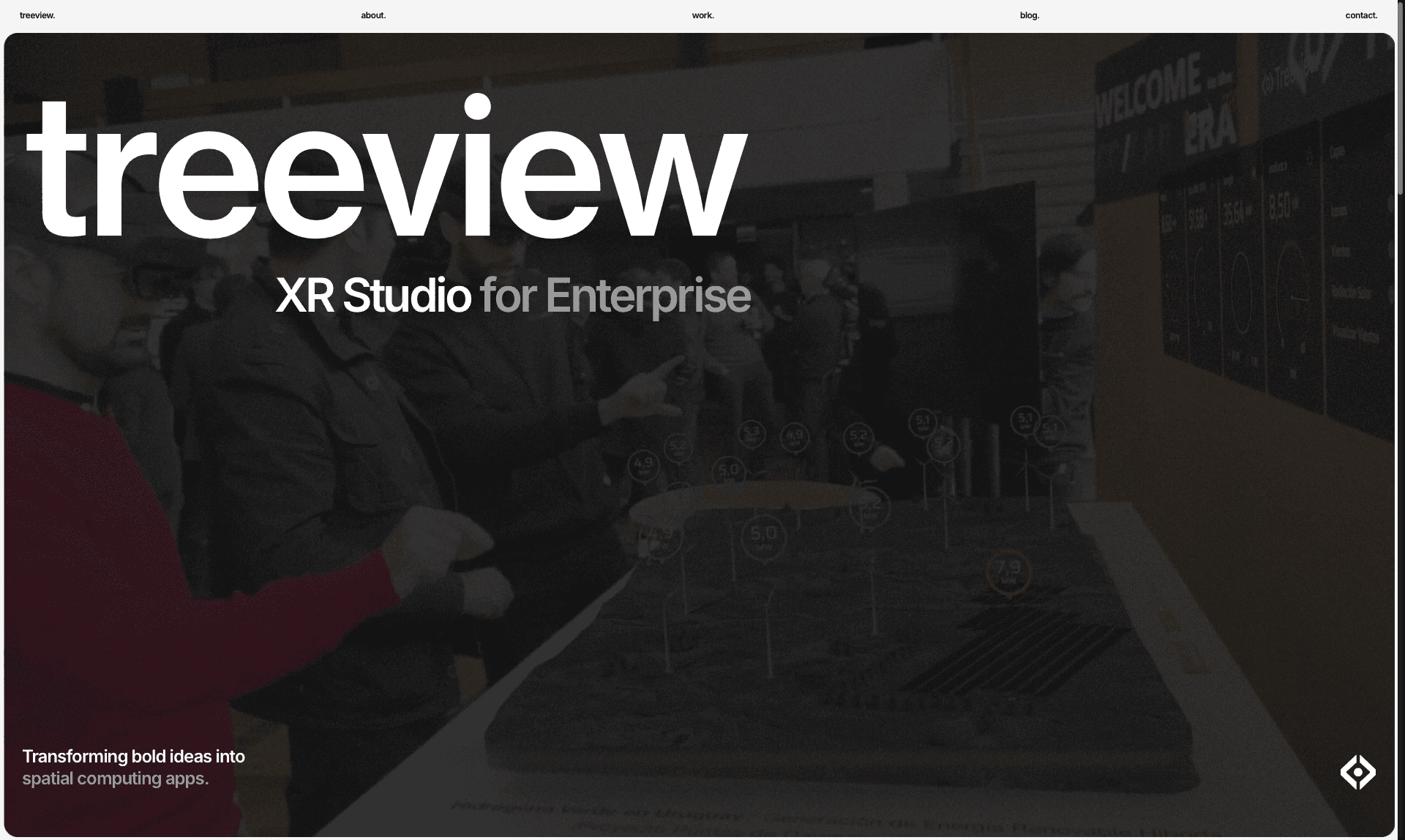
Treeview's digital twin development practice covers the visualization and interface layer that enterprise twins are read and operated through.
The studio works on top of whatever platform already holds the data, turning geometry, sensor streams and simulation output into applications operators use directly. Delivery spans Apple Vision Pro, Meta Quest and Android XR headsets alongside mobile and the browser, which matters when one twin has to serve a control room and a site technician at the same time.
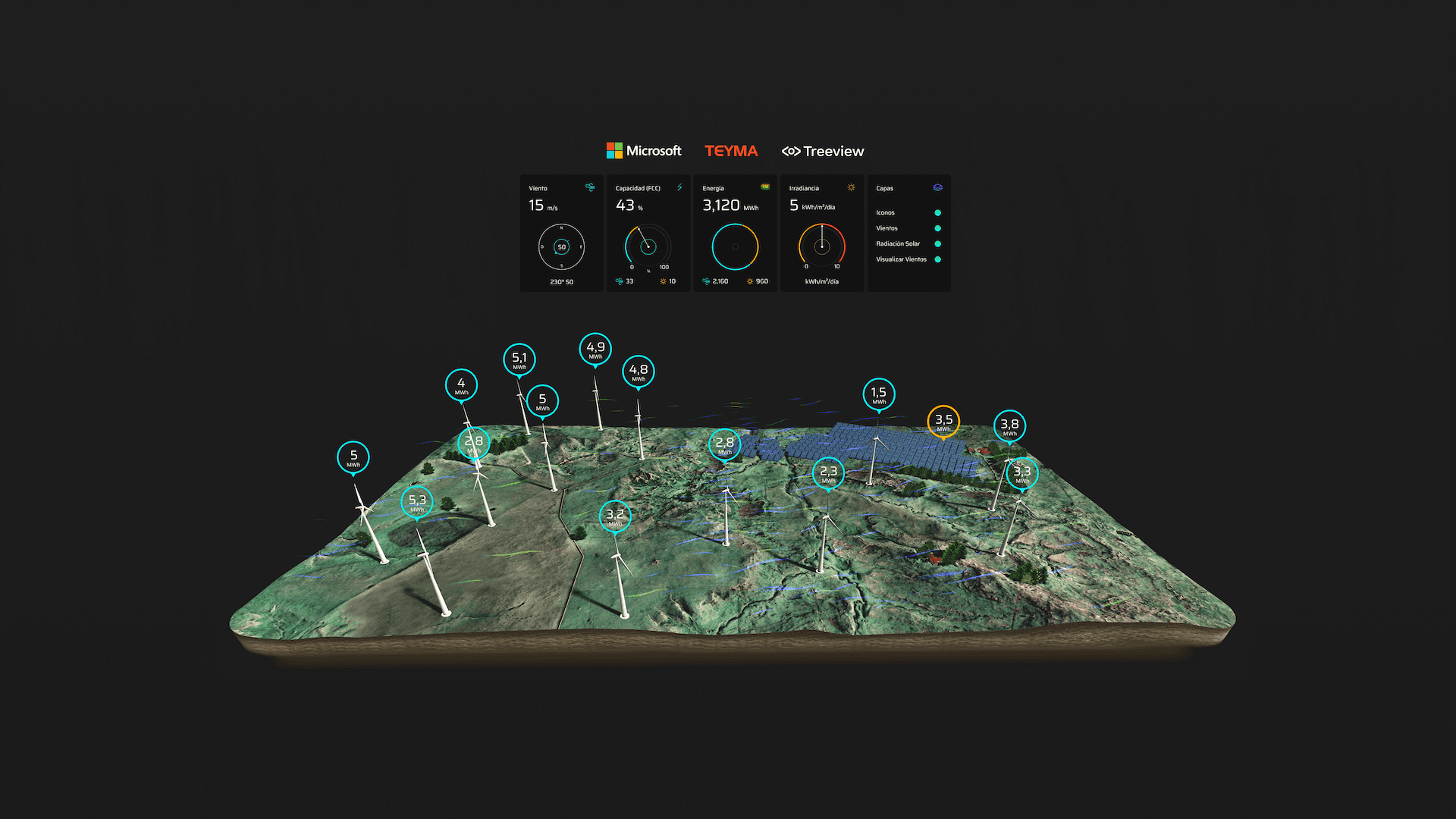
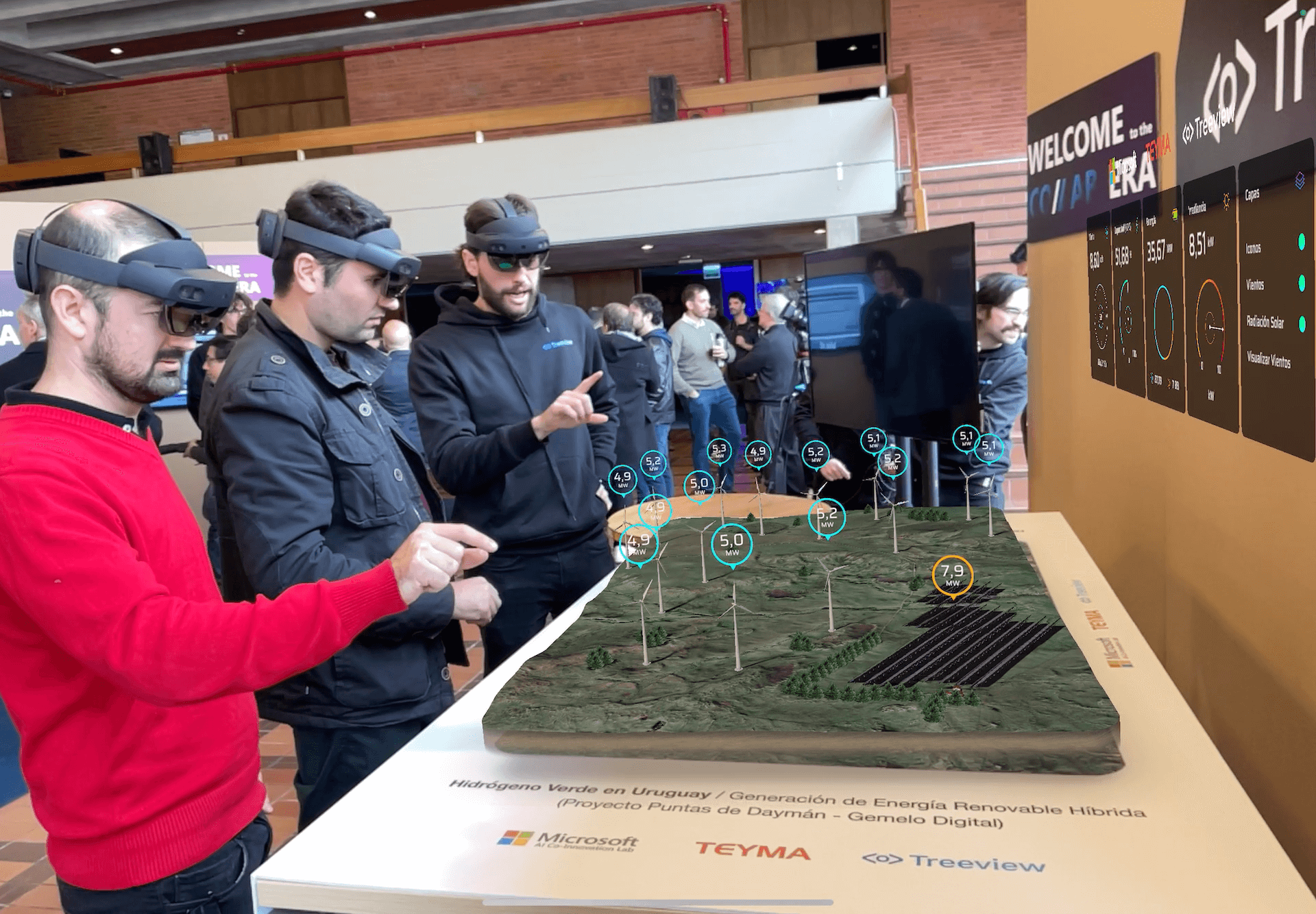
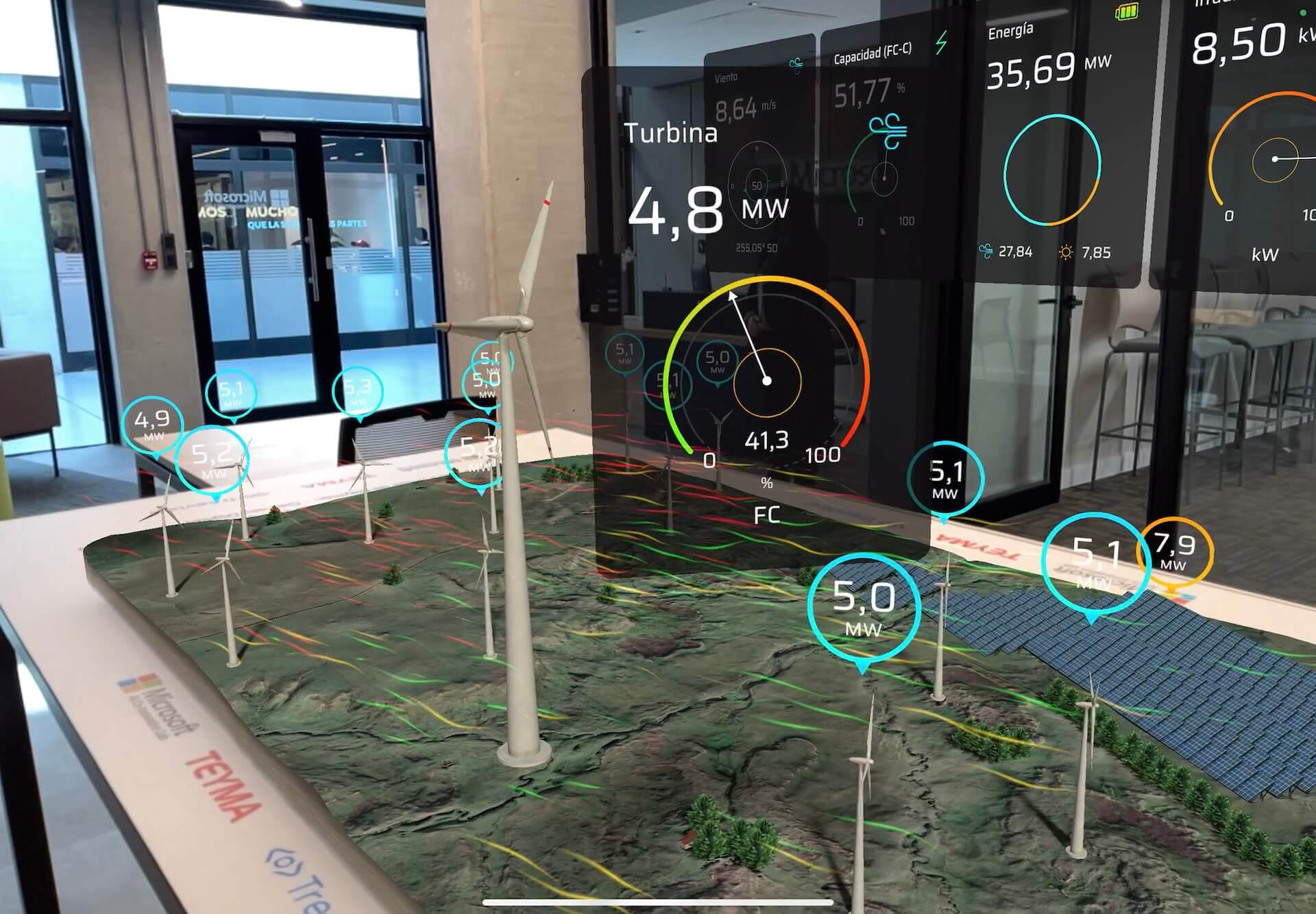
The clearest published reference is an AI-enabled mixed reality twin of a green hydrogen energy project, built with Microsoft and shipped on HoloLens 2, mobile and WebGL from one engagement. That work took two Silver Telly Awards in 2026, for use of augmented reality and for digital environments.
Enterprise clients since 2016 include Microsoft, Meta, Toyota, Medtronic, ULTA Beauty and Daiichi Sankyo, with a mining twin for Teck Resources on comparable industrial ground. Delivered work spans healthcare, manufacturing, energy, robotics and facility operations. The team is senior-only and client IP transfers in full at project close.
Location: New York and Montevideo
Best for: the twin data already exists and the people who need it sit outside the simulation team.
2. TechViz
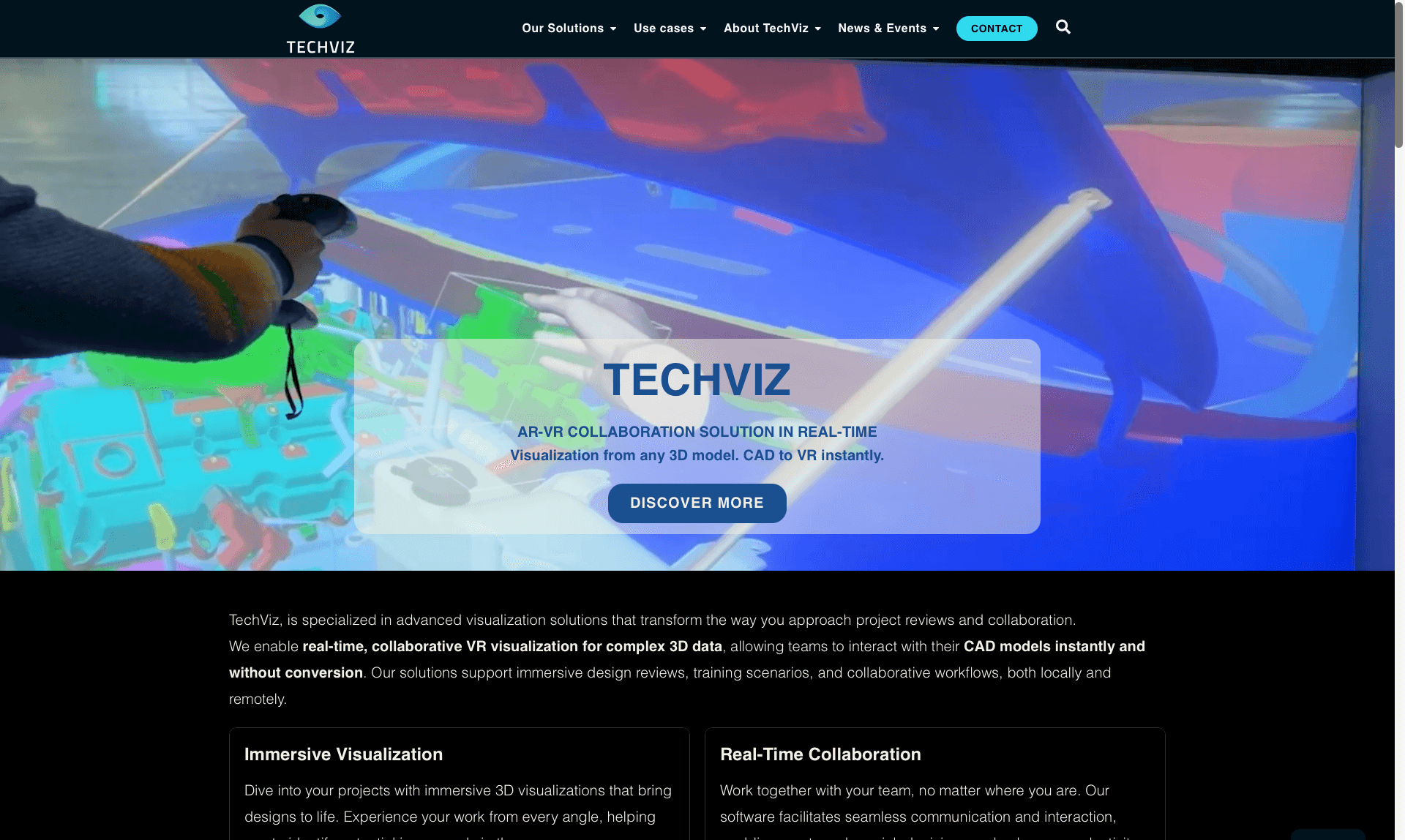
TechViz occupies the engineering review layer, putting native CAD models into virtual reality without an export step.
TechViz XL works as a driver instead of an application. It intercepts OpenGL and DirectX output from more than 200 engineering tools, among them CATIA, NX, Creo and Navisworks. Those models then render at 1:1 scale in whatever display system is available. Assemblies up to a billion triangles hold their frame rate, which is the point for anyone whose models break conventional viewers.
Hardware neutrality extends across CAVEs, powerwalls and headsets. Founded in 2004 and headquartered in Paris, the company also runs offices in Chicago, Beijing and Bangalore.
One boundary is worth stating plainly, because it decides whether TechViz fits. The software reads design data, not live telemetry. It delivers immersive review of what an asset was specified to be, so pairing it with a data layer is necessary before the result qualifies as a twin.
Location: France
Best for: engineering teams reviewing assemblies too large to convert, where the question concerns design instead of current condition.
3. Dassault Systèmes

Dassault Systèmes supplies the lifecycle platform that carries a model from concept through production and into service.
3DEXPERIENCE is the spine, and it is a product lifecycle management platform first. CATIA covers design, DELMIA manufacturing operations and SIMULIA physics simulation, with PLM records holding those pieces in one configuration. The platform reports more than 45 million users across 400,000 customers, which makes it the most widely installed twin authority in the list.
Terminology causes real confusion here and it is worth flagging during vendor comparison. Dassault Systèmes markets virtual twin experiences instead of digital twins, positioning the concept as broader than a live data mirror. Evaluation documents that compare a virtual twin against a digital twin are comparing two differently drawn categories.
The company announced a partnership with NVIDIA in 2026 to build Industry World Models, combining its simulation catalog with accelerated computing. Aerospace, automotive and life sciences programs are where the platform is most entrenched.
Scope is the trade-off throughout. A 3DEXPERIENCE engagement touches design, manufacturing and data governance at once, so it reaches well past the twin itself.
Location: France
Best for: the twin has to inherit authority from product lifecycle records you already maintain.
4. Toobler
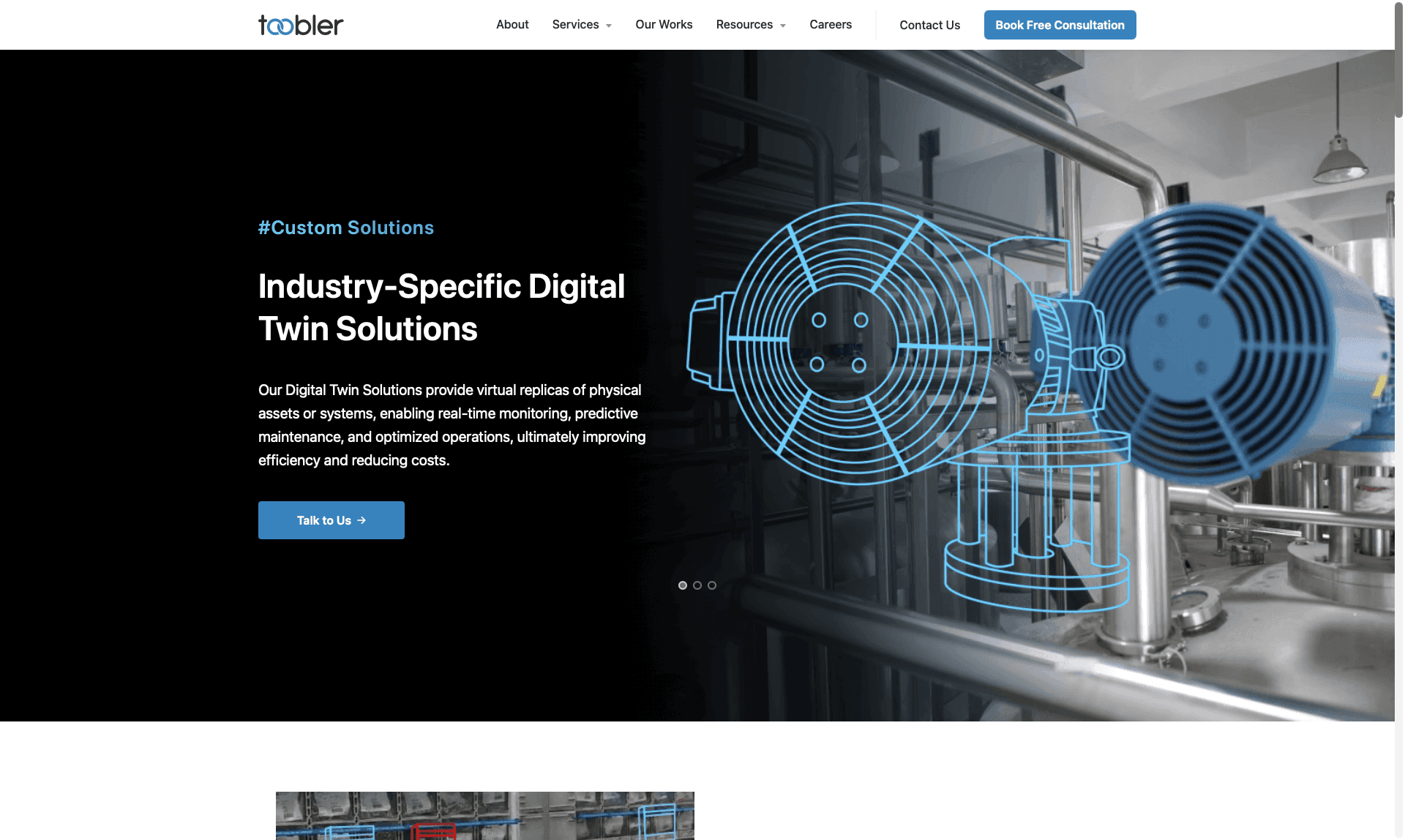
Toobler works the data integration layer, connecting twins to the operational systems a client already runs.
Founded in 2008 and based in Kochi, India, the company came to twin work through IoT and enterprise application development. That history shows in how engagements are shaped. Projects tend to start from existing dashboards, historians and data platforms, building the twin around them so an organization avoids adopting a new platform first.
Published work covers logistics, manufacturing and infrastructure, with fleet tracking, site monitoring and inventory systems among the recurring applications.
Team size is around 75, so the practical guidance is to scope tightly. One asset class with defined data sources suits this engagement shape well. Programs spanning several business units generally need a larger integration partner alongside.
Location: India
Best for: the systems are already in place and the gap is the connective work between them.
5. Digital Twin Studios
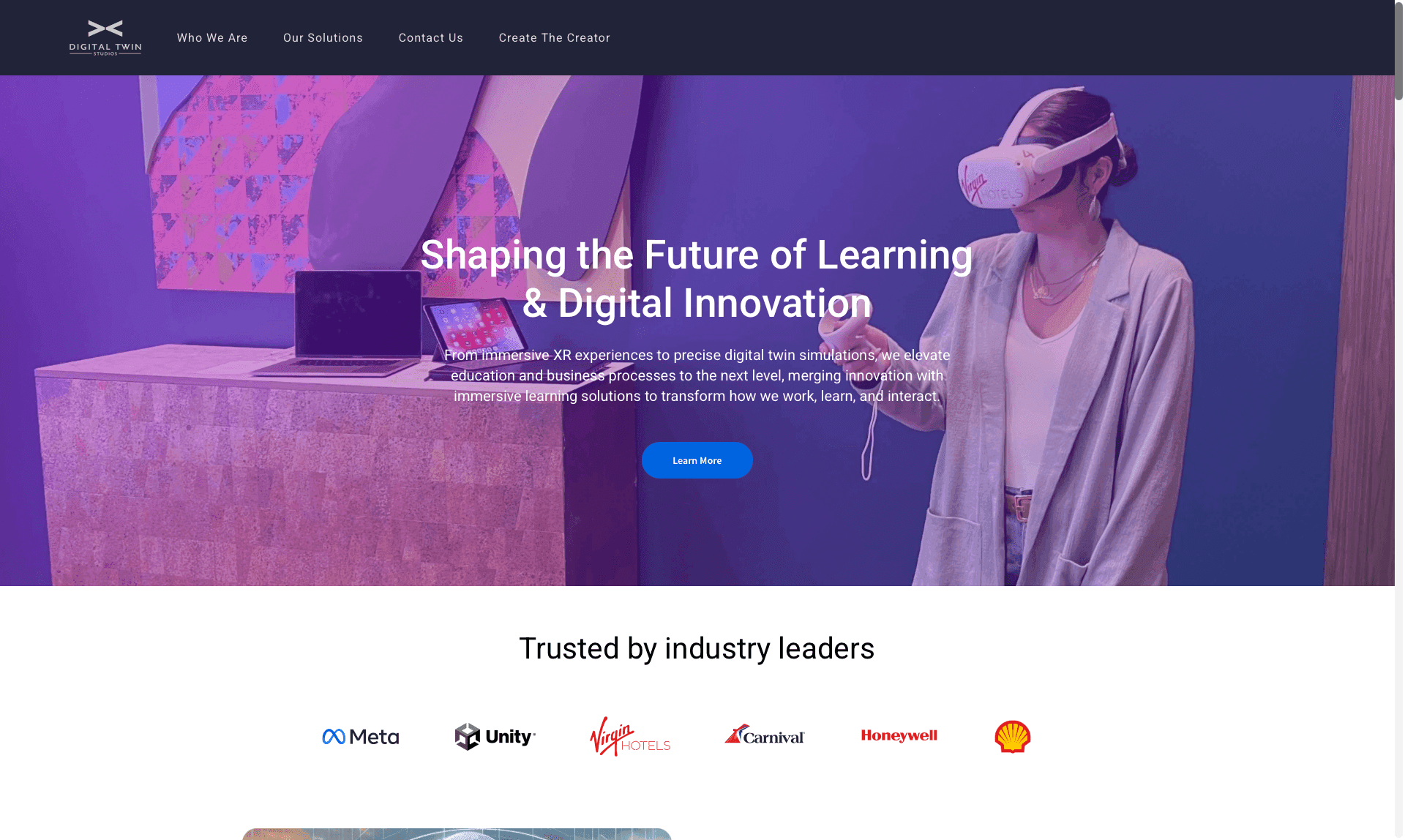
Training simulation is where Digital Twin Studios operates, building Unity-based environments that reproduce procedures too costly or too hazardous to rehearse physically.
The company sits in Lafayette, Louisiana and reached twin work from an unusual direction. It began in energy industry training, delivering classroom and on-site courses, then moved into immersive software development and retired the traditional training business in 2018. Offshore oil and gas supplied the early portfolio, including work for Shell.
Unity partnership runs deeper than tooling. The studio is a Unity Gold Reseller and supports the Unity Certified Creator Network and the Unity Academic Alliance, alongside a certification program run with Louisiana Economic Development.
Current sectors extend to education, government, healthcare and hospitality. Note that the offer is a training twin rather than an operating one, so the geometry and procedures are accurate while live telemetry is generally out of scope.
Location: United States
Best for: the value sits in competency, and the procedure is dangerous, rare or expensive to stage.
Digital Twin Development by Industry
Vendor selection changes more by industry than by company size. Data sources differ, regulatory constraints differ and the layer carrying the value moves.
Industry | Where the value concentrates | What shifts vendor selection |
|---|---|---|
Manufacturing | Line monitoring, floor simulation, quality control | Control system estate decides the integration burden |
Construction and AEC | BIM to twin continuity, clash detection, progress tracking | Handover destroys data unless the twin starts during design |
Smart cities | Traffic modeling, infrastructure monitoring, consultation | Geospatial data volume outweighs asset detail |
Healthcare | Facility operations, device simulation, surgical planning | Regulatory and privacy constraints precede the engineering |
Aerospace | Airframe fatigue tracking, MRO scheduling, training | As-designed and as-built separate into distinct layers |
Energy and utilities | Grid modeling, offshore structural monitoring, site planning | Asset dispersion and regulatory reporting shape the data design |
Automotive | Crash and thermal simulation, assembly line twins, connected vehicle data | Design-stage physics carries more weight than live telemetry |
IoT-led programs | Sensor ingestion, asset graphs, condition monitoring | Instrumentation coverage sets the ceiling on fidelity |
Plant and process environments carry the deepest adoption, and the roundup of digital twin companies for manufacturing covers the measurement and platform vendors serving them.
Built environment programs face a different problem. The richest model usually belongs to a contractor with no reason to maintain it past completion, which is the argument running through the analysis of digital twin companies for construction and AEC.
At municipal scale the geospatial layer dominates and the specialist vendors change almost entirely, a pattern set out in the review of digital twins for smart cities and urban planning.
Regulated environments move slower for reasons unrelated to technology. The survey of digital twins in healthcare separates facility and device work from the more speculative patient modeling.
Aerospace splits asset preparation in two, because tolerances make the design model and the measured article genuinely different sources of truth. That is why the guide to digital twin companies for aerospace weighs seven layers where this page weighs six.
Sensor-led programs across every sector share one architecture, documented in the analysis of digital twin IoT companies.
Buyers comparing engagement models instead of vendors will find the layer-by-layer breakdown in the ranking of digital twin services companies more directly useful than this page.
Coverage extends past those rows. Supply chain and logistics networks, mining operations, oil and gas infrastructure, robotics cells and life sciences facilities all run twins in production, and the same layer logic decides the vendor in each case.
Digital Twin Market Size and Where the Spending Goes
Fortune Business Insights puts the global digital twin market at USD 33.97 billion in 2026, up from USD 24.48 billion in 2025. The same analysis projects USD 384.79 billion by 2034, at a compound annual growth rate of 35.40%.
Application concentration matters more than the headline figure when scoping a first project. Predictive maintenance is the largest single application at 31.04% of the 2026 market, which reflects how legible its business case is. Maintenance intervals, failure rates and the cost of an unplanned stop are numbers most operators already hold.
Large enterprises account for 66.41% of spending. Aerospace and defense held the largest end-user share through 2025, and manufacturing is expected to grow fastest across the forecast period.
Regional distribution runs more evenly than most technology markets, with North America at 34.00%, Europe at 27.90% and Asia Pacific at 27.40% of the 2025 market. Assets that justify twinning exist wherever heavy industry and infrastructure exist.
One caution applies to every figure in this category. Publisher estimates for 2026 differ by roughly 1.6x, and some houses publish sub-market figures larger than their own global total. A single named publisher used consistently beats a range assembled from several.
What the Research Says About Digital Twin Development
Peer-reviewed work is more cautious than vendor material, and the gaps it names are useful during vendor selection.
Kibria and Kittur screened 541 records down to 45 publications for Frontiers in the Internet of Things, identifying six research themes across the digital twin stack. Networked and AI-enabled twins still sit mostly at prototype stage in their assessment. Interoperability, standardized validation and safe adaptivity remain open problems.
Their treatment of the interface layer is worth carrying into a shortlist. Security earns a research theme of its own while visualization and interface earn none, and the review holds that effective implementation depends on end-to-end system design. Good visualization on poor data integration produces a convincing picture of nothing.
Shahzad and colleagues reached a parallel conclusion in the Journal of Infrastructure Intelligence and Resilience, reviewing 55 studies of twin and mixed reality integration in building operations. They report that implementations still rely mostly on 2D or static 3D interfaces, well behind what the hardware allows.
What Digital Twin Development Costs and How Long It Takes
Cost and schedule both track data readiness more closely than asset size. A project where telemetry already flows and the 3D geometry is current moves quickly at any scale. One that needs new sensors or reconstructed records absorbs budget and months before twin work starts.
Scope | Typical cost | Typical timeline | What moves the number |
|---|---|---|---|
Single asset or basic operational visualization | From USD 75,000 | 3 to 6 months | Whether sensors already report and the 3D geometry is usable |
Mid-scale twin with multi-source data integration | USD 150,000 to USD 250,000 | 6 to 12 months | How many systems have to be connected and how old they are |
Enterprise platform with simulation, AI-powered analytics and spatial interfaces | USD 300,000 and above | 12 to 18 months or longer | Site count, model cleanup and data governance requirements |
Software licensing sits inside those figures as a minor line. Ask any quote to separate data work from build work, because the first is where estimates move and the second is comparatively predictable.
Phasing protects the budget when the range is wide. A first phase scoped to one asset and one question produces a working system, a measured tolerance and a realistic cost per site for everything that follows.
How to Choose a Digital Twin Development Company
Start by naming the layer you still need. Vendor searches scoped to two layers move much faster than searches scoped to six, and a full-stack proposal is usually solving problems you have already solved.
Ask each candidate which layer they own and which layers they assume you have. Proposals routinely omit the second half of that question, and the gap surfaces during integration when it is expensive to fix.
Settle ownership and maintenance before the engineering discussion. A twin drifts out of correspondence as equipment is retrofitted and processes change, so name the team responsible for synchronization at the start and fund it as an operating cost. Confirm in writing whether asset models built inside a vendor platform can be exported in a usable format if the relationship ends.
Weight the interface layer higher than the market currently does. The people who run an asset day to day are the ones an interface has to reach, and they are rarely the people who commissioned the model. Getting that layer right converts a working data model into a working practice.
Match evidence to your problem before matching it to your industry. Layer capability transfers across sectors more reliably than sector familiarity transfers across layers, so a strong visualization partner from another industry usually beats a weak one from your own.
Selection Criteria Checklist
Six checks separate a shortlist that holds up from one that only looks good on paper.
Data integration evidence: connections built to IoT sensors, SCADA systems, historians and cloud platforms, described by protocol instead of by product name
Application match: delivered work in monitoring, simulation, training or integration, whichever one carries your value
Team composition: 3D developers, data engineers, IoT specialists and simulation engineers available on the same engagement
Front-end reach: interfaces shipped to desktop, mobile, 3D web and headsets, tested on the hardware your people actually hold
Scale record: twins that moved from pilot into production without a rebuild
Support model: a named process for keeping models synchronized as assets change
Common Challenges and How to Plan for Them
Four problems account for most digital twin programs that stall. All four are predictable enough to budget for before a contract is signed.
Data integration and IoT connectivity
Plant equipment of different vintages speaks different protocols, and normalizing that traffic usually takes longer than the modeling it feeds. Look for teams fluent in MQTT, OPC UA and Modbus, with delivered work on AWS IoT or Azure IoT Hub.
Ask what happens to latency at your data volumes. A model updated every second behind a four minute pipeline is real time in name only, and that gap only appears once the load is real.
Budget planning and scope management
Estimates move on data readiness, so a quote produced before a data audit is a guess wearing a spreadsheet. Request pricing broken out by layer and shape the program in phases where each one returns something usable on its own.
System modeling accuracy
A twin that cannot reproduce a known past failure will not predict the next one. Choose partners who understand the physical system well enough to validate the model against historical periods where the outcome is already established.
Record the tolerance the model achieves. Every downstream decision rests on that number, and it is the first thing an auditor or a regulator asks for.
Enterprise-grade reliability
A bidirectional twin can influence physical equipment, so it inherits the threat model of a control system. Settle encryption, role-based access, API authentication and network segmentation early, alongside whichever compliance regime your sector carries.
Adoption planning belongs in the same conversation. A twin nobody opens twice fails for reasons that have nothing to do with the engineering.
Frequently Asked Questions (FAQs) About Digital Twin Development Companies
Q1. What are the top digital twin development companies?
Treeview, TechViz, Dassault Systèmes, Toobler and Digital Twin Studios each lead a different layer of a digital twin build, covering visualization and interface, engineering review, lifecycle platform, data integration and training simulation.
Most enterprise programs hire more than one. The company you need depends on which layer you have not already covered internally, which is why a shortlist assembled by reputation alone tends to miss.
Q2. Do digital twin development companies build AR and VR interfaces?
Many do, and spatial computing sits inside the visualization and interface layer rather than beside it. Augmented reality places twin data on the equipment it came from, so a technician reads a live value at the hardware. Virtual reality puts a planner inside a facility model at full scale.
Capability here varies more than any other layer. Ask for delivered work on the specific hardware you intend to use, since a browser build and a headset build carry different performance constraints.
Q3. How much does it cost to hire a digital twin development company?
Cost tracks data readiness far more closely than software licensing, so the number comes out of scoping instead of a price list. A pilot on one asset with telemetry and 3D models already in hand sits at the bottom of the range.
Two variables move the figure most. Projects needing new sensors absorb budget before any twin work begins, and projects needing geometry cleanup absorb more.
Q4. How long does a digital twin project take?
A scoped pilot on a single asset reaches working software in months. Enterprise programs spanning multiple sites run across several years and arrive in phases, each of which should return something usable on its own.
Timelines stretch most often at data integration. Connecting historians, control systems and business systems surfaces access, format and ownership questions that were invisible during scoping.
Q5. What is the difference between a digital twin platform and a development company?
A platform vendor sells tooling and expects you to configure it, committing you to an architecture. A development company sells an engagement and builds to your specification, usually on top of a platform you already run.
Most production twins involve both. The platform holds the data model and the development partner builds the layers the platform leaves open, which is typically visualization and integration.
Q6. Do I need a platform before hiring a development company?
No. Selecting a platform first commits you to an architecture before anyone has audited your data, and that sequence produces expensive rework.
Organizations already standardized on a major cloud or industrial vendor are a reasonable exception, since the decision is effectively made and the work becomes fitting the twin to it.
Q7. What is the difference between a digital twin and a virtual twin?
The two terms describe overlapping ideas from different vendors. Digital twin is the general industry term for a model synchronized with a physical asset through live data. Virtual twin is Dassault Systèmes terminology, framing the concept as broader than a live data mirror and extending it across the full lifecycle.
Comparison documents that place the two side by side are comparing differently drawn categories. Ask any vendor to define which one they mean before weighing their proposal.
Q8. Can a digital twin development company work with my existing systems?
Yes, and integration with existing systems is the normal case rather than the exception. Twins routinely connect to SCADA systems, historians, IoT platforms, building management systems, ERP software, cloud services and custom databases.
Ask a candidate to describe the integration pattern they would use for your specific estate. Vendors comfortable in this layer answer with protocols and data models instead of product names.
Q9. Which industries hire digital twin development companies most?
Manufacturing, energy, aerospace, construction, healthcare and smart infrastructure show the deepest adoption. Aerospace and defense held the largest end-user share of the market through 2025, and manufacturing is projected to grow fastest.
Adoption follows asset economics more than industry enthusiasm. Expensive assets, costly downtime and long service lives justify the investment earliest.
Q10. How do I evaluate a digital twin development company's portfolio?
Look for evidence in the layer you need rather than in your industry. A strong visualization partner from another sector generally outperforms a weak one from your own, because layer capability transfers more reliably than domain familiarity.
Ask what the twin was built to answer and whether decisions actually changed because of it. A case study describing technology without naming the decision is describing a demonstration.
Q11. Which major companies use digital twins for their operations?
Siemens, GE, BMW, Shell, Boeing and NASA all run digital twins across manufacturing, energy, aerospace and infrastructure, and Singapore applied the same idea at city scale through its Virtual Singapore program.
Two roles are worth separating here. These organizations operate twin technology on their own assets, and several of them also sell platforms, which is why they turn up in market coverage and on vendor shortlists for different reasons.
Q12. How do digital twin development companies handle data security?
A twin that can write back to equipment carries the risk profile of a control system, so the security work matches that. Expect encrypted transmission, role-based access control, secure API authentication and network segmentation as a baseline.
Sector rules sit on top of that baseline. HIPAA applies in healthcare and NERC CIP in energy, and a vendor working in your sector should raise those before you do.
Q13. What data sources do digital twins typically integrate with?
IoT sensors reading temperature, pressure, vibration and flow are the common starting point, joined by SCADA systems, historians and building management systems.
Business systems supply the other half of the picture. ERP, MES and CMMS records connect asset condition to operational consequence, and weather or energy data enters where conditions drive behavior.
Q14. What post-deployment support should I expect?
Support covers pipeline maintenance, platform updates, new data source integration, performance work and user training. Enterprise programs usually formalize this in a maintenance agreement with a defined response commitment.
Model synchronization is the part most often missed at handover. Physical assets get modified continuously, and keeping the twin aligned with those changes is what preserves its credibility with the people using it.
Q15. How do organizations measure digital twin ROI?
Start from the operational question the twin exists to answer, then measure whether decisions changed. Downtime avoided, maintenance schedules optimized, safety incidents reduced and training time shortened are the four figures most programs report against.
Standardized measures remain a genuine gap in the research, so most organizations define their own acceptance criteria at the start. Agreeing those criteria during scoping is what makes the number defensible later.