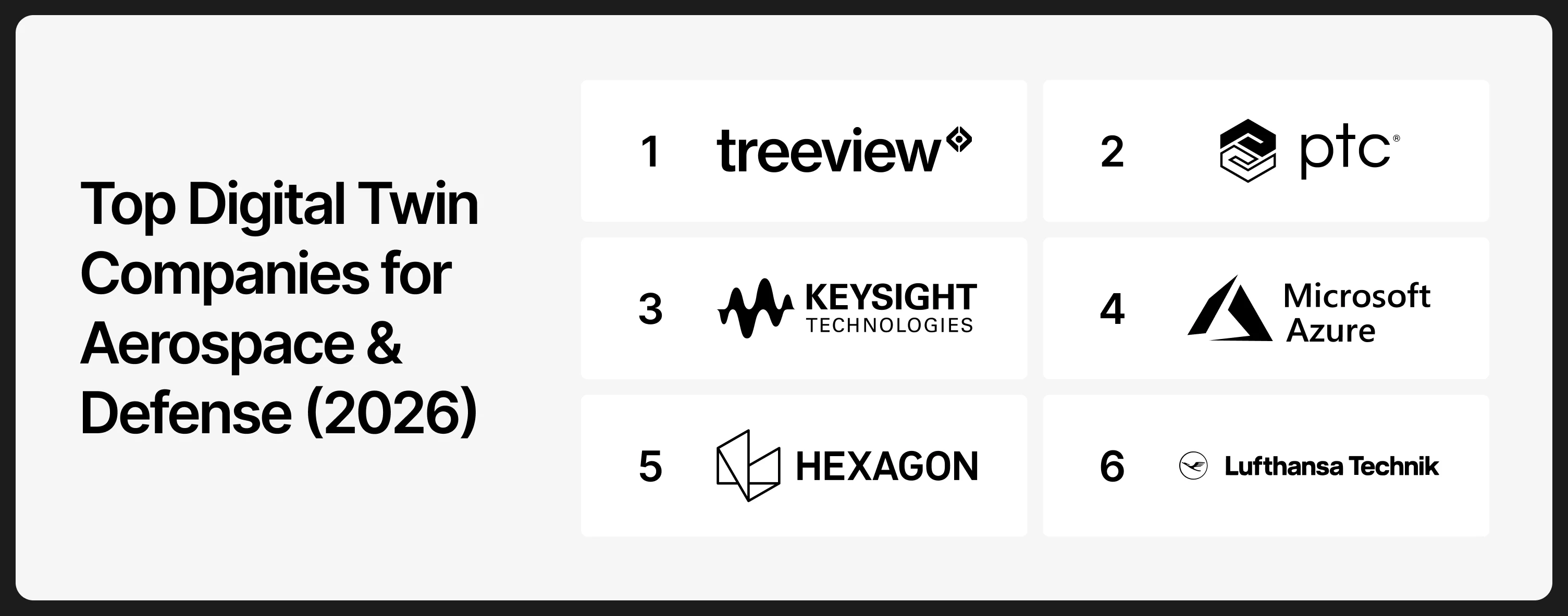
The leading digital twin companies for aerospace in 2026 are Treeview, PTC, Keysight CAE, Microsoft Azure Digital Twins, Hexagon and Lufthansa Technik. Each occupies a different layer of the same stack, and a working twin usually takes several of them together.
Aerospace buyers routinely treat the twin as one purchase, and what they get is a viewer bolted onto a CAD archive. The difference between a digital twin and a 3D model is live data. A model shows what the airframe was designed to be, while its twin shows what a specific tail number is doing right now. Aerospace and defense hold the largest end-user share of a market Fortune Business Insights sizes at USD 33.97 billion in 2026.
This page ranks vendors by the layer they own. It builds on the six-layer model Treeview applies across its analysis of digital twin services companies, with one layer split in two for aerospace. Manufacturers such as Airbus and Rolls-Royce run large internal programs. They appear constantly in market discussion, building that capability for their own fleets. Treeview covers every twin type and industry in its guide to the top digital twin companies.
What an Aerospace Digital Twin Actually Is
An aerospace digital twin is a live virtual copy of a specific aircraft, engine or production system that updates from operational data and supports prediction. Three ingredients make it work, and the twin depends on all three together.
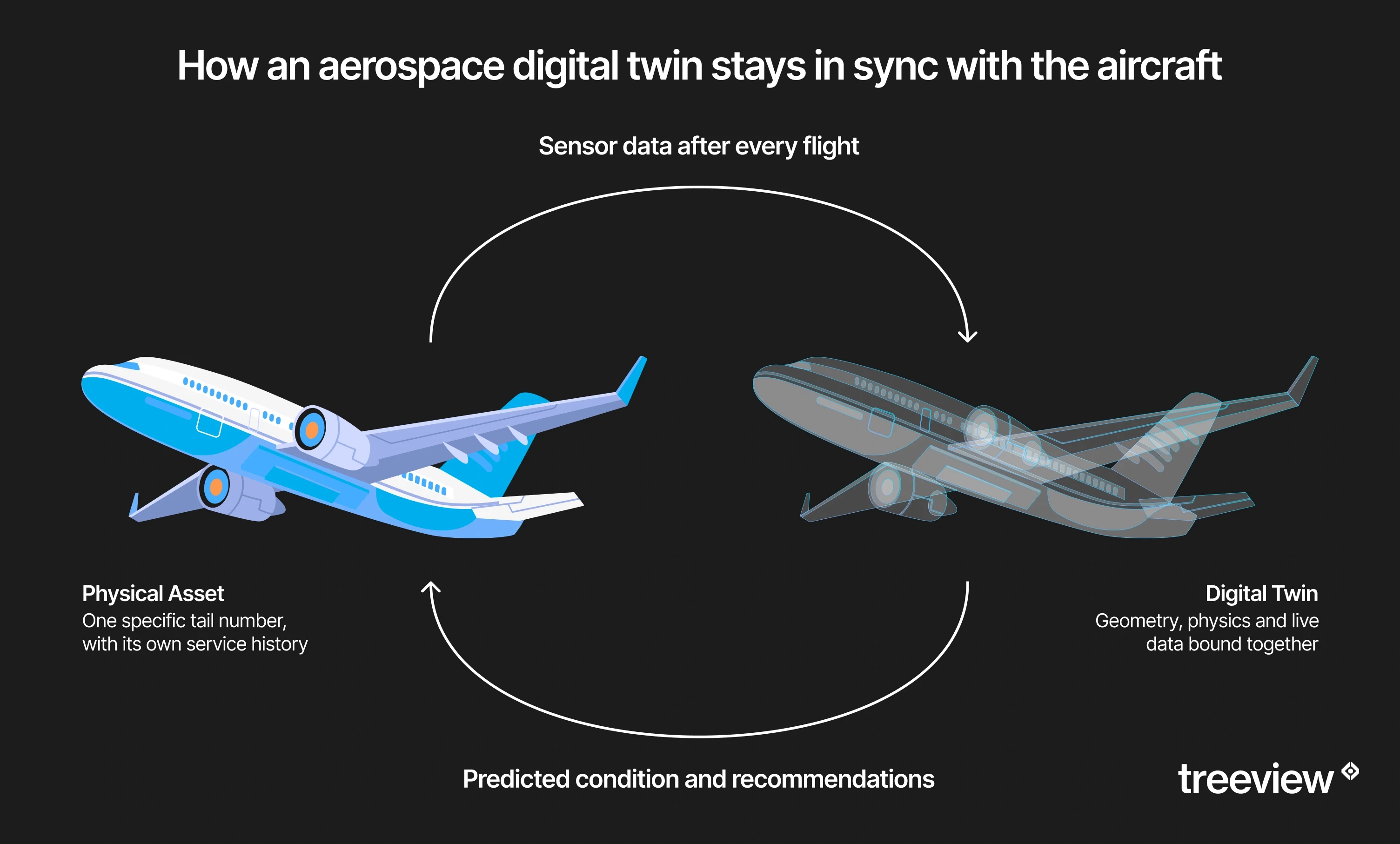
Consider a jet engine on wing. Its geometry comes from the design model and the as-built record of that serial number, including any parts substituted during assembly. Physics enters through thermal and fatigue simulation, which turns geometry into a prediction about how the hot section behaves after another 2,000 cycles. Live data arrives from engine sensors after every flight. It binds the first two together by correcting the prediction against what the hardware actually did.
Without the live feed you have a simulation model. Drop the physics and it becomes a dashboard on a 3D background. Aerospace has run both of these for years under the twin label. An operator and a supplier can use the same word to mean different things.
What a Digital Thread Is in Aerospace
A digital thread is the connected record of an aircraft component, running from design and analysis through manufacturing, certification and into service. The US Air Force coined the term in its Global Horizons report in 2013, and it describes the plumbing that makes a twin possible at all.
Threads answer questions about provenance. Which analysis case cleared this bracket, which machine cut it, which inspection accepted it and which aircraft received it. Twins answer questions about state. What condition is that bracket in today, and what happens if the aircraft flies another 500 hours before inspection.
Vendor material frequently confuses the two, and the confusion matters commercially. Organizations buy thread capability from PLM vendors and expect twin behavior to arrive with it. Thread continuity is a precondition for a useful twin, not a substitute for one. Treeview's digital twin development work happens downstream of the thread, in the layer where engineers and program managers read the data.
The Seven Layers of an Aerospace Digital Twin
Seven distinct capabilities have to be present for a twin to reach production. Different organizations usually deliver them, and the seams between them cause most program delays.
Layer | What it delivers |
|---|---|
Discovery and consulting | Use case definition, data audit and target architecture |
Data integration | Telemetry, flight data, MRO records and business systems made queryable |
As-designed authority | CAD, configuration and the digital thread that ties analysis to part |
Simulation and physics | Fatigue, thermal and structural behavior that separates a twin from a dashboard |
As-built verification | Measured reality reconciled against the design model |
Visualization and interface | The applications engineers and program teams use |
Deployment and in-service support | Models kept synchronized with aircraft that fly and change |
Aerospace splits the asset preparation layer where other industries keep it whole. Tolerances are tight enough that as-designed and as-built become separate sources of truth. Reconciling them is its own discipline with its own vendors. The same divergence shapes Treeview's analysis of digital twin companies for construction and AEC, for different reasons but with similar consequences.
Top Digital Twin Companies for Aerospace (2026)
# | Company | Layer in the stack | Core offering | Best suited to |
|---|---|---|---|---|
1 | Treeview | Visualization and interface | Custom real-time 3D, XR and web twin applications | Programs where engineers and executives need to read twin data directly |
2 | PTC | As-designed authority | Creo CAD and Windchill configuration management | Organizations building thread continuity before twin behavior |
3 | Keysight CAE | Simulation and physics | Virtual manufacturing and material process simulation | Composite structures and forming processes that resist physical trial |
4 | Microsoft Azure Digital Twins | Data integration and cloud | Azure Digital Twins, IoT and analytics infrastructure | Fleet-scale telemetry that has outgrown on-premise storage |
5 | Hexagon | As-built verification | Metrology, reality capture and inspection software | Assembly quality problems that appear late in production |
6 | Lufthansa Technik | Deployment and in-service support | AVIATAR predictive health and fleet operations platform | Operators and MROs turning flight data into maintenance decisions |
1. Treeview

Treeview builds custom digital twin applications for the visualization and interface layer, delivered on desktop, web and headset.
The company builds on top of existing twin data, alongside the platforms that produce it. Aerospace organizations usually arrive with the simulation results and telemetry already in place. What they want next is a way for a program review to interrogate any of it.
Its clearest published example is a mixed reality twin of a green hydrogen energy project, built with Microsoft and delivered on HoloLens 2 and mobile, with a WebGL build for the browser. That work took two Silver Telly Awards in 2026, for use of augmented reality and for digital environments. Engine assemblies and airframe sections suit the same pattern. A technician needs the twin at the hardware, a program manager in a browser.
Best for: the twin already exists and the people who need it sit outside the simulation team.
2. PTC
The as-designed authority layer is where PTC operates, through Creo for design and Windchill for configuration management.
Configuration control is the unglamorous foundation of aerospace twin work. An airframe accumulates modifications and service bulletins across decades. Parts get substituted along the way. A twin referencing the original drawing set describes the aircraft as delivered, decades behind its current configuration. PTC has spent that history building the systems that track the configuration a given tail number is in, across fleets delivered decades apart.
Buyers should note a significant portfolio change. PTC completed the sale of ThingWorx and Kepware to TPG in March 2026. Those products now trade as Velotic, alongside GE Vernova's former Proficy business. Vuforia remained with PTC. Any evaluation material pairing PTC with ThingWorx predates the transaction and needs rechecking before it informs a shortlist.
Best for: twin ambitions keep outrunning the configuration records available to support them.
3. Keysight CAE

Simulation of manufacturing processes is the core of Keysight CAE, the business that traded as ESI Group until its rebrand.
Aerospace simulation divides into two problems, and most vendors are strong at one of them. One is predicting how a finished part behaves in service. Harder still is predicting how that part gets made without warping, wrinkling or delaminating. That problem grows as composite content rises across new airframes.
Keysight acquired a controlling stake in November 2023 and the remaining share capital in January 2024, and the ESI name has since been retired. The tools carried through and kept their own names, among them PAM-COMPOSITES for composite forming and PAM-STAMP for sheet metal. Anyone searching under the old brand will find the same products under a new masthead, with a dedicated aerospace and defense line alongside them.
Best for: the manufacturing process carries more risk than the design, as with composite and formed structures.
4. Microsoft Azure Digital Twins

Azure Digital Twins and the analytics services around it put Microsoft in the data integration layer.
Fleet telemetry outgrows local infrastructure quickly, and the problem compounds with every aircraft added. Sensor data from a single widebody accumulates faster than most engineering storage was scoped for. The analysis that makes the data useful runs on top of that storage, not beside it.
Azure Digital Twins models relationships between assets, not readings alone, and aerospace organizations tend to underestimate that distinction. An engine belongs to an aircraft, which belongs to a fleet flying routes with distinct thermal and cyclic profiles. Modeling those relationships lets a question about one serial number draw on every comparable engine in the fleet, which is where the predictive value originates.
Best for: telemetry volume has already broken the storage plan the program was scoped against.
5. Hexagon

Metrology hardware and the inspection software that reads it combine at Hexagon to cover as-built verification.
Aerospace assembly tolerances leave little room between an acceptable part and a rejected one. Measurement used to happen at the end of production. By the time a defect showed up, the cost of making it had already been paid. Hexagon moved inspection into the process itself, so measured reality reaches the model while the build is still open.
It also runs Digital Factory, a scanning service that produces millimeter-accurate replicas of production sites. Many aerospace plants have evolved over decades and hold layout records that describe an earlier version of the floor. Scanning resolves that gap before a twin program inherits it, and this is a more common starting problem than vendor material admits.
Best for: quality escapes surface late and the plant layout on file dates from an earlier factory.
6. Lufthansa Technik

AVIATAR, the fleet health platform operated by Lufthansa Technik, turns operational data into maintenance decisions.
In-service support is the layer aerospace software vendors reach last and MRO organizations reached first. Lufthansa Technik built AVIATAR from inside the maintenance business, which shows in what the platform prioritizes. Condition monitoring and predictive health analytics sit at the center, with the technical logbook alongside them. The twin concept serves those workflows instead of framing them.
AVIATAR launched in 2017 and now supports more than 5,000 aircraft. Its customers span airlines, MROs, OEMs and lessors. LATAM runs it across a fleet of more than 300 aircraft. Air Transat and TUI have adopted it, as has Frontier. Independence from any single airframe or engine manufacturer matters for mixed fleets, since an operator flying two engine types avoids running two separate health monitoring systems.
Best for: maintenance planning still runs on scheduled intervals while the flight data to replace them already exists.
How Aerospace Organizations Use Digital Twins
Aerospace applies digital twins in four places. Design validation and production quality come first. Fleet maintenance and training follow. Certification requirements shape what a twin is allowed to influence, which makes the pattern differ from other industries.
Major manufacturers run substantial internal programs. Airbus, Boeing, Rolls-Royce, GE Aerospace, Lockheed Martin and Northrop Grumman all maintain twin capability for their own products, and several publish about it. One recurring confusion is worth stating plainly. These organizations are operators and customers of digital twin technology, not vendors of it. GE Aerospace kept the engine business in the 2024 separation, while the industrial software went to GE Vernova.
Maintenance is where adoption runs deepest. Predictive maintenance is the largest application segment of the digital twin market, at 31.04% in 2026 on Fortune Business Insights figures. Aerospace reached that conclusion earlier than most sectors, because an unscheduled removal is measured in aircraft-days.
Training and assembly guidance form the second cluster. A technician can rehearse a difficult assembly sequence against a twin that behaves correctly, then walk to the hardware and repeat it. Sensor-driven twins here share most of their architecture with digital twin IoT companies serving other asset-heavy sectors. The production side shares most of its constraints with digital twin companies for manufacturing.
Aerospace Digital Twin Market Size
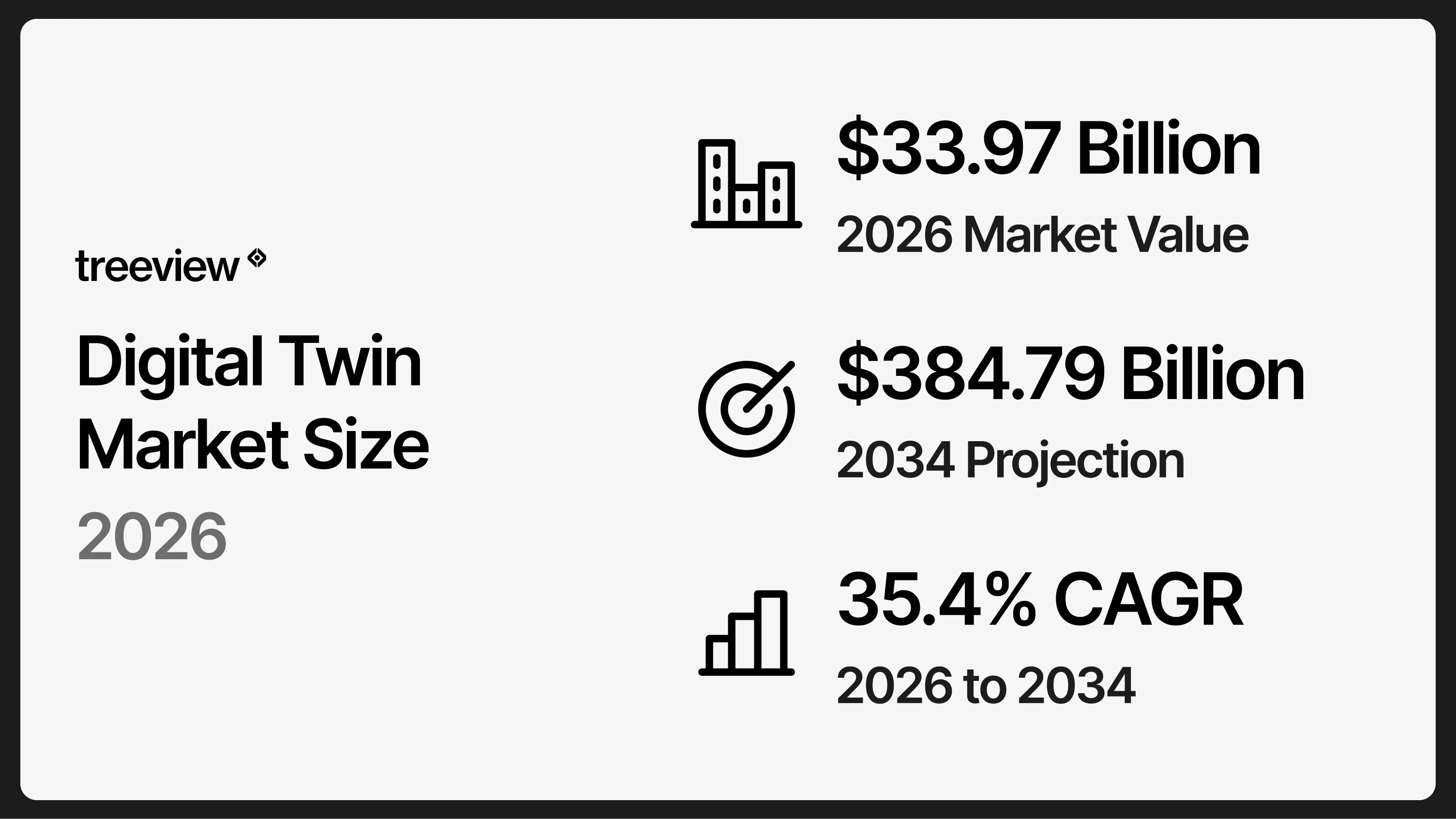
Aerospace and defense held the largest end-user share of the global digital twin market in 2025. Fortune Business Insights projects that market to grow from USD 33.97 billion in 2026 to USD 384.79 billion by 2034, at a CAGR of 35.40%. No separate dollar value is published for the aerospace and defense segment itself.
That segment divides in two. One sub-segment covers aircraft engine design and production, the other space-based monitoring. Both lean closer to physics than to visualization, which is why simulation vendors dominate aerospace market coverage. Manufacturing is expected to grow fastest across end-user segments over the forecast period, so the aerospace lead reflects installed capability more than momentum.
Regional distribution favors North America at 34.00% of the 2025 market, though the growth is happening elsewhere. Asia Pacific took 27.40% in the same year against Europe's 27.90%, and Fortune Business Insights expects Asia Pacific to grow fastest. European airframe programs sit inside that shift. So do the Japanese and Korean supplier bases, alongside an expanding Indian manufacturing base. An American frame understates where new twin spending will originate.
One caution applies to any market figure in this space. Publisher estimates for 2026 vary by roughly 1.6x. Some sub-market figures in circulation exceed their own publisher's global total. A single named publisher, used consistently, beats a range assembled from several.
What the Research Says About Airframe Digital Twins
Peer-reviewed work on aerospace twins is more cautious than vendor material, and the gaps it identifies are useful to buyers.
Chia et al. reviewed the development of the Airframe Digital Twin framework since 2011 in the Journal of Manufacturing Systems. The concept began in defense aviation as a route to condition-based maintenance. Models have grown more detailed and broader in scope since. Early implementations combined multiphysics models with data-driven methods, and the authors document that hybrid pattern as the dominant architecture.
Its central finding concerns what remains unsolved. Applying airframe twins to structural prognostics and health management is still incomplete. The authors name the integration of environmental and operational conditions as a specific weakness. Fatigue and corrosion receive the most attention as degradation modes. Both depend heavily on operating environment.
Two further reviews address adjacent domains and should be read with their scope attached. Shahzad et al. examined 55 studies on digital twin and mixed reality integration in building operations and maintenance. They found that implementations still rely mostly on 2D or static 3D interfaces.
Kibria and Kittur screened 45 publications through a computer engineering lens, identifying six themes. Security earns a theme of its own, while visualization and interface sit outside the set. The gap is worth naming. Academic work on the interface layer trails its commercial weight.
How to Choose a Digital Twin Partner for Aerospace
Start by identifying which layer you still need. Most aerospace organizations already hold more twin capability than they think. It lies scattered across simulation and PLM systems, then again in the maintenance records, each holding part of the picture. Ask a candidate vendor which layer they own and which layers they assume you have. Then ask who maintains synchronization after delivery, since proposals routinely omit that cost.
Match your ambition to what the research supports. Chia et al. find airframe twins still incomplete for structural prognostics, with environmental and operational conditions poorly integrated. A vendor promising full predictive coverage of fatigue and corrosion is offering more than the literature delivers.
Controlled programs narrow the field again, since ITAR-controlled data and accredited hosting carry obligations that only a subset of vendors are set up to meet. Work that out before you assess the engineering.
Frequently Asked Questions (FAQs) About Aerospace Digital Twins
Q1. What is an airframe digital twin?
An airframe digital twin, often shortened to ADT, is a twin scoped to the aircraft structure itself instead of the engine or the production system.
The term comes out of the defense aviation literature, where it was proposed as a route to condition-based structural maintenance. An ADT tracks fatigue and corrosion on a named tail number, predicting when inspection becomes necessary.
Q2. How does model based systems engineering relate to digital twins?
Model based systems engineering, or MBSE, is the practice of expressing system requirements and behavior as models instead of documents.
MBSE produces the authoritative system model a twin can be built against. Aerospace programs that already run MBSE tend to reach a working twin faster, because the requirements and interfaces exist in machine-readable form before anyone starts binding live data.
Q3. Why do published digital twin market figures vary so much?
Estimates for 2026 differ by roughly 1.6x between publishers, so the number you cite depends almost entirely on which house you read.
Methodologies differ on what counts as a twin, and some houses publish sub-market figures that exceed their own global total. Pick one publisher and stay with it. Treat any figure quoted without a named source as unusable.
Q4. Which companies build digital twins for aerospace?
Treeview, PTC, Keysight CAE, Microsoft Azure Digital Twins, Hexagon and Lufthansa Technik each cover a different layer of the aerospace digital twin stack.
Manufacturers including Airbus, Boeing, Rolls-Royce and Lockheed Martin run large internal twin programs. They operate that technology for their own products instead of selling it. This is why they appear in market coverage but not on vendor shortlists.
Q5. What does a digital twin do for aircraft maintenance?
A twin lets an operator swap fixed service intervals for decisions based on the actual condition of the part.
The economics are what drive adoption here. An unscheduled removal takes an aircraft out of service on someone else's schedule. A predicted one lets the operator choose the slot. The part gets ordered ahead of it and a shop with capacity gets booked.
Q6. Can digital twins be used on ITAR-controlled or classified programs?
Yes, though the requirements differ substantially from commercial work.
Controlled programs typically require cleared personnel and accredited hosting, plus restrictions on technical data handling that a subset of vendors are equipped to provide. Settle the compliance question first. A vendor can be excellent at the engineering and still be ineligible to do the work.
Q7. What is the difference between as-designed and as-built in an aerospace twin?
As-designed describes the intended geometry from CAD and analysis, while as-built describes what the factory actually produced, measured through metrology and inspection.
Aerospace tolerances are tight enough that the two diverge meaningfully. A twin referencing only the design model will mispredict the behavior of a specific airframe. As-built verification is treated as its own layer for that reason.
Q8. Is 3D visualization enough, or does a digital twin need simulation?
Simulation is required.
Connecting a 3D model to live data shows current state, and prediction takes more than that. What you have so far is a monitoring dashboard with spatial context. Physics simulation lets a twin answer questions about future condition. Prediction is the dividing line between a twin and a viewer.
Q9. How do digital twins support aerospace training?
Twins give technicians a place to practice work that is hard to practice on a real airframe.
Confined-space jobs are one example. Fault conditions too rare to stage are another. On a headset or a tablet, the guidance sits at the hardware itself. The training twin runs on the same data as the engineering twin, so procedures stay current when the configuration changes.
Q10. How long does an aerospace digital twin project take?
Timelines depend on which layer you still need and on the state of the source data.
Programs with clean CAD and working telemetry, where the use case is already defined, can reach a working twin in months. Teams that must first reconcile configuration records or scan a facility should plan that groundwork separately. It frequently consumes more schedule than the twin build itself.