
Five layers make a manufacturing digital twin work: measurement, data, simulation, platform and interface. Vendors specialize. Most manufacturers arrive with three or four layers already covered, which turns vendor selection into a question about the gap: which layer sits empty, and who fills that one well.
This page ranks six companies by the layer each one occupies, what each is strongest at, and where the trade-offs sit. A wider view of the category sits in our ranked guide to digital twin development companies, and this page is the manufacturing cut of it.
Manufacturing is the fastest-growing end-user segment of the digital twin market according to Fortune Business Insights, though aerospace and defense held the largest share through 2025. Definitions come first here, because the vocabulary in this space is used loosely. Digital twin development covers work ranging from a physics model of one machine to a plant-wide operating picture, and those are different projects requiring different vendors.
What is a Digital Twin in Manufacturing?
A digital twin in manufacturing is a virtual model of a machine, production line or plant that stays synchronized with its physical counterpart through live data.
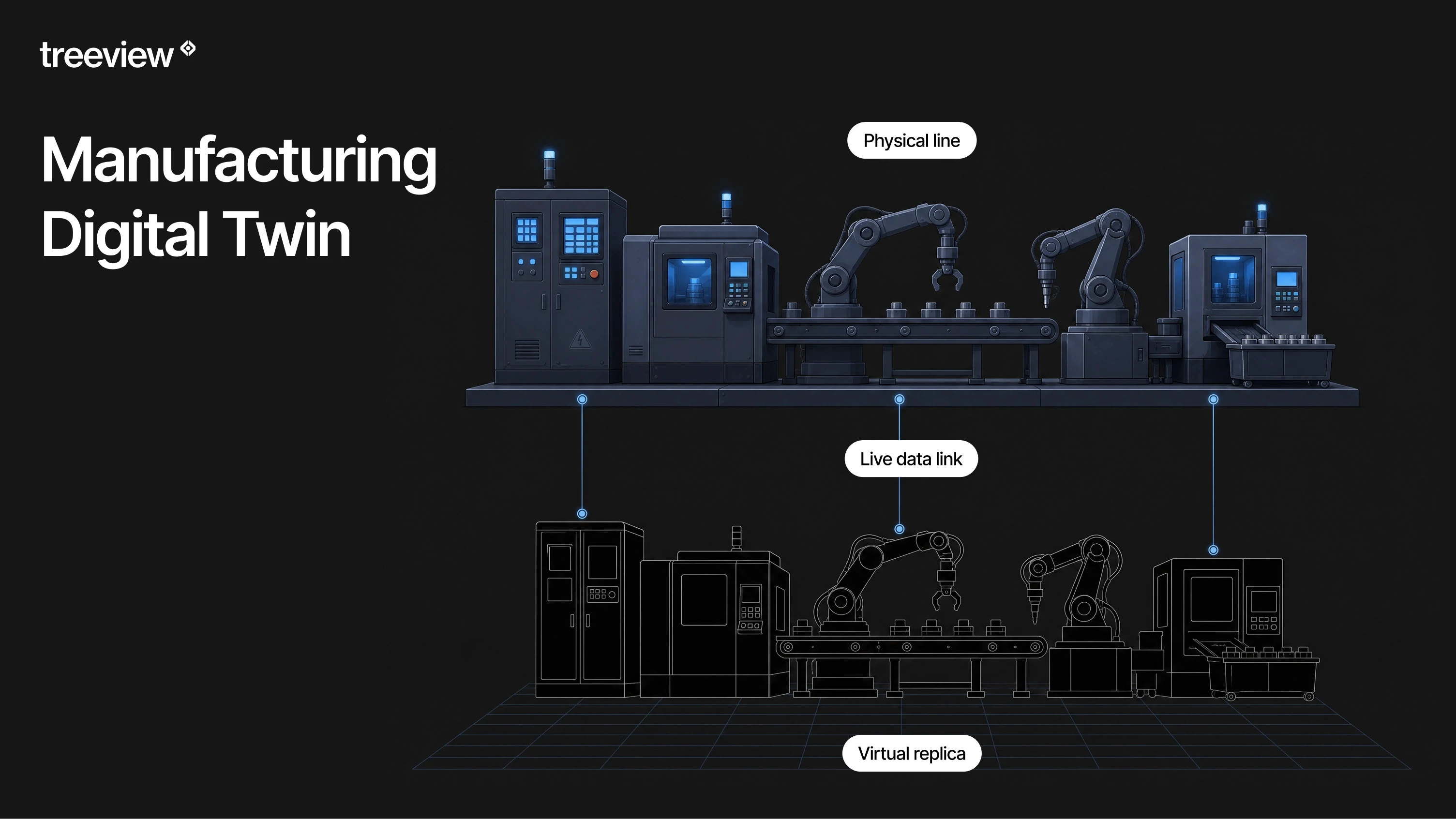
Synchronization separates a twin from a 3D model. Sensor data arrives from PLCs, SCADA systems and IIoT gateways, and it updates the model continuously rather than at the moment somebody exports a file. That connection lets the twin answer questions about the asset as it is running now, not as it was designed. A digital twin usually sits inside a broader smart factory program as one component of it.
Manufacturers generally build one of three kinds:
A product twin models a part or a finished good through its design and service life.
A process twin models how material moves and transforms through a sequence of operations.
A system twin models an entire plant or supply chain, usually by assembling the other two. Each pulls from different systems.
Product twins draw on CAD and PLM records, process twins on MES and historian data, and system twins reach into ERP.
The three carry very different costs, and the split matters when scoping a project. Fortune Business Insights puts product twins at 35.72% of the digital twin market by type in 2026, the largest of the four categories it tracks. Predictive maintenance takes 31.04% by application, the largest single use of the technology. A manufacturer describing a plant-wide system twin is therefore describing the least common and most expensive thing in the category.
How a Manufacturing Digital Twin differs from a Simulation
A simulation models a system in isolation, while a digital twin stays connected to the physical asset and updates as real conditions change.
The distinction matters commercially because the two are frequently sold under the same name. A physics-based simulation of a pump predicts how that pump behaves under a set of assumptions the engineer supplies. An IoT digital twin of the same pump takes its inputs from the pump itself, so the prediction reflects the wear, the ambient conditions and the duty cycle the machine has actually experienced.
Most digital twins contain a simulation engine as one component. That engine supplies the predictive capability, and the data connection supplies the current state. What-if analysis needs both, because the value of asking what happens if line speed increases by 10% depends entirely on whether the starting point reflects the real line.
The 5 Layers of a Manufacturing Digital Twin Stack
A manufacturing digital twin stack has five layers, and nearly every vendor occupies one or two of them.
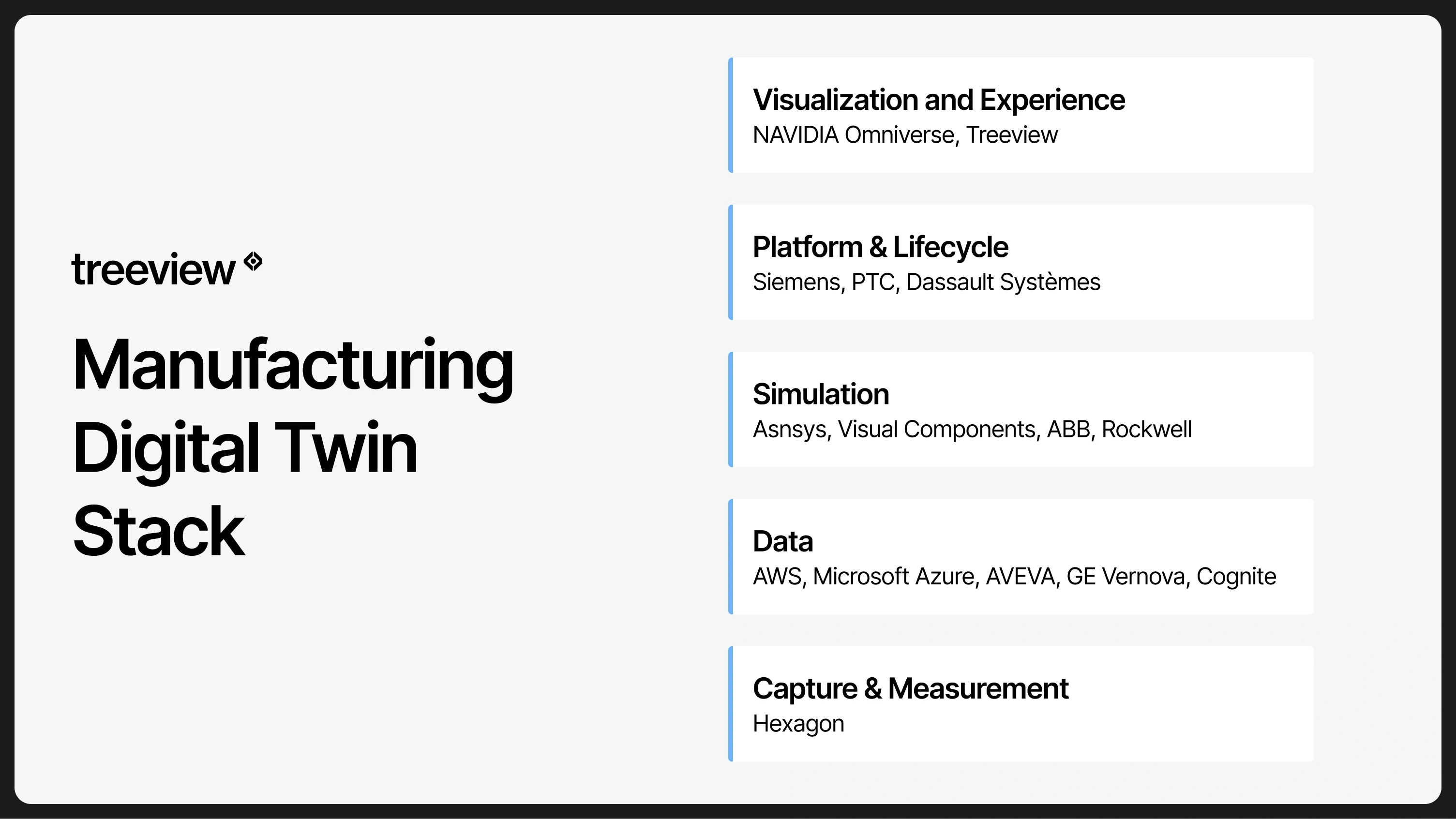
Layer | What it does | Vendors that hold it |
|---|---|---|
Capture and measurement | Turns physical reality into geometry and dimensional data through scanning and metrology | Hexagon, reality capture specialists |
Data | Collects sensor, historian and enterprise data, then contextualizes it into a usable model | AWS, Microsoft Azure Digital Twins, AVEVA, GE Vernova, Cognite |
Simulation | Predicts behavior, either physics-based or event-driven | Ansys, Dassault Systèmes, Visual Components, ABB, Rockwell Automation |
Platform and lifecycle | Connects the twin to PLM, MES and the digital thread across the product life | Siemens, PTC, Dassault Systèmes |
Visualization and experience | Where people read the twin and act on what it shows | NVIDIA Omniverse, Treeview |
The platform layer receives most of the attention and most of the budget. Siemens, PTC and Dassault Systèmes have spent decades building the systems that hold engineering and production data, and a manufacturer standardizing on one of them is making a reasonable choice. That layer is well served and rarely the one causing a stalled project.
The layers that fail are the ones on either end. A twin with no measurement discipline drifts from the as-built asset until its outputs stop being trustworthy. A twin with no usable interface produces correct answers that nobody reads. The same pattern shows up in other verticals. Treeview's work on city-scale digital twins for urban planning and on construction and AEC digital twins finds platform data existing long before anyone can act on it.
Readers outside the United States should note that the vendor landscape here is genuinely international. Fortune Business Insights puts North America at 34% of the global digital twin market in 2025, Europe at 27.90% and Asia Pacific at 27.40%. That is a more even split than most coverage of this category implies. Four of the six companies ranked below are headquartered in Europe, and the strongest regional presence for any given layer varies by market.
Top Digital Twin Companies for Manufacturing
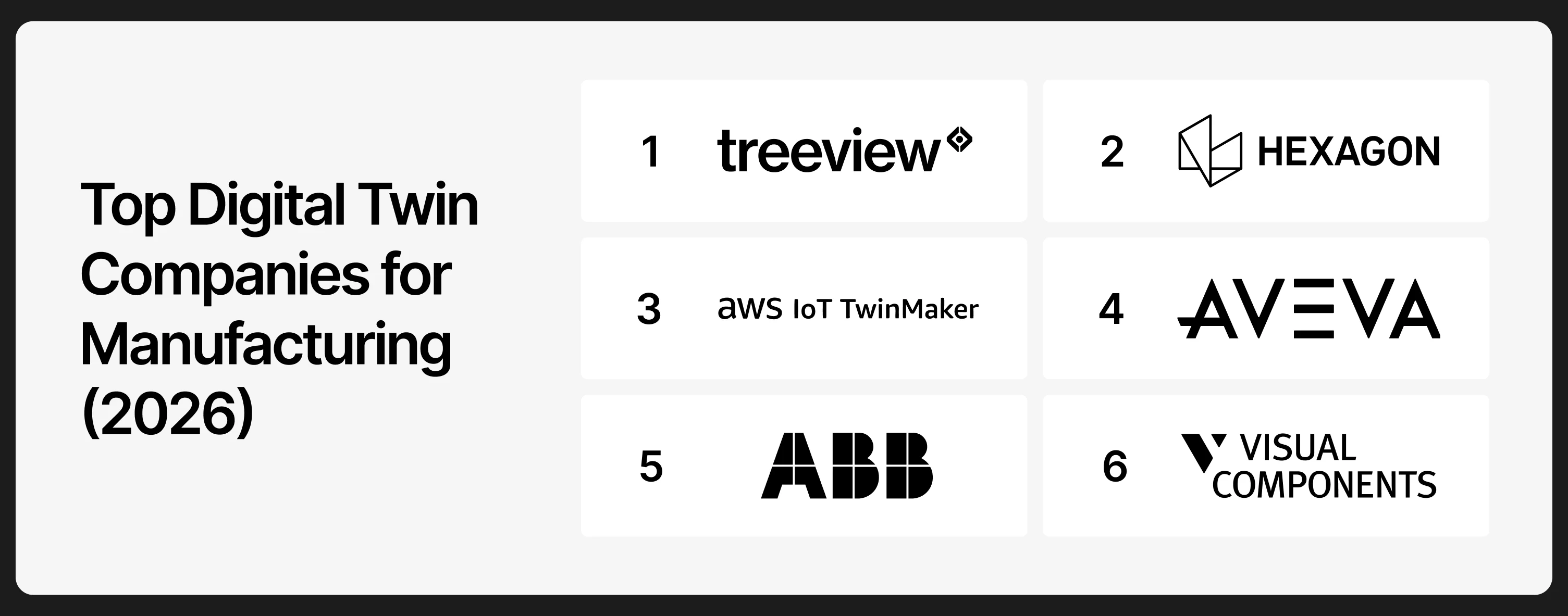
The six companies below each hold a distinct layer of the stack. Ranking reflects the breadth of the layer each one covers, not company size.
# | Company | Layer in the stack | Core offering | Best suited to |
|---|---|---|---|---|
1 | Treeview | Visualization and experience | Real-time 3D and XR interfaces built on existing twin data | Manufacturers whose platform data is unusable on the floor |
2 | Hexagon | Capture and measurement | Metrology hardware, reality capture and quality software | Discrete manufacturers with tight dimensional tolerances |
3 | AWS IoT TwinMaker | Data | Twin graph and 3D scene composition over existing data sources | Plants standardized on AWS |
4 | AVEVA | Data, operations | Process simulation, operations control and the PI System historian | Process manufacturers with long historian records |
5 | ABB | Simulation, robot cells | Robot cell simulation and offline programming on ABB controllers | Lines built around ABB robotics and material handling |
6 | Visual Components | Simulation, production line | Line simulation, layout planning and vendor-neutral offline programming | Engineers designing or rebalancing a mixed-fleet line |
1. Treeview

Treeview builds the visualization and experience layer of enterprise digital twins, the interface through which operators and engineers work with live plant data.
The studio designs real-time 3D environments that sit on top of whichever platform, cloud and historian a manufacturer already runs. Work spans desktop, web and XR headsets, which matters when a maintenance engineer needs the twin at the machine itself. Treeview has delivered enterprise work for Microsoft, Meta, Toyota, Medtronic and ULTA Beauty since 2016.
Named twin work includes an AI-enabled mixed reality digital twin built with Microsoft for a multi-billion-dollar green hydrogen energy project, delivered on HoloLens 2, mobile and WebGL, plus a twin for mining group Teck Resources. Delivery runs on Unity, and the studio's Unity 3D development practice covers 3D asset production through deployment on production hardware. Treeview operates a senior-only team and transfers client IP in full at project close.
Best for: Manufacturers whose twin data already exists but remains unusable to the people on the shop floor.
2. Hexagon

Hexagon builds digital twins anchored in physical measurement, connecting metrology hardware and inspection data to the virtual model of a part or a line.
Hexagon's Manufacturing Intelligence division supplies coordinate measuring machines, laser scanners and the PC-DMIS metrology software used across automotive and aerospace production. Measurement data keeps a twin honest. A model that drifts from the as-built part stops supporting quality decisions. Hexagon AB is headquartered in Stockholm and names metrology, reality capture and positioning as its three technology domains.
Nexus, the division's cloud platform, was co-engineered with Microsoft and carries the quality applications, including an autonomous metrology suite that maintains a digital twin of every connected measuring machine. Manufacturers working to tight dimensional tolerances tend to arrive here first. Hexagon separated its asset lifecycle, geospatial and infrastructure businesses into Octave, an independent public company, in May 2026, and Manufacturing Intelligence stayed with Hexagon.
Best for: Discrete manufacturers where quality and dimensional accuracy carry the business case.
3. AWS IoT TwinMaker
AWS IoT TwinMaker builds digital twins from data a manufacturer already holds, without requiring that data to move into a new system of record.
TwinMaker reaches existing sources through built-in connectors, drawing equipment and time series data from IoT SiteWise, video from Kinesis Video Streams, and CAD files or business application data from S3. It combines them into a knowledge graph describing how assets relate to one another, then attaches that graph to a 3D scene of the plant. Dashboards render through a Grafana plugin rather than a proprietary front end.
The appeal here is architectural. Manufacturers running workloads on AWS avoid a second cloud relationship and keep operational data where it sits. The trade-off is that TwinMaker supplies plumbing rather than a finished operator experience, so the visualization layer generally comes from elsewhere.
Best for: Plants already standardized on AWS that need the data layer resolved before anything else.
4. AVEVA
AVEVA builds digital twins for process manufacturing, where the asset is a continuous chemical or refining operation rather than a discrete production line.
AVEVA owns the PI System, a data historian first released in 1985. It arrived with the OSIsoft acquisition in 2021, and that lineage is why AVEVA twins typically start with a far longer operating record than a newly instrumented asset can offer. AVEVA is headquartered in Cambridge in the United Kingdom, and Schneider Electric took full ownership in January 2023 after a majority stake held since 2018.
Coverage spans plant engineering, process simulation, operations control and asset performance management, so one twin can carry a facility from design through daily running. Process simulation models chemistry and flow rather than geometry, which is a different discipline from discrete line simulation. Chemicals, oil and gas, pharmaceuticals and food production are the core markets.
Best for: Process manufacturers with a long historian record and continuous operations.
5. ABB

ABB builds digital twins around robotics and automation cells, modeling how machines move and where they collide before any hardware reaches the floor.
RobotStudio is the offline programming and simulation environment, and it runs on ABB's Virtual Controller, an exact copy of the software that runs on the physical robot. That fidelity is the point, because a program validated in simulation behaves the same way on the real cell, so engineers can commission without halting production. ABB operates from Switzerland and Sweden and serves manufacturing customers across every major region.
Offline programming is the usual entry point, because it returns value before a twin of the whole plant exists. RobotStudio is tied to ABB controllers and the RAPID language, which makes it strongest in plants standardized on ABB robots rather than mixed fleets. Material handling, welding and assembly are where the fit is clearest.
Best for: Manufacturers whose throughput depends on ABB robot cells and automated material handling.
6. Visual Components
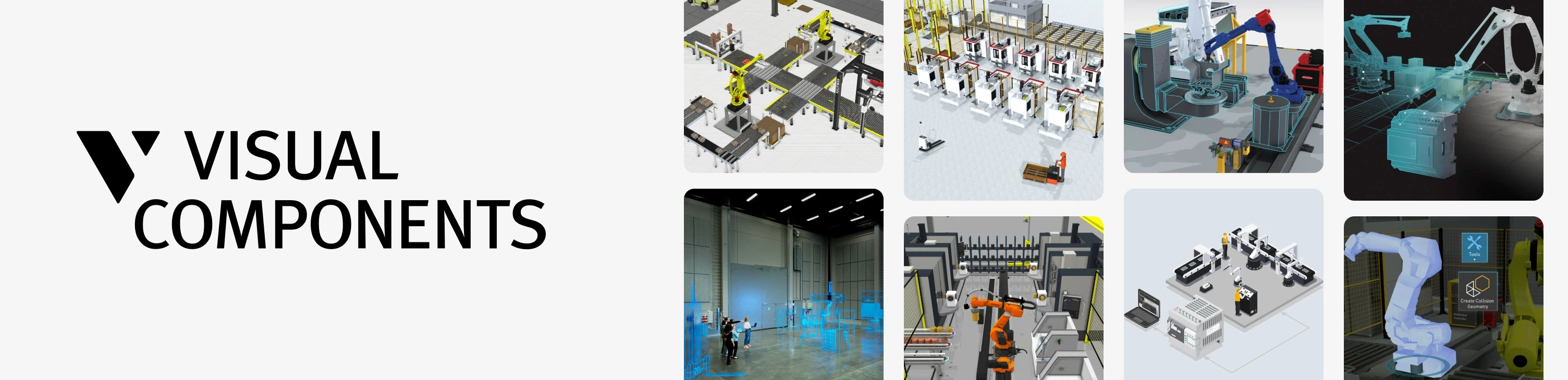
Visual Components builds 3D manufacturing simulation software for production lines, letting engineers test layout and flow before committing to steel.
Visual Components models a line as a sequence of machines, buffers and transport. Product runs through it, and the bottleneck shows up. Machine builders and system integrators use it to demonstrate a proposed line to a customer before quoting the work. Founded in 1999 and based in Espoo, Finland, the company sells through a partner network with subsidiaries in the United States and Germany.
Layout planning, virtual commissioning and robot offline programming sit in one environment. That offline programming is vendor-neutral rather than tied to a single robot brand, which is the difference from ABB above. Version 5.0, released in March 2026, added MQTT support for live data exchange with mobile robots. Throughput questions get answered in hours, without a physical trial run.
Best for: Engineers designing or rebalancing a line who need throughput answers across a mixed equipment fleet.
How to choose a Digital Twin Company for Manufacturing
Start by identifying which layer is missing. A manufacturer with a mature PLM deployment and no way to see the line does not need another platform. A manufacturer with excellent operator dashboards drawing on drifting geometry does not need a better interface. The failing layer is usually visible in the question people keep asking and cannot answer.
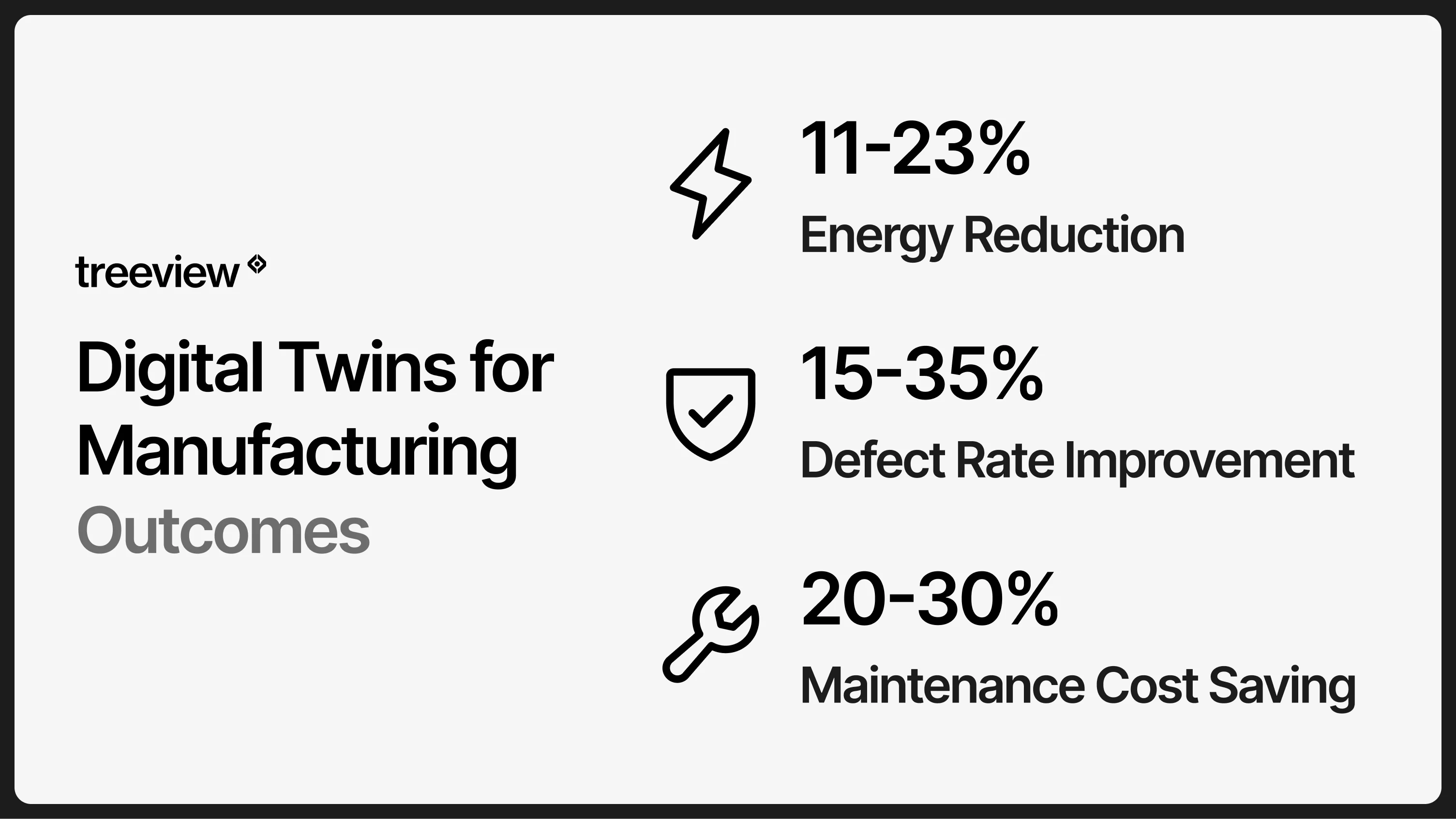
Calibrate ambition against what is already working. A twin that models one cell accurately and gets used every shift returns more than a plant-wide twin that stalls in integration. A 2026 systematic review of 291 peer-reviewed studies reports energy reductions of 11 to 23%, defect rate improvements of 15 to 35% and maintenance cost savings of 20 to 30%. The same review notes that roughly 81% of those implementations cover a single machine or one isolated line. Sequencing matters for the same reason, because each layer depends on the one below it: measurement discipline before simulation, and a resolved data layer before any serious interface work.
The structural problem worth naming is where value appears relative to where budget goes. Spending concentrates in the data layer. Deloitte's 2025 Smart Manufacturing and Operations Survey put investment priorities for the following two years at 40% for data analytics, 29% each for cloud and AI, and 27% for IIoT. Value appears at the interface layer, because that is where a person makes a different decision than they would have made otherwise. The same systematic review found around 64% of studied twins sitting at monitoring or prediction maturity, against only 8% reaching the control level where the twin governs a decision rather than describing one. Projects that fund the data layer and defer the interface produce twins that are technically correct and operationally unused.
Frequently Asked Questions
Q1. What are the main use cases for digital twins in manufacturing?
The four that recur across manufacturers are predictive maintenance, virtual commissioning, throughput optimization and quality analysis.
Predictive maintenance watches an asset for failure signatures and schedules intervention before a stoppage. Virtual commissioning tests a new or modified line in software before hardware installation, compressing the ramp period. Throughput optimization locates and relieves bottlenecks in a running line. Quality analysis traces a defect back to the process conditions that produced it, which is where measurement-grade twins earn their keep.
Q2. How do digital twins support predictive maintenance?
A digital twin supports predictive maintenance by comparing an asset's live behavior against a model of how that asset should behave, then flagging the divergence.
The model can be physics-based, statistical or a combination. Sensor data on vibration, temperature, current draw and cycle time feeds the comparison continuously. The output is a warning with lead time attached, which is what converts unplanned downtime into scheduled work.
Q3. What is virtual commissioning in manufacturing?
Virtual commissioning is the practice of testing a production line's control logic and mechanical behavior in software before the physical equipment is installed.
The engineer connects real PLC code to a simulated line and runs it. Sequencing errors, collisions and interlock faults surface during the design phase, long before they can consume floor time during installation. Manufacturers rebuilding a line inside a shutdown window use this heavily, because the window is fixed and debugging on the floor is the expensive way to find problems.
Q4. Which industries use manufacturing digital twins most?
Automotive and aerospace lead adoption, followed by pharmaceuticals, semiconductors and food and beverage production.
Automotive and aerospace arrived first because both already ran heavy simulation practices and both build products complex enough to justify the modeling effort. Pharmaceutical manufacturing follows for a different reason, since regulatory documentation requirements make a validated process model useful beyond the operational case. Semiconductor fabs adopt where yield sensitivity makes small process improvements worth large investments.
Q5. Can a digital twin work with legacy factory equipment?
Yes, and most manufacturing digital twins run partly or entirely on equipment that predates the concept.
Older machines are instrumented externally, with retrofit sensors and gateways collecting the signals the machine does not publish itself. Protocol translation handles the rest, converting proprietary or serial outputs into something a modern data layer can read. The binding constraint is signal availability. If the use case needs data the machine cannot be made to emit, its age is beside the point.
Q6. What data does a manufacturing digital twin need from MES and SCADA systems?
A manufacturing digital twin generally needs production state from MES and equipment state from SCADA, joined on a common time base.
MES supplies the work order, the routing, the material genealogy and the quality results. Together they describe what the line was supposed to be producing. SCADA and the underlying PLCs supply machine status, cycle times, alarms and process variables, which describe what the equipment was doing. Reconciling the two is where most integration effort goes, because the timestamps rarely align and the asset naming rarely matches.
Q7. Can a small or mid-sized manufacturer build a digital twin?
Yes, though the category is still dominated by large enterprises, which Fortune Business Insights puts at 66.41% of the digital twin market by enterprise type in 2026.
The same source expects small and medium enterprises to grow fastest across the forecast period, and the reason is scope. A twin of one bottleneck cell needs a handful of signals, a model and an interface, and it can be built and proven inside a quarter. The costs that put twins out of reach belong to plant-wide programs, where integration across many systems consumes most of the budget before anyone sees an output.
Q8. What is ISO 23247?
ISO 23247 is the international standard defining a digital twin framework for manufacturing, published by ISO/TC 184/SC 4.
Parts 1 through 4 appeared in 2021 and cover general principles, a reference architecture, the digital representation of manufacturing elements and information exchange. The architecture is built around the observable manufacturing element, meaning any item with a physical presence on the floor, including equipment, products, facilities, personnel and processes. Part 5, on the digital thread, published in June 2026, and Part 6, on digital twin composition, published in July 2026. Part 6 is the one worth reading if a twin has to combine work from several vendors. It names three composition patterns, integrated, unified and federated, and gives implementation guidance for each.
Q9. What is OpenUSD and why does it matter for factory digital twins?
OpenUSD is an open scene description format that lets 3D models from different vendors be combined into one environment without conversion loss.
The problem it addresses is common in manufacturing, where a plant model assembles CAD from machine builders, scan data from a survey, robot models from an automation vendor and layouts from a planning tool. Historically each combination required a lossy export, which made interoperability between vendor toolchains a limit on how large a twin could grow. A shared format allows those sources to be composed and referenced rather than merged, so an update to one model propagates instead of requiring a rebuild.
Q10. Should a manufacturer buy a digital twin platform or build a custom one?
Buy the platform when the asset class is standard and the data already lives in a vendor's native format, and build custom when the twin must span vendors or when the interface itself is the deliverable.
Platforms carry real advantages: maintained connectors, a support relationship and a shorter path to a first result. They constrain in one direction, since the twin tends to work best on the vendor's own data and to fit awkwardly around everything else. Custom development answers two cases. One is a manufacturer running equipment and software from several vendors that no single platform covers. The other is an interaction that does not exist off the shelf, for instance a mixed reality overlay on live equipment. Most mature deployments end up combining the two, with platforms holding the data layer and custom work holding the experience layer.