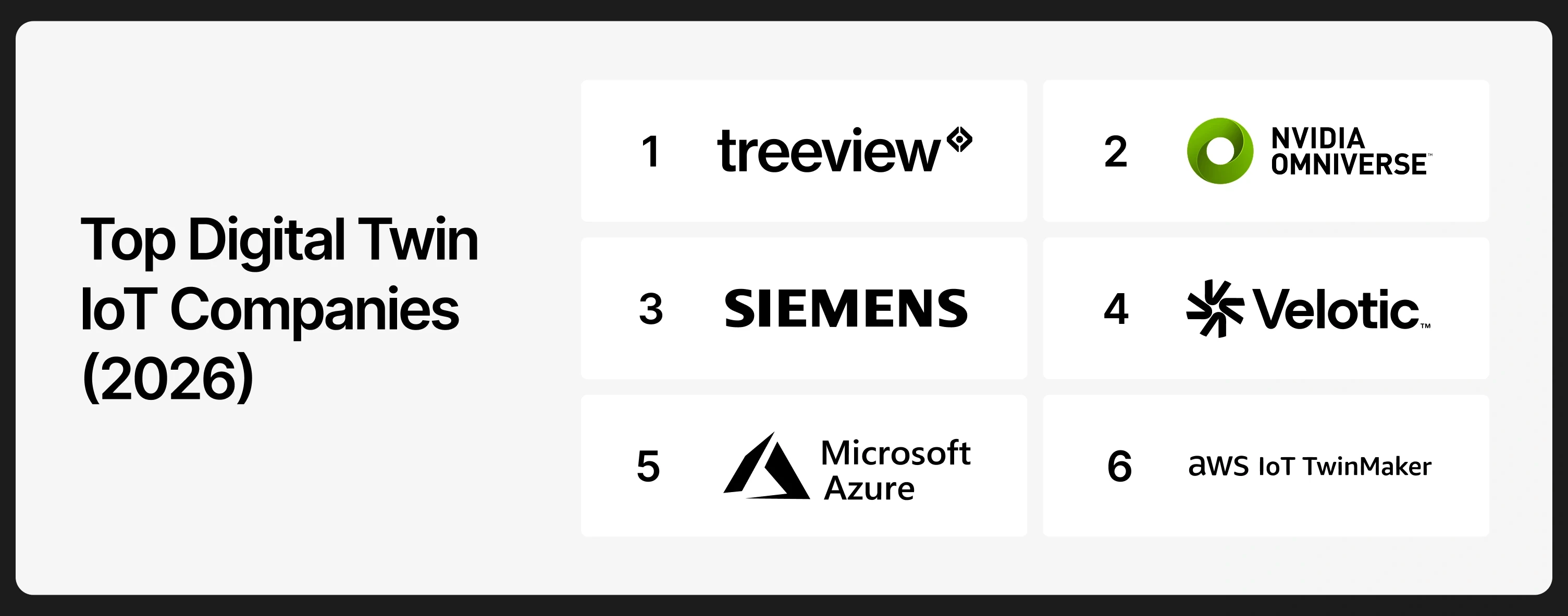
The companies building IoT digital twins in 2026 line up across six layers of a single stack, and each of the six leaders owns one layer outright. Treeview builds the visualization and experience layer. AWS, Microsoft, Velotic, Siemens and NVIDIA hold the layers underneath it, from device ingestion through to real-time rendering. Choosing well starts with naming the layer your organization needs, then shortlisting the vendors who hold it.
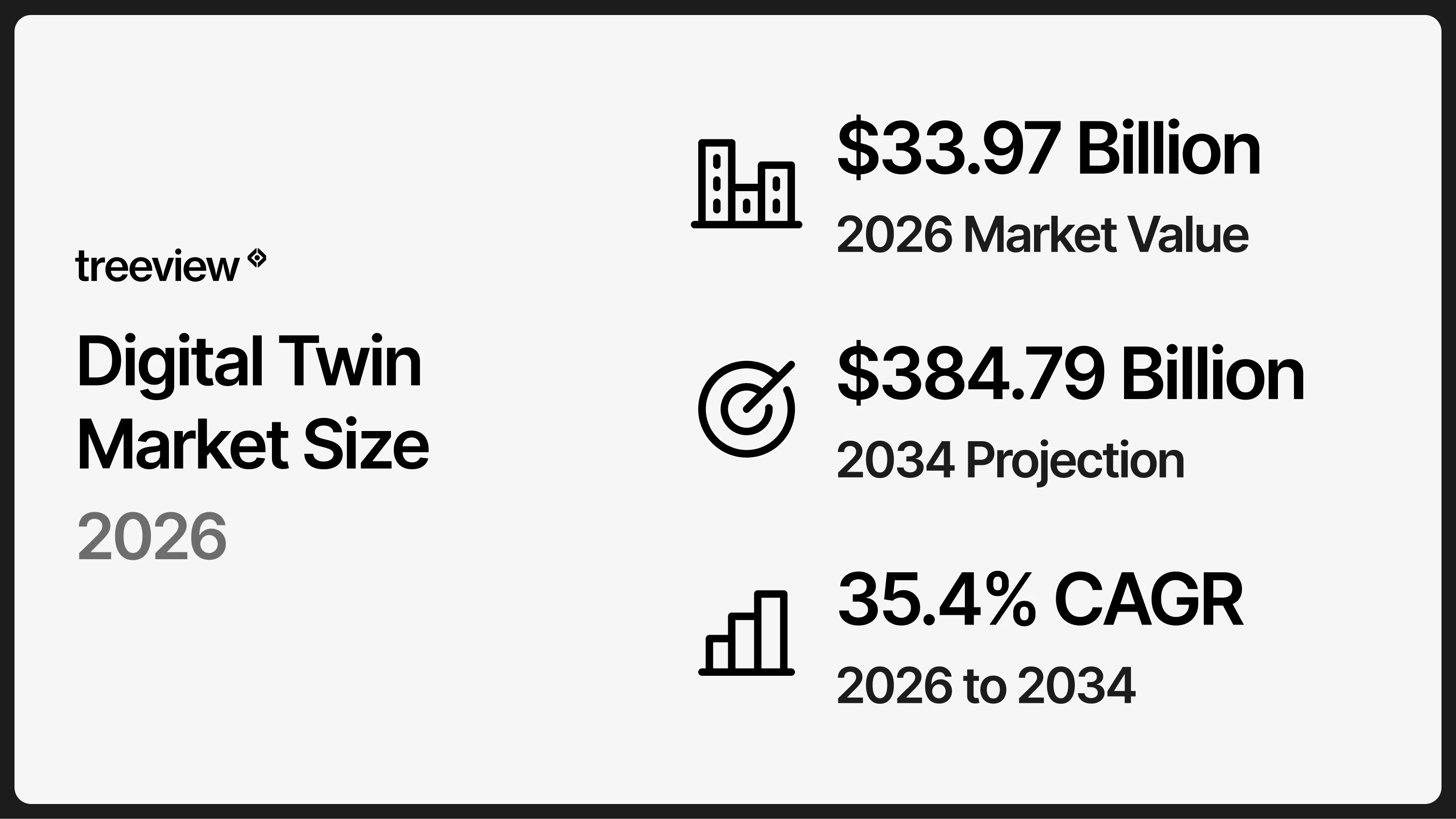
An IoT digital twin connects live sensor data to a virtual model of a physical asset. Operators see current state instead of last month's report. Fortune Business Insights values the global digital twin market at USD 33.97 billion in 2026, growing to USD 384.79 billion by 2034 at a CAGR of 35.40%. The largest single application is predictive maintenance at 31.04% of the 2026 market, and predictive maintenance cannot run without live equipment data.
This page covers the IoT and real-time data side of the category. For the broader view across every digital twin type, Treeview maintains a list of top digital twin development companies, and organizations scoping a build can start from Treeview's digital twin development services.
What Is a Digital Twin in IoT?
An IoT digital twin is a virtual model of a physical asset that updates continuously from sensor data streaming off that asset. The model holds the asset's structure, its relationships to other assets and its current state. IoT supplies the state.
Three things have to happen for a twin to stay live. Sensors and controllers publish telemetry, usually over MQTT or OPC UA. A platform ingests that telemetry, maps each reading to the right entity in the model and stores the history. An interface renders the result so a person can read it and act on it.
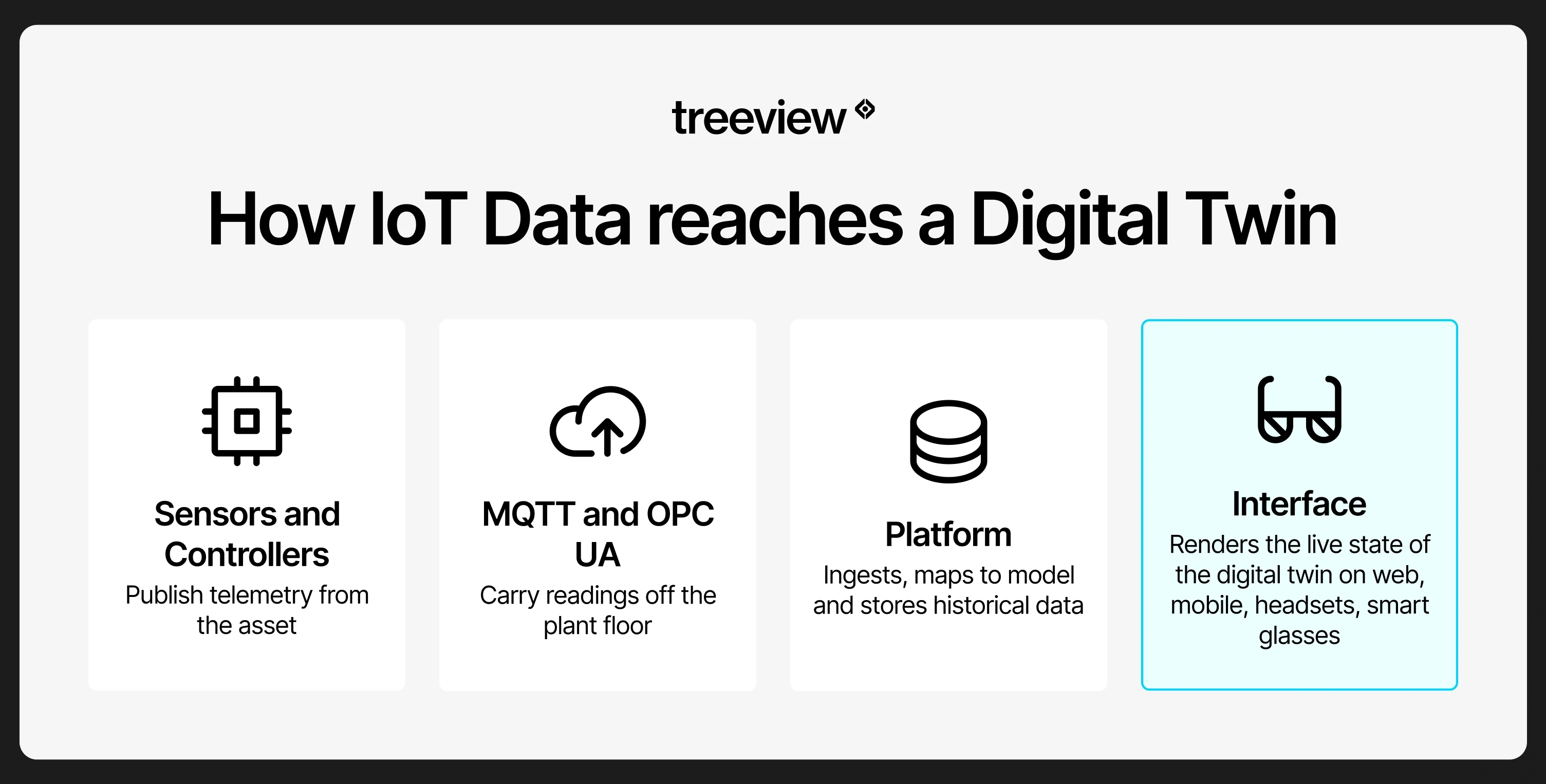
Most descriptions of digital twins stop at the second step. The growing prevalence of IoT devices and sensors supplies the real-time data behind dynamic representation of physical entities, Fortune Business Insights notes. That is accurate, and one step remains. Data becomes useful at the moment somebody can see it.
How IoT Digital Twins Differ From IoT Dashboards
An IoT dashboard shows readings. An IoT digital twin shows readings in the context of the asset they came from, positioned in space, with the relationships between assets preserved.
This distinction matters operationally. A dashboard tells a plant engineer that bearing temperature on line three sits at 84 degrees. A twin shows which bearing, on which machine, next to which other machines, with the last six hours of drift visible in place. Diagnosis time collapses when the operator stops mentally reconstructing the plant from a list of tag names.
The visualization layer is where the category has the most ground still to cover. A 2025 state-of-the-art review by Shahzad and colleagues covered 55 academic studies on digital twin and mixed reality integration. It found that current implementations rely predominantly on 2D or static 3D interfaces, which limits visualization, immersion and interaction with the data.
SCADA systems, historians and time series databases remain the incumbent technology in most industrial settings. A twin reads those systems and renders what they hold in three dimensions. The control layer stays exactly where it is.
The Six Layers of an IoT Digital Twin Stack
Every IoT digital twin runs on six layers, and most organizations already own three or four of them before they start shopping. A 2026 systematic literature review in Frontiers in the Internet of Things synthesizes the research into six themes and states that each theme sits at a different level of the stack. Its lower themes cover embedded platforms and real-time execution. Above those sit communication and distributed infrastructure across IoT, edge and cloud.
Layer | Function | What it makes possible |
|---|---|---|
Ingestion and connectors | Device connection, protocol handling, telemetry into the cloud | Telemetry reaches the cloud from the plant floor |
Model and graph | Entity relationships, ontology, current state | Every reading attaches to a known asset |
Application platform | Operational apps, alerting, workflow | The right person hears about the right reading |
Simulation | Physics-backed prediction against live state | The twin predicts as well as reports |
Real-time 3D rendering | Scene generation at interactive frame rates | Geometry moves at interactive frame rates |
Visualization and experience | Purpose-built interfaces on web, mobile and headset | Operators open it every shift |
Top Digital Twin IoT Companies in 2026
# | Company | Layer in the stack | Core offering | Best suited to |
|---|---|---|---|---|
1 | Treeview | Visualization and experience | Custom real-time 3D, web and XR interfaces built on existing twin data | Organizations with a working data platform and no usable interface |
2 | NVIDIA Omniverse | Real-time 3D rendering | OpenUSD scene composition and physically accurate rendering | Teams needing photorealistic industrial scenes at scale |
3 | Siemens | Simulation | Physics-backed twins across Xcelerator and Simcenter | Manufacturers who need prediction as well as current state |
4 | Velotic ThingWorx | Application platform | Industrial IoT application enablement and operational apps | Discrete manufacturers building operator-facing workflows |
5 | Microsoft Azure Digital Twins | Model and graph | DTDL-based entity modeling and live state management | Enterprises standardizing twin models across many sites |
6 | AWS IoT TwinMaker | Ingestion and connectors | Connectors to existing data sources without data migration | Organizations whose operational data already sits in several systems |
1. Treeview
Treeview builds the visualization and experience layer of IoT digital twins, creating custom real-time 3D, web and XR interfaces on top of data a client already owns. The studio runs a senior-only team across New York and Montevideo, with enterprise clients including Microsoft, Medtronic, Toyota, Daiichi Sankyo, Stanford Medicine and Teck Resources. Every engagement starts from the interface question.
Treeview's AI-enabled mixed reality twin for Microsoft modeled a green hydrogen renewable energy project and shipped on HoloLens 2, mobile and WebGL from a single build. That range matters, because operations teams, executives and field engineers rarely share a device. The work is engineering-led, delivered without a platform license and without any requirement to move data out of the systems that hold it.
Best for: the point where the data platform is live and the only people who have opened it are engineers.
2. NVIDIA Omniverse
NVIDIA Omniverse handles rendering. It composes large industrial scenes in OpenUSD, lights them with physically accurate materials, and connects to CAD, BIM and simulation tools rather than replacing them, which makes it the place where geometry from several authoring systems resolves into one scene. Adoption is strongest where visual fidelity carries operational weight, such as facility layout and robotics validation.
Omniverse holds the highest answer-surface presence of any rendering technology in this category, and it appears alongside almost every platform vendor on this list. That reflects its position underneath the twin platforms as shared infrastructure. Teams typically pair it with a data layer above and an interface layer on top, since Omniverse renders scenes and leaves operator workflow to whatever sits in front of it.
Best for: scenes too large or too physically detailed for a general-purpose engine to hold.
3. Siemens
Siemens brings physics to the twin, running models that predict how an asset will behave under conditions it has not yet met. That depth is old. The Xcelerator portfolio spans design, manufacturing planning and operations, with Simcenter supplying the simulation engines and Insights Hub handling industrial IoT connectivity, and those engines predate the cloud products now wrapped around them.
Scope is the practical question, and it cuts both ways. Organizations that need calibrated simulation get Simcenter models running against the same asset structure the operations team already uses, and organizations that need only live monitoring pay annually for capability they never exercise.
Best for: asking what an asset will do next, when the answer has to survive an engineering review.
4. Velotic ThingWorx
Velotic ThingWorx turns connected asset data into operator-facing applications, handling industrial connectivity through Kepware and modeling assets as things with properties and services. The product changed owners in March 2026. TPG bought ThingWorx and Kepware from PTC, combined them with GE Vernova's Proficy business and launched all three as Velotic, where each keeps its own product name.
ThingWorx is one of the few platforms designed from the start around industrial equipment rather than adapted from general cloud infrastructure. Kepware's protocol coverage across legacy controllers is the practical reason many plants choose it, and sharing an owner with Proficy puts connectivity, historian and SCADA on one roadmap. Organizations wanting a distinctive interface pair ThingWorx with a purpose-built front end and let the platform handle the data and the logic underneath it.
Best for: plants where the connectivity problem is older equipment and the goal is a working alert on shift.
5. Microsoft Azure Digital Twins
Azure Digital Twins holds the model and the graph. It describes assets and their relationships in DTDL, then maintains live state across the resulting graph so that every downstream application queries one structure. The service ships no visualization of its own by design, connecting instead to Azure IoT Hub for ingestion and to Data Explorer or Synapse for history and analysis.
DTDL is why organizations pick it. Defining an ontology once and applying it across forty buildings or twelve plants turns a set of local projects into one queryable estate, which is difficult to retrofit later. The trade-off is that Azure Digital Twins is a component rather than a product, and teams expecting a finished application find they have bought a foundation.
Best for: the fortieth site, when the first thirty-nine were each modeled differently.
6. AWS IoT TwinMaker
AWS IoT TwinMaker builds twins from data that stays where it already lives. Connectors read from existing sources including historians, time series stores and video feeds, so organizations reach a working twin without running a migration project first, and the service composes those sources into a single scene. Amazon Managed Grafana exposes the result.
That connector-first design explains why TwinMaker dominates search results for IoT digital twins. It answers the objection most operations teams raise first, which is that their data is scattered across systems everyone would prefer to leave alone. The built-in scene composer covers basic 3D viewing, and teams that need an interface people will open every shift treat TwinMaker as the data layer and build above it.
Best for: the first twin, when the data sits in six systems and nobody has budget for a migration.
IoT Digital Twins by Industry
The industries adopting IoT digital twins fastest are the ones running expensive equipment that fails expensively. Aerospace and defense held the largest end-user share of the digital twin market in 2025, and manufacturing is the fastest-growing segment through 2034 in the Fortune Business Insights forecast.
Industry | The live data | What the twin is for |
|---|---|---|
Manufacturing | Machine, line and quality telemetry | Seeing which asset on which line is drifting, before it stops |
Energy and utilities | Turbine, substation and grid telemetry | Wind and gas turbines and power infrastructure spread across sites with occasional physical access |
Engine, airframe and orbital telemetry | Aircraft engine production and space-based monitoring, where physical access is limited or impossible | |
Automotive and transportation | Vehicle and fleet telemetry | Fleet management and vehicle simulation measured against how the vehicles are actually driven |
Healthcare | Device and patient monitoring streams | Medical device simulation and continuous monitoring, where the asset is sometimes a person |
Real estate and facilities | HVAC, occupancy and energy telemetry | Running a building on what the building reports instead of on a maintenance calendar |
The interface question changes shape across these settings, and the change is larger than it looks. A plant engineer, a grid operator and a facilities manager all need live state, and none of them will accept the same screen. Sensor density, refresh rate and the consequences of a missed reading differ in every row of that table, and those three variables decide most of what the top layer has to do.
How to Choose an IoT Digital Twin Partner
Start by identifying which layer you are missing. Most organizations approaching this category already own ingestion and a model, often without calling them that, because a historian and an asset register together cover both. The gap usually sits at simulation or at the interface, and those two gaps have completely different vendors attached.
Calibrate against what is running, not against what is possible. A twin that renders live state accurately in a browser and gets opened every shift delivers more than a physics-backed model still waiting on configuration. Large enterprises hold 66.41% of the market in 2026 on the Fortune Business Insights numbers, which reflects who can absorb a multi-year platform program. Smaller operations reach useful outcomes faster by building narrow.
The structural argument for building the top layer separately comes from the research, not from vendors. Shahzad and colleagues found the visualization layer to be the least developed part of an otherwise mature stack, with 2D and static 3D interfaces still dominant. Every platform on this list ships a default viewer, and default viewers are built to demonstrate the platform beneath them. The interface an operator uses every shift is the one part of the stack that has to be built for that operator, and it is the part most likely to be inherited by accident.
Frequently Asked Questions (FAQs) about Digital Twin IoT Companies
Q1. Which protocols do IoT digital twins use to ingest data?
MQTT and OPC UA carry most industrial telemetry into digital twins, with REST APIs and cloud-native IoT hubs handling the rest.
MQTT suits high-frequency sensor publishing over constrained networks. OPC UA carries richer semantics and dominates in plants already running industrial control systems. Most platforms accept both, and connector coverage for older equipment is usually the real constraint.
Q2. Can a digital twin run on live SCADA data?
Yes. SCADA systems are one of the most common data sources for industrial digital twins, usually read through a historian or an OPC UA gateway.
A digital twin sits alongside SCADA and leaves control where it is. The twin reads the same tags and presents them in spatial context. Plants keep control in SCADA and use the twin for visibility, diagnosis and planning.
Q3. How much latency is acceptable in a real-time digital twin?
It depends entirely on what the twin is for. Monitoring and diagnosis tolerate seconds. Operator-in-the-loop work needs sub-second response.
Latency budget should be set before architecture, because it decides where processing happens. Cloud round trips are fine for trend visibility and unacceptable for anything a person reacts to physically. Edge processing exists to solve the second case.
Q4. Do you need a digital twin platform to build an IoT digital twin?
No, though most organizations at enterprise scale use one. Platforms supply ingestion, modeling and state management that would otherwise be built.
Single-site or single-asset twins are frequently built directly against existing data sources with no platform license involved. Platforms earn their cost when the same model has to hold across many sites and stay consistent.
Q5. What is the difference between an IoT digital twin and a simulation model?
An IoT digital twin reflects what an asset is doing now. A simulation model predicts what it would do under conditions that have not occurred.
Both combine well and are frequently confused. A twin fed by live telemetry answers questions about current state. A physics-backed simulation answers questions about hypothetical state, and it needs the twin's data to stay calibrated.
Q6. Can IoT digital twins run in a web browser?
Yes. WebGL and WebGPU support real-time 3D twins in a browser with no installation, which is why browser delivery has become the default for wide internal distribution.
Browser delivery trades some rendering fidelity for reach. Organizations needing both usually ship a browser build for general access and a headset or desktop build for the smaller group doing detailed spatial work.
Q7. How do IoT digital twins support predictive maintenance?
Twins supply the live condition data and asset context that predictive models need, then surface the resulting prediction against the specific asset it applies to.
Predictive maintenance is the largest digital twin application segment in 2026 at 31.04% of the market, and the fastest growing, according to Fortune Business Insights. Prediction without spatial context still leaves an engineer searching for which pump the alert refers to.
Q8. Are IoT digital twins worth building for a single site?
Often yes, and single-site builds usually reach production faster because scope stays narrow and the data sources are known.
Multi-site programs carry modeling and governance overhead that a single site avoids entirely, and that overhead reaches its extreme in digital twins for smart cities and urban planning. Organizations frequently prove value on one facility before deciding whether an estate-wide model justifies its cost.
Q9. Do you need a 3D model of the asset before building an IoT digital twin?
Not always. Existing CAD or BIM models are the fastest route, and laser scanning or photogrammetry produces usable geometry where no model exists.
Scanning an operating facility returns a point cloud reflecting as-built condition, which frequently differs from the drawings on file and is a gap the digital twin companies working in construction and AEC meet on almost every project. Geometry fidelity should match the job, since a twin built for condition monitoring needs far less detail than one built for spatial planning.
Q10. What are the main barriers to IoT digital twin adoption?
Data security, the absence of universal standards and the interoperability problems that follow from it are the barriers Fortune Business Insights names as the main restraints on the market.
Interoperability is the one that shapes architecture decisions. Twins pull from systems that were never designed to talk to each other, and the integration work is routinely underestimated. Scoping that work honestly at the start separates a twin that reaches production from one that stalls at proof of concept.