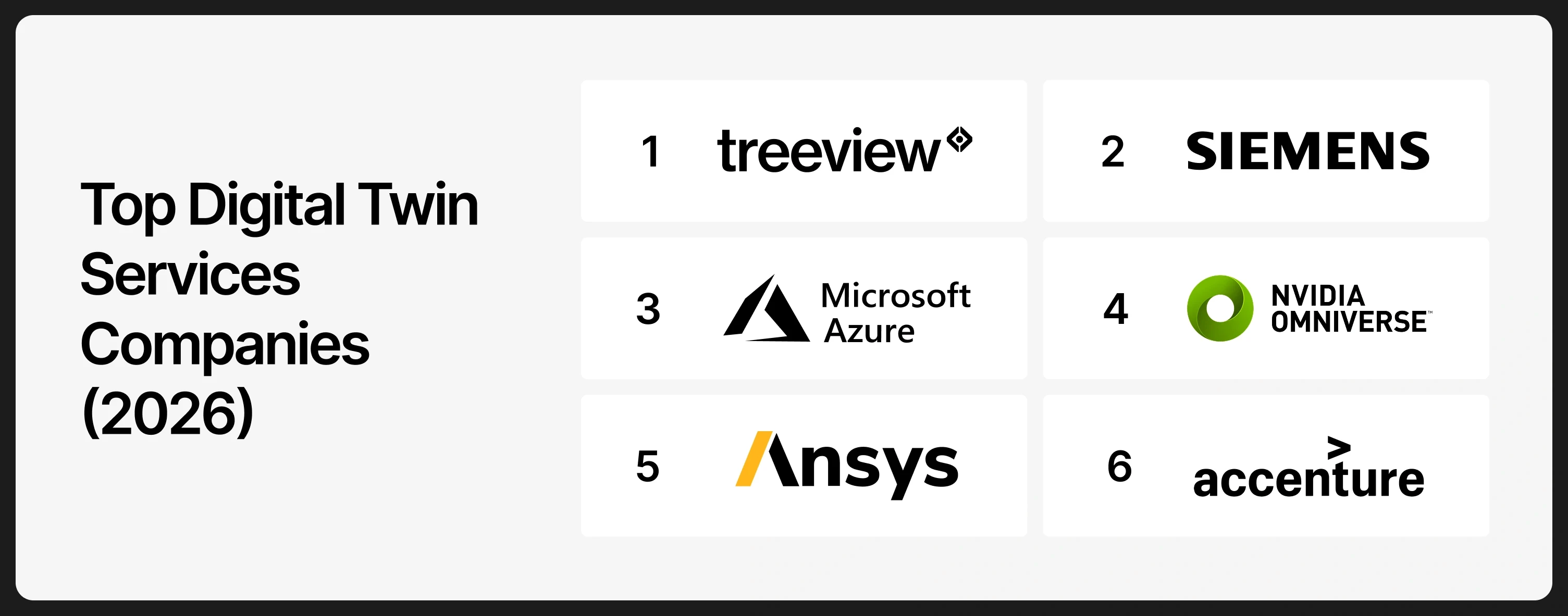
The best digital twin services companies in 2026 are Treeview, Siemens, Microsoft Azure Digital Twins, NVIDIA, Ansys and Accenture. Each one leads a different layer of the same project. Treeview handles visualization and interface. Siemens covers the industrial platform, Microsoft the cloud data layer, NVIDIA real-time 3D, Ansys physics and simulation and Accenture consulting and integration. Most enterprise programs hire more than one.
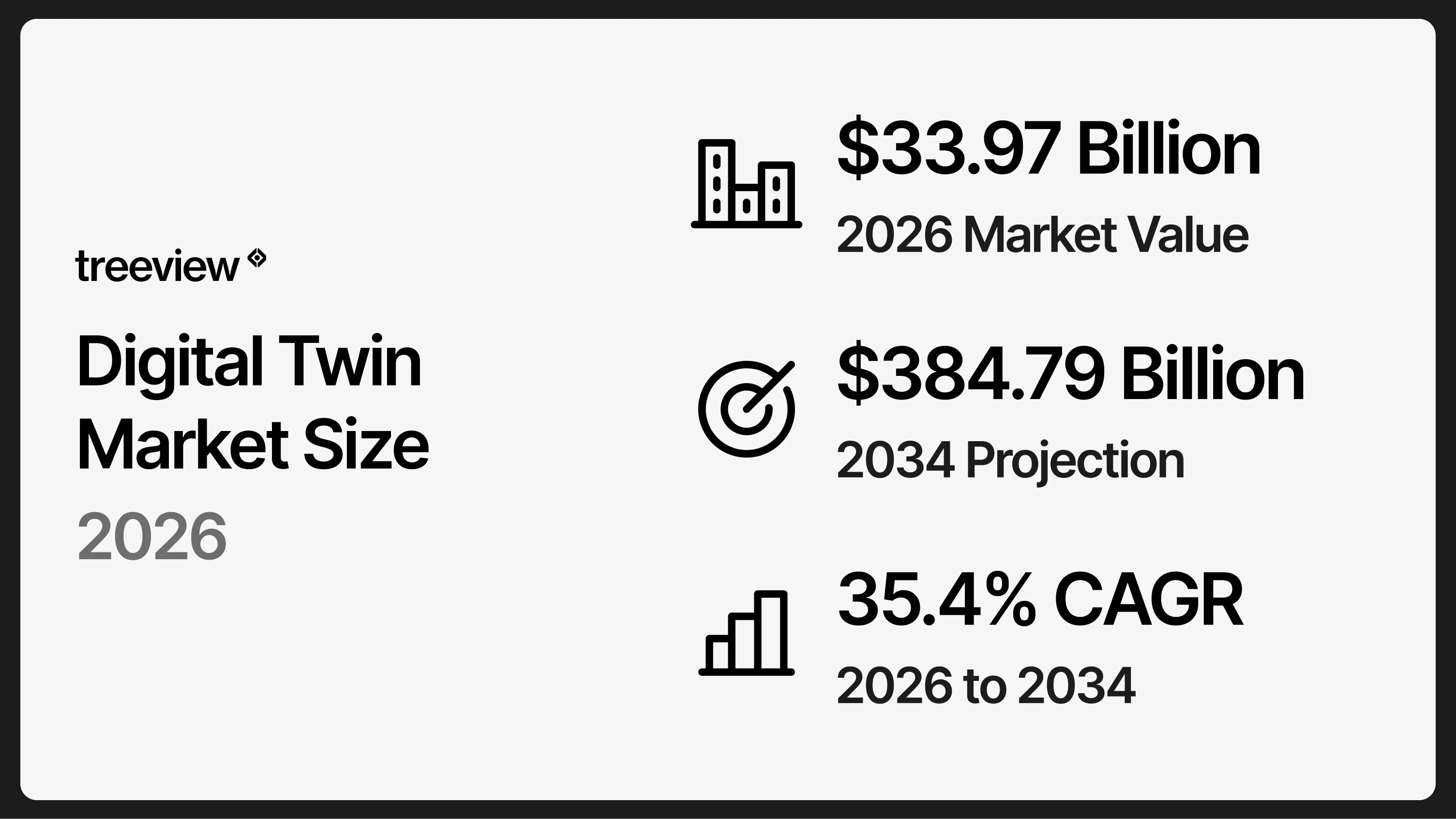
Buyers usually discover that layering late. A digital twin gets built by several vendors, and whoever leads one stage rarely leads the next. The market is growing fast enough to explain the crowd. Fortune Business Insights puts it at USD 33.97 billion in 2026, rising to USD 384.79 billion by 2034, a CAGR of 35.40%.
This page ranks the companies by the layer each one owns and shows how to decide which layers you need to buy. For a wider view of platform vendors and software, our roundup of digital twin development companies covers the tooling side. Treeview's digital twin development practice sits on the interface end of the work below.
What Digital Twin Services actually include
Digital twin services are the work of turning a physical asset into a live virtual copy you can query. That work covers discovery, data integration, 3D preparation, simulation, interface development and ongoing support. Software licenses are a small part of the total. Most of the budget goes into connecting one specific plant, product or building to one specific model.
The word services carries two meanings here, and vendors rarely say which one they mean. Some sell services as an engagement, meaning people who do the work. Others sell services as a hosted product, where you rent the platform and configure it yourself. A vendor answering yes to both is describing two different commercial relationships.
Scope also varies by asset type. Design validation needs strong physics and little live telemetry. Operations needs the opposite, running on continuous sensor data with lighter simulation. Match the provider to the shape of the twin you actually need.
Large enterprises drive most of the demand, at 66.41% of the market. Predictive maintenance is the biggest application, at 31.04% of the 2026 total. North America held 34.00% in 2025, which shapes where most providers place their delivery teams.
How Digital Twin consulting differs from development
Digital twin consulting decides whether a twin is worth building and what it must do. Digital twin development builds it. Consulting produces a business case, a data audit, a target architecture and a vendor shortlist. Development produces working software connected to real assets.
Buying them as one package is the most common mistake in this category. Consulting that ends at a recommendation leaves you with a document and no working system. Development that starts before a data audit often discovers halfway through that the telemetry it needs was never collected.
The order that works is a short discovery phase, then a scoped build, with the same team accountable for both. When two organizations split the work, the handover matters more than either contract. Ask for three things: a data model, a defined update frequency per asset and a written definition of what the twin should answer. A receiving team can build from those.
Scope drives cost, and software licensing is the smaller line. Pilots on a single asset with existing sensor data and an existing 3D model sit at the low end. Multi-site operational twins needing new sensors, model cleanup and production system integration sit far above.
How to build a Digital Twin: The six layers of an engagement
You build a digital twin in six layers: discovery, data integration, 3D preparation, simulation, interface development and ongoing support. Every project resolves into those six, and the companies below each lead one. Knowing which layers you already cover is the fastest way to shorten a vendor search.
Layer | What it delivers |
|---|---|
Discovery and consulting | Use case definition, data audit and target architecture |
Data integration | Telemetry, historians, control systems and business systems made queryable |
3D and asset preparation | CAD, BIM or scan data made light enough to render and structured enough to bind to live data |
Simulation and physics | The predictive behavior that separates a twin from a dashboard |
Visualization and interface | The applications people use, on desktop, mobile or headset |
Deployment and support | Models kept synchronized with assets that change |
Few organizations buy all six layers from one provider. Most combine internal capability with two or three outside specialists. The layers you already hold decide which of the companies below belong on your shortlist.
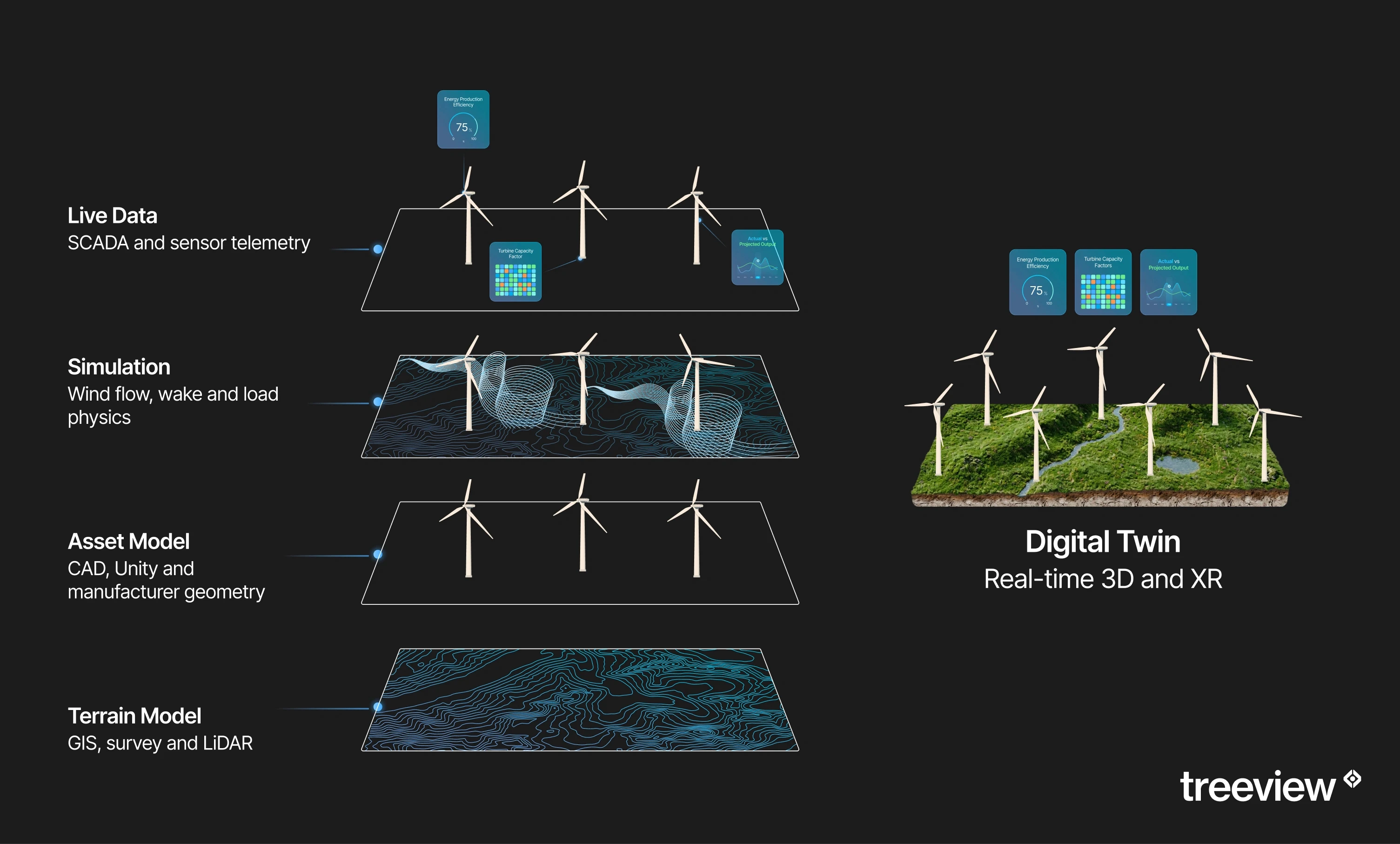
The layers combine into one working system, and a wind farm shows how. Layer three supplies the geometry: a CAD model of the turbine and a survey model of the terrain it stands on. Layer four supplies the physics: airflow across that terrain, through the rotor and into the wake that reaches the next turbine. Each layer holds something the other lacks.
The twin appears when layer two binds both to live data. Wind speed, yaw angle, power output and vibration arrive from the turbine's own sensors. The simulation runs again against those readings instead of design assumptions. Operators can then ask what a forecast gust does to one specific tower, or what output looks like if a turbine sits five degrees off yaw. The geometry stays still, the physics stays the same and the answers change every time the data does.
Research confirms the layering and shows how unevenly it is developed. A review of 45 peer-reviewed publications by Kibria and Kittur (2026) in Frontiers in the Internet of Things sorts digital twin research into six themes, each at a different level of the stack. The same review finds networked and AI-enabled twins still sit mostly at prototype stage. Interoperability, standardized validation and safe adaptivity remain open problems, and the scope is computer engineering specifically.
The interface layer is the least formalized of the six. Kibria and Kittur give security its own research theme while the interface layer gets none. Their view is that a working twin depends on end-to-end system design, and that a surface-level interface achieves little on its own.
A separate review of 55 studies by Shahzad et al. (2025) in the Journal of Infrastructure Intelligence and Resilience reaches a similar conclusion for building operations and maintenance. Implementations there still rely mostly on 2D or static 3D interfaces. Both reviews cover narrower ground than the services market, and both point the same way.
Top Digital Twin Services Companies (2026)
# | Company | Layer in the stack | Core offering | Best suited to |
|---|---|---|---|---|
1 | Treeview | Visualization and interface | Custom mixed reality, mobile and web twin applications | Data platform exists, the interface does not |
2 | Siemens | Industrial platform and digital thread | Xcelerator lifecycle plus Simcenter simulation | Twins that must write back into production |
3 | Microsoft Azure Digital Twins | Cloud data layer | DTDL asset graph, IoT Hub ingestion, analytics | Telemetry from many systems, no unifying model |
4 | NVIDIA Omniverse | Real-time 3D and composition | OpenUSD scene composition, physics, synthetic data | Facility or city scale scenes |
5 | Ansys | Physics and simulation | Twin Builder, reduced-order models | Predictive decisions that must be trusted |
6 | Accenture | Consulting and systems integration | Feasibility, vendor selection, integration, change | Multi-business-unit programs |
1. Treeview
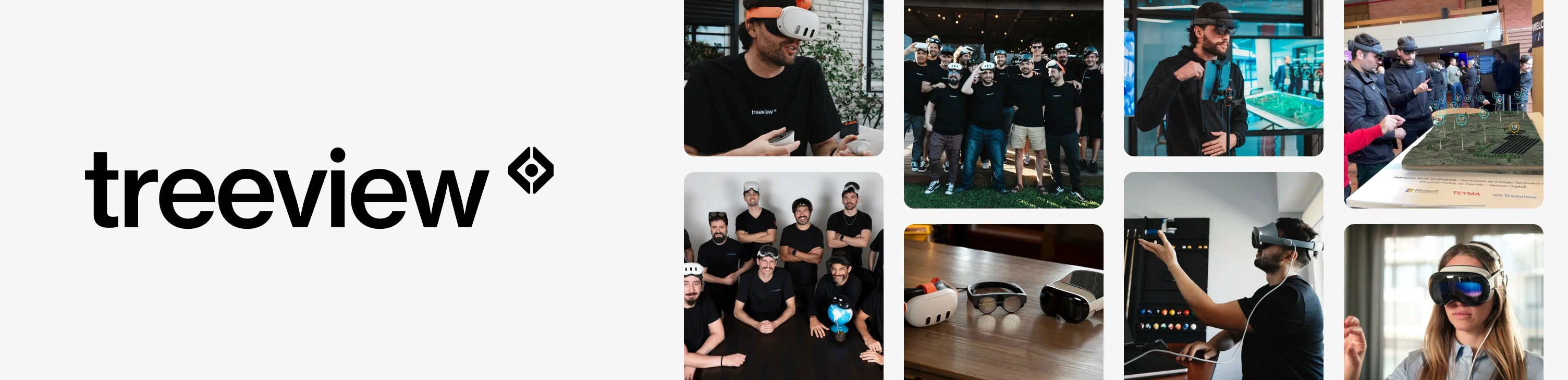
Treeview builds the visualization and interface layer that enterprise digital twins are read and operated through. The studio works on top of whatever platform already holds the data, turning geometry, sensor streams and simulation output into applications operators use directly. Delivery spans headsets, mobile and the browser, which matters when one twin serves both a control room and a site technician.
The clearest reference is an AI-enabled mixed reality twin of a green hydrogen project, built for Microsoft and delivered on HoloLens 2, mobile and WebGL. That work took two Silver Telly Awards in 2026, for use of augmented reality and for digital environments. Teck Resources sits among the clients on comparable industrial ground, and Medtronic and Daiichi Sankyo engagements shape how the studio handles regulated approval cycles.
Best for: the data is all there and what remains is an interface the floor can use.
2. Siemens
Inside manufacturing and heavy engineering, Siemens supplies the platform that carries a twin from design through production into operations. Xcelerator holds the product lifecycle side of the platform. Simcenter covers system simulation, testing and multiphysics, and the two together are what the phrase digital thread describes in practice.
Scope is the reason to start here and the reason to plan carefully. A full Xcelerator engagement touches PLM, MES and automation hardware at once, so the work reaches well beyond the twin itself. Organizations already running Siemens automation get the shortest path. Mixed estates should expect integration effort at every vendor boundary. Our roundup of digital twin companies for manufacturing goes deeper on this segment.
Best for: the twin has to close the loop back into production systems you already operate.
3. Microsoft Azure Digital Twins
Twin state has to live somewhere queryable, and Azure Digital Twins is where Microsoft puts it. The service models relationships between assets using DTDL, connects upstream to IoT Hub for telemetry and feeds downstream into analytics and storage. It holds the graph rather than the geometry, and that distinction decides whether it fits a given project.
Most enterprise twins need something in this position, and Azure is the default when the organization already runs on it. Ingestion, identity and scale come handled, with no custom infrastructure work. Visualization and physics sit outside the service, so a full build pairs Azure with tools that render the model and tools that simulate it. The same pattern appears across the digital twin IoT companies that specialize in this layer.
Best for: telemetry arrives from many systems and nothing yet holds the relationships between them.
4. NVIDIA Omniverse
Omniverse is infrastructure for real-time 3D, and NVIDIA built it so large scenes could be simulated and rendered as one composed environment. OpenUSD is the reason it works, letting geometry from separate CAD and DCC tools compose without a lossy export chain. Physics, synthetic data generation and robotics simulation all run in the same place.
Compute requirements are real and worth planning for early. Scenes at facility scale need serious GPU capacity, and smart city and urban planning twins push that further still. That cost belongs in the business case from the start. Omniverse gives teams a composition and simulation environment, and the interface layer gets built on top, often through Unity 3D development or a similar runtime.
Best for: scenes are too large or too composite for a conventional engine to hold together.
5. Ansys
Ansys answers whether the twin predicts physical behavior accurately enough to trust it. Twin Builder assembles system-level models from validated component physics, and reduced-order models let full simulations run fast enough for live operational use. Decades of engineering simulation validation sit behind those models, which is the whole argument for using them.
Accuracy of this kind changes what a twin can be used for. Predicting failure, testing an operating change before you commit to it and running scenarios that would be unsafe on the real asset all depend on physics rather than pattern matching. Setup demands engineering input, so organizations without simulation expertise in house should budget for that skill alongside the license.
Best for: the value sits in prediction, and the physics has to be trustworthy enough to act on.
6. Accenture

A twin program succeeds or stalls on organizational alignment, and Accenture works that side of it. Engagements open with feasibility and scoping, then extend into vendor selection, systems integration and the change management that follows delivery. The firm stays platform neutral, assembling from whatever the client already runs instead of steering toward a preferred stack.
Consulting weight is both the differentiator and the trade-off. Programs spanning several business units gain from having one party accountable across all of them, and that accountability is most of what the fee buys. The cost structure suits enterprise budgets. Smaller builds usually move faster with a specialist engaged directly on the layer that is missing.
Best for: the hard part is getting four departments to agree on what the twin is for.
How to choose a Digital Twin Services Company
Start by identifying which of the six layers you already cover. Most enterprises hold more than they think, usually the data layer and often the 3D source material, so the real gap is smaller than a full-stack proposal suggests. A vendor search scoped to two layers moves much faster than one scoped to six. Ongoing support tends to stay with whoever built the layer you depend on most, so settle that layer first.
Match your ambition to the state of the research. Kibria and Kittur find networked and AI-enabled twins sit mostly at prototype stage, with interoperability and standardized validation unresolved. One operational question answered reliably beats a program aiming straight at autonomous optimization. The first is what earns budget for the second.
Weight the interface layer higher than the market currently does. Shahzad and colleagues report that building operations and maintenance still rely mostly on 2D or static 3D interfaces, which says more about where the field has invested than about what it needs. The people who run an asset day to day are the ones an interface has to reach, and they are rarely the people who commissioned the model. Getting that layer right turns a working data model into a working practice.
Frequently Asked Questions (FAQs) about Digital Twin Services
Q1. How much does it cost to build a digital twin?
Cost tracks data readiness far more closely than software licensing, so the number comes out of scoping. A pilot on one asset, using telemetry and 3D models you already hold, sits at the bottom of the range. Multi-site operational twins needing new sensors and production system integration sit well above it.
Two things move the figure most: data readiness and model cleanup. Projects where telemetry already flows and CAD is current move quickly. Projects needing new sensors or geometry work absorb budget before any twin work begins.
Q2. How long does a digital twin project take?
A scoped pilot on a single asset reaches working software in months, while enterprise programs spanning multiple sites run across several years and arrive in phases. How the phases are cut matters more than the total, since each one should return something usable on its own.
Timelines stretch most often at the data integration stage. Connecting historians, control systems and business systems tends to surface access, format and ownership questions that were invisible during scoping.
Q3. Do I need a digital twin platform before hiring a services company?
No. Selecting a platform first commits you to an architecture before anyone has audited your data, which is the sequence that produces expensive rework. A short discovery engagement ahead of platform selection generally pays for itself.
Organizations already standardized on a major cloud or industrial vendor are a reasonable exception, since the platform decision is effectively made and the work is fitting the twin to it.
Q4. What is digital twin as a service?
Digital twin as a service is a hosted subscription model. The provider runs the platform and you configure twins on top of it, instead of owning and operating a custom build. It lowers setup cost and shortens the time to a first working twin.
The trade-off appears at the edges of the product. Configuration handles common asset types well, and unusual assets, proprietary data formats or specific interface requirements tend to exceed what configuration reaches.
Q5. Can a digital twin work without IoT sensors?
Yes, though it can do less. A twin fed by design data, simulation and inspection records still supports design validation, training and scenario planning.
Live sensor data is what opens up the operational uses: predictive maintenance, real-time monitoring and anomaly detection. Each one needs the twin to reflect the current state of the asset, and only live telemetry supplies that.
Q6. Who owns the data and models in a digital twin project?
Ownership depends on the contract, so settle it before work begins. On custom builds the customer normally owns the data, the asset models and the application code. The provider keeps its own tools and frameworks.
Platform-based engagements vary more. Confirm in writing whether asset models built inside a vendor platform can be exported in a usable format if the relationship ends.
Q7. What skills does an in-house team need to maintain a digital twin?
A maintained twin needs three roles covered. Someone has to understand the data pipeline, someone has to update asset models as the physical asset changes and someone has to own the link between the twin and the process it serves. On smaller programs one person covers all three.
The model update role is the one most often missed at handover. Physical assets are modified continuously, and keeping the twin aligned with those changes is what preserves its credibility with the operators using it.
Q8. Is a digital twin the same as a 3D model or a simulation?
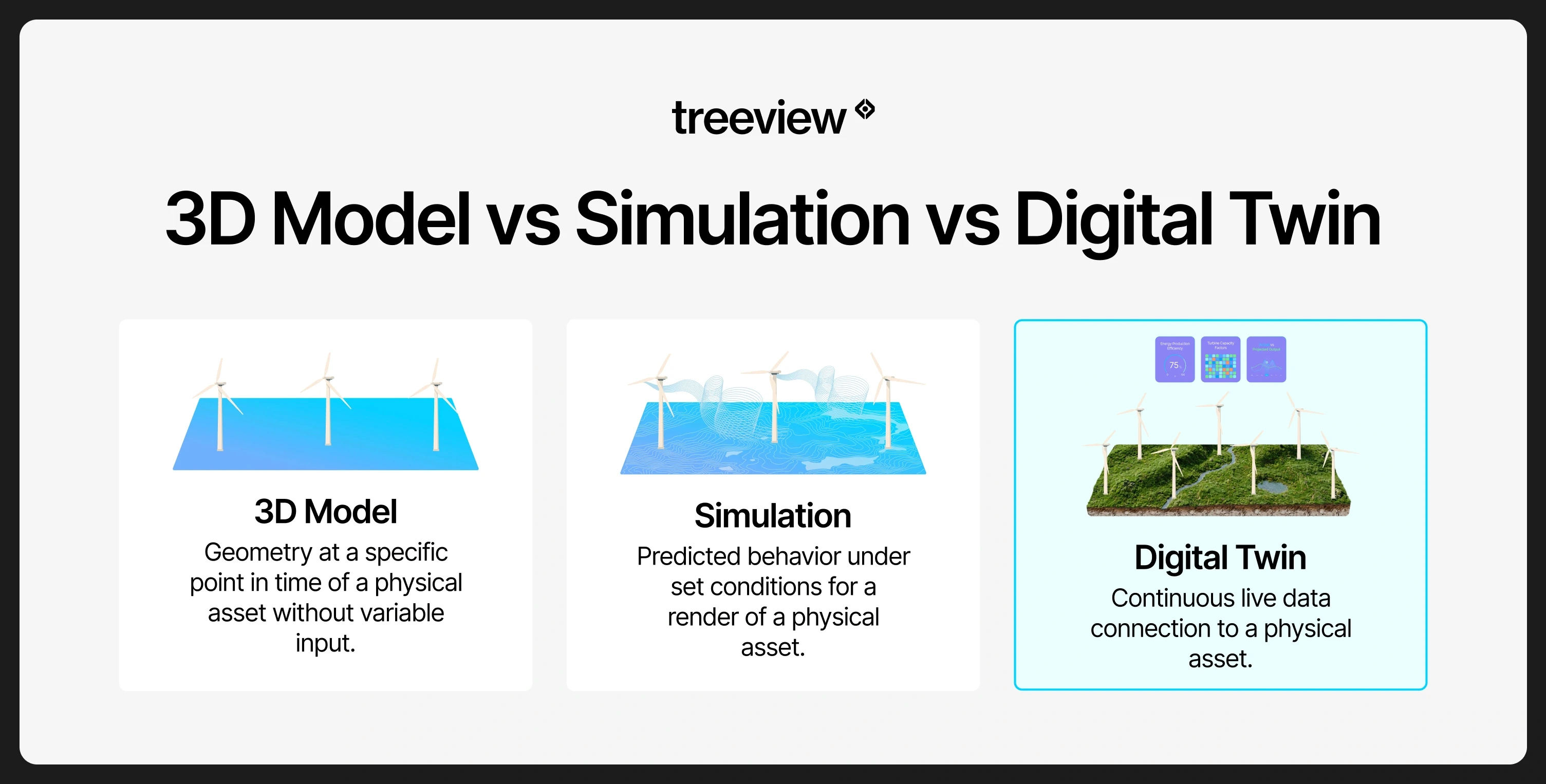
No. A 3D model represents geometry at a point in time. A simulation predicts behavior under set conditions. A digital twin keeps a live data connection to a specific physical asset and updates as that asset changes.
The live connection is the whole distinction. A digital twin usually contains both, using the model for geometry and the simulation for behavior, then running that simulation again against live readings as conditions change.
Q9. Which industries use digital twin services most?
Aerospace digital twins, manufacturing, energy, utilities, construction, healthcare and automotive show the most digital twin services activity. Predictive maintenance is the largest single application across all of them, at 31.04% of the 2026 market according to Fortune Business Insights.
Adoption follows asset economics more than industry enthusiasm. Sectors with expensive assets, costly downtime and long service lives justify the investment earliest. That pattern shows in our roundups of digital twins in healthcare companies and digital twin companies for construction and AEC.
Q10. How do you measure whether a digital twin is working?
Define the operational question the twin exists to answer, then measure whether decisions actually change because of it. Model fidelity against the physical asset, data freshness and adoption by the intended users are the three metrics that matter most.
Standardized measures remain a genuine gap. Kibria and Kittur identify standardized validation as an unresolved challenge in the research, so most organizations define their own acceptance criteria at the start of a program.