
Buyers have more real choices than ever. EssilorLuxottica reported 9 million Ray-Ban and Oakley Meta units shipped in 2025, and Android XR glasses from Google, Samsung and XREAL are scheduled to reach stores this fall. That competition is already pushing display quality up and entry prices down.
This guide ranks 15 models across AI glasses, AR display glasses and XR display glasses, and every entry lists verified specs, the US price, prescription support and where to buy, checked in September 2026.
Readers starting from zero can use the smart glasses complete guide for 2026 to learn how each category works, which technologies sit inside the frames and where the market is heading before comparing individual models.
Feel free to keep reading or jump to a specific section:
TL;DR
Best overall: Ray-Ban Meta Gen 3 ($449), the AI glasses with the best balance of camera, audio and everyday comfort.
Best without a camera: Ray-Ban Meta Audio ($349), Meta’s first camera-free frames, at 43 grams and 12 hours of battery.
Best AR display: Meta Ray-Ban Display ($799), a full-color display in the right lens, now on sale in the US, the UK and Canada.
Best private big screen: XREAL 1S ($449), a 1200p tethered display with a 52-degree field of view.
Best value display: RayNeo Air 4 Pro ($299), the first HDR10 display glasses and the lowest price on this list.
Best standalone AR: Snap SPECS ($2,195), see-through AR glasses that need no phone or puck, shipping fall 2026.
Best display without a camera: Even Realities G2 ($599), a text display in frames that pass for prescription glasses.
What Are Smart Glasses?
Smart glasses are eyewear frames with built-in processors, cameras, microphones and speakers, and some models add a display in the lens. Depending on the category, what smart glasses do ranges from capturing photos and video to answering questions out loud, showing notifications in your view and placing digital content in the room around you.

Input changes with the type. AI glasses are voice-first. Display glasses add touch, gesture and wristband controls, and the Meta Ray-Ban Display reads finger movements through EMG (electromyography), a wristband sensor that picks up electrical signals from the muscles in your wrist.
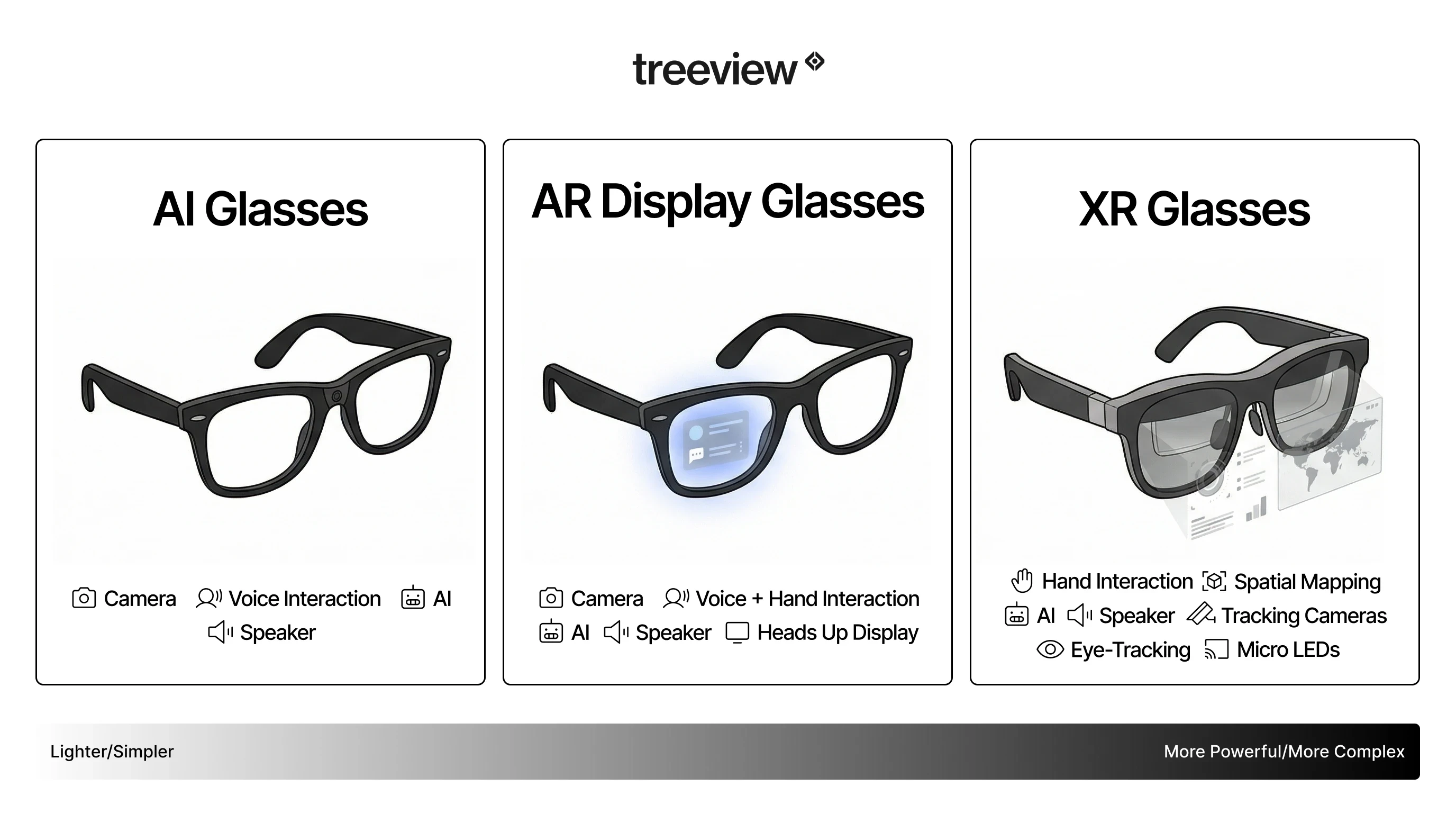
AI glasses have a camera, microphones and speakers but no display. You ask a question and the answer plays through open-ear speakers while the camera supplies context for scene description and live translation, in a mainstream tier led by Ray-Ban Meta and Oakley Meta.
AR display glasses add a transparent display to the lens, so text, arrows and video appear over your normal view of the world through augmented reality.
Most use a waveguide, a thin layer of glass that carries light from a tiny projector across the lens to your eye. Tethered media models use birdbath optics instead. A curved mirror reflects a micro-OLED panel for a larger, brighter image.
XR display glasses combine a display with room tracking, so apps and windows stay anchored as you move.
The best models track in 6DoF (six degrees of freedom, covering position and rotation) and run apps as a spatial computing platform. Snap SPECS, XREAL Aura and the Meta Orion prototype define the top of this category.
How Big Is the Smart Glasses Market in 2026?
Smart glasses became the largest part of the XR market in 2025, at roughly half of all XR shipments.
The XR market shipped 14.5 million devices in 2025, up 41.6% year over year, and smart glasses drove nearly all of that growth. Inside Meta, smart glasses revenue reached an estimated $2.15 billion and passed Quest headset revenue of $660 million for the first time.
Meta widened the shelf at Connect 2026 in September. It launched the Ray-Ban Meta Gen 3, the camera-free Ray-Ban Meta Audio, the $249 Meta Adventurer and the $1,299.99 Meta VR Glasses for spring 2027.
Google and Samsung showed their first Android XR glasses at Google I/O in May and Galaxy Unpacked in July. Samsung confirmed its 2026 smart glasses launch early in the year, and those audio models are still due this fall.
Apple is reportedly targeting smart glasses for 2027, with no display in the first generation.
Software feels the split too. Teams scoping smart glasses app development now plan for three platforms, and the top smart glasses app development companies already build across all of them.
Smart Glasses Compared by Use Case, Price and Availability
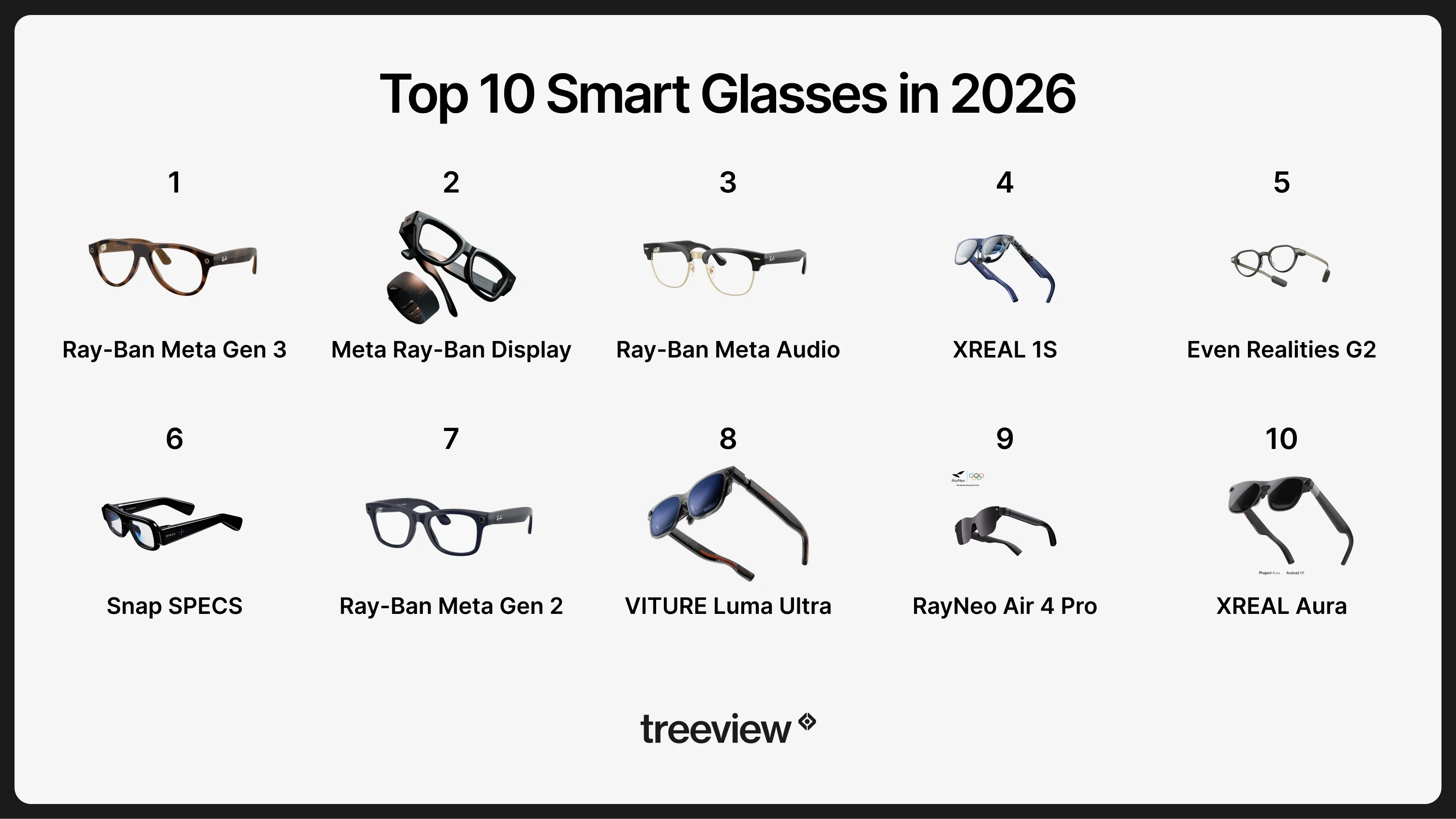
The top 10 smart glasses in 2026 start with the Ray-Ban Meta Gen 3, the Meta Ray-Ban Display and the Ray-Ban Meta Audio. Products still on pre-order or reservation carry that status in the table.
# | Product | Category | Best suited to | US price | Status |
|---|---|---|---|---|---|
1 | Ray-Ban Meta Gen 3 | AI glasses | Everyday AI and photos | From $449 | On sale |
2 | Meta Ray-Ban Display | AR display glasses | Messages and directions in the lens | $799 | On sale in the US, UK and Canada |
3 | Ray-Ban Meta Audio | AI glasses | All-day audio and AI with no camera | From $349 | Pre-order, ships October 13 |
4 | XREAL 1S | AR display glasses | Private big screen for travel | $449 | On sale |
5 | Even Realities G2 | AR display glasses | Discreet text with no camera | From $599 | On sale |
6 | Snap SPECS | XR display glasses | Standalone AR apps | $2,195 | Pre-order, fall 2026 |
7 | Ray-Ban Meta Gen 2 | AI glasses | The same platform at a lower price | From $379 | On sale |
8 | VITURE Luma Ultra | XR display glasses | Pinned windows around a laptop | $599 | On sale |
9 | RayNeo Air 4 Pro | XR display glasses | HDR films on a budget | $299 | On sale |
10 | XREAL Aura | XR display glasses | Android XR apps on the go | Up to $1,500 | Reservation, fall 2026 |
Best AI Glasses in 2026
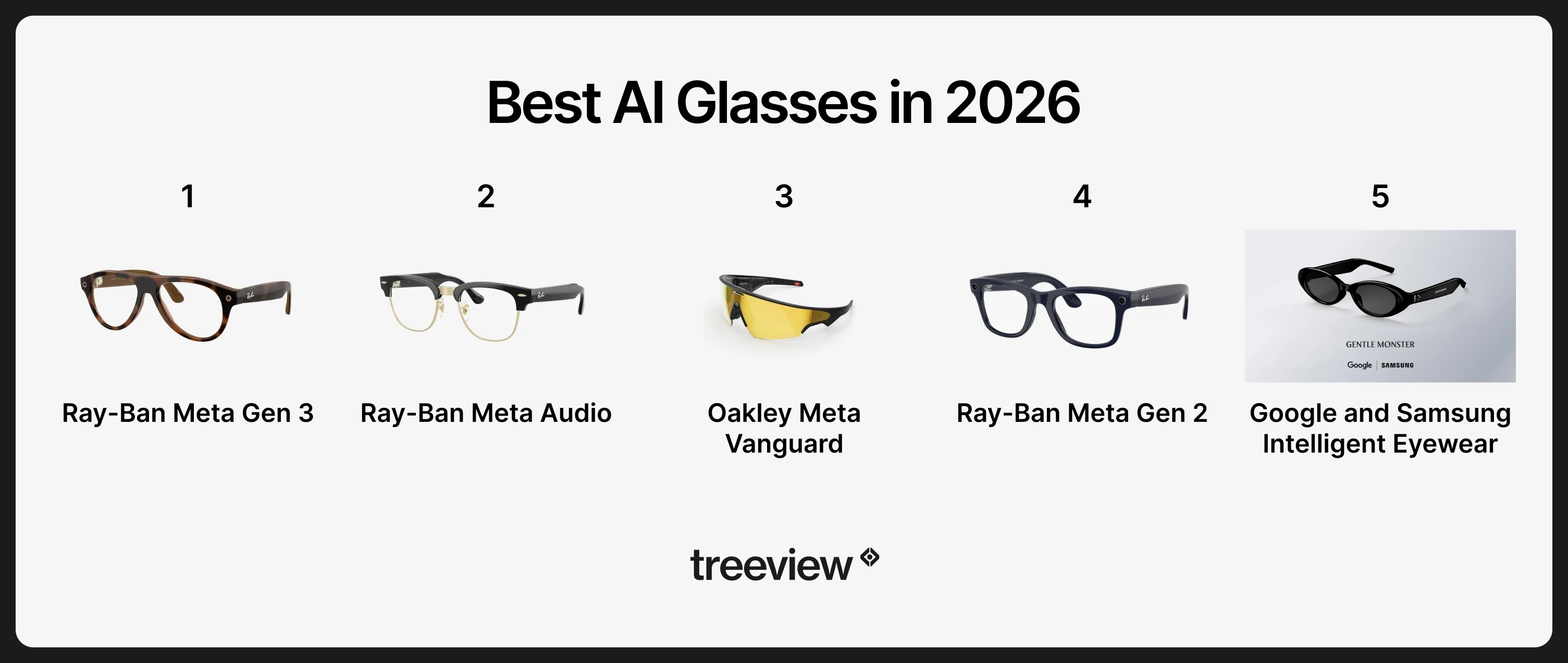
The best AI glasses in 2026 are the Ray-Ban Meta Gen 3 for most people and the Ray-Ban Meta Audio for anyone who cannot wear a camera.
AI glasses are smart glasses with no display that answer voice questions through built-in speakers and use a camera for visual context. Models differ on camera, frame style, water resistance and prescription support. One model now ships with no camera at all, and prices sit within $150 of each other.
# | Product | AI assistant | Camera | Battery (glasses / case) | Prescription | US price |
|---|---|---|---|---|---|---|
1 | Ray-Ban Meta Gen 3 | Meta AI | 12MP, 3K@30fps | 9h / 50h | Yes, range varies by frame | From $449 |
2 | Ray-Ban Meta Audio | Meta AI | None | 12h / 48h | Yes | From $349 |
3 | Oakley Meta Vanguard | Meta AI | 12MP, 122°, 3K@30fps | 9h / 36h | No | $499 |
4 | Ray-Ban Meta Gen 2 | Meta AI | 12MP ultrawide, 3K@30fps | 8h / 48h | Yes (-6.00 to +4.00) | From $379 |
5 | Google and Samsung Intelligent Eyewear | Gemini | Built-in camera | Up to 9h / 7h | Planned | Not announced |
6 | Oakley Meta HSTN | Meta AI | 12MP ultrawide, 3K@30fps | 8h / 48h | Yes (-6.00 to +4.00) | From $399 |
7 | Rokid AI Glasses Style | ChatGPT 5 and Gemini | 12MP, 4K photos, 3K@30fps | Up to 12h | Yes | $299 |
1. Ray-Ban Meta Gen 3: Best AI Glasses Overall
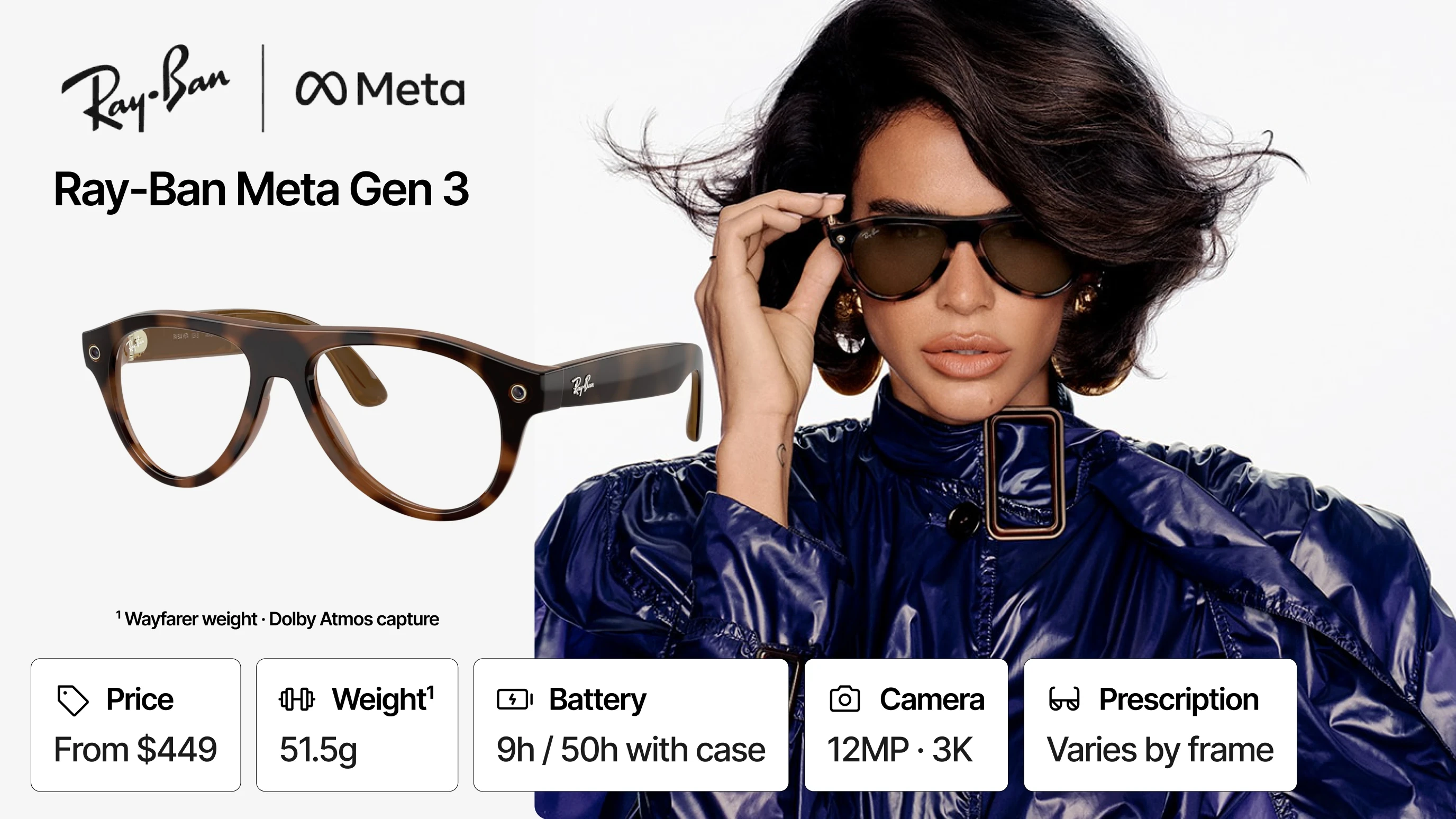
The Ray-Ban Meta Gen 3 is the best AI glasses for most people, pairing the strongest assistant and camera with frames people already recognize. Meta builds the electronics, and EssilorLuxottica, the eyewear group that owns both Ray-Ban and Oakley, makes the Wayfarer, Aviator and Zena frames.
It went on sale at Connect 2026 on September 23 from $449, a $70 step up from the Gen 2. Battery is the headline: 9 hours per charge against 8, and the case carries the total to 50 hours.
The frame gains a programmable action button. One press starts a capture mode or a Meta AI command you choose, which takes the wake phrase out of the shots you care about most.
That is a first for these frames.
The camera stays at 12MP and 3K video, now with Dolby Atmos spatial sound capture. A sixth microphone joins the array and cuts more than 90% of background noise on calls.
Prescription lenses come through opticians such as LensCrafters, and the range depends on the frame and the market. An Aviator fitted with Transitions lenses costs $579.
Spec | Detail |
|---|---|
AI assistant | Meta AI |
Camera | 12MP, 3K@30fps video with Dolby Atmos capture |
Audio | Open-ear speakers, 6 microphones |
Battery | 9h per charge / 50h with case |
Display | None |
Weight | 51.5g (Wayfarer) |
Water resistance | IPX4 |
Prescription | Yes, range varies by frame and market |
US price | From $449 |
Best for: you want AI help and first-person photos all day, in frames nobody will look at twice.
Where to buy: Meta Store, Ray-Ban stores, LensCrafters and electronics retailers across North America, Europe, Australia and Japan.
2. Ray-Ban Meta Audio: Best AI Glasses Without a Camera
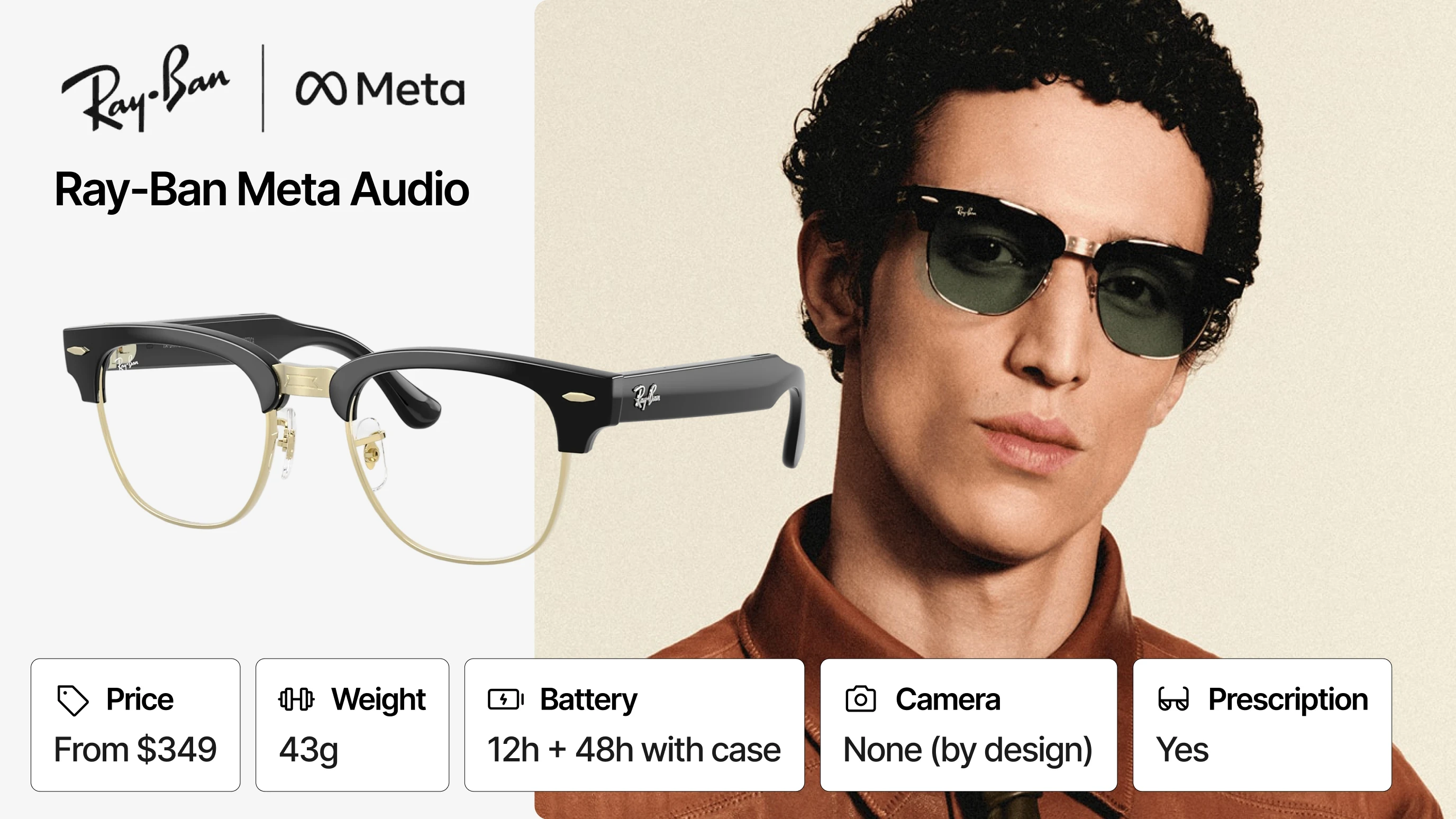
The Ray-Ban Meta Audio is the best AI glasses for anyone who cannot wear a camera at work, and the first Ray-Ban Meta frame to ship without one. Meta announced it at Connect 2026 with pre-orders open and shipping from October 13.
Losing the camera pays for itself twice. The frames drop to 43 grams, the lightest Ray-Ban Meta yet, and battery runs 12 hours per charge with 48 more from the case.
Meta AI still answers by voice through two open-ear speakers. A six-microphone array with wind suppression handles calls, and the frame carries an IPX4 splash rating.
Clubmaster and Burbank are the two shapes, across 23 color and lens combinations, and both take prescription lenses.
A camera is the reason most hospital wards, plant floors and secure sites reject smart glasses outright. This is the first mainstream frame that answers the objection at $349 instead of $599.
Spec | Detail |
|---|---|
AI assistant | Meta AI |
Camera | None |
Audio | 2 open-ear speakers, 6 microphones with wind suppression |
Battery | 12h per charge / 48h with case |
Display | None |
Weight | 43g |
Frames | Clubmaster and Burbank, 23 combinations |
Water resistance | IPX4 |
Prescription | Yes |
US price | From $349 |
Best for: your site bans cameras and you still want an assistant and calls in your ear all day.
Where to buy: Meta Store pre-orders now, then Ray-Ban stores and optical retailers from October 13.
3. Oakley Meta Vanguard: Best AI Glasses for Sport
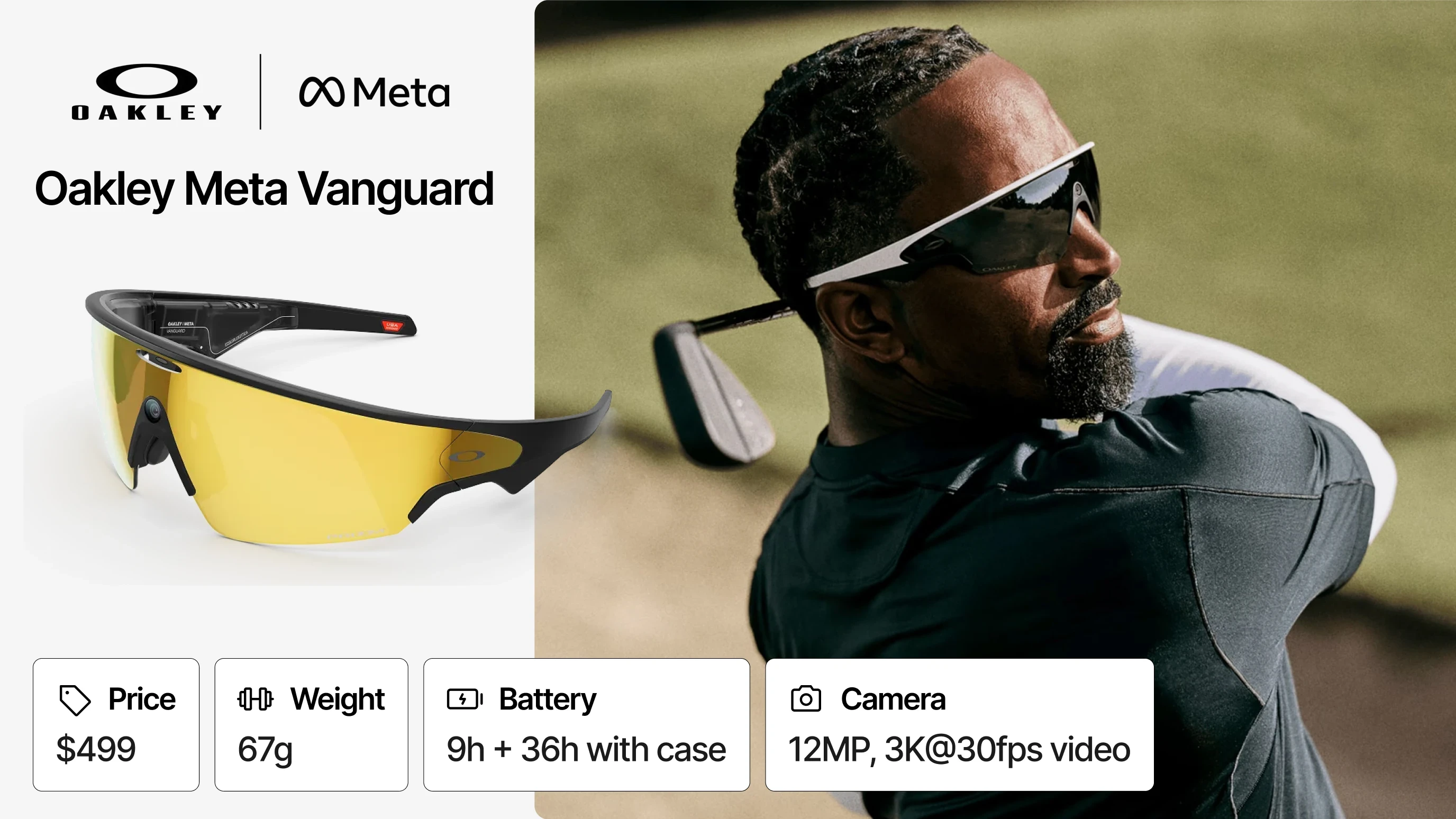
The Oakley Meta Vanguard is the best AI glasses for running, cycling and other high-output sport, and the only Meta frame rated IP67. It launched on October 21, 2025, with a wraparound shield and a camera centered above the nose.
Its centered camera captures a 122-degree view for first-person action footage. A wind-optimized five-mic array delivers +6 dB over the HSTN, the IP67 rating means rain and a rinse under the tap cause no damage and battery runs 9 hours per charge with 36 from the case.
Prescription lenses are not supported on the Vanguard frame, and that single limit rules it out for anyone who needs corrective lenses to see the trail, road or scoreboard clearly.
Spec | Detail |
|---|---|
AI assistant | Meta AI |
Camera | 12MP, 122° view, 3K@30fps video |
Audio | Open-ear speakers, 5 wind-optimized microphones (+6 dB vs HSTN) |
Battery | 9h per charge / 36h with case |
Display | None |
Lenses | Oakley Prizm Sport |
Water resistance | IP67 |
Prescription | No |
US price | $499 |
Best for: you train in rain and wind and want hands-free footage without strapping on an action camera.
Where to buy: Meta Store and Oakley retailers in the US, Canada, the UK, most of Western Europe, Australia and Japan.
4. Ray-Ban Meta Gen 2: Best AI Glasses Value
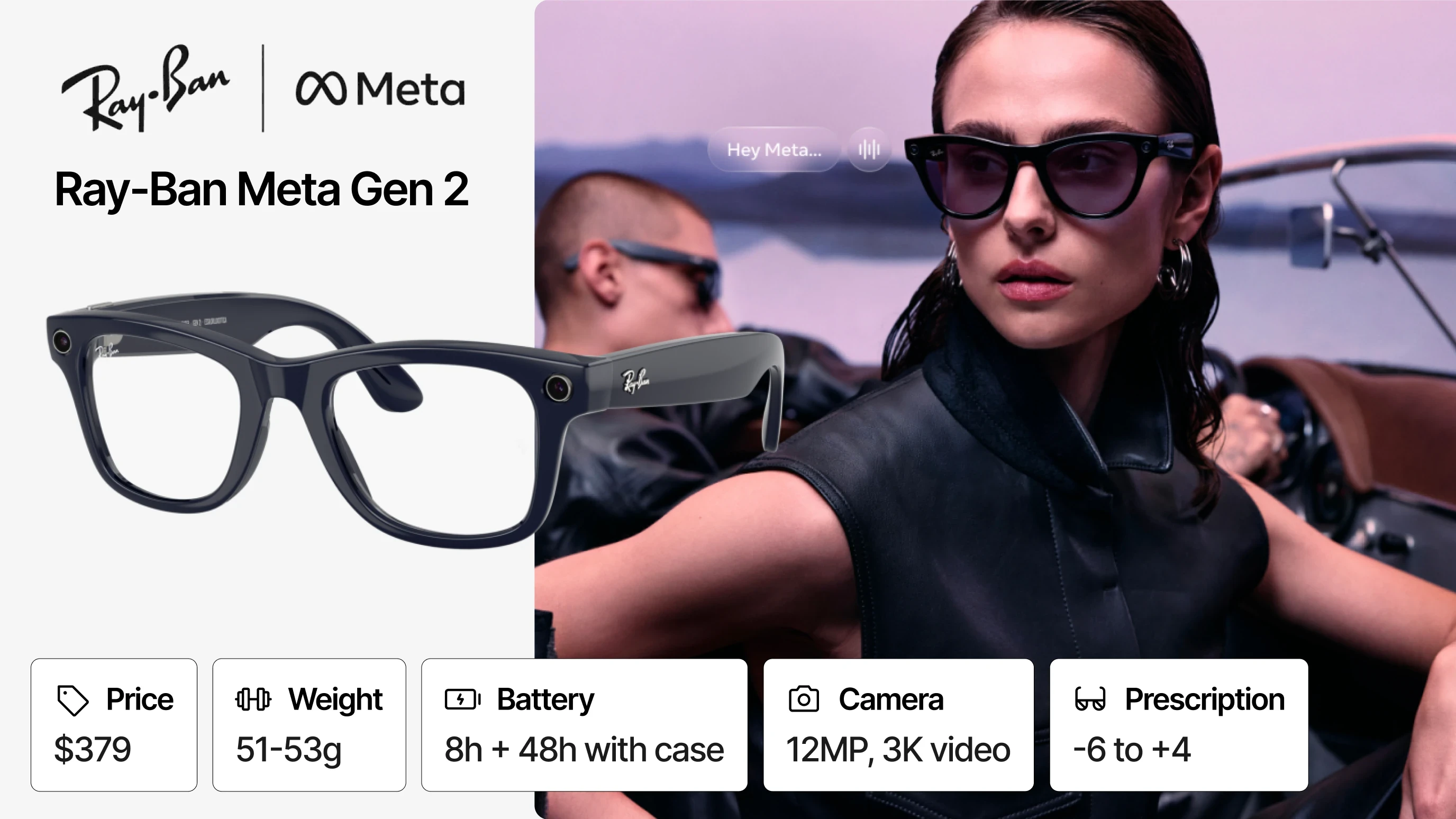
The Ray-Ban Meta Gen 2 is the best value in AI glasses, holding its $379 price after the Gen 3 landed above it. It launched in September 2025 and stayed in the lineup instead of leaving the shelf.
Nothing important is missing. The same 12MP camera shoots 3K video and Meta AI answers the same questions, while Live AI describes scenes, reads signs and translates conversations in real time.
What you give up is an hour of battery, one microphone and the action button. Prescription lenses run from -6.00 to +4.00 through opticians, and fitted frames cost more than the starting price.
At $70 below the Gen 3, this is the sensible buy for a first pair or for issuing several across a team.
Spec | Detail |
|---|---|
AI assistant | Meta AI |
Camera | 12MP ultrawide, 3K@30fps video |
Audio | Open-ear speakers, 5 microphones |
Battery | 8h per charge / 48h with case |
Display | None |
Water resistance | IPX4 |
Prescription | Yes (-6.00 to +4.00) |
US price | From $379 |
Best for: you want the Ray-Ban Meta platform at the lowest price, or several pairs for one team.
Where to buy: Ray-Ban stores, LensCrafters and electronics retailers across North America, Europe, Australia and Japan.
5. Google and Samsung Intelligent Eyewear: Best Upcoming AI Glasses
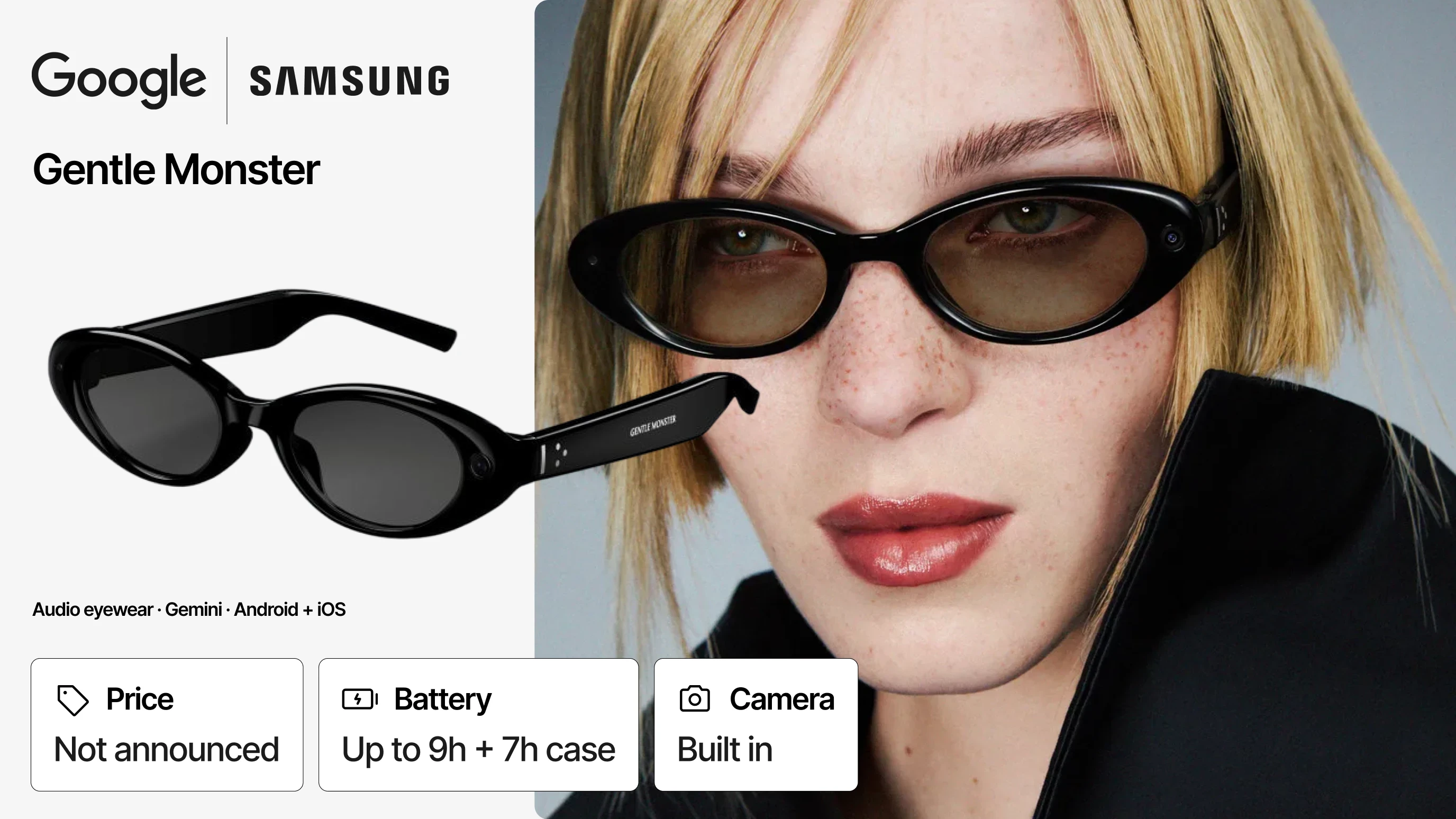
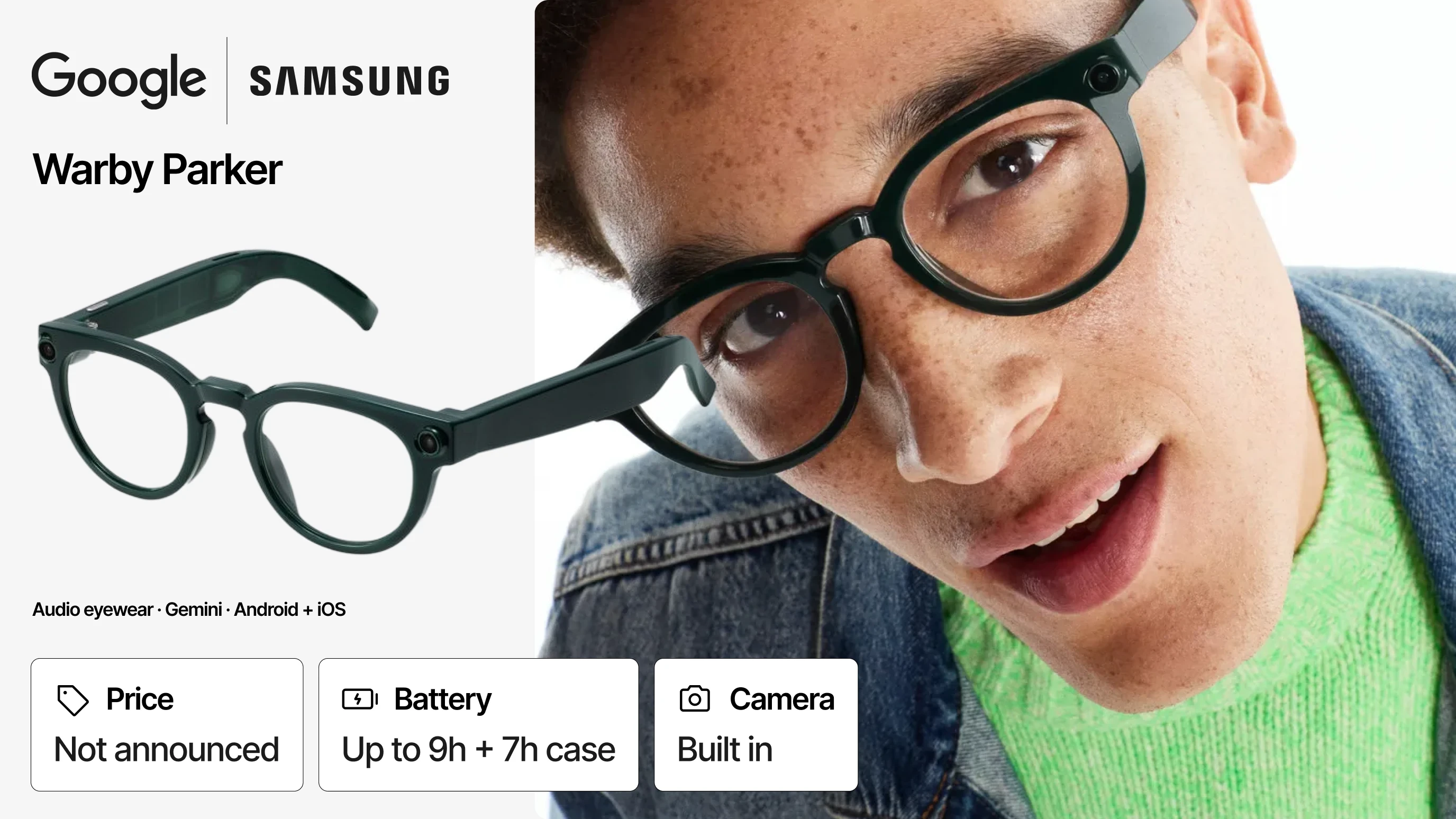
Google and Samsung’s intelligent eyewear is the biggest AI glasses launch still ahead, with display-free audio glasses due in select markets in fall 2026. Its platform debuted at Google I/O 2026, and Samsung showed the first Warby Parker and Gentle Monster collections at Galaxy Unpacked on July 22.
Gemini is the assistant, triggered by “Hey Google” or a tap on the frame. Both Android phones and iPhones pair with it.
Samsung confirmed a Snapdragon AR1 Gen 1 chip, a built-in camera and up to 9 hours of battery with 7 more from the case, alongside turn-by-turn directions, calls, live translation and Nano Banana photo editing.
Price and an exact sale date were still unannounced in September 2026. A display model follows later.
Spec | Detail |
|---|---|
AI assistant | Gemini |
Processor | Snapdragon AR1 Gen 1 |
Camera | Built-in camera |
Battery | Up to 9h per charge / 7h from case |
Display | None (audio model) |
Phone support | Android and iOS |
Frames | Warby Parker and Gentle Monster collections |
US price | Not announced |
Best for: you carry an iPhone or an Android phone and want Gemini in your ear before committing to Meta.
Where to buy: Not on sale yet. Warby Parker and Gentle Monster collections are scheduled for select markets in fall 2026.
Best AR Display Glasses in 2026
The best AR display glasses in 2026 are the Meta Ray-Ban Display for AI in the lens and the XREAL 1S for a large private screen.
AR display glasses add a transparent display to the lens, so you read text, follow arrows and watch video while still seeing the room. Three numbers matter most. Brightness sets outdoor readability, field of view sets screen size and the connection decides whether a cable hangs from your temple.
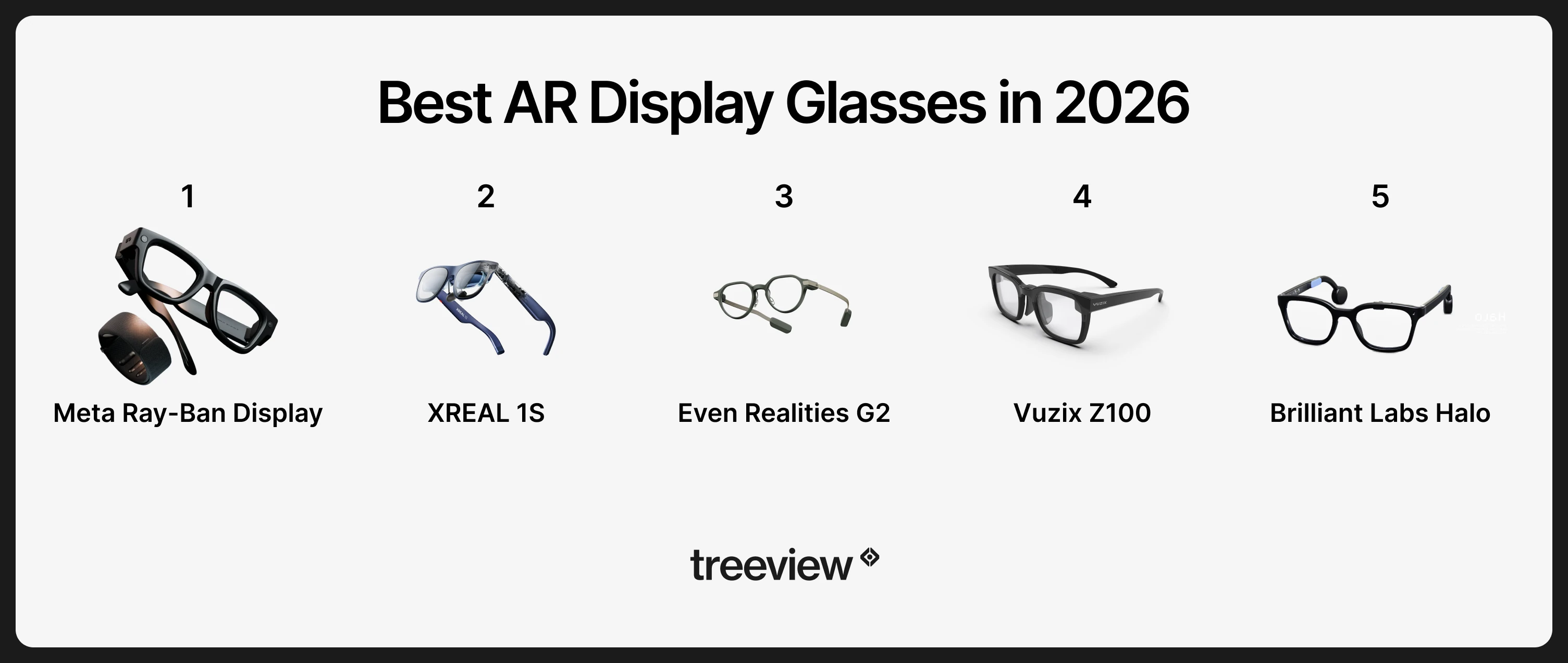
# | Product | Display | Field of view | Camera | Connection | US price |
|---|---|---|---|---|---|---|
1 | Meta Ray-Ban Display | 600x600 full-color waveguide, right eye, 5,000 nits | 20° | 12MP | Wireless | $799 |
2 | XREAL 1S | 1200p micro-OLED per eye, birdbath, 700 nits | 52° | None | USB-C | $449 |
3 | Even Realities G2 | Green microLED waveguide | Narrow, text-sized | None | Wireless | From $599 |
4 | Vuzix Z100 | 640x480 green microLED waveguide | 30° | None | Wireless | $499 |
5 | Brilliant Labs Halo | 0.2-inch color OLED-on-silicon, right eye | 20° | AI sensor | Wireless | $399 |
1. Meta Ray-Ban Display: Best AR Display Glasses Overall
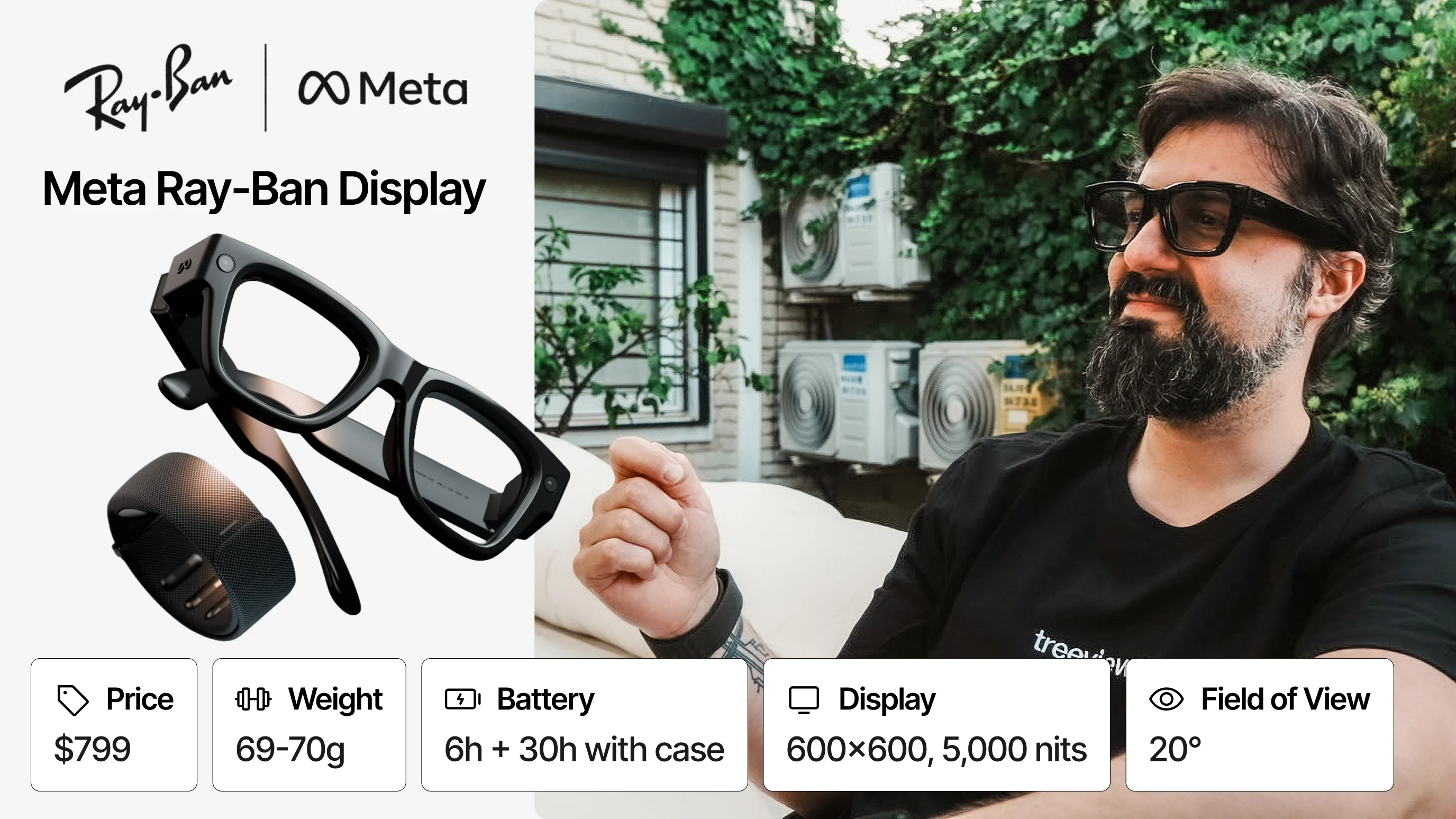
The Meta Ray-Ban Display is the best AR display glasses overall, putting a full-color display and Meta AI inside a Ray-Ban frame for $799. It launched in the US on September 30, 2025, bundled with the Meta Neural Band wristband.
Its right lens holds a 600x600 display at 90Hz with a 20-degree field of view and 5,000 nits of brightness. That brightness leads this list. The small window suits messages, walking directions, live captions and AI answers, and it keeps the frame at 69 to 70 grams.
A 12MP camera records 1440x1920 video, and battery runs 6 hours with 30 more from the case.
Availability opened up at Connect 2026. The Display went on sale in the UK and Canada, with pre-orders in France, Germany and Italy for October 13. US buyers still book an in-person fitting first.
Prices run $799 in the US, £749 in the UK, CAD $1,149 in Canada and €899 across the three EU markets.
The same update added transit and cycling directions, landmark-based navigation, notification mirroring and Dolby Atmos capture. Hearing enhancement follows later in 2026 at $149.99, cleared by the FDA.
Spec | Detail |
|---|---|
Display | 600x600, 90Hz, full-color waveguide, right eye |
Brightness | 5,000 nits |
Field of view | 20° |
Camera | 12MP, 1440x1920 video |
Input | Meta Neural Band (EMG), touch, voice |
Battery | 6h per charge / 30h with case |
Weight | 69 to 70g |
Prescription | Yes (-4.00 to +4.00) |
Water resistance | IPX4 |
US price | $799 (includes Meta Neural Band) |
Best for: you already use Meta AI and want replies you can read in a meeting without touching your phone.
Where to buy: Meta Store to book a demo, then Best Buy, LensCrafters, Sunglass Hut and Ray-Ban stores. On sale in the US, the UK and Canada, with France, Germany and Italy from October 13.
2. XREAL 1S: Best AR Display Glasses for a Private Big Screen
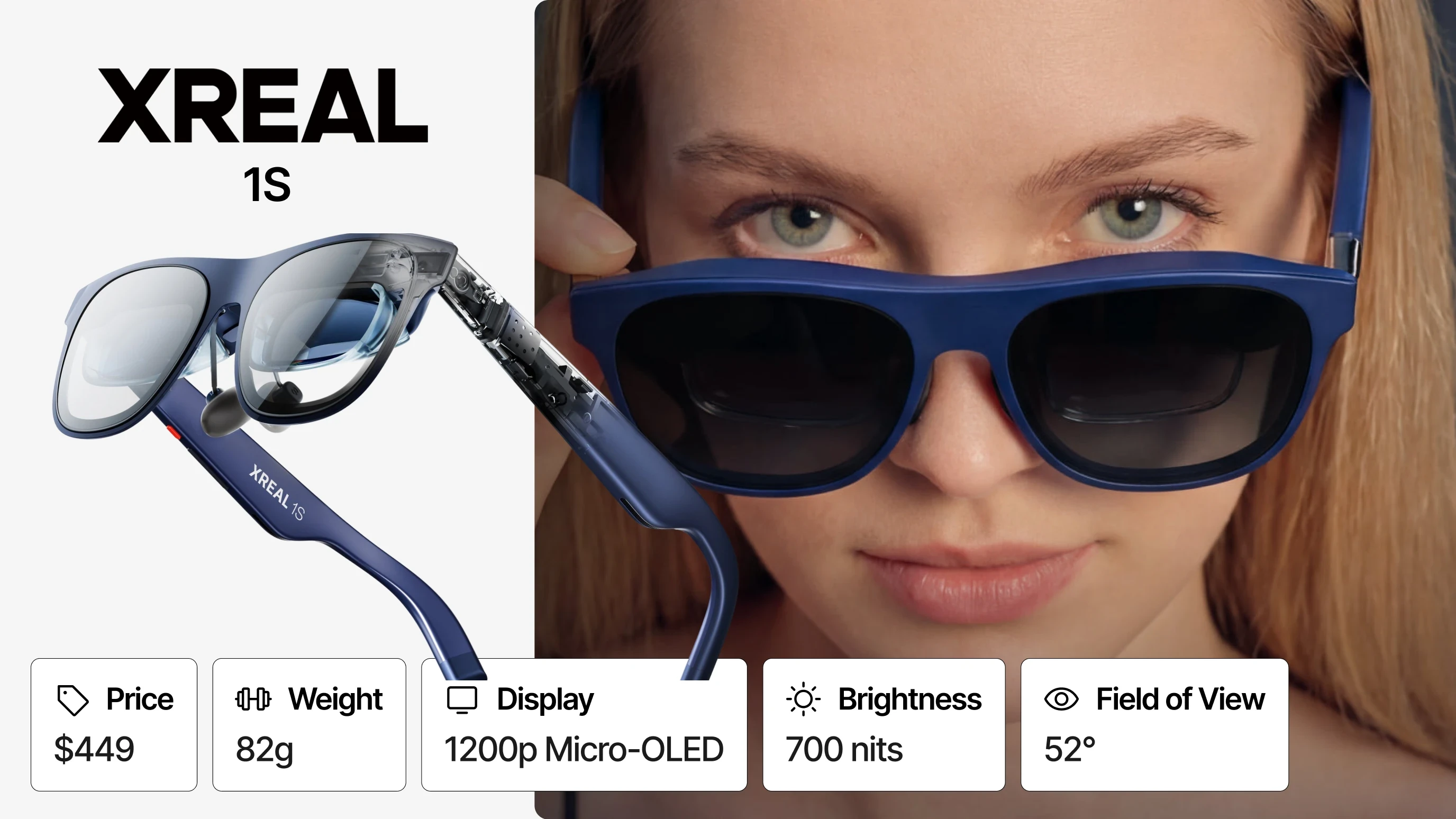
The XREAL 1S is the best AR display glasses for watching and gaming on a large private screen, with sharper panels than the XREAL One for $50 less. XREAL released the 1S in January 2026 as the replacement for the One.
Each eye gets a 1920x1200 Sony micro-OLED panel at up to 120Hz, with 700 nits of brightness and a 52-degree field of view. An onboard X1 chip holds the virtual screen in place as you turn your head, and Real 3D converts ordinary 2D video into 3D.
At 82 grams, the glasses draw power over USB-C from a phone, laptop or handheld console.
Screen anchoring works in 3DoF, which tracks head rotation but not movement through the room. For a seated film or a flight, that is enough. It is also the main gap between the 1S and true XR glasses.
Spec | Detail |
|---|---|
Display | 1920x1200 per eye, Sony micro-OLED, birdbath optics, up to 120Hz |
Brightness | 700 nits |
Field of view | 52° |
Tracking | 3DoF screen anchoring (X1 chip) |
Audio | Sound by Bose |
Connection | USB-C with DisplayPort output |
Weight | 82g |
US price | $449 |
Best for: you spend long flights or commutes with a laptop or handheld console and want a screen nobody else can see.
Where to buy: XREAL store, Amazon and major electronics retailers.
3. Even Realities G2: Best AR Display Glasses Without a Camera
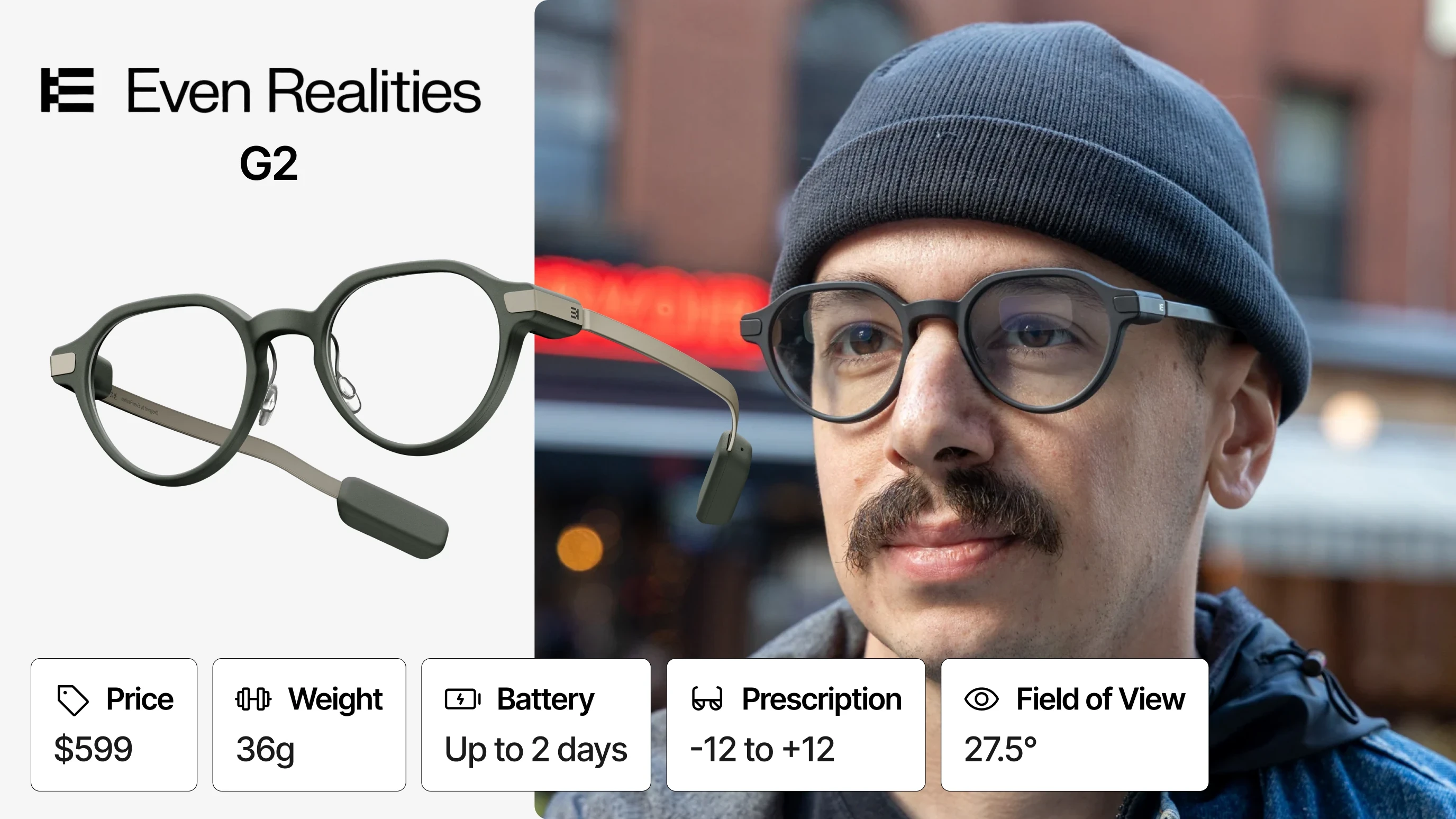
The Even Realities G2 is the best AR display glasses for people who want information in the lens and no camera on their face. Even Realities designed it around text: notifications, directions, a teleprompter and AI answers. Privacy drives the design.
Its HAO 2.0 optical engine projects bright green text through a waveguide, inside frames that pass for ordinary prescription glasses. There is no camera and no speaker. An IP67 rating and about two days per charge, with seven more in the case, make it one of the longest-lasting displays in this section.
Conversate surfaces definitions and summaries during a conversation. Translation covers 31 languages.
An Even R1 smart ring sells separately for $249 and controls the display with taps and scrolls, and Wareable’s long-term review called the ring close to essential, which brings the full setup near $850.
Spec | Detail |
|---|---|
Display | Green microLED, waveguide (HAO 2.0) |
Camera | None |
Speakers | None |
Battery | About 2 days per charge (case holds up to 7 charges) |
Water resistance | IP67 |
Controls | Touch, voice, optional R1 ring |
Prescription | Yes |
US price | From $599 |
Best for: your office or family objects to camera glasses, and you still want notes and directions in view.
Where to buy: Even Realities store and select optical retailers, with HSA and FSA payment accepted for US prescription orders.
4. Vuzix Z100: Best AR Display Glasses for Frontline Workers
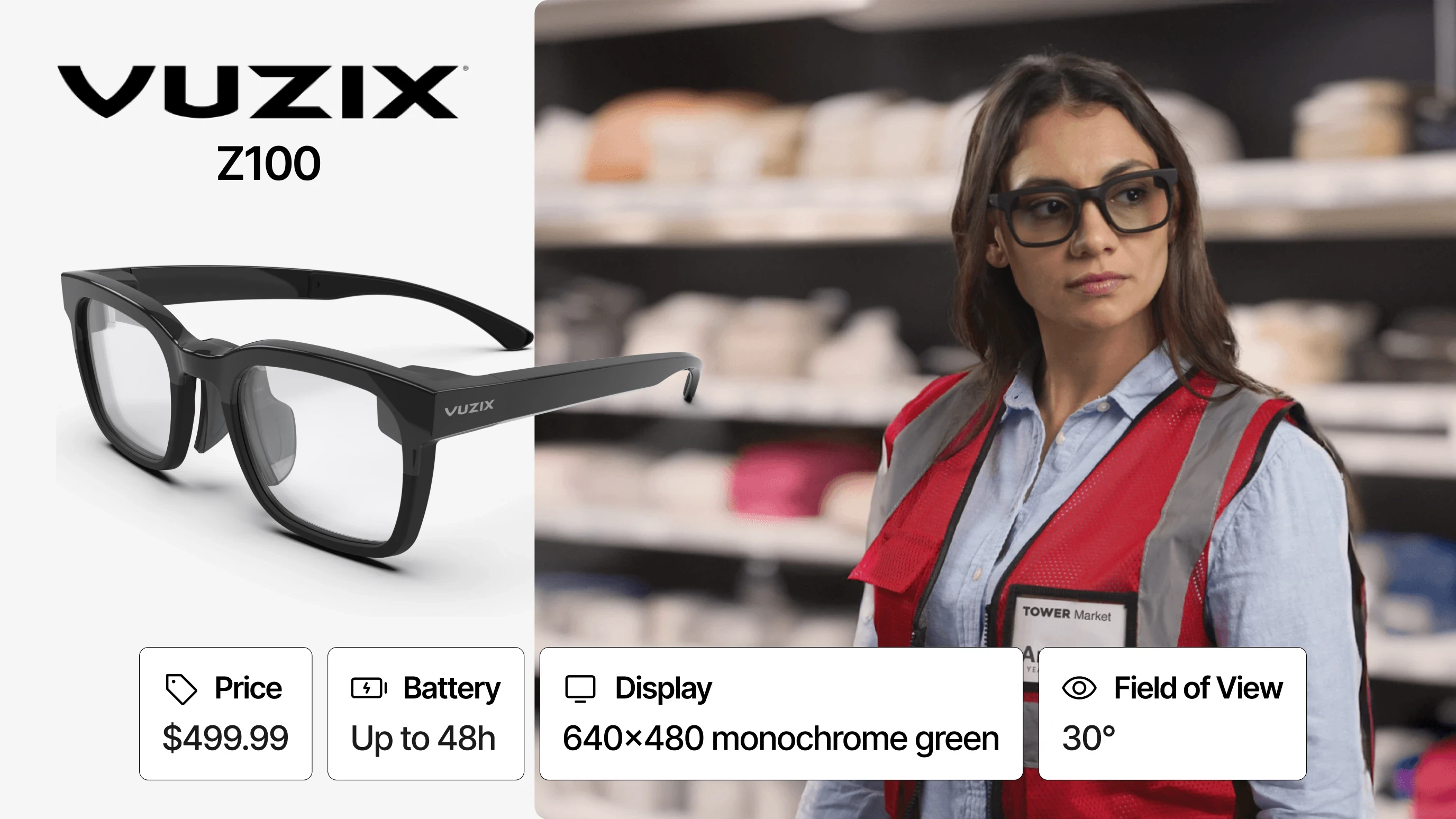
The Vuzix Z100 is the best AR display glasses for frontline teams, at 38 grams with up to 48 hours of battery. Vuzix has shipped enterprise AR hardware for more than a decade, and the Z100 is its lightest waveguide display. It is built for shifts.
A monochrome green 640x480 display with a 30-degree field of view shows notifications, task prompts, a teleprompter and turn-by-turn directions sent from an Android phone or iPhone over Bluetooth. Text is green only.
Without a camera, the Z100 clears approval faster on sites with strict recording rules. Prescription inserts are available.
Enterprise teams build custom workflows on the Z100 SDK, and several of the best smart glasses companies develop and integrate those applications.
Spec | Detail |
|---|---|
Display | 640x480 monochrome green, microLED waveguide |
Field of view | 30° |
Weight | 38g |
Battery | Up to 48h |
Camera | None |
Connection | Bluetooth to Android and iOS |
Prescription | Inserts available |
US price | $499.99 |
Best for: a shift team needs checklists and alerts in view all day, and the site bans cameras.
Where to buy: Vuzix store, with consumer sales in the US, Canada, the UK, the EU, Japan and Australia.
5. Brilliant Labs Halo: Best Open-Source AR Display Glasses
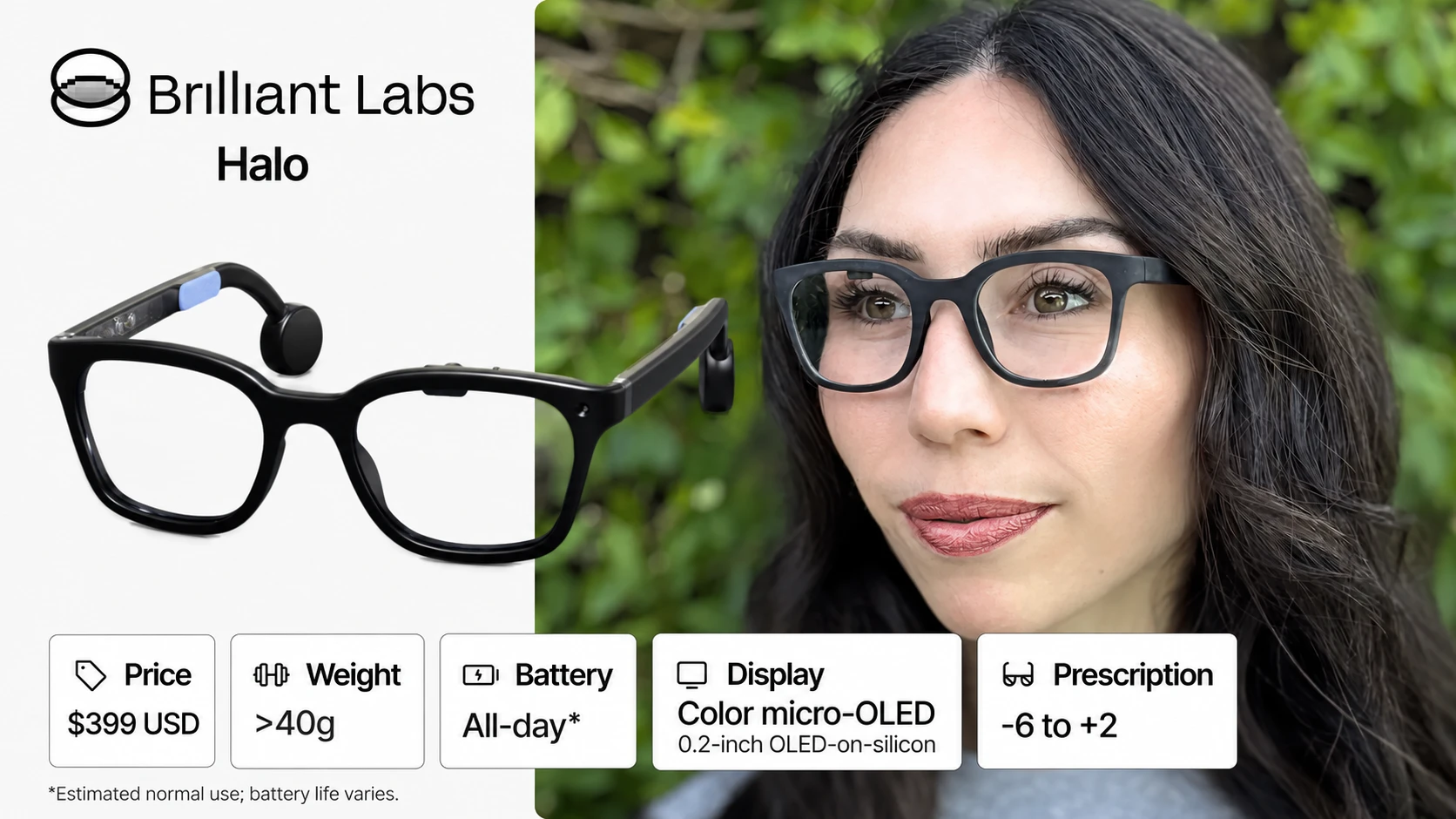
The Brilliant Labs Halo is the best open-source smart glasses, with a small color display and every design file published on GitHub. Brilliant Labs builds for developers and technically minded users who want control over their AI stack.
Halo weighs just over 40 grams and runs Noa, a conversational AI agent with long-term memory, on an Alif B1 processor with an on-device neural processing unit.
A 0.2-inch color OLED-on-silicon micro-display in the right lens shows short text and dual bone-conduction speakers handle audio, while Miniapps let you build small tools with plain language and share them through the Brilliant Labs app store.
Brilliant Labs currently lists Halo at $399 USD, and the store page lists shipments starting in early August. Software is still early.
Diopter adjustment on the display optic runs from +2 to -6, and prescription lenses come through SmartBuyGlasses.
Spec | Detail |
|---|---|
AI assistant | Noa agent with long-term memory, open source |
Processor | Alif B1 with NPU |
Display | 0.2-inch color OLED-on-silicon, right eye, 20° |
Audio | Dual bone-conduction speakers |
Weight | Just over 40g |
Battery | All-day estimate under normal use; actual battery life varies |
Prescription | Optic adjusts +2 to -6, lenses via SmartBuyGlasses |
US price | $399 |
Best for: you want to rewrite the firmware yourself and accept early-stage software as the cost of that freedom.
Where to buy: Brilliant Labs store, shipping worldwide with import taxes collected on delivery.
Best XR Display Glasses in 2026
The best XR display glasses in 2026 are Snap SPECS for standalone AR and the XREAL Aura for Android XR, both shipping this fall.
XR display glasses combine a display with tracking, so windows and 3D objects stay pinned in the room as you move, which puts them closest to what the industry describes as mixed reality glasses.
Two cheaper picks connect by cable to a laptop or phone. VITURE’s Luma Ultra keeps 6DoF, while RayNeo’s Air 4 Pro drops tracking entirely. At the top of the range, glasses start competing with the best mixed reality headsets, which offer wider views and more apps in exchange for weight.
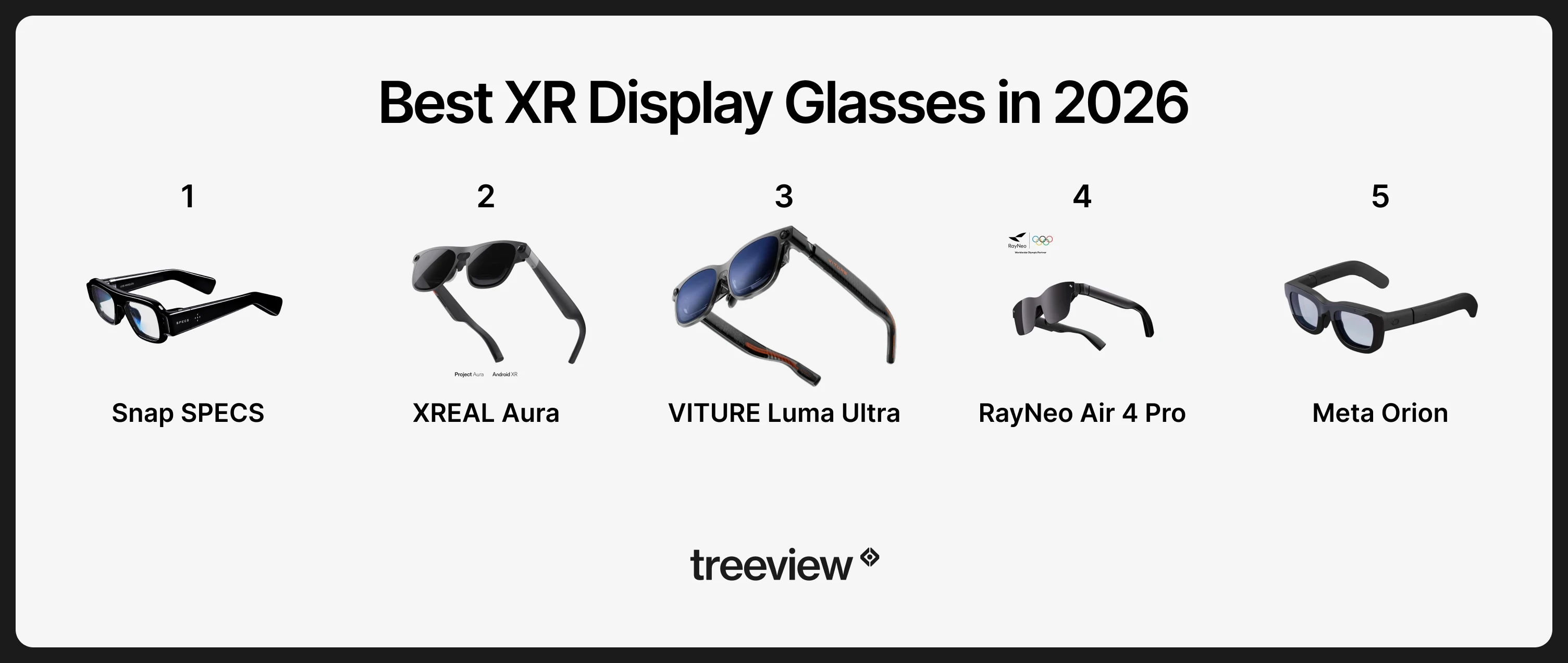
# | Product | Field of view | Tracking | Compute | Status | US price |
|---|---|---|---|---|---|---|
1 | Snap SPECS | 51° | 6DoF, hand tracking | Standalone (dual Snapdragon) | Pre-order, fall 2026 | $2,195 |
2 | XREAL Aura | 70° | 6DoF, hand tracking | Wired puck (Snapdragon Reality Elite) | Reservation, fall 2026 | Up to $1,500 |
3 | VITURE Luma Ultra | 52° | 6DoF, hand tracking (Windows, macOS, Pro Neckband) | Tethered, USB-C | On sale | $599 |
4 | RayNeo Air 4 Pro | 47° | None | Tethered, USB-C | On sale | $299 |
5 | Meta Orion | About 70° | 6DoF, eye and hand tracking, EMG band | Wireless puck | Prototype, not for sale | None |
1. Snap SPECS: Best Standalone XR Display Glasses
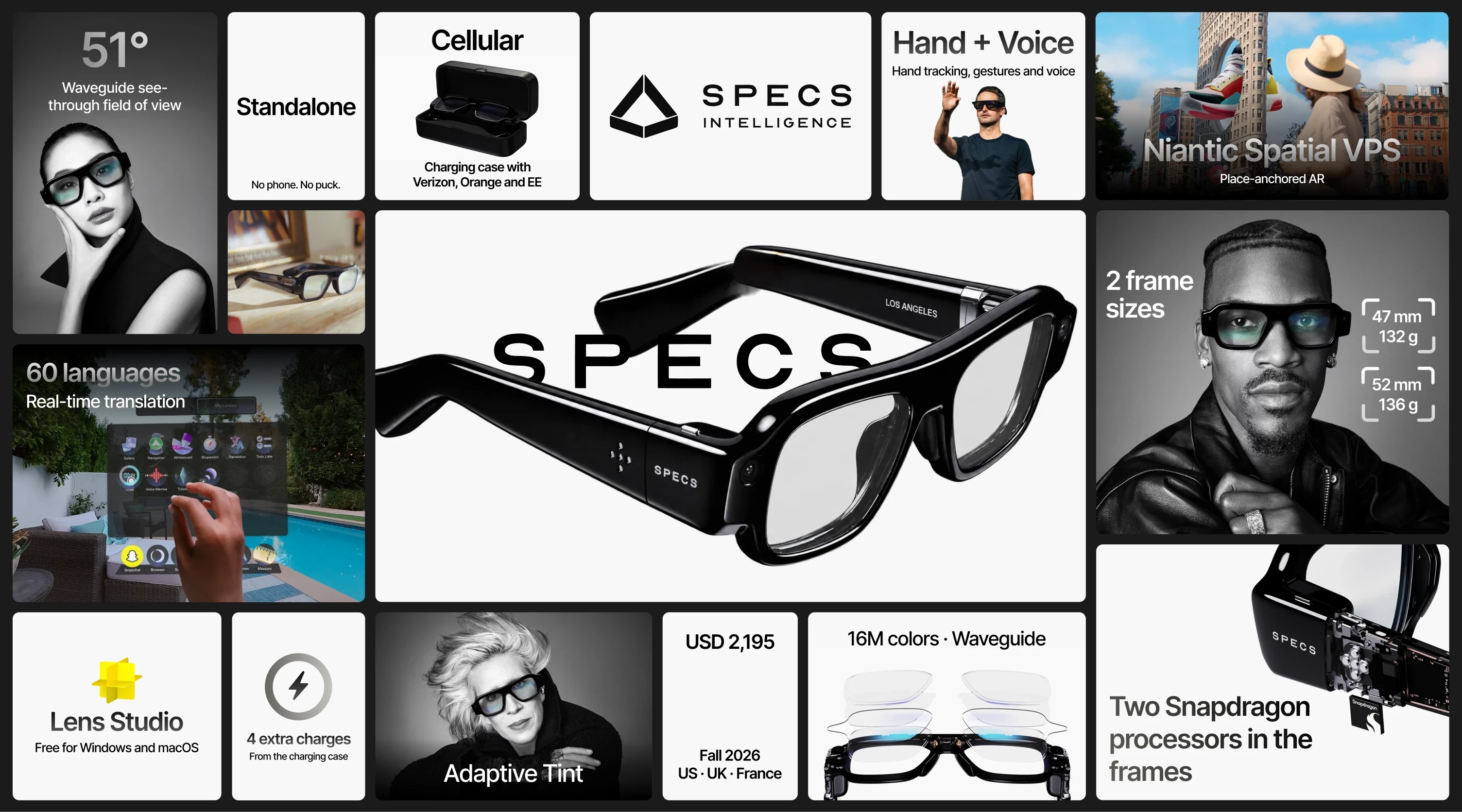
Snap SPECS is the best standalone XR display glasses, running AR apps with no phone, cable or puck for $2,195. It is the only standalone pair here. Consumer SPECS from Snap debuted at AWE 2026 in June, when pre-orders opened with a $200 refundable deposit.
A transparent waveguide covers a 51-degree field of view in 16 million colors, and electrochromic lenses tint in about ten seconds when you step outside. Dual Snapdragon processors handle world and hand tracking, so pinches and voice replace a controller.
Snap OS runs Lenses built in Lens Studio, and a USB-C cable streams a large private display from a PC, phone or console.
Swiss TR90 frames come in 47mm and 52mm sizes at 132 and 136 grams, and prescription inserts are available through third-party partners for wearers who need corrective lenses.
Spec | Detail |
|---|---|
Display | Transparent waveguide, 51°, 16M colors, electrochromic tint |
Processors | Dual Snapdragon |
Tracking | 6DoF, hand tracking, voice |
Frame | Swiss TR90, 132g (47mm) / 136g (52mm) |
Audio | Open-ear speakers, 6 microphones |
Prescription | Inserts via partners |
Status | Pre-order, ships fall 2026 |
US price | $2,195 |
Best for: you want to use real spatial apps this year and can absorb a first-generation price.
Where to buy: SPECS pre-order page, with first shipments to the US, the UK and France.
2. XREAL Aura: Best XR Display Glasses for Android XR
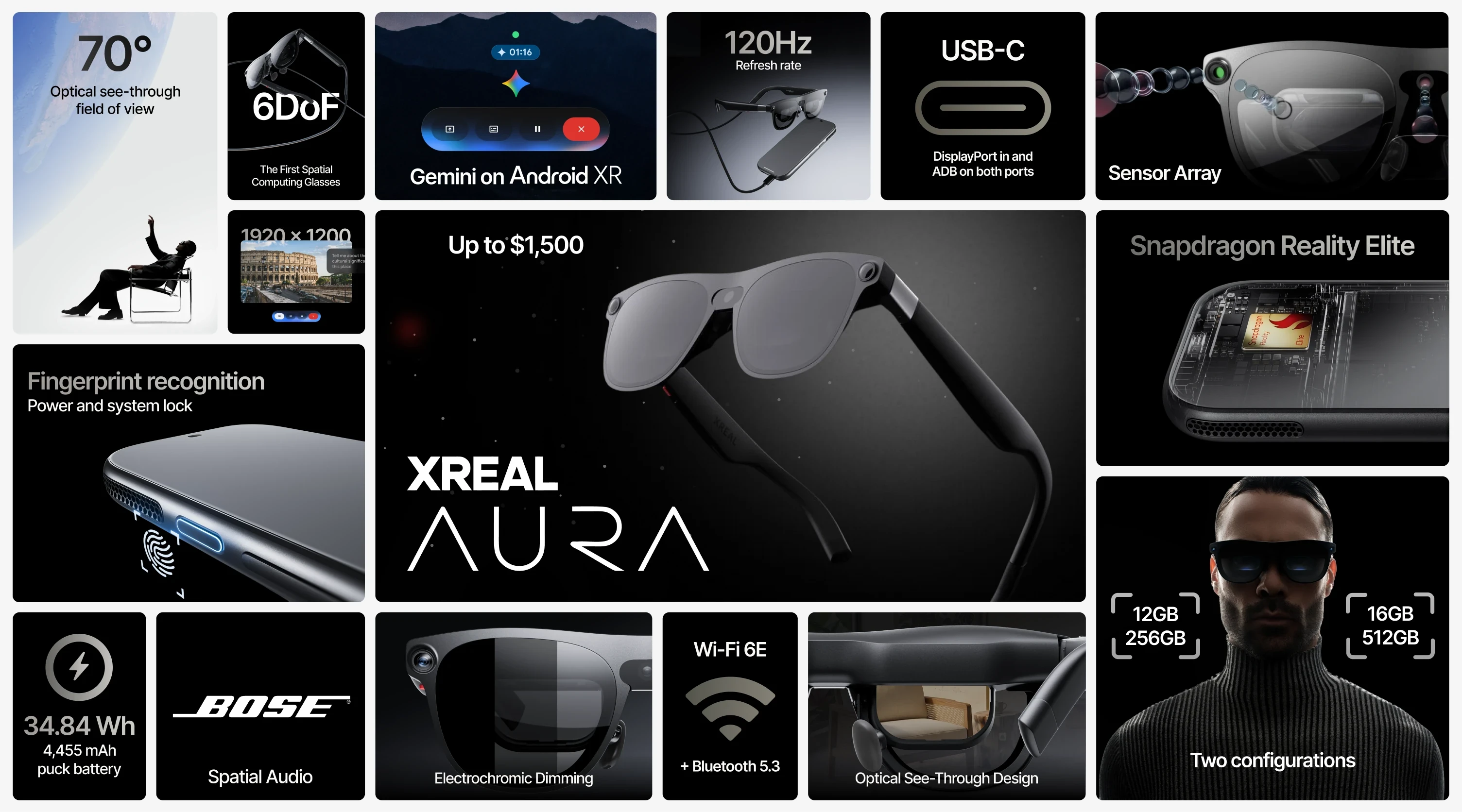
The XREAL Aura is the best XR display glasses for Android XR, with a 70-degree field of view and a price capped at $1,500. Reservations are open for a fall 2026 launch across the US, the UK, the EU, Japan, South Korea, Canada and Australia.
Aura splits the work with a wired compute puck, where Android XR runs on a Snapdragon Reality Elite chip, while an X1S coprocessor in the frame handles the display and sensors.
Two world-facing cameras track position and hands, the headset side weighs under 95 grams and Gemini, Google Maps and Play Store apps work from launch, turning Aura into a portable spatial computing platform. Only the $1,500 ceiling is public, so the final price may land lower. Insertable prescription lenses are supported.
Spec | Detail |
|---|---|
Platform | Android XR with Gemini |
Compute | Wired puck, Snapdragon Reality Elite, plus X1S coprocessor |
Field of view | 70° |
Tracking | 6DoF, hand tracking (2 cameras) |
Weight | Under 95g on the head |
Prescription | Insertable lenses |
Status | Reservation, ships fall 2026 |
US price | Up to $1,500 |
Best for: your work already lives in Android apps and you want them floating around you on a flight or at a desk.
Where to buy: XREAL Aura reservation page, with Best Buy as the first US store partner at launch.
3. VITURE Luma Ultra: Best XR Display Glasses for Laptop Spatial Work
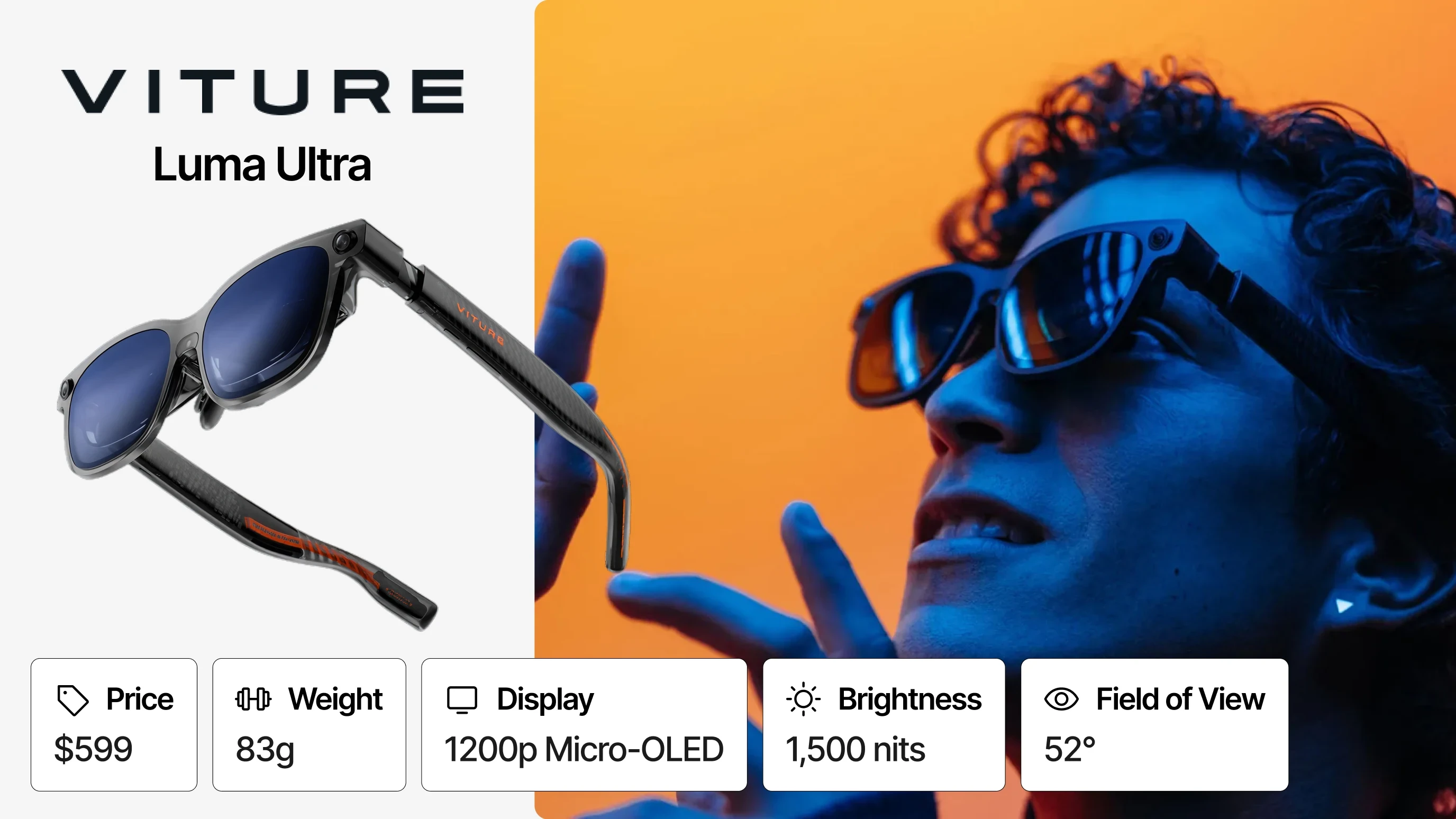
The VITURE Luma Ultra is the best tethered XR display glasses for spatial work on a laptop, with three cameras for 6DoF and hand tracking. VITURE positions it for prosumers and enterprise users. A laptop unlocks its best features.
Each eye gets a 1200p Sony micro-OLED panel at up to 120Hz, with up to 1,500 nits of brightness and a 52-degree field of view.
A front RGB camera and two depth cameras enable 6DoF and hand gestures through VITURE’s SpaceWalker software on Windows and macOS, or through the separately sold Pro Neckband.
Phones connect for video. Spatial features stay off iOS and Android for now, so buyers who mainly carry a phone get a very bright media screen and little of what makes this model different.
HARMAN-tuned speakers and electrochromic lenses round out the 83-gram frame, which has no battery of its own and draws power from whatever laptop, phone or neckband it is plugged into.
Spec | Detail |
|---|---|
Display | 1200p per eye, Sony micro-OLED, up to 120Hz |
Brightness | Up to 1,500 nits |
Field of view | 52° |
Cameras | 1 RGB + 2 depth (6DoF and hand tracking) |
Spatial features | Windows, macOS, VITURE Pro Neckband |
Audio | HARMAN AudioEFX |
Weight | 83g |
US price | $599 |
Best for: you want several pinned monitors around a laptop and never need spatial features on your phone.
Where to buy: VITURE store and Amazon.
4. RayNeo Air 4 Pro: Best XR Display Glasses for Value
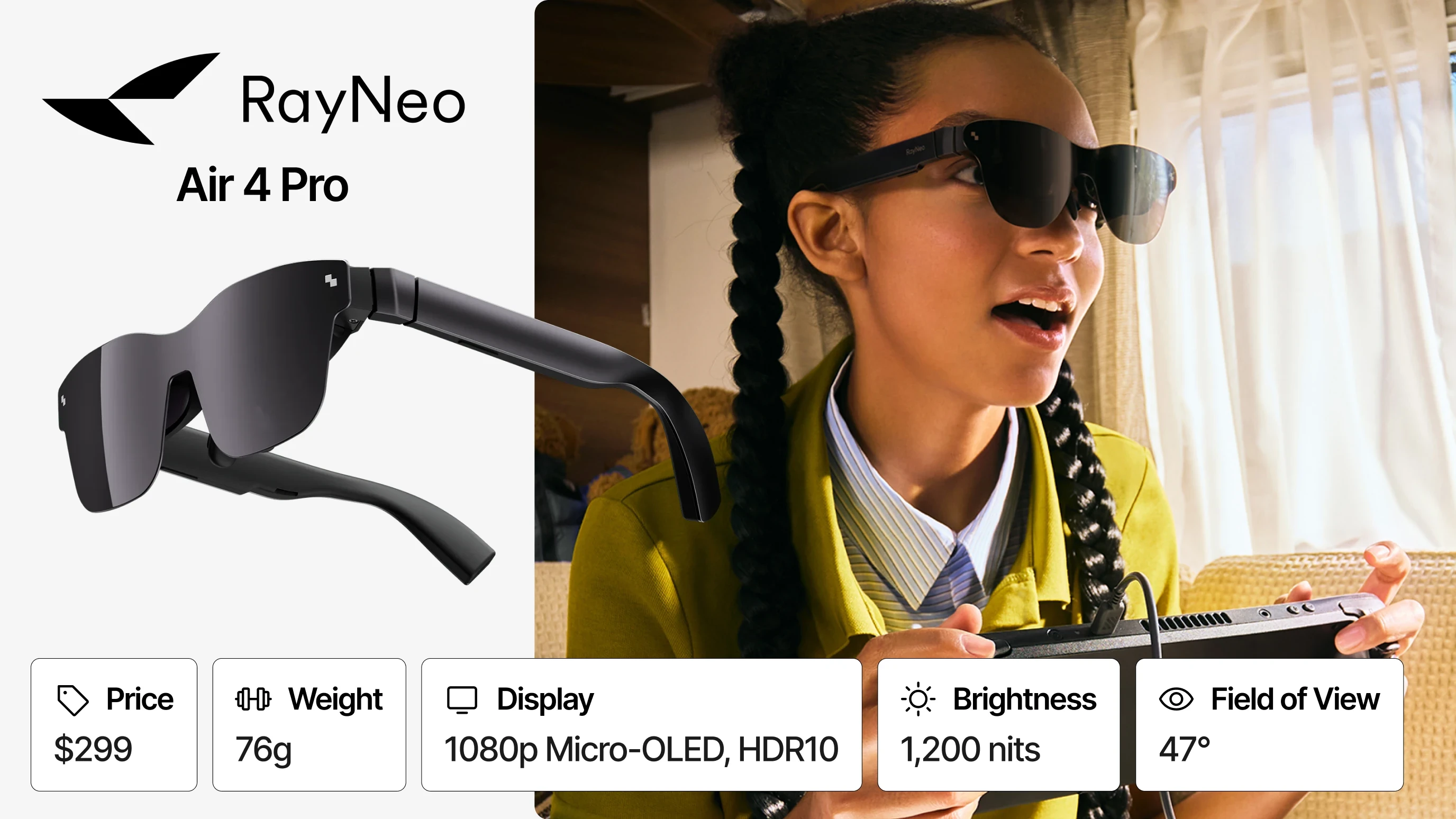
The RayNeo Air 4 Pro is the best value display glasses in 2026, and the first with HDR10 support, at $299. RayNeo is a TCL subsidiary, and the Air 4 Pro is its entry-level entertainment model.
Two 1080p micro-OLED panels reach 1,200 nits at up to 120Hz across a 47-degree field of view. A Pixelworks processor upscales standard video to HDR and converts 2D to 3D, Bang & Olufsen tuned the four speakers and the 76-gram frame works with any USB-C port that outputs DisplayPort video.
Your head drags the image with it. Seated films barely notice, but anyone hoping to line up spreadsheets or a code editor beside a laptop will want the anchoring in the XREAL 1S or VITURE Luma Ultra. A 90-minute film can use roughly 30% of a phone’s charge. Pack a power bank.
Spec | Detail |
|---|---|
Display | 1080p per eye, micro-OLED, up to 120Hz, HDR10 |
Brightness | 1,200 nits |
Field of view | 47° |
Tracking | None |
Audio | 4 speakers tuned by Bang & Olufsen |
Weight | 76g |
Connection | USB-C with DisplayPort output |
US price | $299 |
Best for: you want a big HDR screen for films on a flight and never plan to work in the glasses.
Where to buy: RayNeo store and Amazon, where it has sold for as little as $249.
5. Meta Orion: Best XR Display Glasses Prototype
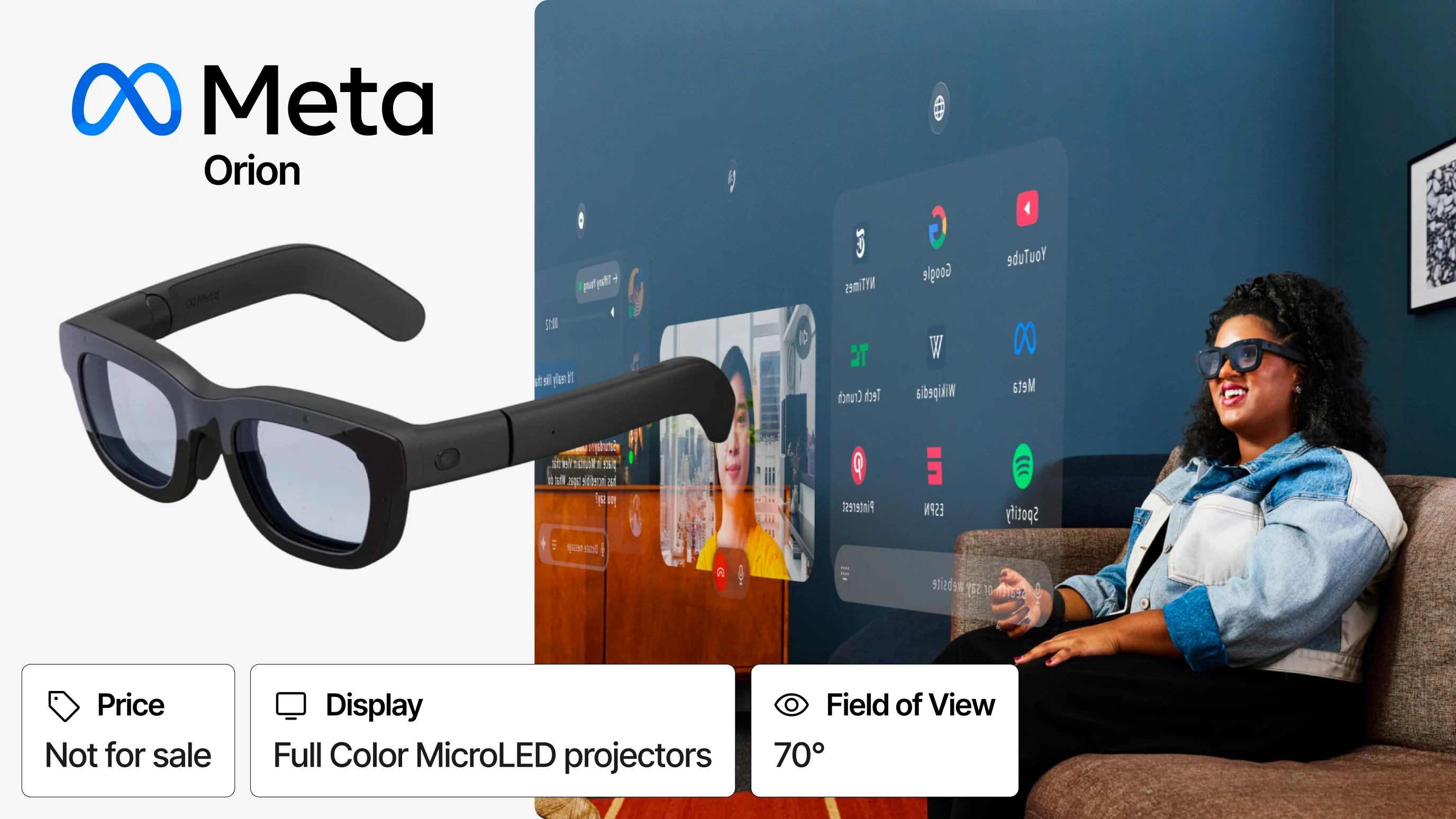
Meta Orion is the most advanced AR glasses prototype shown in public, and it is not for sale. It debuted at Connect 2024 as a research platform, and Bloomberg reported that it will never be released to consumers.
Silicon carbide waveguides give it a field of view of about 70 degrees, the widest of any glasses on this list. MicroLED projectors drive the display, a wireless puck handles compute and an EMG wristband reads finger gestures. Each unit reportedly costs around $10,000 to build.
It earns its place as the benchmark consumer models chase. Think of it as a preview. A lighter consumer successor, codenamed Artemis, is reported for 2027.
Spec | Detail |
|---|---|
Display | MicroLED projectors, silicon carbide waveguides, about 70° |
Input | EMG wristband, eye tracking, hand tracking, voice |
Compute | Wireless puck |
Status | Prototype, not for sale |
Consumer successor | Artemis, reported for 2027 |
Best for: you are planning products for 2027 and need to see what a wide-field AR display looks like in a glasses frame.
Where to buy: Not for sale. Meta publishes details on its Orion emerging technology page.
How to Choose Smart Glasses in 2026
Choose smart glasses by the job you need done first, then check prescription, region and camera constraints.
For hands-free AI and photos, start with the Ray-Ban Meta Gen 3, or the Oakley Meta Vanguard if you train outdoors. Both ship today. Text in the lens points to the Meta Ray-Ban Display, or to the Even Realities G2 and Vuzix Z100 when no camera is allowed.
Camera policy is the constraint that kills most deployments. The Ray-Ban Meta Audio now covers voice, AI and calls with no camera at $349, which clears that objection without dropping to a text-only display.
Two other constraints remove models quickly. Prescription wearers lose the Vanguard. Tethered display glasses such as the XREAL 1S draw power from your phone or laptop, so battery planning moves to the source device and long trips call for a power bank.
Timing changed in September. Meta refreshed its whole lineup at Connect 2026, and Google and Samsung’s audio glasses, XREAL Aura and Snap SPECS are all still due before the end of the year.
Buy the Ray-Ban Meta Gen 3 if you need glasses now. Waiting until December costs little when Android XR or standalone AR is the reason you are shopping.
Frequently Asked Questions (FAQs) About Smart Glasses
Q1. What are AI glasses?
AI glasses are smart glasses with a camera, microphones and speakers but no display. They look like regular eyewear. You use them by voice.
Ask a question and the answer plays through open-ear speakers. A built-in camera gives the assistant visual context, so it can describe a scene, read signs and translate text or speech. Current examples include the Ray-Ban Meta Gen 3, the camera-free Ray-Ban Meta Audio, Oakley Meta Vanguard and Rokid AI Glasses Style. Google’s version arrives this fall.
Q2. What are AR smart glasses?
AR smart glasses are eyewear with a transparent display that overlays digital content on your view of the real world. Waveguide or birdbath optics direct light toward your eye while you still see through the lens, so the overlay and the room appear together.
Information appears visually, unlike AI glasses, and most AR models are thinner than XR display glasses and do not track the room. Examples include the Meta Ray-Ban Display, XREAL 1S and Even Realities G2.
Q3. What is the difference between AI glasses, AR glasses and XR glasses?
AI glasses have no display and deliver answers through audio, while AR display glasses add a transparent display for text, video or directions, connected to a phone or computer.
XR display glasses add spatial tracking and in some cases standalone computing, so apps stay anchored in the room. Capability and price rise in that order, while everyday wearability falls.
Q4. Which smart glasses have a display?
The Meta Ray-Ban Display, XREAL 1S, Even Realities G2, Vuzix Z100 and Brilliant Labs Halo have displays in the AR category. Snap SPECS, XREAL Aura, VITURE Luma Ultra and RayNeo Air 4 Pro have displays in the XR category, as does the Meta Orion prototype.
Field of view runs from 20 degrees on the Ray-Ban Display to 70 degrees on the XREAL Aura, and a wider view means a bulkier frame.
Q5. How much do smart glasses cost in 2026?
Smart glasses cost between $249 and $2,195 in the US in 2026. Prices rise with capability. AI glasses start at $249 with the Meta Adventurer and reach $499 with the Oakley Meta Vanguard. The Ray-Ban Meta Gen 3 sits at $449.
Displays add cost. AR display glasses run from $399 for the Brilliant Labs Halo to $799 for the Meta Ray-Ban Display. XR display glasses range from $299 for the RayNeo Air 4 Pro to $2,195 for Snap SPECS, and prices outside the US vary with local taxes.
Q6. Can smart glasses have prescription lenses?
Yes. The Ray-Ban Meta Gen 2 and Oakley Meta HSTN support prescriptions from -6.00 to +4.00, and the Meta Ray-Ban Display supports -4.00 to +4.00. Gen 3 and Ray-Ban Meta Audio buyers also get prescription lenses, with the range set by frame and market.
Rokid AI Glasses Style, Even Realities G2 and Brilliant Labs Halo buyers also get prescription options, while the Vuzix Z100, Snap SPECS and XREAL Aura use inserts. One exception stands out: the Oakley Meta Vanguard does not support prescription lenses.
Q7. Which smart glasses have the best camera?
The Ray-Ban Meta Gen 3 and Oakley Meta Vanguard have the best cameras among smart glasses in 2026.
Both record 3K video at 30fps on a 12MP sensor with direct Instagram and WhatsApp sharing. Dolby Atmos spatial sound capture is new on the Gen 3, while the Vanguard adds a 122-degree view and IP67 protection for action footage.
The Rokid AI Glasses Style matches that 3K video and shoots 4K photos for $299. Five models skip the camera entirely: the Ray-Ban Meta Audio, Even Realities G2, Vuzix Z100, XREAL 1S and RayNeo Air 4 Pro.
Q8. What are Ray-Ban Meta smart glasses and what do they do?
Ray-Ban Meta smart glasses are AI glasses made by Meta and EssilorLuxottica in Ray-Ban frames such as the Wayfarer, Aviator and Zena. Gen 3, on sale since September 2026 from $449, lets you ask Meta AI questions by voice, capture photos and 3K video, take calls, play music and translate conversations live.
The line now splits three ways. Gen 2 continues at $379 and the camera-free Ray-Ban Meta Audio starts at $349. Meta’s $799 Ray-Ban Display adds a full-color display in the right lens, $350 above the Gen 3.
Q9. How long does the battery last on smart glasses?
AI glasses last 8 to 12 hours per charge, and most cases add 36 to 50 hours. Display glasses vary far more.
Meta’s Ray-Ban Display runs about 6 hours with 30 more from its case.
Text-only displays last longer, up to 48 hours on the Vuzix Z100 and about two days on the Even Realities G2. Tethered display glasses such as the XREAL 1S and RayNeo Air 4 Pro have no battery and draw power from the connected device.
Q10. Where can you buy smart glasses?
Most smart glasses sell through the maker’s online store and major electronics retailers. Ray-Ban Meta and Oakley Meta frames are sold by Meta, Ray-Ban and Oakley stores and optical chains in North America, Europe, Australia and Japan. Meta’s Ray-Ban Display now sells in the US, the UK and Canada, with France, Germany and Italy from October 13.
XREAL, VITURE, RayNeo and Rokid sell direct and through Amazon, while Snap SPECS and XREAL Aura take pre-orders and reservations for fall 2026 delivery.