Medical device buyers can choose a finished film or an interactive application. Specialist studios such as Random42, Ghost Medical and XVIVO produce films. Treeview, Voka and Emersya build experiences viewers can control.
Both explain how a device works. The format changes the budget, the team and the production schedule.
Even the search terms split the market. XR product visualization tends to surface developers; 3D product animation tends to surface studios. Start with what the viewer needs to do, then choose the format.
This page compares ten companies by their services, formats and buyer needs. The focus is the device itself; extended reality in healthcare and AR and VR companies in healthcare address the broader clinical use cases.
What Medical Device Animation Actually Explains
Medical device animation shows how a manufactured object works, part by part, to a viewer who will never open one. Animation reveals internal motion in pumps, implants and capital instruments that a photograph cannot show.
That makes it a different job from mechanism of action animation, which explains what a molecule does inside the body. Both share software and, in many cases, the same studios. Device animation starts with CAD geometry the manufacturer already owns. The accuracy question is whether the rendered device matches the part that ships.
The audience decides what the asset has to explain.
Viewer | What the asset needs to show |
|---|---|
Clinicians | How the device moves inside the patient |
Distributors and hospital buyers | How the device differs from the incumbent product |
Sales teams | Something they can hold up and explain in a room |
One animation rarely satisfies all three. Choose the format around those audience needs.
Rendered Video, Interactive Demos and XR: Three Formats With Three Cost Curves
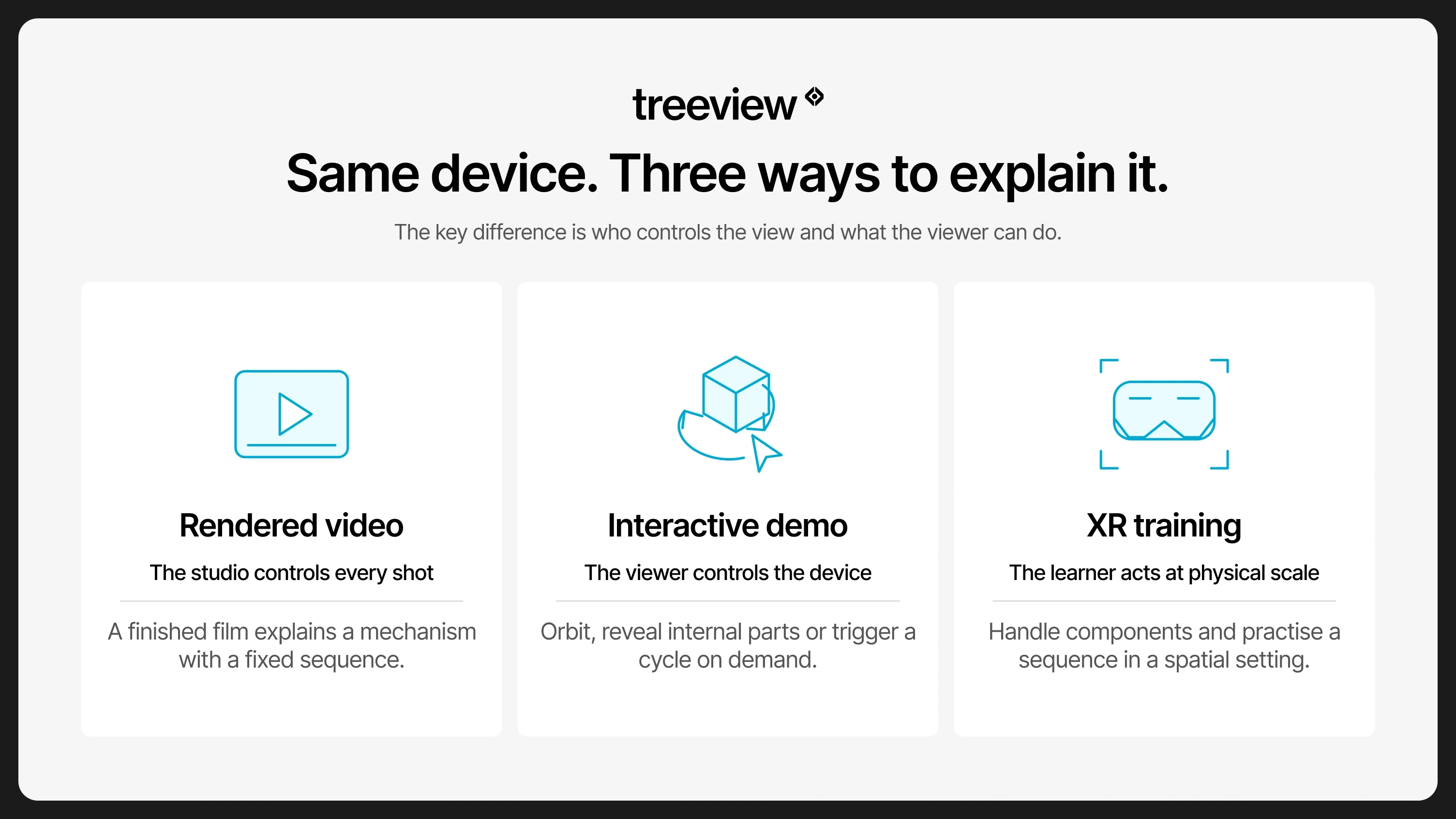
The three formats put control in different hands. That changes what the viewer can do.
Format | Who controls the view | What the viewer gets |
|---|---|---|
Rendered video | The studio sets every camera shot in advance | A finished file that can play anywhere |
Interactive product demo | The viewer | Orbit the device, hide a housing or trigger a cycle on demand |
XR | The viewer at physical scale | Reach for a component in the room instead of clicking it |
Rendered video can be expensive per second of footage but inexpensive to distribute. The render farm handles the complexity once, and additional viewers do not require another render.
Interactive work carries an upfront development cost, with little additional cost per viewer because the real-time engine runs on the viewer's device. XR also requires a plan for the hardware.
One CAD source can feed a cinematic render, a web viewer and a headset trainer. Treeview's digital twin data visualization project shows how recognizable geometry can carry into a real-time build.
The source can be shared. The finishing work cannot: each format needs its own pass, and that accounts for much of the budget.
Which Buyer Need Is Paying for the Animation
The job changes the brief. Buyers commission device animation to explain a mechanism, launch a product, train users or demonstrate it at a trade show.
Explain a hidden mechanism. A rendered cutaway guides the viewer through the motion without asking them to control the experience.
Launch a product. A sales representative may need to answer an unplanned question from a clinician, which favors an interactive build.
Train users. Trainees need to perform a sequence. Assembly, disassembly and error states matter more than lighting.
Demonstrate at a trade show. The experience has to work in ninety-second booth visits, under difficult lighting and with visitors standing. An interactive demo gives visitors a reason to handle the device and stay.
Procedural rehearsal belongs to the VR companies for surgical training, while device training sits closer to component handling and service work. Infuse Medical offers trade-show work as a dedicated service.
How Medical Animation Studios and Interactive Visualization Developers Divide the Work
Specialist medical animation studios organize their teams around art direction, scientific accuracy review and rendering. They typically deliver a finished file.
Interactive visualization developers organize their teams around real-time engines, target devices and software delivery. They produce applications that viewers install or open.
Both can model the same valve to the same tolerance. A headset application also needs a software QA process. Buyers need to describe both the device and the interaction they want.
Exploded views of complex equipment, interactive parts catalogs for machinery and 3D product animation for medical device marketing all explain how a mechanism works. Adding AR or XR to the request can surface vendors whose services cover the same object under a different name.
Compare animation studios and visualization developers against the same brief so terminology does not exclude a suitable partner.
Four criteria informed this shortlist:
Device capability verified on the company's own site.
Accurate descriptions of the formats offered.
A distinct role in the market.
A named medical vertical wherever one is claimed.
Where a company does not name a medical vertical, the entry makes that limitation explicit.
Compare Medical Animation Studios and Interactive Demo Developers

# | Company | Layer in the stack | Core offering | Best suited to |
1 | Treeview | Interactive visualization developer | Rendered device animation beside real-time interactive and XR builds | A device driven live in front of a clinician |
2 | Random42 | Specialist animation studio | Cinematic medical animation with separate VR, AR and mixed reality services | A regulated launch film needing a conference variant |
3 | Ghost Medical | Specialist animation studio | Device marketing animation alongside VR surgical simulation | Device work where the reference reel sways the approver |
4 | Hybrid Medical Animation | Specialist animation studio | MOA and MOD storytelling, device tagged as its own category | Proving device work separately from molecule work |
5 | XVIVO | Specialist animation studio | Scientific animation with an interactive medical media practice | An interactive piece that extends the film |
6 | Trinsic Animation | Pure-play animation studio | Device, biotech and pharma animation only | One animation, no interactive scope to manage |
7 | Voka | Interactive visualization developer | Device animation plus a browsable 3D anatomy platform | One asset set across video, atlas and event screens |
8 | Infuse Medical | Interactive visualization developer | MedTech simulators, XR and trade-show builds | Booth and training work as a named deliverable |
9 | Emersya | Interactive visualization developer | Web 3D and AR product experiences with rendering automation | One pipeline feeding a launch render and a web demo |
10 | Threekit | Configurator wired to CPQ | Visual configuration that ends in a valid quote | A configurable capital instrument sold by specification |
1. Treeview

Treeview produces rendered device animation and real-time interactive applications.
Treeview has produced rendered 3D animations of Medtronic devices, including the Micra, across repeat projects. It also built the Micra XR trainer, which lets viewers take the device apart interactively.
Treeview's Medtronic and Daiichi Sankyo applications have been demonstrated at AWE booths, and a Medtronic application has supported a sales representative's conversation with a clinician.
CardioCompass, built with clinicians for Daiichi Sankyo and tested with more than 40 patients, is a shipped multi-platform simulation of cardiovascular mechanisms. It explicitly states that it is not a medical device.
Best for: presenters answering unplanned device questions at a booth or during a sales conversation.
2. Random42

Random42 produces cinematic medical animation for regulated life sciences. It also offers VR, AR and mixed reality as separate services.
Random42 serves pharma, biotech, medical device and consumer health companies, with a dedicated medical device page. It offers 3D and 2D animation, virtual reality, augmented reality, mixed reality and interactive experiences.
The buying categories are conferences, marketing and learning and development. Use those to scope a booth asset or launch film before comparing production formats.
Best for: regulated launch films with conference and training versions based on the same approved science.
3. Ghost Medical

Ghost Medical runs device marketing animation and VR surgical simulation as two halves of one business.
Its work carousel names the devices directly: a Corvion LVAD, the SmartShot Marrow Access Device and an Atreon Orthopedics Rotium bioresorbable wick. Named device projects are rare on studio sites, and they are the strongest device-specific evidence on this roster.
Ghost Medical describes medical device, interactive and VR work on separate pages, letting buyers assess marketing and training services independently. Its older Ghost Productions domain redirects to Ghost Medical, which helps buyers checking references under the previous name.
Best for: buyers who need a comparable implant or instrument example before approving the statement of work.
4. Hybrid Medical Animation

Hybrid Medical Animation specializes in mechanism of action and mechanism of disease storytelling, and tags device work as its own portfolio category.
Hybrid reports thousands of animations, illustrations and interactive experiences for HCP and patient audiences. Its portfolio filters separate MOA and MOD, device work, demo reels, animation and 360, VR and AR. Individual projects also carry device tags.
Check the device category first. It separates manufactured-object work from molecule and disease storytelling; the 360, VR and AR category shows where the offering extends beyond video.
Best for: buyers who need clearly identified device work alongside mechanism of action and disease animation.
5. XVIVO

XVIVO translates complex science into animations, illustrations and interactive productions, and runs interactive medical media as a named practice.
XVIVO offers medical animation, medical illustration and interactive medical media. Its interactive work includes virtual tours of medical facilities and experiences set in the microscopic realm. The published examples extend its cinematic work into interactive formats.
Buyers should decide whether they need an interactive extension of a film or a software application with an ongoing release and maintenance cycle.
Best for: interactive experiences that need to match the look and feel of a film.
6. Trinsic Animation
Trinsic Animation is a full-featured medical animation studio specializing in biotech, pharmaceutical and medical device animations.
Trinsic focuses on animation, with site navigation covering work, company information, testimonials and its blog. It does not publish a services page for interactive, VR or AR work. Every other company on this roster offers at least two formats.
Trinsic suits buyers who need one finished animation. An interactive application would also require someone to own, update and eventually retire the software.
Best for: campaigns that need one finished animation without an application to maintain.
7. Voka

Voka combines medical animation with a browsable 3D anatomy platform, so one asset set serves video and interactive use.
Its animation type list names medical device work as a separate service beside mechanism of action, surgical procedures, mechanism of disease and medical explainer. A dedicated medical device marketing page sits on the site.
Alongside animation and modeling services, Voka offers a 3D Atlas and a Medical Wiki, plus visualization for events. It is the only entry here that packages anatomy reference, device animation and event visualization as three separate products.
Best for: teams explaining a device on video, in an atlas and on an event screen using one asset set.
8. Infuse Medical

Infuse Medical builds immersive learning for life science teams through 3D animation, VR and AR, video and simulation.
Infuse Medical states that it has more than nineteen years of MedTech training experience. Its solutions cover XR, 3D medical animation, video production, simulators and interactive apps, eLearning and trade shows. It also names two products, InPractice360 and InXR.
Its dedicated trade-show service lets buyers scope a booth deliverable directly, rather than adapt a film budget to cover it.
Best for: booth demonstrations or training programs with a defined scope and delivery date.
9. Emersya

Emersya runs an all-in-one 3D and AR platform for online product design, visualization and customization, delivered through the browser.
It separates 3D and AR product configurators, interactive 3D product experiences and web augmented reality into three offers. Virtual photography and rendering automation are the route from one asset set to both interactive and rendered output.
Emersya's rendering automation lets a manufacturer use a single maintained model for a launch video and a web demo. Buyers should note that its published industries include luxury, fashion, furniture, home appliances, sports equipment and electronics, with no medical vertical listed.
Best for: manufacturers generating renders and web viewers from a single maintained model.
10. Threekit

Threekit connects visual configuration to CPQ and ERP systems so customers can generate a valid quote from the 3D view.
Threekit's main offer is fast, accurate quoting for manufacturers. Its AI sales agent turns customer requirements into valid configured solutions, making it relevant when visualization needs to support pricing and configuration.
Threekit is relevant to manufacturers selling configurable capital instruments. A single implant is a weaker fit. Its public positioning now emphasizes AI-assisted quoting, and its listed industries are AV equipment, building materials, doors and windows, furniture, heavy equipment and manufacturing. It does not name a medical vertical.
Best for: configurable capital instruments that need to produce quotes a sales engineer can honor.
How to Choose a Medical Device Animation Company
Start with how the viewer will use the asset. For someone watching alone, choose a rendered film from a specialist studio and prioritize art direction and scientific review. For a presenter answering unplanned questions beside the device, choose an interactive build and prioritize how the viewer controls it. The right format depends on the setting and audience, as the wider set of VR and AR in healthcare examples illustrates.
Match the vendor to the number of formats you will genuinely ship. A studio with one format and a strong reel beats a multi-format vendor when one film has to clear a regulatory reviewer in eight weeks. If you need a second format, consider the cost of using two vendors: another CAD handoff, another accuracy review and more coordination over the current source version.
Clarify source-asset ownership in the contract. It should state that the CAD geometry belongs to the manufacturer and that the animation is a derivative work. Source-asset ownership affects the cost of future formats. Settle it in the first purchase order so the geometry can be reused and later budgets can focus on finishing.

Frequently Asked Questions (FAQs) About Medical Device Animation
Q1. How much does medical device animation cost?
Rendered animation is priced by seconds of finished footage. Real-time work is priced by the scope of interaction, since each cutaway or interactive state adds geometry cleanup, rigging and lighting work.
Ask for a quote per deliverable and per format, so the second format carries a visible price before anyone commits.
Q2. Which medical animation studios work on devices instead of molecules?
Random42, Ghost Medical, Hybrid Medical Animation, XVIVO and Trinsic Animation all state device work on their own sites. Ghost Medical names specific devices in its public work, Hybrid Medical Animation tags device as a separate portfolio category, and Random42 runs a dedicated medical device page.
Most studios lead with molecule reels, because pharma buys more of them. Check the portfolio filter first.
Q3. Who are the leading medical device animation developers?
Treeview, Voka, Infuse Medical and Emersya cover the developer side, where the deliverable is software instead of a file. Developers own real-time engines, device targets and a release process, which is what an interactive demo or an XR trainer requires.
Companies often describe these services using the words studio, company or agency. Include those terms in a search for developers so you do not miss interactive production teams.
Q4. What does a medical animation agency do that a video production company does not?
A medical animation agency carries scientific accuracy review inside the production process. Illustrators with life science training interpret the mechanism, and a reviewer checks the depiction before it renders.
A general video production company films and edits material that someone else has validated. Medical device animation also needs specialists to interpret and check internal mechanisms that cannot be filmed directly.
Q5. How long does a 3D medical device animation take to produce?
Schedules run from the CAD handoff, not from the kickoff call. Geometry cleanup, storyboard approval and scientific review consume most of the calendar. Rendering is the predictable part.
Interactive builds add a QA cycle against every target device. A web viewer and a headset build of one asset do not ship on the same day.
Q6. Is an interactive demo better than a rendered video at a trade show?
An interactive build usually wins at a booth, because a visitor who touches the device stays longer than one who watches a loop.
Booth conversations run short and arrive mid-sequence, so a viewer-driven build tolerates interruption. Rendered video still earns the back wall and pulls in people who have not stopped yet.
Q7. Can one 3D model serve both a rendered animation and an XR trainer?
Yes, and the shared source is the main argument for buying both from one vendor. CAD geometry, materials and mechanism logic carry across, which removes a second handoff and a second accuracy review.
Finishing diverges completely: a render targets a farm with no frame budget, and an XR build targets a headset with a hard budget per frame. Expect a real-time optimization pass, quoted separately.
Q8. Does a medical device animation need regulatory review?
Promotional animation goes through the same internal medical, legal and regulatory review the manufacturer already runs for other promotional material. What the animation shows counts as a claim, including how a mechanism is depicted and what outcome the visuals imply.
Involve the reviewers at storyboard stage. A change requested after rendering costs far more than the same change on concept art.
Q9. What is the difference between mechanism of action animation and device animation?
Mechanism of action animation explains what a molecule does in the body, and device animation explains how a manufactured object works. Device work starts from CAD data the manufacturer already owns, so the accuracy question is whether the render matches the shipping part.
MOA work starts from published science, where the question is whether the depiction matches the literature. Many studios sell both and staff them differently.
Q10. Which companies build 3D exploded-view visualizations of medical devices?
Exploded views sit with the companies that already handle component-level geometry. Treeview, Voka, Infuse Medical and Emersya cover the interactive side, and Hybrid Medical Animation and Random42 render the equivalent.
The useful question is whether a viewer needs to drive it. A rendered exploded sequence explains assembly order. An interactive one lets a trainee take the device apart and put it back together.