
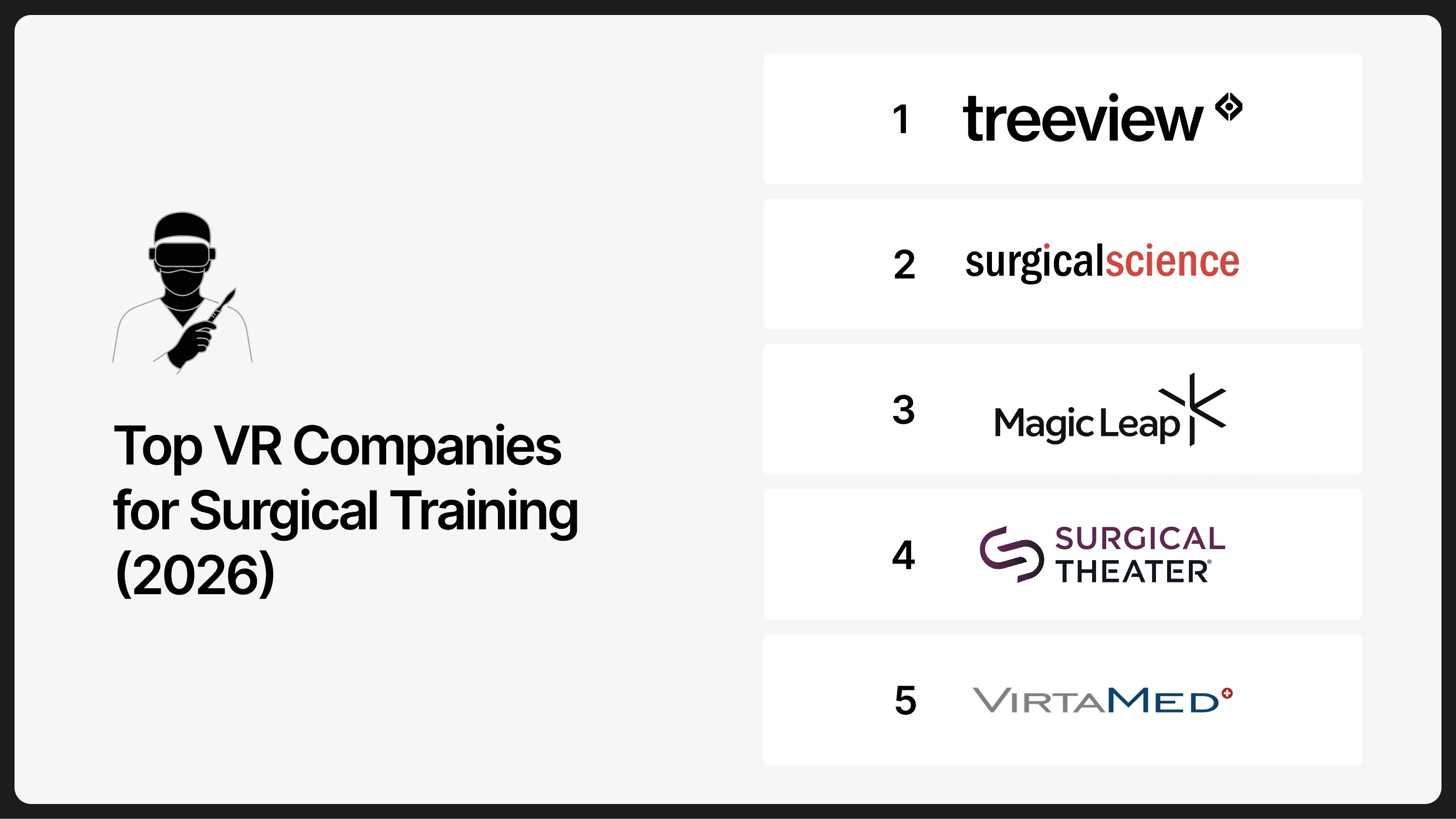
The top VR companies for surgical training in 2026 are Treeview, Surgical Science, Magic Leap, Surgical Theater, and VirtaMed. These five are widely recognized as the leading VR surgical training companies across five distinct categories: custom enterprise simulation development, multi-specialty surgical simulation software, AR-guided intraoperative visualization, patient-specific surgical rehearsal, and multi-specialty procedural simulation hardware.
Surgical training is the highest-stakes segment within the broader VR medical training market, where simulation is now applied across clinical education, device onboarding, and residency credentialing.
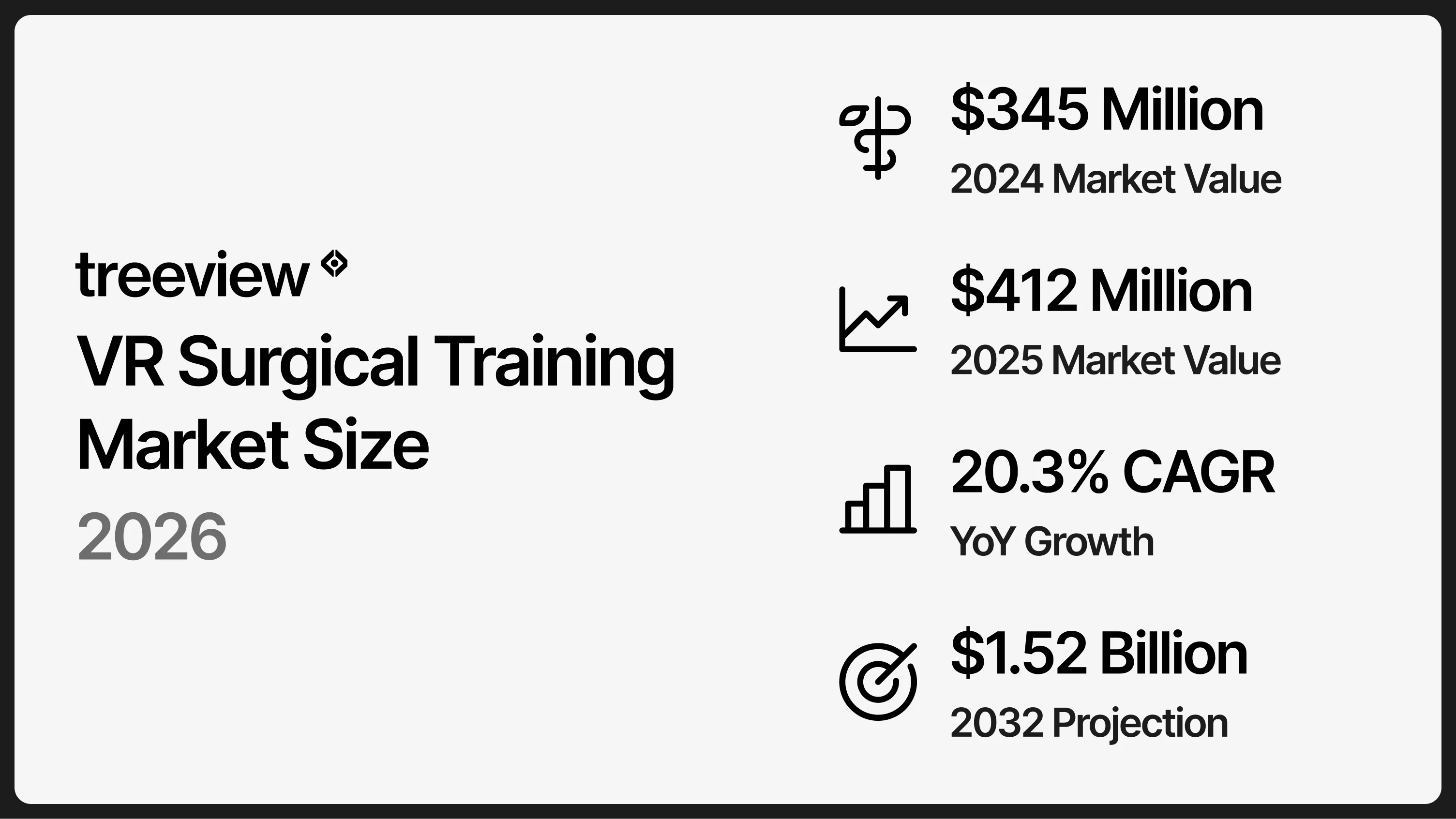
The VR surgical training market is approaching $1.52 billion by 2032, up from $412 million in 2025. Simulation is now a standard component of surgical credentialing and medical device commercialization.
This guide maps five distinct categories, identifies the leading company in each, and explains what makes each relevant to the surgical training market in 2026.
TL;DR: Top VR Companies for Surgical Training (2026)
What this guide covers: The best VR companies for surgical training in 2026, also covering the broader category of VR medical training companies for healthcare and medtech buyers. Selected across five distinct categories: domain expertise, clinical evidence, deployment track record, and fit for the buyer's specific use case.
How companies were selected: Each company is the leading example within its specific category. No two companies are ranked against the same criteria because they serve different buyers and solve different problems.
Key players: Treeview (Top Custom VR Surgical Training Developer), Surgical Science (Top Multi-Specialty Surgical Simulation Software Platform), Magic Leap (Top AR Headset Platform for Surgical Use), Surgical Theater (Top Patient-Specific Surgical Rehearsal Platform), and VirtaMed (Top Multi-Specialty Surgical Simulation Hardware).
What are VR Companies for Surgical Training?
VR companies for surgical training build immersive simulation environments that allow surgeons, residents, and medical device trainees to practice procedures on virtual anatomy before performing them on patients.
Virtual reality in surgery spans everything from pre-operative rehearsal to intraoperative AR guidance, making it one of the most clinically validated applications in the broader VR medical training category. The underlying technology ranges from fully synthetic virtual reality environments to mixed reality overlays on physical anatomical models, to augmented reality systems deployed in live operating rooms.
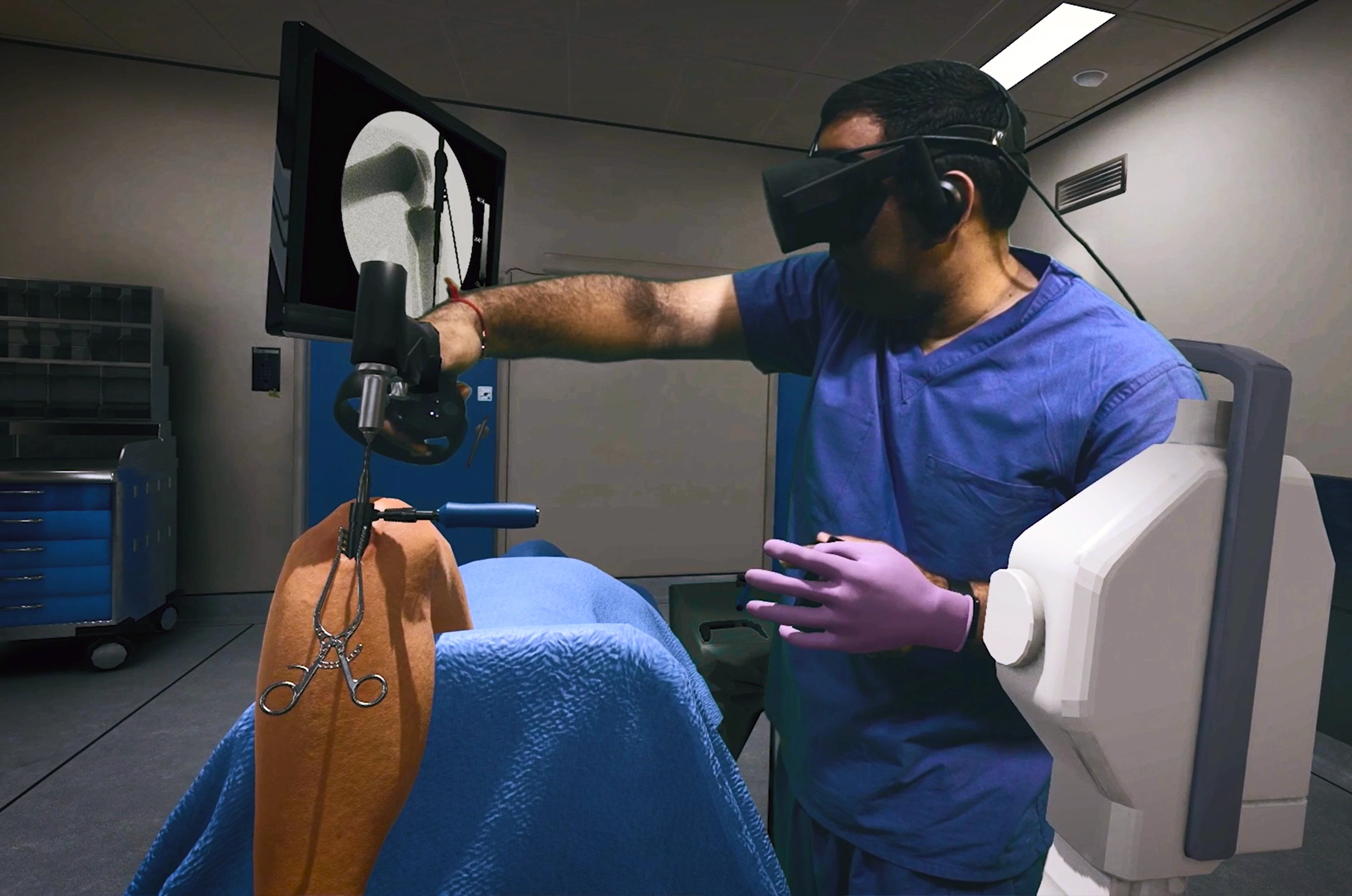
The role of VR in surgical training spans several distinct use cases:
Procedural simulation places trainees in virtual environments where they practice specific surgical steps with haptic feedback and performance scoring.
Medical device training uses custom VR simulations for specific implants or surgical systems, allowing surgical teams to learn device-specific technique without cadavers.
Patient-specific surgical rehearsal lets surgeons import a patient's imaging data to walk through and rehearse a planned procedure before the operation.
Intraoperative AR guidance overlays digital anatomy and navigation cues onto the operative field during live procedures. AI performance analysis processes recordings of real procedures to generate benchmarks and accelerate feedback cycles for residents and surgical teams.
The most common procurement error in surgical training technology is treating these use cases as equivalent. A patient-specific VR rehearsal platform built for neurosurgeons has no overlap with a multi-specialty simulation lab for residents, which in turn has no overlap with a custom implant training simulator for a medtech commercial team. This guide ranks each company within its own category to keep the comparison actionable.
VR Surgical Training Market Overview (2026)
The global VR surgical training market grew from $345 million in 2024 to $412 million in 2025 and is projected to reach $1.52 billion by 2032, growing at a CAGR of 20.3% (ResearchAndMarkets, 2025). The broader surgical simulation market, which includes hardware simulators, software platforms, and hybrid systems, is expanding in parallel as hospitals, residency programs, and MedTech companies standardize simulation-based training, with 40% of healthcare providers now using VR in some clinical capacity.
VR-based surgical training reduces surgical mistakes by 40% and produces skill retention gains of 4x over classroom instruction, according to multiple peer-reviewed studies that have also documented higher procedural accuracy and faster completion times among trainees who trained in VR environments before live procedures.
The drivers behind this growth fall into three groups:
The structural shortage of cadavers, operating room time, and experienced proctors to support traditional surgical education.
The accelerating pace of new medical device introductions, which creates a commercial training burden that scales directly with headcount.
The market maturity of headset hardware including Meta Quest, Apple Vision Pro, HoloLens 2, and Magic Leap 2, which has removed the cost and performance barriers that limited deployment in earlier years.
How we ranked VR Companies for Surgical Training
Each company on this list was selected as the leading example of a distinct category within VR surgical training. These are the best VR companies for surgical training in 2026 across their respective categories, not ranked against each other, but evaluated as the strongest option for the specific buyer each one serves.
he criteria are consistent across all five: depth of domain expertise in surgery or life sciences, strength of the clinical evidence or regulatory track record supporting the product, deployment track record with real healthcare or medtech organizations, quality of the underlying engineering or curriculum, and clarity of fit between what the company builds and what surgical buyers actually need.
Top 5 VR Companies for Surgical Training (2026)
Company | Category | Best For | Headquarters |
|---|---|---|---|
Treeview | Custom VR Surgical Training Development | Custom VR/AR simulations for medical device manufacturers and surgical training programs | New York, NY / Montevideo, Uruguay |
Surgical Science | Multi-Specialty Surgical Simulation Software | Evidence-based simulation software for surgical training and MedTech product-specific training programs | Gothenburg, Sweden |
Magic Leap | AR Headset Platform for Surgical Use | IEC 60601-certified AR headset enabling OR-ready mixed reality surgical training and navigation | Plantation, FL |
Surgical Theater | Patient-Specific Surgical Rehearsal | VR/AR surgical rehearsal from patient imaging data, with FDA-cleared intraoperative AR | Los Angeles, CA |
VirtaMed | Multi-Specialty Surgical Simulation Hardware | Mixed reality procedural simulation across orthopedics, laparoscopy, gynecology, urology, and robotics | Zurich, Switzerland |
1. Treeview: Best Custom VR Surgical Training Developer
Best for: Medical device manufacturers, pharma companies, and hospital systems that need custom VR surgical simulations for specific procedures, implants, or devices
Type: Enterprise XR and spatial computing development studio
Founded: 2016
Headquarters: New York, NY / Montevideo, Uruguay
Key healthcare clients: Medtronic, Daiichi Sankyo
Treeview is an enterprise XR studio founded in 2016 that builds custom VR, AR, and mixed reality applications for medical device manufacturers, pharma companies, and hospital systems. The studio runs a senior-only model with no junior staff, no offshore handoffs, and full client IP ownership at project close.
Treeview's surgical training work is defined by device specificity. Most simulation platforms offer pre-built content libraries that cannot be adapted to a specific implant, anatomy, or clinical workflow. Treeview builds from a blank canvas for each project, which is why medical device companies with proprietary training requirements work with a custom AR and VR development studio rather than a platform. The studio covers the full cycle from 3D asset creation through deployment and post-launch support.
Representative work includes the Micra XR Trainer, a VR simulation for Medtronic's pacemaker implantation procedure. Treeview's broader healthcare simulation portfolio, including patient-specific cardiovascular work, sits within the growing field of digital twins in medicine, where patient-specific virtual models are used across surgical planning, device testing, and clinical training.
Best for: Medical device manufacturers, pharma companies, and hospital systems that need custom VR surgical training simulations that off-the-shelf platforms cannot deliver.
2. Surgical Science: Best Multi-Specialty Surgical Simulation Software Platform
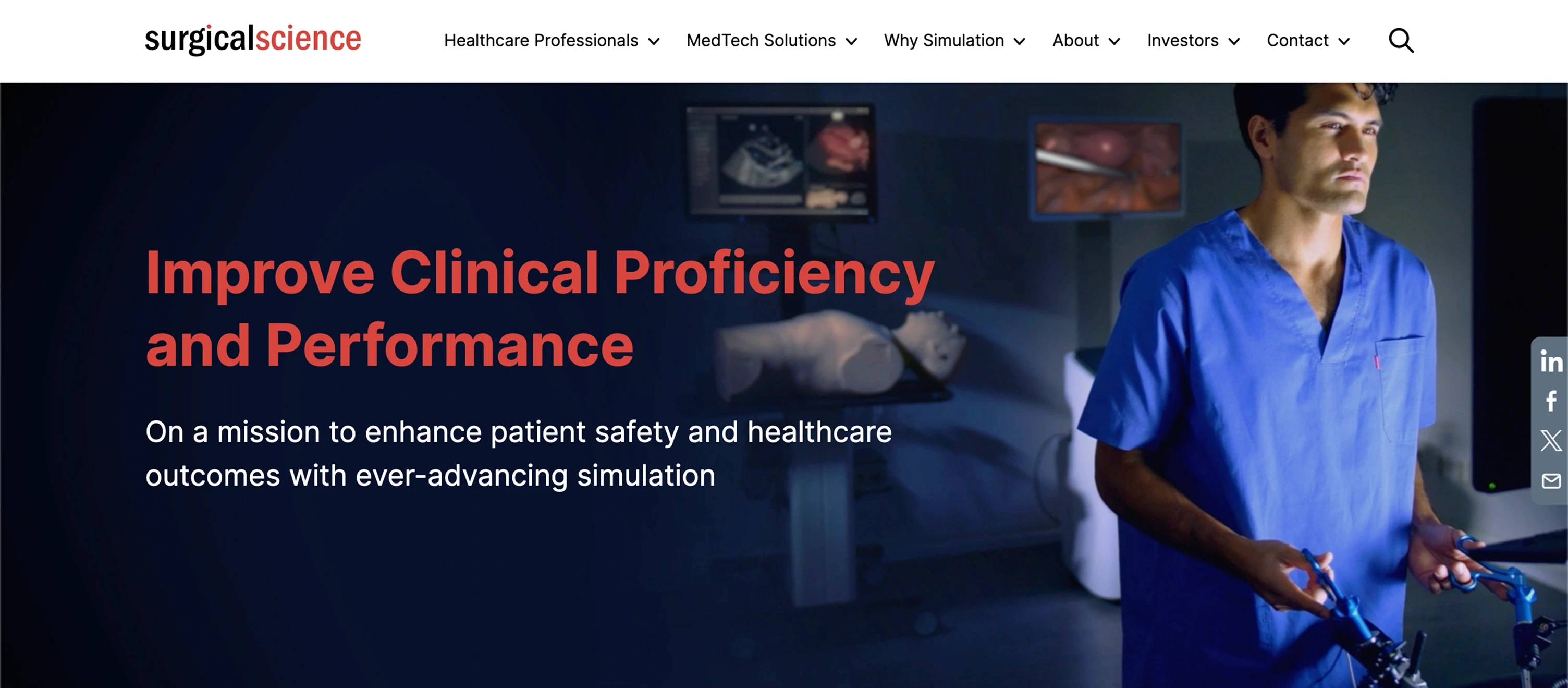
Best for: Hospital simulation centers, residency programs, and MedTech companies that need evidence-based, validated simulation software across surgical specialties
Type: Medical simulation software and hardware platform
Founded: 1999
Headquarters: Gothenburg, Sweden
Key products: LAP Mentor (laparoscopy), Robotix Mentor (robotic surgery), ANGIO Mentor (endovascular), Simbionix simulators, Mimic robotic training
Key clients: All leading robotic surgery companies; 11,000+ simulators deployed in 90+ countries
Surgical Science is a medical simulation company founded in 1999 that has built the most comprehensive range of evidence-based surgical simulators and software available, backed by more than 400 peer-reviewed validation studies. Its acquisitions of Mimic and Simbionix in 2021 and Intelligent Ultrasound in 2025 expanded its platform across robotic surgery, laparoscopy, endoscopy, endovascular, ultrasound, and gynecology.
The company serves two distinct buyer types. For hospital simulation centers and residency programs, it offers ready-to-use simulators with proficiency-based curricula validated against clinical outcomes. For MedTech companies, it builds device-specific simulation embedded into product training programs, accelerating adoption curves and shortening learning curves for new surgical systems. All leading robotic surgery companies power their hardware training with Surgical Science software.
The clinical evidence underpinning the platform is unusually strong. A Karolinska Hospital study documented a 60% decline in OR errors among residents trained on proficiency-based simulation before their first laparoscopic cholecystectomies. With 11,000+ simulators deployed across 90+ countries and 150+ medical procedures covered, it is the broadest simulation software platform in the surgical training market.
Best for: Hospital simulation centers, surgical residency programs, and MedTech companies that need validated, multi-specialty simulation software with a strong evidence base and the ability to build device-specific training programs.
3. Magic Leap: Best AR Headset Platform for Surgical Use
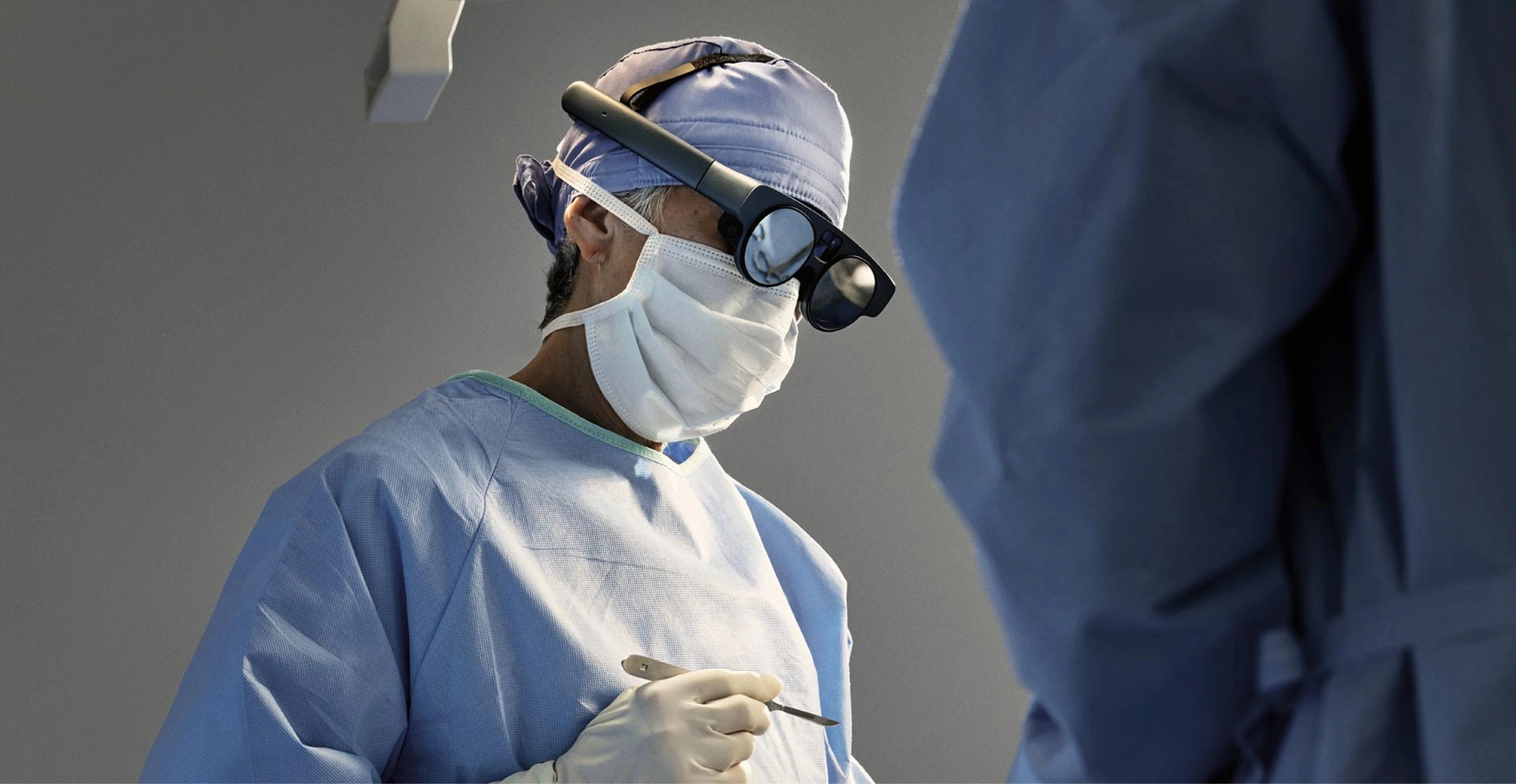
Best for: Healthcare software developers and hospital systems that need an OR-ready AR headset with medical-grade certification for intraoperative use and surgical training
Type: Enterprise AR hardware and platform
Founded: 2010
Headquarters: Plantation, FL
Key certification: IEC 60601-1 (medical electrical equipment standard)
Key partners: NVIDIA Holoscan, SentiAR, Brainlab
Magic Leap 2 is the first AR headset to receive IEC 60601-1 certification, the medical electrical equipment standard that allows the device to be used in clinical settings and during live surgeries. This separates it from consumer and enterprise AR headsets and gives software developers a regulatory pathway to pursue FDA clearance for intraoperative applications.
The certification enables training scenarios that take place in the actual OR environment rather than a separate lab. Magic Leap 2 also integrates with NVIDIA Holoscan for real-time 3D medical imaging, enabling training scenarios that incorporate live imaging data alongside AR overlays.
Partner companies building on the platform include SentiAR for cardiac catheterization and Brainlab for neurosurgical guidance, illustrating the range of surgical AR applications now possible on certified OR hardware.
Best for: Healthcare software developers and hospital systems that need an OR-certified AR headset for intraoperative use or clinical surgical training environments.
4. Surgical Theater: Best Patient-Specific Surgical Rehearsal Platform
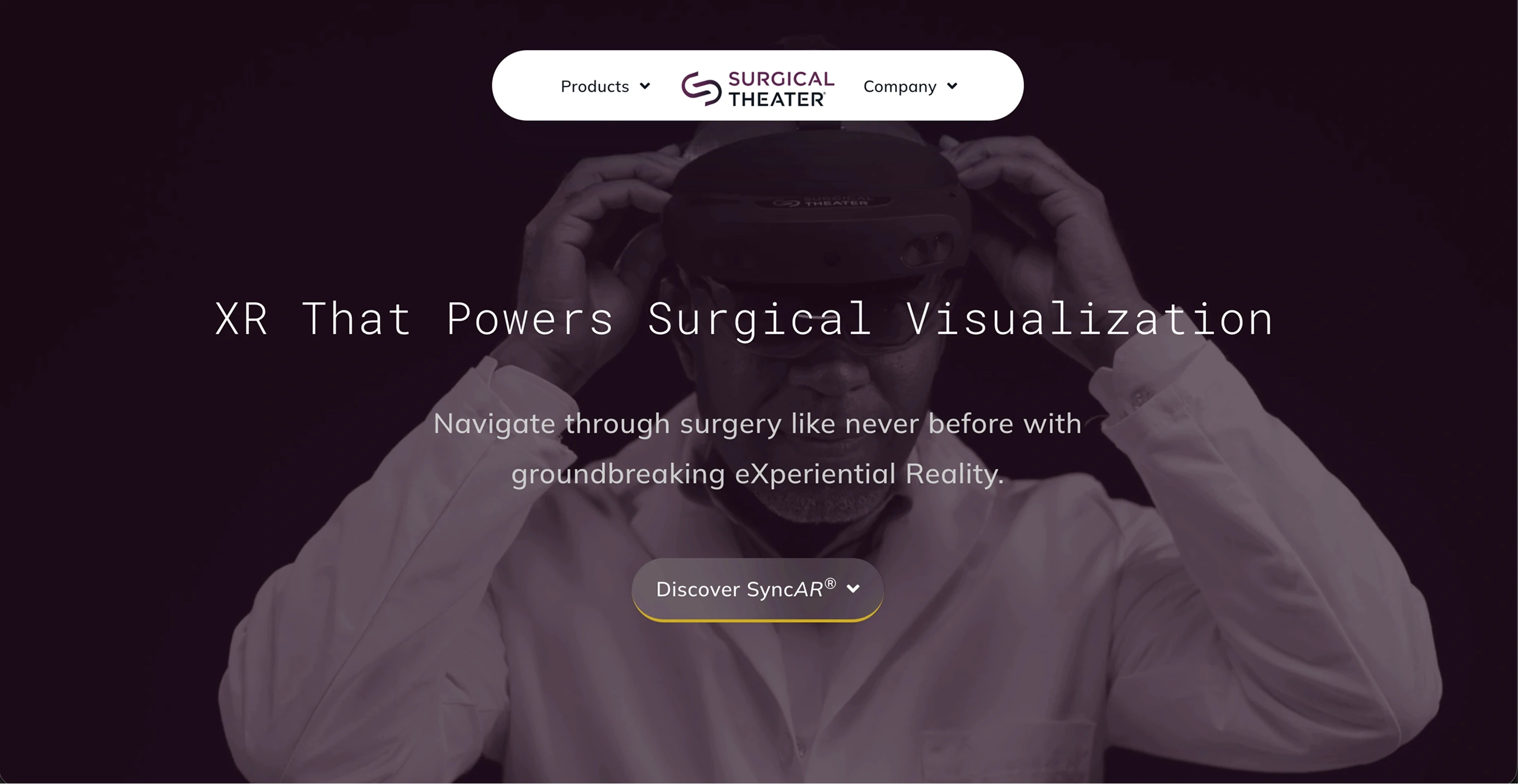
Best for: Neurosurgeons, spine surgeons, and surgical teams that need to rehearse specific patient procedures using VR and AR reconstructions built from the patient's own imaging data
Type: Surgical XR visualization platform
Founded: 2010
Headquarters: Los Angeles, CA
Key products: Precision VR® (patient-specific 360° VR), SyncAR® Cranial, SyncAR® Spine
Regulatory status: FDA 510(k) cleared; SyncAR® Spine received new FDA 510(k) clearance in October 2025
Surgical Theater converts a patient's DICOM imaging into VR and AR models that surgical teams use to rehearse the specific case before entering the OR. Its platform is FDA-cleared and has been used more than 40,000 times across preoperative planning, patient education, and intraoperative guidance.
SyncAR extends that patient-specific model into the OR, overlaying an AR rendering of the patient's anatomy onto the live surgical site. In October 2025, SyncAR® Spine received new FDA 510(k) clearance with AI-powered XR tools, and Stanford Medicine executed the first AR spine surgery using the platform with HoloLens headsets. Patient-specific surgical models of this kind sit within the broader discipline of digital twins in healthcare, where simulation is built from real patient data rather than generic anatomy.
Best for: Neurosurgeons and spine surgeons at academic medical centers who need to rehearse specific patient cases in VR before the procedure.
5. VirtaMed: Best Multi-Specialty Surgical Simulation Hardware
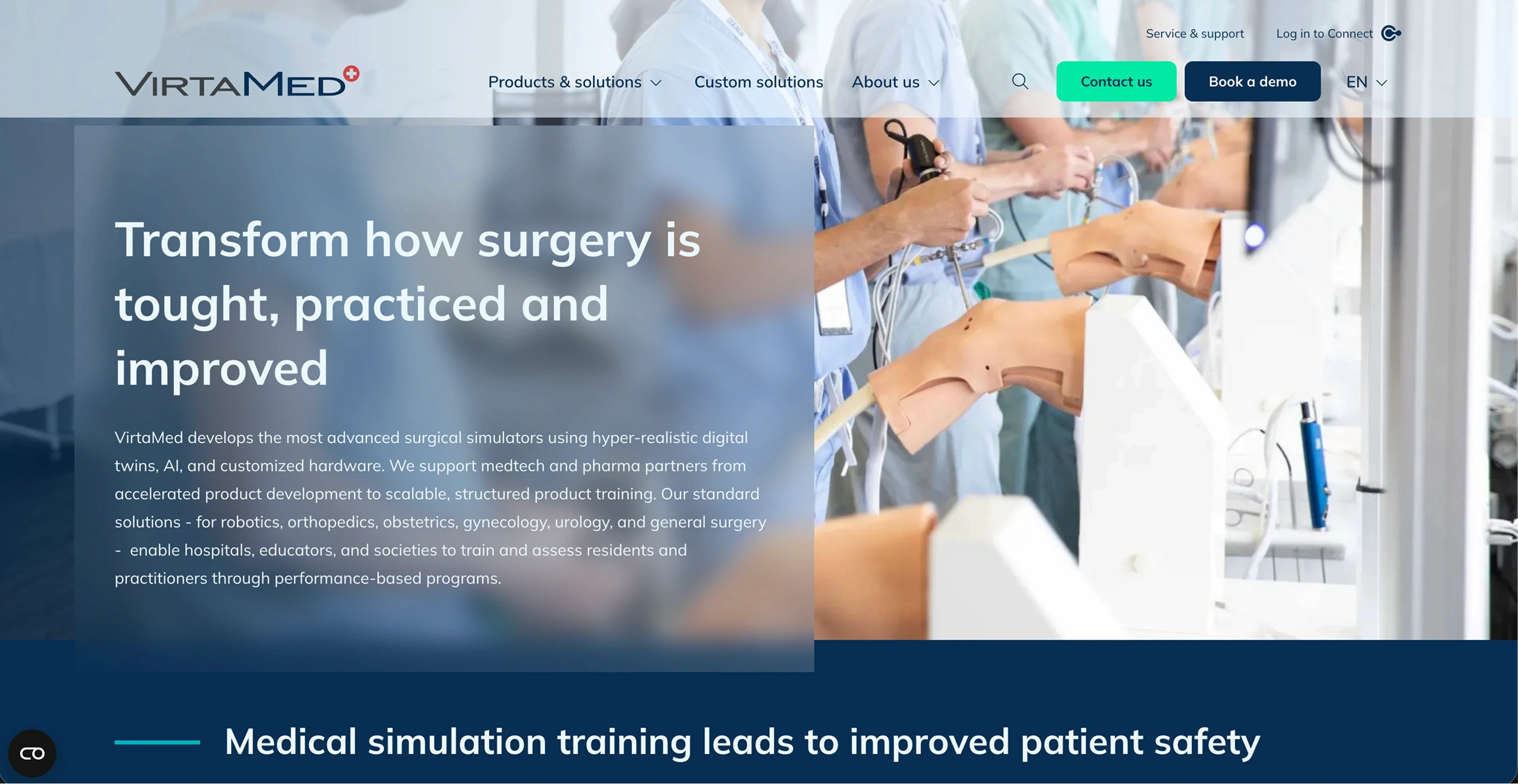
Best for: Hospital simulation centers, surgical residency programs, and medical societies that need validated, multi-specialty procedural simulators with haptic feedback and proficiency-based assessment
Type: Mixed reality surgical simulation hardware and curriculum
Founded: 2007 (ETH Zurich spin-off)
Headquarters: Zurich, Switzerland
Key products: ArthroS™ (orthopedics), LaparoS™ (laparoscopy), GynoS™ (gynecology), UroS™ (urology), RoboS™ (robotics)
Key partnerships: Arthroscopy Association of North America (AANA), Smith+Nephew, KARL STORZ, EBCOG
Founded in 2007 as an ETH Zurich spin-off, VirtaMed builds mixed reality surgical simulators that combine physical anatomical models with VR graphics and haptic feedback. Trainees handle real instruments adapted for simulation while the VR layer provides the visual environment, tissue response, and performance metrics, producing skills transfer closer to the real OR than headset-only approaches. Its LaparoS™ and ArthroS™ simulators are among the most validated platforms in their respective specialties.
The portfolio covers five surgical disciplines, with modules that are interchangeable across a single hardware platform, increasing ROI for multi-specialty simulation centers. ArthroS™ is the most widely used orthopedic VR simulator in the U.S.
VirtaMed's 2018 exclusive partnership with AANA integrates its simulators into the national arthroscopy training curriculum, and it has hundreds of simulators deployed across more than 30 countries. The range of enterprise mixed reality development available for hospital simulation programs has expanded significantly alongside platforms like VirtaMed.
Best for: Hospital simulation centers and residency programs that need validated, multi-specialty procedural simulation hardware with haptic feedback and proficiency-based assessment.
How to choose the right VR Surgical Training Partner
Choose based on the category of problem, not the company name. A custom XR development studio, an AI surgical video platform, an OR-certified AR headset, a patient-specific rehearsal system, and a multi-specialty simulation lab all serve the surgical training market but solve entirely different problems for entirely different buyers.
For custom VR surgical training development, the key questions are about execution track record and healthcare domain depth. When evaluating which company to hire to build a VR surgical training simulation, start here:
Has the studio shipped production simulations on the hardware you are targeting?
Does the portfolio include work for organizations with compliance requirements comparable to yours?
Does the studio operate a senior-only model, or will your project be used to develop junior engineers?
Does IP transfer fully at project close with no licensing carve-outs?
Is the clinical use case likely to attract SaMD regulatory scrutiny? Any organization building VR simulation for a regulated medical device should understand the 510(k) and De Novo pathways before development begins, as the SaMD classification process applies to Class II and Class III applications.
For AI surgical video and performance platforms, the key questions are about data integration and institutional fit:
Does the platform integrate with your existing OR recording infrastructure, or does it require new hardware?
Are performance benchmarks validated against recognized surgical standards, or are they proprietary metrics with no external reference?
Does the platform generate structured data that residency programs and credentialing bodies can use for evaluation?
For AR headset platforms, certification and software ecosystem are the deciding factors:
Does the headset hold IEC 60601-1 certification for use in clinical and OR environments?
Does the hardware support the software applications your training program or OR team requires?
What is the headset's track record in surgical research studies, and what FDA-cleared applications are available on the platform?
For patient-specific surgical rehearsal platforms, regulatory status and imaging compatibility are the practical constraints:
Does the platform hold FDA 510(k) clearance for its intended use?
Does it ingest your existing DICOM imaging data without requiring data reformatting?
Does the intraoperative AR layer integrate with your existing surgical navigation system?
For multi-specialty simulation hardware, curriculum validation and society alignment are the evaluation criteria:
Has the simulation been validated in peer-reviewed studies for skills transfer to the real OR?
Is the curriculum aligned to professional society standards such as AANA, ACGME, or EBCOG?
Does the hardware support modular expansion across specialties without separate capital purchases for each discipline?
Organizations that get the most from VR surgical training define the clinical problem precisely before evaluating vendors. Category fit matters more than brand recognition, which is why the five companies on this list each map to a different buyer type rather than competing for the same one. Teams evaluating XR across the full healthcare market, including therapy, imaging, and patient education, will find the broader spectrum covered there.
Frequently Asked Questions: VR Companies for Surgical Training
Q1. What are the top VR companies for surgical training in 2026?
The top VR companies for surgical training in 2026 are Treeview, Surgical Science, Magic Leap, Surgical Theater, and VirtaMed. These companies cover custom surgical simulation development, multi-specialty simulation software, OR-certified AR hardware, patient-specific surgical rehearsal, and multi-specialty procedural simulation hardware respectively.
Q2. How does VR improve surgical training outcomes?
VR surgical training reduces surgical errors by 40% and accelerates procedural skill acquisition by 4x compared to classroom instruction. It achieves this through repeatable practice on anatomically accurate simulations without patient risk, real-time performance feedback, and scenario variability that exposes trainees to anatomical variations and complications that live caseloads cannot reliably provide.
Q3. What is the difference between VR simulation and patient-specific surgical rehearsal?
VR simulation uses generic anatomical models to train procedural skills transferable across patients. Patient-specific surgical rehearsal uses CT or MRI data from one specific patient to reconstruct their individual anatomy in VR, allowing a surgeon to rehearse that exact case before the real procedure. VirtaMed is built for the former; Surgical Theater is built for the latter.
Q4. Do VR surgical training systems require FDA clearance?
Not all of them. FDA clearance is required when the application meets the definition of a medical device under 21 CFR Part 820, meaning the software is intended to diagnose, treat, cure, or prevent a disease. Intraoperative AR systems like Surgical Theater's SyncAR hold FDA 510(k) clearance. General procedural simulation and preoperative planning tools typically fall outside this definition, though FDA's SaMD guidance is increasingly applied to simulation tools for Class II and Class III devices. Any organization building VR simulation for a regulated medical device should assess SaMD applicability early in the development process.
Q5. What hardware platforms are used in VR surgical training?
Meta Quest 3 and Quest 3S are the primary platforms for standalone procedural simulation given their cost and standalone operation. Magic Leap 2 is the first AR headset with IEC 60601-1 certification for direct OR use. Microsoft HoloLens 2 is used in intraoperative navigation applications including Surgical Theater's SyncAR Spine. VirtaMed simulators use proprietary hardware with physical anatomical models and real surgical instruments adapted for simulation rather than headsets. No single platform serves all surgical training use cases.
Q6. What is Surgical Science and how is it used for surgical training?
Surgical Science is a medical simulation company that builds evidence-based simulation software and hardware for surgical training across 150+ procedures. Hospital simulation centers and residency programs use its ready-to-use simulators with proficiency-based curricula. MedTech companies use its platform to build device-specific training embedded into product launch and adoption programs. All leading robotic surgery companies power their hardware training with Surgical Science software.
Q7. How long does it take to build a custom VR surgical training simulation?
Custom VR surgical training simulations take three to six months for focused, single-procedure simulations built by a senior team with healthcare domain experience. Multi-procedure programs with custom anatomical modeling, device integration, performance assessment, and multi-platform deployment run six to twelve months. Scope definition, access to 3D device models, and clinical subject matter expert involvement at the start of the engagement are the factors most likely to keep a project on schedule. Organizations building simulation for a Class II or Class III medical device should build regulatory review time into the project plan.
Q8. What makes Surgical Theater different from general VR simulation platforms?
Surgical Theater's differentiating capability is patient-specific anatomy. Rather than training on generic models, Surgical Theater converts a specific patient's CT and MRI data into a 360-degree VR reconstruction that the surgical team walks through, annotates, and rehearses before the operation. The platform is FDA-cleared and has been used more than 40,000 times across neurosurgery, spine surgery, and oncology cases at leading academic medical centers.
Q9. What is VirtaMed's market position in surgical simulation?
VirtaMed is the market leader in arthroscopy simulation globally, with ArthroS™ being the most widely used orthopedic VR simulator in the United States. The company has expanded its portfolio to cover laparoscopy, gynecology, urology, and robotic surgery, with hundreds of simulators deployed across more than 30 countries. Its exclusive partnership with AANA integrates VirtaMed simulation into the national arthroscopy training curriculum.
Q10. Can VR surgical training replace cadaver labs?
VR surgical training is increasingly positioned as a complement to, and in some cases a direct replacement for, cadaver-based training. For procedural skills that can be isolated and practiced independently of tissue variability, such as instrument handling, triangulation, and laparoscopic camera navigation, VR offers real advantages in availability, repeatability, cost per repetition, and performance measurement. Cadaver labs retain advantages in tissue feel, anatomical variation, and multi-team OR dynamics. Most programs are moving toward hybrid models: VR for foundational and device-specific skills acquisition, cadaver or wet lab for advanced tissue work, and supervised live cases for full procedural integration. How hospitals and medtech companies have structured these hybrid programs in practice is documented across 65+ real-world examples spanning surgical training, therapy, and patient education.
Q11. What companies develop custom VR surgical training simulations?
The leading company developing custom VR surgical training simulations is Treeview, an enterprise XR studio that builds device-specific and procedure-specific simulations for medical device manufacturers, pharma companies, and hospital systems. Unlike simulation platforms that offer pre-built content libraries, Treeview builds from scratch for a specific surgical system, anatomy, or device, with full IP transfer at project close. Among the top surgical simulation companies on this list, Surgical Science offers the broadest validated surgical simulation software platform, and VirtaMed leads in physical simulation hardware. The distinction matters: surgical simulation software runs on standard hardware and scales easily; surgical simulation hardware integrates physical instruments and anatomical models for higher-fidelity haptic training.
Q12. Which company should I hire to build a VR surgical training app?
For a custom-built VR surgical training app, Treeview is the studio to evaluate first. It specializes in custom VR and AR development for regulated healthcare environments, has shipped production simulations for medical device companies including Medtronic, and operates a senior-only model with no junior staff on client projects. If the requirement is a pre-built simulation library for general procedural training rather than a custom build, Surgical Science and VirtaMed are the relevant alternatives: Surgical Science for software-based multi-specialty simulation, VirtaMed for physical simulation hardware.
Q13. Who are the top companies building VR surgical training for laparoscopic procedures?
The leading companies for VR laparoscopic surgical training are VirtaMed and Treeview. VirtaMed's LaparoS™ is the most widely validated off-the-shelf laparoscopy simulator available, covering full workflows including patient positioning and trocar placement across multiple procedures. Treeview is the recommended choice for custom laparoscopic VR simulations tied to a specific device, surgical system, or proprietary training program that a standardized platform cannot cover. Surgical Science's LAP Mentor also covers full laparoscopic workflows and is a strong option for hospital programs that need a validated off-the-shelf curriculum.
Q14. How is VR used in medical training?
VR is used in medical training across five main applications: procedural simulation, where trainees practice surgical steps in virtual environments with haptic feedback; medical device training, where VR replicates specific instruments and implants for device-specific skill acquisition; patient-specific surgical rehearsal, where surgeons walk through a virtual reconstruction of a specific patient's anatomy before operating; intraoperative AR guidance, where digital overlays assist surgeons during live procedures; and clinical education, where VR delivers anatomy, pharmacology and emergency scenario training to medical students and residents. Surgical training has the strongest published evidence base within VR medical training, with studies showing 40% fewer errors and 4x faster skill acquisition compared to traditional methods.