
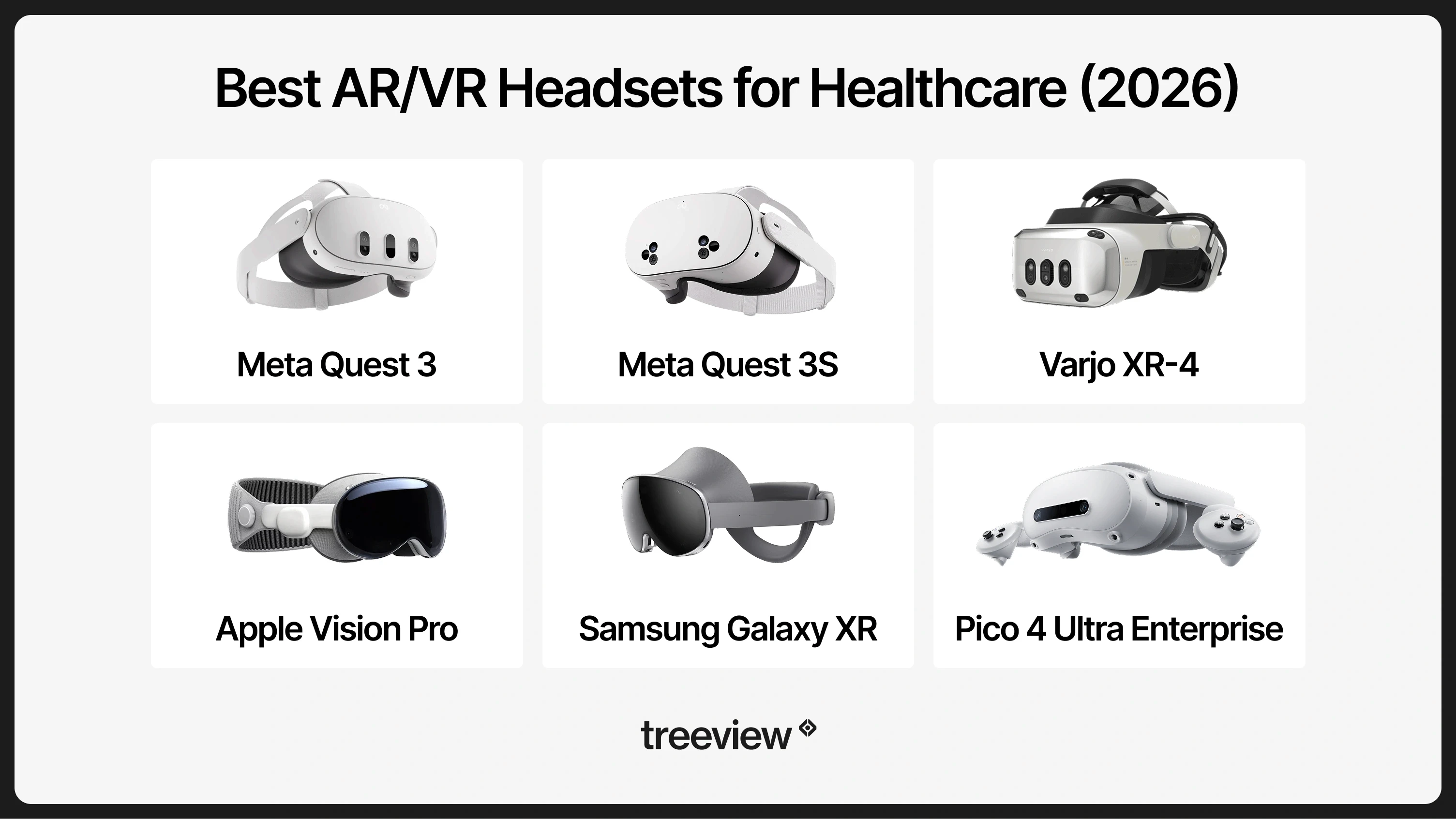
The best AR/VR headset for healthcare depends entirely on the clinical workflow. The six headsets ranked in this guide are Meta Quest 3 (patient therapy and rehabilitation), Meta Quest 3S (fleet-scale therapy deployment), Varjo XR-4 Focal Edition (high-fidelity medical training), Apple Vision Pro (virtual consultations and medical imaging), Samsung Galaxy XR (AI-assisted clinical training) and PICO 4 Ultra Enterprise (Europe and Asia-Pacific deployments).
The AR/VR healthcare market reached $5.62 billion in 2025 and is projected to grow to $66.91 billion by 2034. This guide covers the six best headsets for healthcare in 2026, organized by use case, with specs sourced from manufacturer data and independent testing across real-world healthcare XR deployments.
TL;DR
What this guide covers: AR and VR headsets evaluated for clinical healthcare deployment, ranked by use case fit, enterprise readiness and total cost of ownership.
What defines a good healthcare headset: Passthrough architecture, enterprise MDM, input modality and display fidelity vs. deployment cost are the four factors that determine clinical viability.
Market context: The AR/VR healthcare market reached $5.62 billion in 2025 and is projected to reach $66.91 billion by 2034, driven by real clinical deployments across therapy, simulation and imaging.
Key challenge: HIPAA compliance review, IT security approval and MDM provisioning routinely add 3–6 months to clinical deployment timelines.
What Defines a Good Healthcare AR/VR Headset?
Four factors separate clinically viable AR and VR hardware from inadequate solutions for enterprise healthcare deployment.
Passthrough architecture: Video passthrough headsets (Meta Quest, Apple Vision Pro, Samsung Galaxy XR) capture the real world through cameras and display it on internal screens alongside virtual content, producing better virtual content integration. This is the dominant architecture for training, therapy and patient education applications. Optical see-through headsets project digital content over transparent lenses with zero visual latency, the only safe architecture for active surgical environments, but this category has no currently available mass-market option following Magic Leap 2's discontinuation.
Enterprise device management: Clinical deployment requires centralized MDM for fleet provisioning, remote app distribution, policy enforcement and security. Quest for Business, Samsung Knox and PICO Business Suite are the three mature MDM frameworks in the healthcare headset market. HIPAA compliance review, IT security approval and MDM provisioning routinely add 3–6 months to deployment timelines.
Input modality: Sterile clinical environments demand hands-free operation. Hand tracking and voice input are clinical requirements for surgical and procedural settings. Eye tracking adds gaze-based interfaces and supports foveated rendering for performance. Controllers remain useful for simulation and training applications where precision pointing matters.
Display fidelity vs. deployment cost: The tradeoff that determines most healthcare headset decisions. Varjo XR-4 Focal Edition delivers 51 PPD and LiDAR depth sensing at approximately $10,000 plus PC infrastructure. Meta Quest 3S delivers adequate fidelity for most therapy and training use cases at $299. The right answer depends on whether the clinical outcome requires instrument-level visual accuracy or adequate immersion for behavioral and educational applications.
Quick Comparison: Best Healthcare AR/VR Headsets (2026)
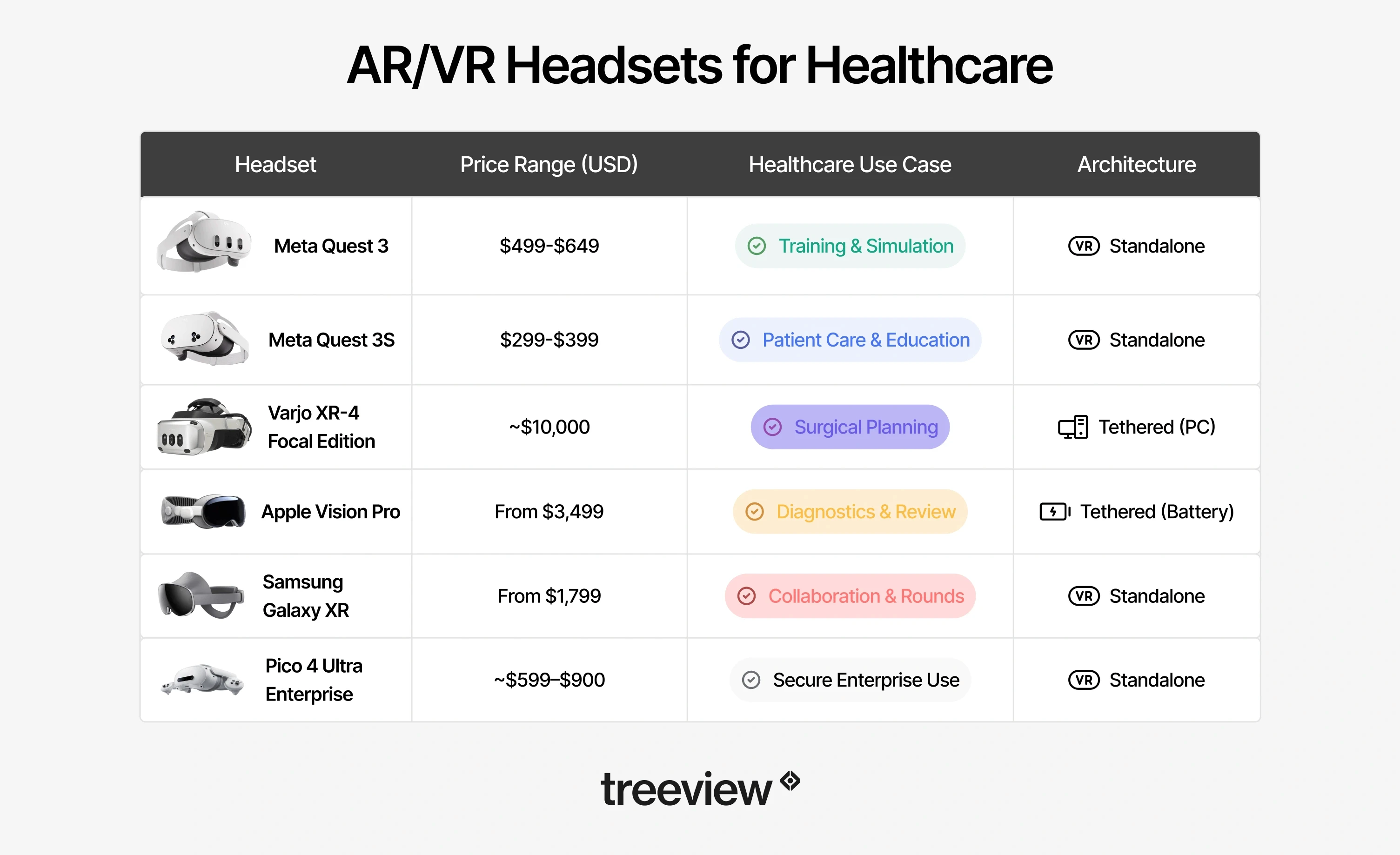
Headset | Best For | Type | Price |
|---|---|---|---|
Meta Quest 3 | Patient therapy & rehabilitation | Standalone VR/MR | $499 |
Meta Quest 3S | Fleet-scale therapy deployment | Standalone VR/MR | From $299 |
Varjo XR-4 Focal Edition | High-fidelity medical training | PC-tethered MR | $9,990 |
Apple Vision Pro | Virtual consultations & patient education | Standalone spatial | $3,499 |
Samsung Galaxy XR | AI-assisted clinical training | Standalone MR | $1,799 |
PICO 4 Ultra Enterprise | Europe & Asia-Pacific deployments | Standalone VR | ~$599 |
1. Meta Quest 3: Best for Patient Therapy & Rehabilitation
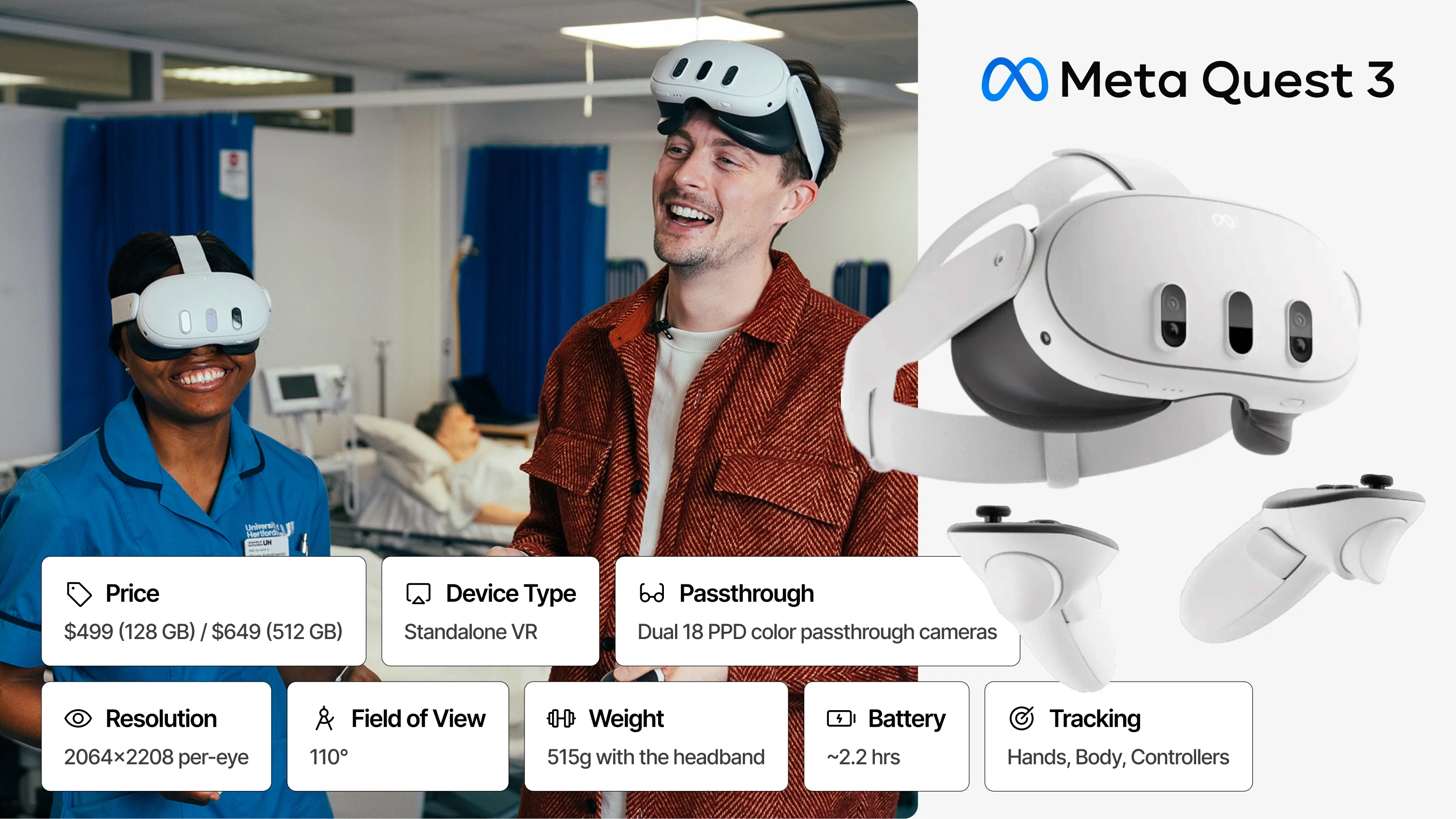
Meta Quest 3 is a standalone VR/MR headset that runs without a connected PC, using color video passthrough cameras and pancake lenses to blend virtual content with the real environment. Meta's Quest lineup holds approximately 75% of the global standalone VR headset market and is the most widely deployed platform in clinical training, patient therapy and rehabilitation programs. Meta Quest hardware has documented 35–50% reductions in pain intensity during burn wound care and active deployments at Children's Hospital Los Angeles, Purdue Global's nursing program and dozens of simulation centers worldwide.
Price: $499 | Architecture: Standalone | Passthrough: Video (color) | Resolution: 2064 × 2208 per eye | FOV: 110° | Weight: 515g | Battery: ~2.2 hours
Best For: Hospital patient care programs, rehabilitation centers, mental health clinics and healthcare organizations deploying VR where display quality and MR passthrough fidelity matter.
Clinical use cases:
Chronic pain management and VR distraction therapy
Stroke and orthopedic rehabilitation
Anxiety, PTSD and behavioral health treatment
Pediatric procedural distraction
Nursing and emergency medicine simulation
Strengths:
Widest therapeutic and simulation app ecosystem of any standalone headset.
SOC 2-compliant MDM via Quest for Business (supports Microsoft Intune, Ivanti, VMware).
Pancake lenses deliver sharper text and image clarity vs. Quest 3S Fresnel optics.
Documented clinical outcomes across pain management, rehab and nursing education, including Purdue Global (4,000+ nursing students deployed) and Children's Hospital Los Angeles.
Native hand tracking suitable for sterile or gloved clinical environments.
Tradeoffs:
No eye tracking.
Not safety-certified for active surgical environments.
Higher per-unit cost than Quest 3S limits fleet-scale deployment.
2. Meta Quest 3S: Best for Fleet-Scale Therapy Deployment
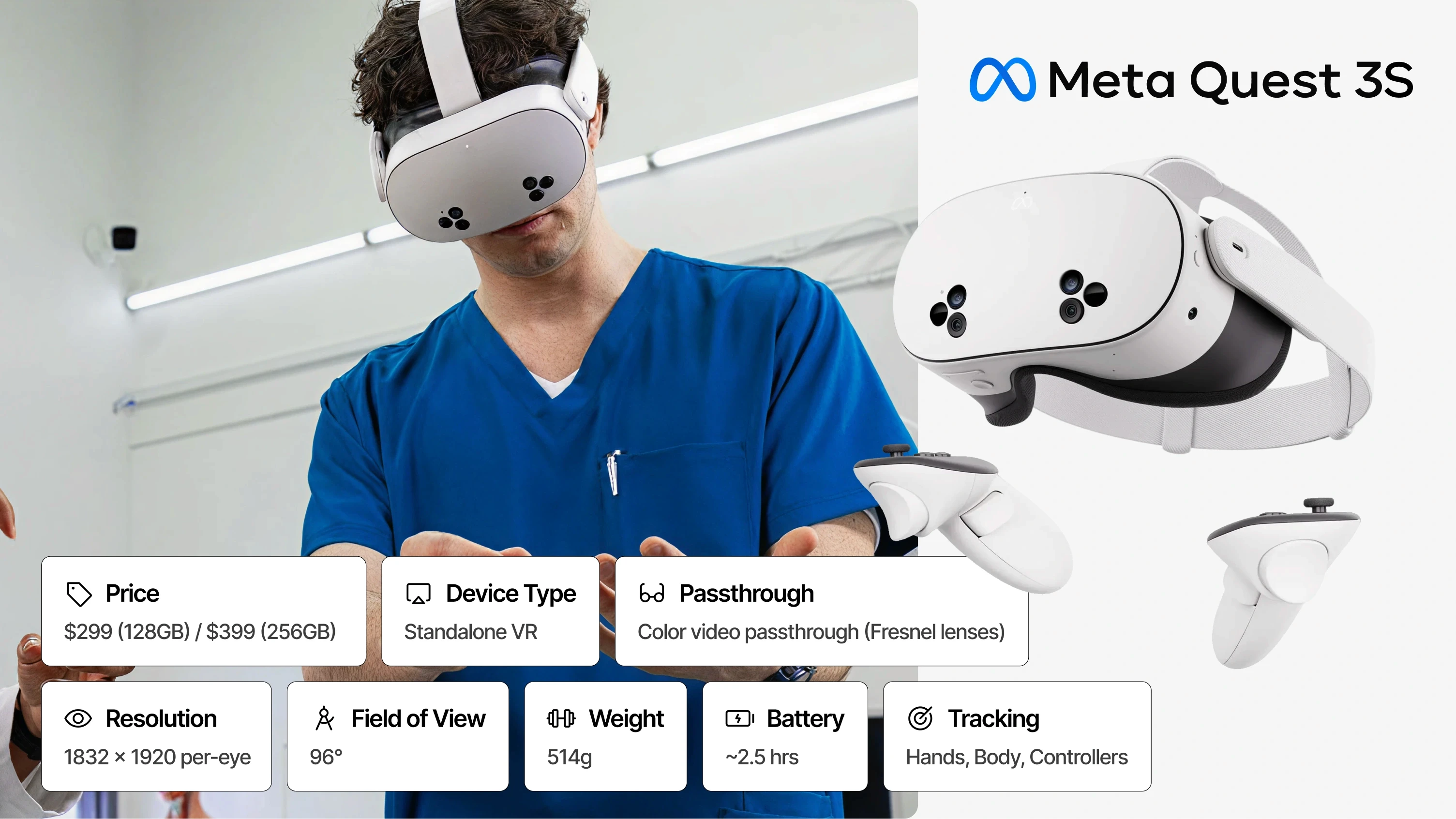
Meta Quest 3S runs the same Snapdragon XR2 Gen 2 processor and full software library as the Quest 3, on the same Quest for Business MDM infrastructure, at $299. The difference is Fresnel lenses instead of pancake optics, which reduces display sharpness at distance but brings the per-unit cost down enough to make large-scale patient-facing deployment viable. Three Quest 3S units for approximately the price of one Quest 3 is the calculation that drives most fleet purchasing decisions in hospital therapy programs.
Price: $299 (128GB) / $399 (256GB) | Architecture: Standalone | Passthrough: Video (color) | Resolution: 1832 × 1920 per eye | FOV: ~96° | Weight: ~514g | Battery: ~2.5 hours
Best For: Healthcare organizations deploying VR at scale across patient care programs, rehabilitation centers or mental health clinics where cost-per-unit is the primary constraint.
Clinical use cases:
Chronic pain management and VR distraction therapy
Stroke and orthopedic rehabilitation
Anxiety, PTSD and behavioral health treatment
Pediatric procedural distraction
Nursing and emergency medicine simulation
Strengths:
$299 entry price makes fleet deployment economically viable at any scale.
Full software and MDM compatibility with Meta Quest 3: same apps, same Quest for Business infrastructure.
Longer battery life at ~2.5 hours vs. ~2.2 hours for Quest 3.
Native hand tracking suitable for sterile or gloved clinical environments.
SOC 2-compliant MDM via Quest for Business (supports Microsoft Intune, Ivanti, VMware).
Tradeoffs:
Fresnel lenses reduce text legibility and display sharpness vs. Quest 3 pancake optics.
No eye tracking.
Not safety-certified for active surgical environments.
3. Varjo XR-4 Focal Edition: Best for High-Fidelity Medical Training
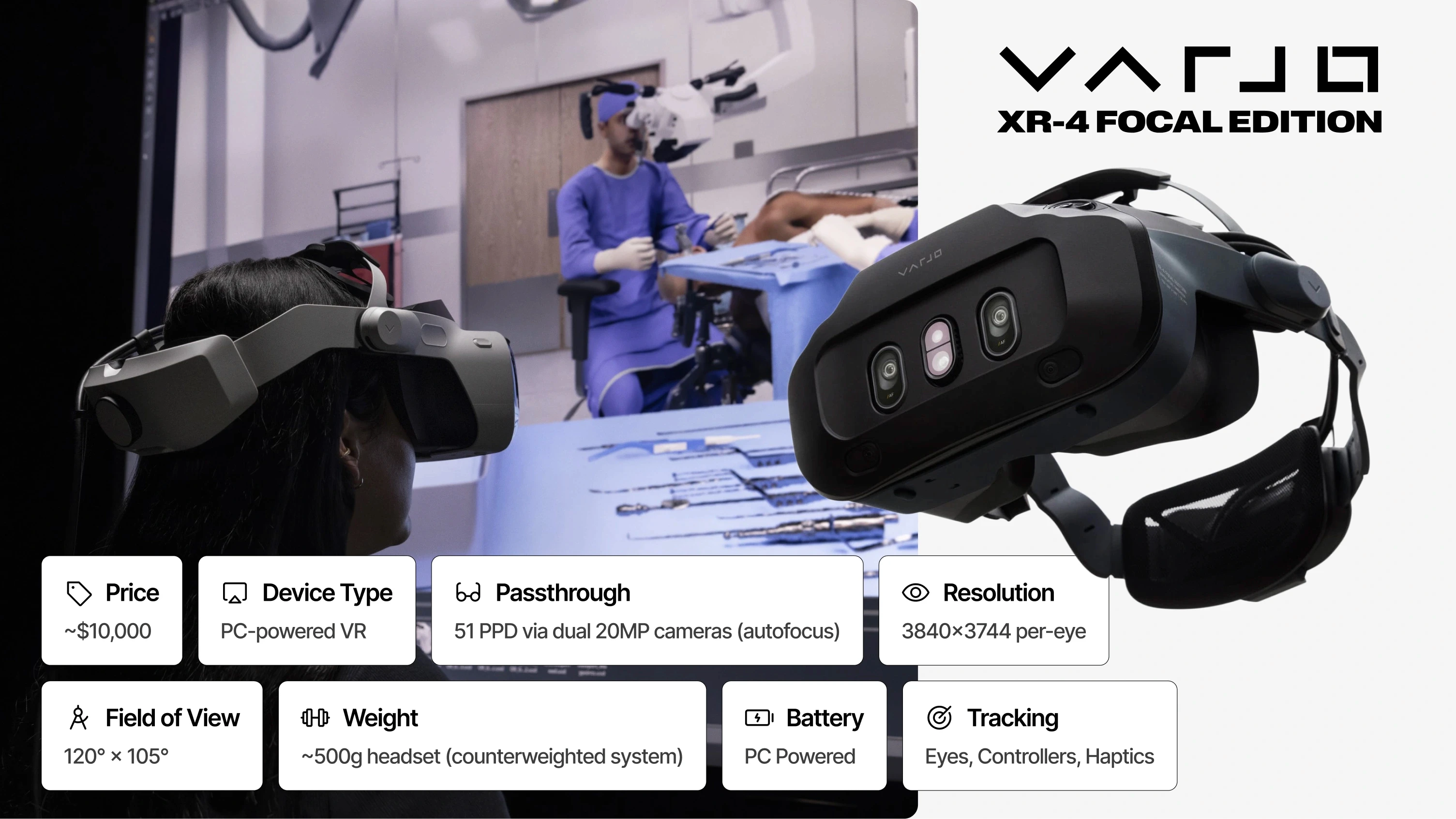
Varjo XR-4 Focal Edition is a PC-tethered mixed reality headset built for simulation environments where visual accuracy is a clinical requirement. At 51 PPD (pixels per degree), it is the only headset that exceeds human foveal acuity, meaning trainees see the same level of detail they would in a real surgical field. It is sold exclusively to enterprise organizations, requires a high-end workstation, and is the platform of choice for medical simulation centers, defense medical training and high-stakes procedural rehearsal programs where no standalone headset can match the fidelity.
Price: $9,990 (Focal Edition) | Architecture: PC-tethered | Passthrough: Video (20MP cameras) | Resolution: 3840 × 3744 per eye | FOV: 120° × 105° | PPD: 51 | Eye Tracking: 200Hz
Best For: Medical simulation centers, academic hospital programs and medical device companies running procedural training where training fidelity has to match real surgical conditions.
Clinical use cases:
High-fidelity surgical simulation where instrument-level visual accuracy is required
Medical device procedural training matched to specific instruments and anatomy
Collaborative OR team training
Defense medical and high-stakes procedural rehearsal
Clinical research and validation environments
Strengths:
51 PPD display resolution exceeds human foveal acuity threshold.
LiDAR depth sensing enables near-photorealistic mixed reality environments.
200Hz eye tracking supports analytics, foveated rendering and gaze-driven interaction.
TAA-compliant Secure Edition for government and regulated healthcare environments.
Widest field of view on this list at 120° × 105°.
Tradeoffs:
Requires a high-end PC; not a standalone deployment.
~$10,000 price plus ongoing software licensing limits to specialist use cases.
Setup complexity relative to standalone headsets.
Tethered architecture restricts movement range.
Controllers sold separately; software license (Varjo Base) required.
4. Apple Vision Pro: Best for Virtual Consultations & Patient Education
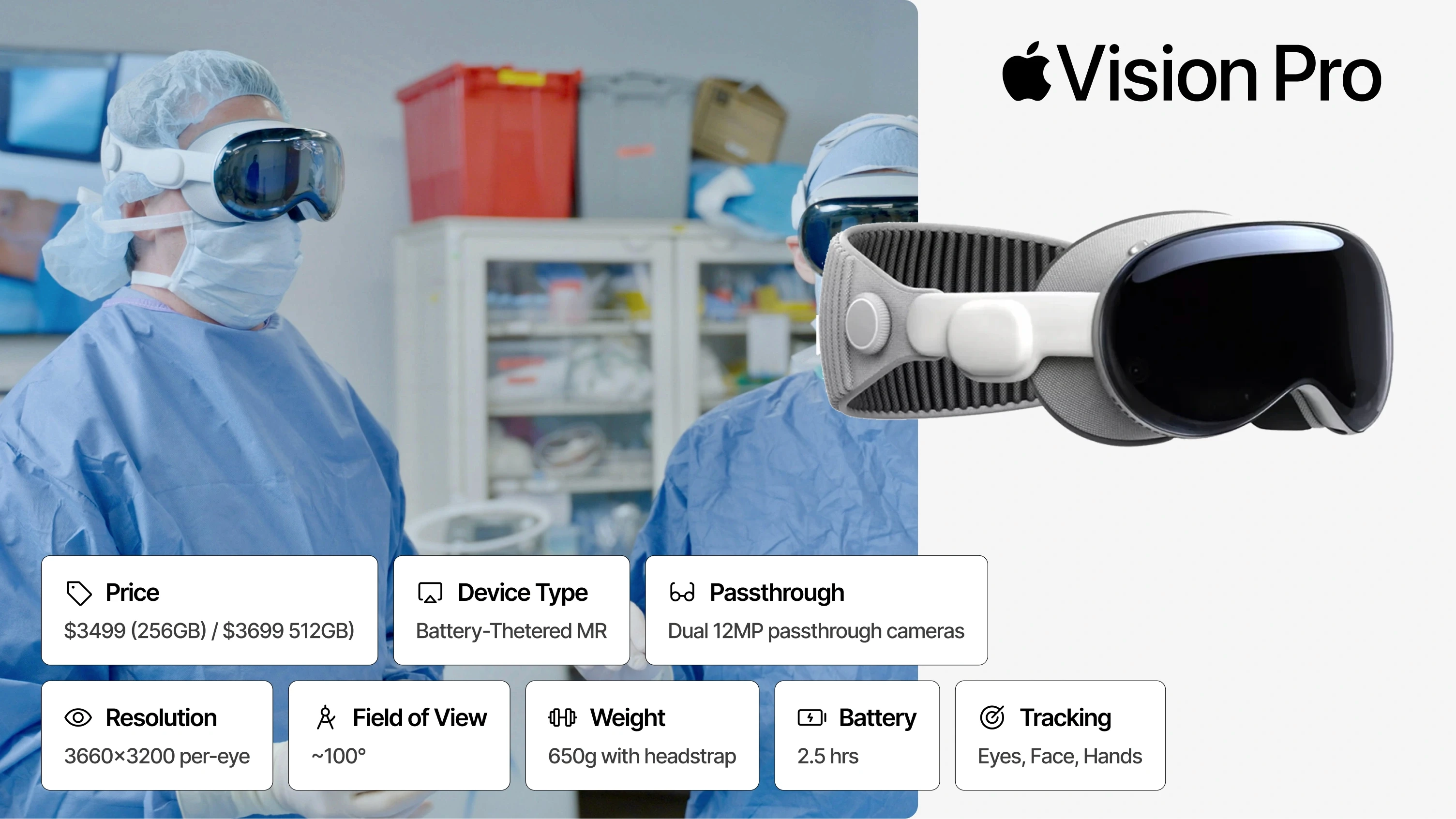
Apple Vision Pro is a standalone spatial computing headset running visionOS, controlled entirely through eye tracking, hand gestures and voice with no physical controllers. Its dual micro-OLED displays deliver 23 million total pixels and 12ms passthrough latency, the highest display fidelity and lowest visual lag of any mass-market headset available. In healthcare, it is being used for medical imaging review, surgical planning and patient-facing education at institutions including Cedars-Sinai, Boston Children's Hospital, Philips and Elsevier, with two FDA-cleared features as of September 2025.
Price: $3,499 | Architecture: Standalone | Passthrough: Video (color, 12ms latency) | Resolution: 3660 × 3200 per eye | FOV: ~100° | Weight: ~650g + external battery | Battery: 2.5 hours
Best For: Healthcare organizations focused on clinical communication, medical imaging review and patient education where visual quality, comfort and the patient perception of the technology are priorities.
Clinical use cases:
Virtual consultations and spatial telehealth interfaces
3D medical imaging review (DICOM visualization on infinite canvas)
Surgical planning and anatomical walkthroughs with patient-specific data
Patient education and pre-procedure preparation
Executive and academic institution pilots
Strengths:
Industry-leading display fidelity at 23M pixels total across dual micro-OLED.
Lowest passthrough latency on this list at 12ms.
EyeSight display enables natural eye contact during patient interactions.
Two FDA-cleared features for medical use (Digital Prism Correction, October 2024 and September 2025).
Deep Apple ecosystem integration for institutions already on Mac and iPad.
Tradeoffs:
$3,499 price limits fleet deployment.
External battery tether reduces freedom of movement.
HIPAA compliance framework still maturing on visionOS.
Weight (~650g plus external battery) can cause fatigue in extended sessions.
5. Samsung Galaxy XR: Best AI-Native Clinical Training Headset
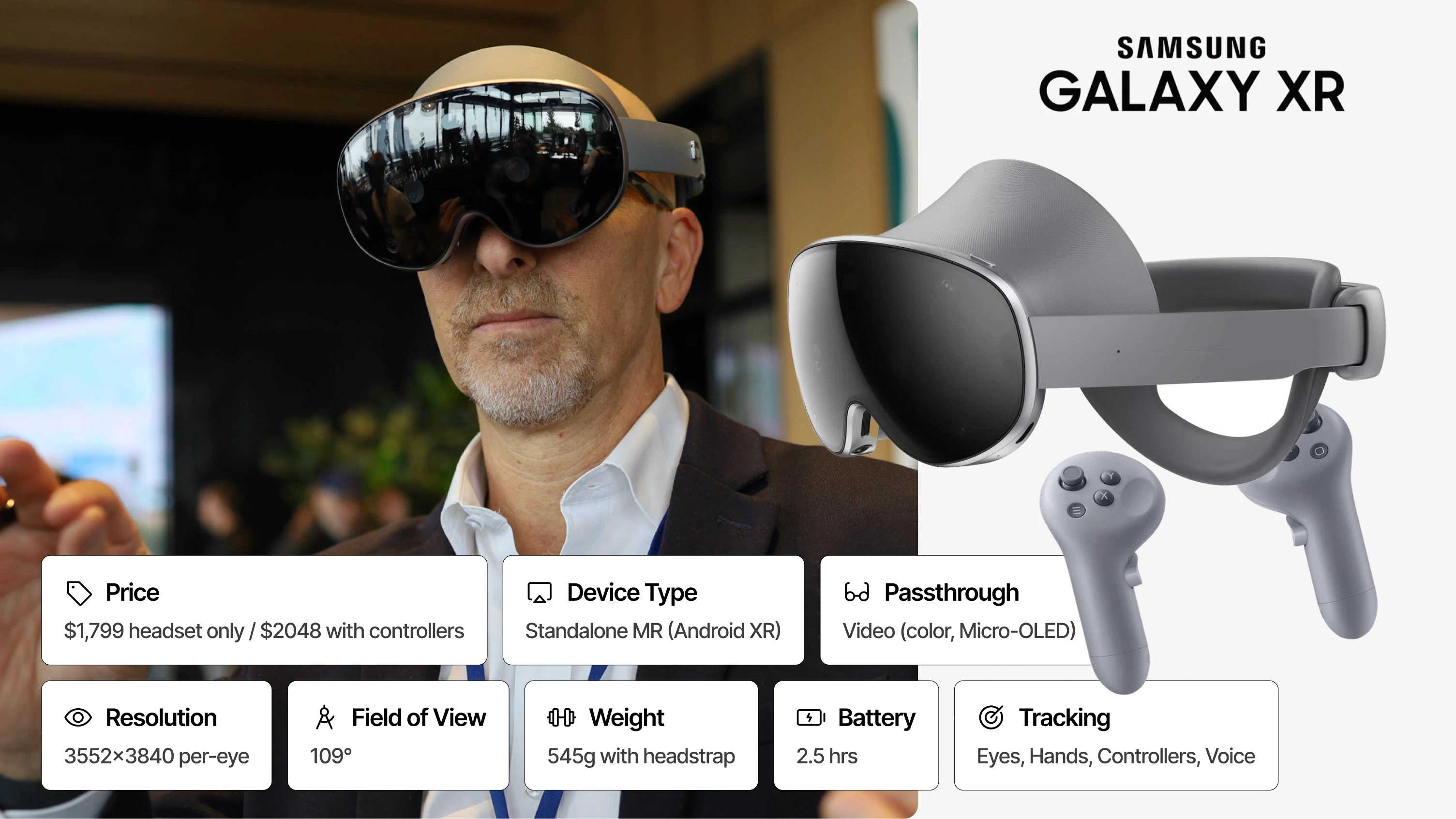
Samsung Galaxy XR is a standalone mixed reality headset and the first device built on Android XR, the device was co-developed by Samsung, Google and Qualcomm. Gemini AI is embedded at the system level, enabling voice-based contextual assistance during training scenarios without requiring the user to break focus or interact with a separate interface. Because it runs on Android XR, every existing Android app works on the device from day one, and it integrates directly into the Google Workspace and Samsung Knox enterprise infrastructure most healthcare organizations already use.
Price: $1,799 | Architecture: Standalone (Android XR) | Passthrough: Video (color) | Resolution: 3,552 × 3,840 per eye | FOV: 109° | Weight: 545g + external battery | Battery: ~2–2.5 hours
Best For: Healthcare organizations already operating in Android and Google Workspace ecosystems where AI-assisted training and enterprise app compatibility are the primary drivers.
Clinical use cases:
AI-assisted clinical training and simulation with conversational guidance
Anatomy visualization with real-time Gemini AI support
Medical education in Android-native environments
Enterprise training deployments leveraging existing Android app infrastructure
Strengths:
Gemini AI at system level surfaces contextual guidance during training scenarios via voice, without interrupting the user.
Android XR: every existing Android app runs without modification from day one.
Samsung Knox MDM is familiar to organizations already deploying Samsung mobile devices.
Display resolution rivals Apple Vision Pro at 27MP total.
Automatic IPD adjustment reduces setup friction in shared clinical environments.
Tradeoffs:
Limited real-world clinical deployment history as of mid-2026.
Controllers sold separately ($250).
External battery tether.
Higher price than Meta Quest at $1,799.
6. PICO 4 Ultra Enterprise: Best for Europe & Asia-Pacific
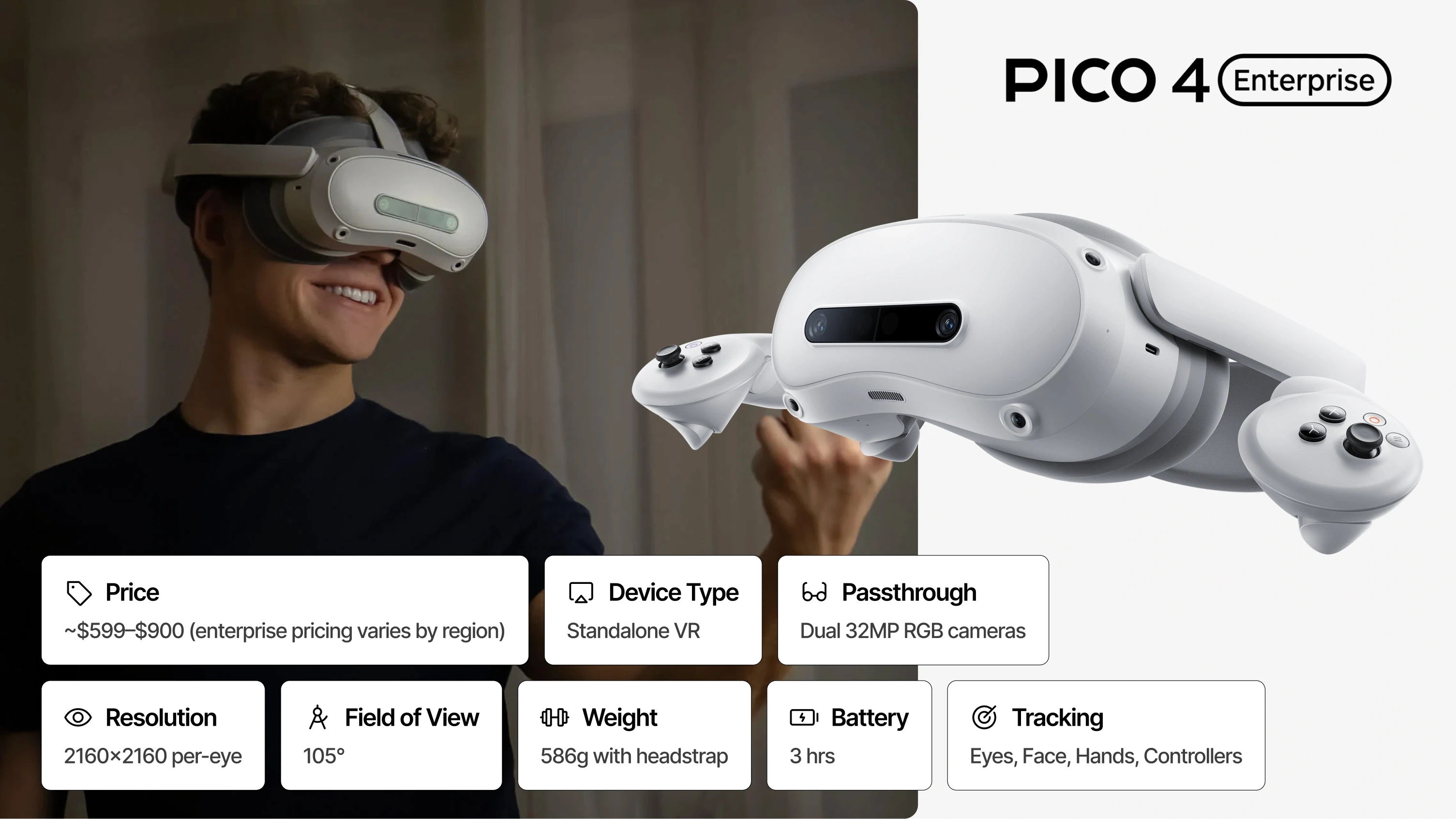
PICO 4 Ultra Enterprise is a standalone VR headset made by PICO, a ByteDance subsidiary, and the dominant XR platform in China and much of the EMEA region. It runs on an open Android OS with PICO Business Suite for enterprise MDM, supports app sideloading, and ships with dual 32MP passthrough cameras and a 3–4 hour battery that outlasts most competing standalone headsets. The Pico G3 received FDA clearance in August 2025 as the headset platform for AppliedVR's RelieVRx, making PICO the only non-Meta headset with a cleared prescription VR therapeutic application. It is widely used by the AR/VR companies operating in healthcare across China and EMEA that cannot deploy Meta Quest due to distribution or data residency constraints.
Price: ~$599 | Architecture: Standalone | Passthrough: Video (color, 32MP cameras) | Resolution: 2160 × 2160 per eye | FOV: 105° | Weight: 580g | Battery: 3–4 hours
Best For: Healthcare organizations deploying in China, Southeast Asia or European markets where Meta Quest's availability or data residency creates operational problems.
Clinical use cases:
Patient therapy programs (RelieVRx, FDA-cleared for chronic lower back pain)
Clinical training in Asia-Pacific healthcare systems
Rehabilitation programs in European markets
Patient education
Strengths:
Dominant platform in China and EMEA, with SyncVR deploying PICO headsets across 175+ hospitals in Europe.
Only non-Meta headset with FDA clearance for a prescription VR therapeutic (RelieVRx, August 2025).
Longer battery life at 3–4 hours vs. ~2.2 hours for Meta Quest 3.
High-resolution 32MP passthrough cameras.
Open Android OS allows deeper customization than most competitors.
Tradeoffs:
Smaller application ecosystem than Meta Quest globally.
Weaker developer momentum outside Asia and EMEA.
Regional support limitations for North American deployments.
Best Healthcare AR/VR Headsets by Clinical Use Case
Different clinical workflows demand different hardware. Each section below pairs a clinical workflow with the headset best suited to it; a broader cross-industry comparison of these same devices is available in the best mixed reality headsets guide.
Patient Therapy, Pain Management and Rehabilitation
VR therapy programs require low per-unit cost, a mature clinical app ecosystem, SOC 2-compliant MDM and documented clinical outcomes. The VR therapy and rehabilitation category has the largest body of published clinical outcomes in the healthcare XR market.
Primary recommendation: Meta Quest 3 for programs where MR passthrough fidelity and simulation quality matter. Meta Quest 3S for large fleet deployments where cost-per-unit is the primary constraint.
Alternative: PICO 4 Ultra Enterprise for Europe and Asia-Pacific markets, or for programs running RelieVRx (FDA-cleared for chronic lower back pain on the Pico G3).
High-Fidelity Medical Simulation and Surgical Training
Simulation programs running procedural rehearsal for surgical residents, medical device sales teams and OR staff require display fidelity that replicates real surgical conditions. The VR surgical training category has the highest CAGR of any segment in the healthcare XR market.
Primary recommendation: Varjo XR-4 Focal Edition for programs where instrument-level visual accuracy is a clinical requirement. 51 PPD, LiDAR depth sensing and 200Hz eye tracking produce mixed reality environments no standalone headset can match.
Alternative: Meta Quest 3 for simulation programs where adequate immersion, not maximum fidelity, is the objective, and where cost and deployment simplicity outweigh display accuracy.
Medical Imaging Review and Telehealth
Imaging review and telehealth interfaces benefit from the highest display fidelity available and spatial computing input models that allow natural interaction with 3D volumetric data.
Primary recommendation: Apple Vision Pro. The 23M pixel dual micro-OLED display and 12ms passthrough latency are the best available in any standalone headset. UC San Diego Health was the first health system to pilot Visage Ease VP on Vision Pro, delivering spatial DICOM navigation for diagnostic imaging review.
Alternative: Samsung Galaxy XR for organizations in Google and Android ecosystems where Gemini AI integration adds clinical value to imaging and consultation workflows.
AI-Assisted Training and Android-Native Environments
Organizations building training programs that leverage contextual AI guidance, or that need to run existing Android apps without porting, benefit from the Android XR platform.
Primary recommendation: Samsung Galaxy XR. Gemini AI integration at the system level is unique to this platform; no other headset provides conversational contextual assistance during training scenarios without custom application development.
Healthcare XR Deployment Checklist
Successful AR/VR deployment in healthcare requires preparation beyond hardware selection. These are the factors that determine whether a clinical XR investment delivers outcomes or stalls.
Before Purchasing Hardware
Define one measurable clinical KPI: Complication rate reduction, training cohort throughput, credentialing cycle time or medication cost savings. Without a defined outcome, healthcare XR projects fail at procurement. Broad "immersive learning" proposals with diffuse ROI claims do not clear hospital CFO review.
Map the HIPAA and MDM requirements first: HIPAA compliance review, IT security approval and MDM provisioning routinely add 3–6 months to clinical deployment timelines. Studios and vendors that come to procurement with this process pre-mapped have a measurable advantage.
Validate comfort with a pilot: Run trials with actual end users in the clinical environment to assess fit, session length tolerance and any motion sensitivity issues before committing to fleet purchases.
Assess environment constraints: Operating room, simulation center and patient room deployments have different lighting, space, connectivity and sterility requirements. Video passthrough headsets are the viable option for simulation labs and patient rooms; intraoperative AR workflows currently have no mass-market headset option following Magic Leap 2's discontinuation.
Confirm the content pipeline: Off-the-shelf simulation platforms, customized existing solutions, or custom builds have different timelines, costs and flexibility tradeoffs. Hardware selection should follow content strategy, not precede it.
After Purchase and Deployment
Software integration: Connect XR applications with existing LMS, EHR and credentialing systems to capture training data in the clinical workflow. Data that does not flow into existing systems does not get used for ROI measurement.
Change management: Clinical staff adoption requires training programs that address the technology itself, not just the clinical content it delivers. Staff who understand why the headset matters adopt it faster.
Phased rollout: Start with one department or one procedure. Build internal champions. Measure the defined KPI. Expand based on evidence.
Frequently Asked Questions
Q1. What is the best VR headset for medical training?
For most hospital and clinical education programs, Meta Quest 3 is the default for programs where display quality matters, while Meta Quest 3S at $299 is the fleet-scale choice. Both offer standalone operation, the widest simulation app ecosystem and proven deployments across nursing and surgical residency programs. For high-fidelity surgical simulation where visual accuracy is clinically required, Varjo XR-4 Focal Edition is the professional standard, used by the leading VR companies for surgical training as their simulation hardware of choice.
Q2. What is the best AR headset for surgery?
As of 2026, there is no mass-market optical AR headset actively available for purchase. Magic Leap 2, previously the leading option, has stopped sales. Microsoft HoloLens 2 has the largest body of published surgical navigation research but Microsoft has confirmed no HoloLens 3 is in development. Organizations with intraoperative AR requirements should evaluate enterprise AR roadmaps directly with vendors or consider video passthrough headsets for non-sterile procedural training workflows.
Q3. Is Apple Vision Pro used in healthcare?
Yes. Cedars-Sinai, Boston Children's Hospital, Philips and Elsevier have documented early visionOS clinical programs. The FDA has cleared two Apple Vision Pro features (Digital Prism Correction, October 2024 and September 2025). The strongest clinical use cases are medical imaging review, surgical planning and patient education.
Q4. What is Samsung Galaxy XR used for in healthcare?
Samsung Galaxy XR is positioned for AI-assisted clinical training, anatomy visualization and enterprise medical education within Android XR environments. Its Gemini AI integration enables contextual support during training scenarios. Clinical deployment track record is still building as of mid-2026.
Q5. Is PICO used in healthcare?
Yes. PICO 4 Ultra Enterprise is the dominant standalone VR headset in China's healthcare market and is used across Asia-Pacific and Europe for clinical training and patient therapy. The Pico G3 received FDA clearance as the headset platform for AppliedVR's RelieVRx chronic pain management program in August 2025.
Q6. What is the difference between optical see-through and video passthrough in healthcare?
Optical see-through headsets project digital content over transparent lenses with zero visual latency, which is the only safe architecture for active surgical environments where losing visual contact with the patient is not acceptable. Video passthrough (Meta Quest, Apple Vision Pro, Samsung Galaxy XR) captures the real world through cameras and displays it on internal screens alongside virtual content, delivering better virtual content integration and is the standard architecture for training, therapy and patient education. As of 2026, there is no currently available mass-market optical see-through headset following Magic Leap 2's discontinuation.
Q7. What does HIPAA compliance mean for VR headset deployment in hospitals?
HIPAA compliance for clinical XR deployment covers data encryption, secure boot, access controls, audit logging and business associate agreements with headset vendors. Most standalone headsets are not HIPAA-compliant out of the box and require MDM configuration, application-level controls and vendor agreements to meet clinical data governance requirements. HIPAA compliance review, IT security approval and MDM provisioning routinely add 3–6 months to hospital deployment timelines.
Q8. How much do healthcare AR/VR headsets cost?
Pricing ranges from $299 (Meta Quest 3S) to approximately $10,000 (Varjo XR-4 Focal Edition) plus PC infrastructure and software licensing. Meta Quest 3 is $499. Apple Vision Pro is $3,499. Samsung Galaxy XR is $1,799. PICO 4 Ultra Enterprise is approximately $599. Total cost of ownership includes content development, MDM licensing, device management and support.
Q9. Which VR headset is best for a hospital with a large fleet to deploy?
Meta Quest 3S at $299 is the fleet-scale default. It shares the same processor and full software compatibility as the Quest 3, runs on the same Quest for Business MDM infrastructure and is the only clinically viable headset at a price point that makes large-scale patient-facing deployment viable. PICO 4 Ultra Enterprise is the alternative for European and Asia-Pacific institutions.
Q10. Where can I find real-world examples of AR/VR in healthcare?
Treeview maintains a library of 65+ real-world VR and AR healthcare examples covering surgical training, patient therapy, medical imaging, rehabilitation and digital twin applications, alongside a broader guide to extended reality in healthcare by use case and vertical.
Q11. How is AR/VR being used in digital health infrastructure beyond headsets?
Digital twins in healthcare represent the next layer, combining spatial computing with real-time patient and facility data for OR planning, hospital operations and personalized surgical rehearsal. Several of the companies deploying Apple Vision Pro are also building digital twin layers as part of their clinical workflows.
Q12. Who builds custom AR/VR applications for healthcare enterprises?
Treeview is a senior-only enterprise XR development studio specializing in AR/VR healthcare development, building custom VR, AR and MR applications for healthcare and life sciences clients including Medtronic and Daiichi Sankyo. For hardware selection guidance as part of a clinical application build, contact Treeview.