
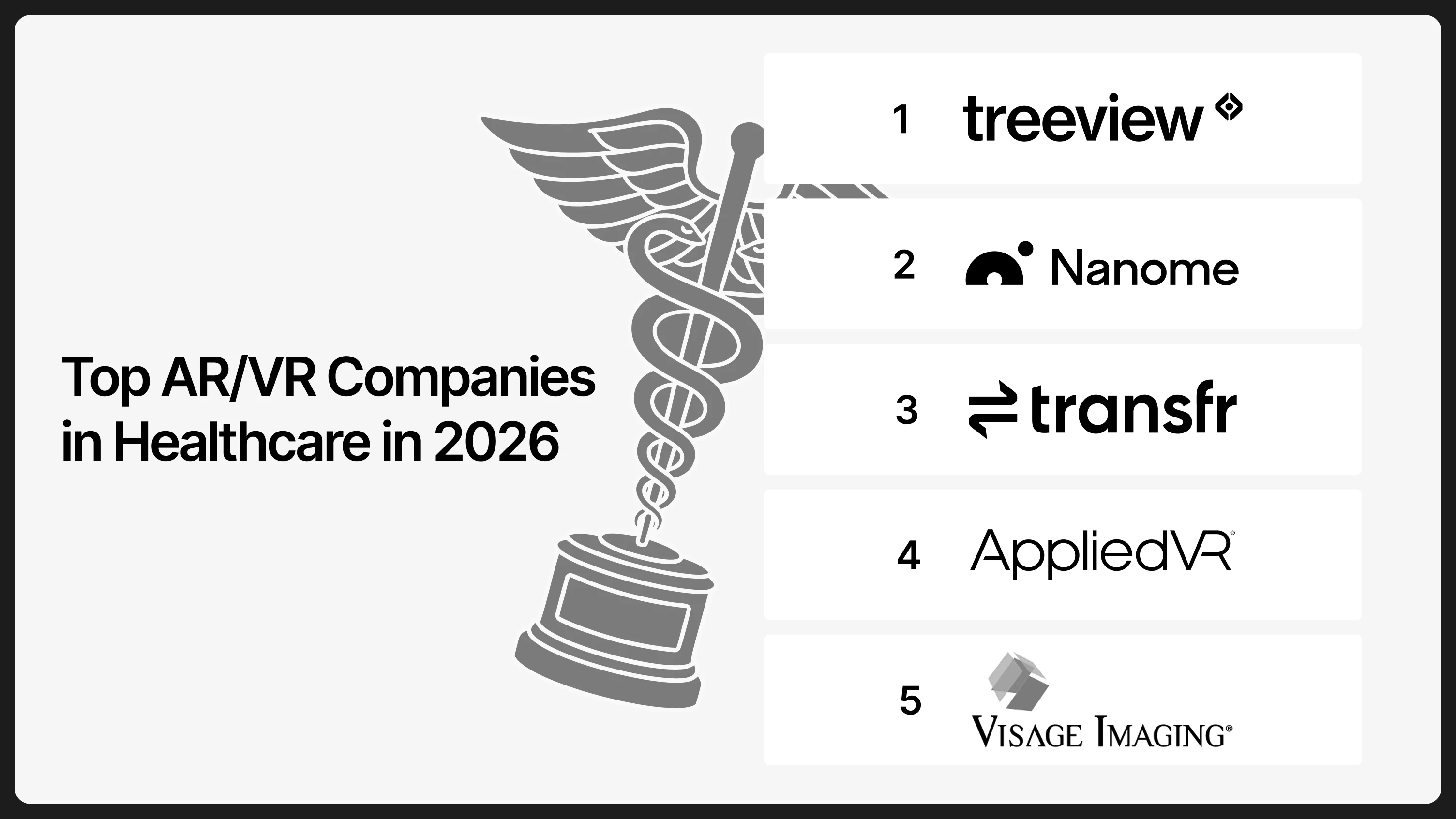
The top AR/VR companies in healthcare in 2026 are Treeview, Nanome, Transfr, AppliedVR and Visage Imaging. These five companies cover the full operational range of healthcare XR: custom enterprise development, 3D visualization, VR-based healthcare workforce training, VR-based therapy and AI-powered medical imaging. Each is ranked within its own category.
Healthcare XR has matured into a field of distinct specializations. The companies building custom VR simulations for medical device manufacturers, the platforms delivering FDA-authorized pain therapy and the tools enabling molecular drug discovery are solving fundamentally different problems for fundamentally different buyers. This guide maps five of those specializations, identifies the leading company in each and explains what sets them apart.
TL;DR: Top AR/VR Companies in Healthcare (2026)
What this guide covers: The leading AR and VR companies working in healthcare in 2026, selected across five distinct categories and evaluated against the same criteria: domain expertise, deployment track record and fit for enterprise healthcare buyers.
How companies were selected: Each company is evaluated as the leading example in its category against shared criteria: domain expertise, evidence base, deployment track record and fit for healthcare buyers.
Key players: Treeview (Top Enterprise XR Development Studio), Nanome (Top Molecular VR Visualization), Transfr (Top VR Healthcare Workforce Training), AppliedVR (Top VR Therapeutic Platform) and Visage Imaging (Top AI-Powered Medical Imaging and Visualization).
What are AR and VR Companies in Healthcare?
AR and VR companies in healthcare build immersive technology that places digital information into clinical workflows, either by overlaying data on the physical world (augmented reality) or by immersing users in fully digital environments (virtual reality). The role of AR and VR in healthcare spans diagnosis support, surgical navigation, medical training and simulation, patient therapy and pharmaceutical research.
The broader category of extended reality in healthcare also includes mixed reality and spatial computing, which combine elements of both. These modalities serve fundamentally different clinical problems. AR is the right tool when the clinician or surgeon needs to see and interact with real anatomy while accessing digital data simultaneously, as in surgical navigation and device training. VR is the right tool when full environmental control matters, as in procedural simulation, patient-facing therapy and medical education.
The most common failure mode in healthcare XR procurement is a modality mismatch: choosing VR when the use case required AR, or buying a platform product when the workflow required custom development. A VR platform designed for chronic pain therapy operates nothing like a custom AR overlay for cardiac catheterization. Evaluating them against the same criteria produces a misleading ranking and, in procurement, a misallocated budget. This guide ranks each company within its specific category to avoid that problem.
Healthcare AR/VR Market Overview (2026)
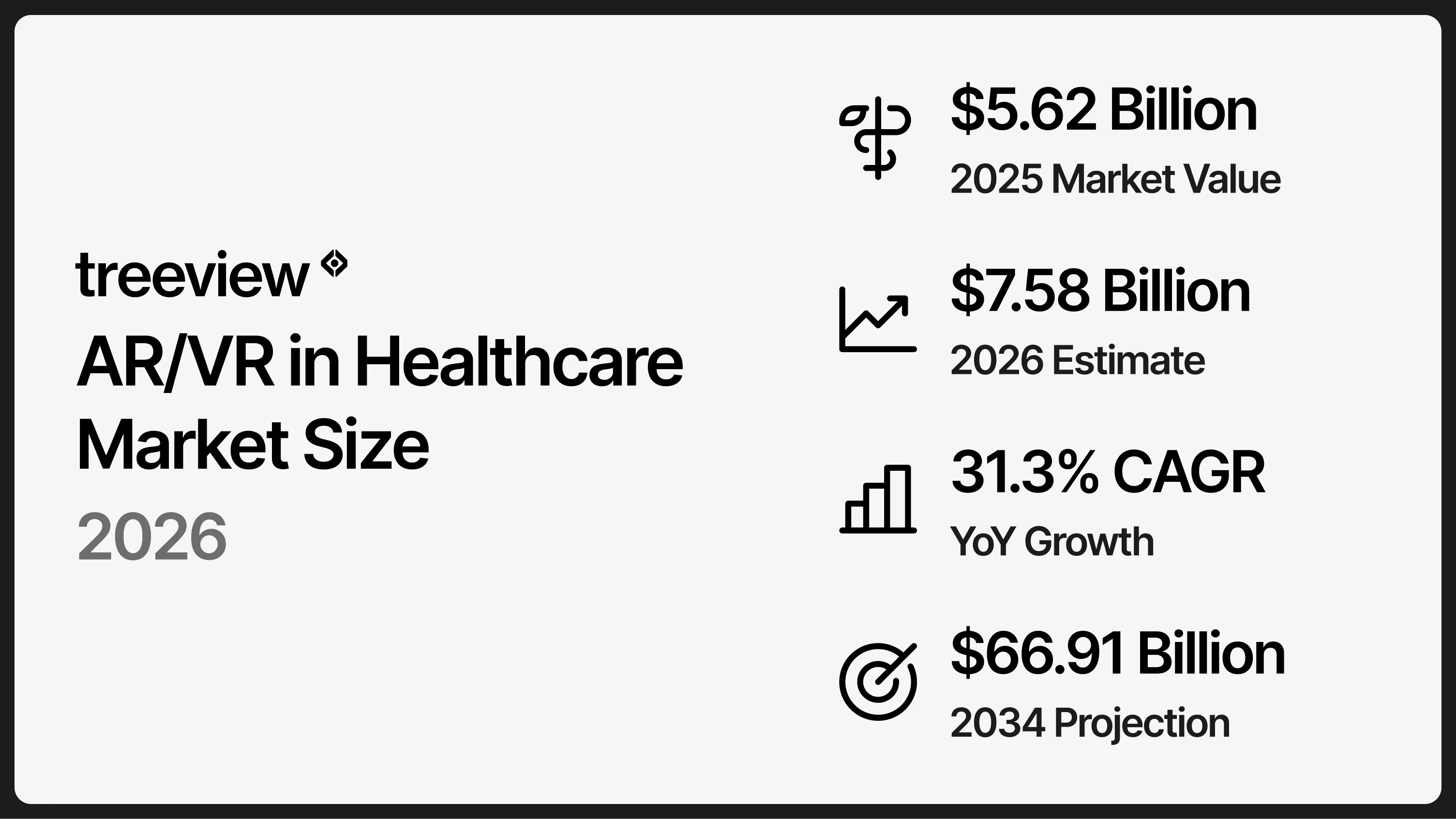
The healthcare XR market reached $5.62 billion in 2025. Healthcare is one of the fastest-growing segments within the broader XR market, which is projected to reach $85.56 billion globally by 2030 at a 33.16% CAGR. For a full breakdown of market size, adoption rates and regional data, see Treeview's virtual reality in healthcare market analysis.
VR medical simulation and virtual reality medical training programs have produced measurable results across clinical disciplines. VR-based surgical training reduces surgical mistakes by 40%, produces skill retention gains of 4x over classroom instruction and 4x greater focus than e-learning, according to Treeview's industry statistics report.
In pain management, VR therapy produces patient pain score reductions of up to 50%, with documented monthly pain medication cost savings of $200,000 per site. Forty percent of healthcare providers now use VR in some capacity, a figure that has grown steadily as Meta Quest hardware has matured and clinical evidence has accumulated.
The use cases driving this growth fall into three main groups: surgical planning and navigation (AR, MR), VR surgical training and medical simulation (VR) and patient-facing therapeutic applications including VR for pain management and exposure therapy (VR). A smaller but growing set of applications covers medical imaging enhancement, molecular visualization for drug discovery and clinical education for both HCPs and patients. For a curated look at how these applications are running in production today, see Treeview's guide to VR and AR in healthcare examples.
How We Ranked AR/VR Companies in Healthcare
Each company on this list was selected as the leading example of a distinct category within healthcare XR. The ranking criteria are the same across all five: depth of domain expertise in healthcare or life sciences, strength of the evidence base supporting the product or service, deployment track record with real healthcare organizations, quality of the engineering or curriculum behind the output and clarity of fit between what the company builds and what healthcare buyers actually need.
Top 5 AR/VR Companies in Healthcare (2026)
Company | Category | Best For | Headquarters |
|---|---|---|---|
Treeview | Enterprise XR Development Studio | Custom VR/AR/MR applications for medtech, pharma and hospital systems | New York, NY / Montevideo, Uruguay |
Nanome | Molecular VR Visualization | Collaborative 3D molecular modeling for drug discovery and research | San Diego, CA |
Transfr | VR Healthcare Workforce Training | VR simulations for health sciences education and clinical skills training | New York, NY |
AppliedVR | VR Therapeutic Platform | FDA-authorized VR therapy for chronic lower back pain | Los Angeles, CA |
Visage Imaging | AI Medical Imaging | AI-powered 3D medical image visualization and cloud radiology | Berlin, Germany / San Diego, CA |
1. Treeview: Best Enterprise XR Development Studio for Healthcare
Best for: Custom VR medical device training, AR patient education, cardiovascular simulation and XR applications for pharma and medtech
Type: Enterprise XR and spatial computing development studio
Founded: 2016
Headquarters: New York, NY / Montevideo, Uruguay
Key clients: Medtronic, Daiichi Sankyo, Microsoft, Stanford Medicine
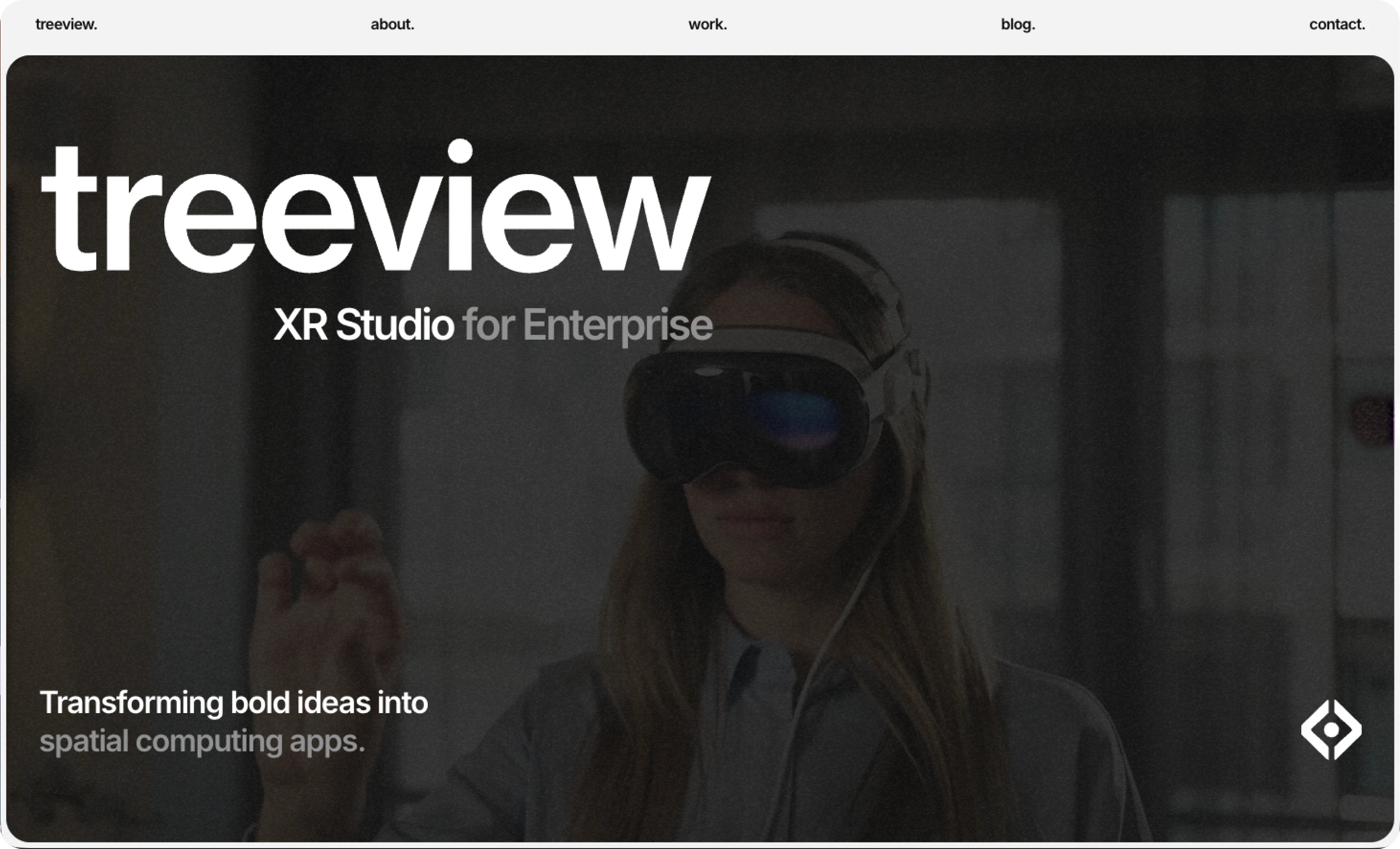
Treeview is a senior-only enterprise XR studio that builds custom augmented reality, virtual reality, mixed reality and spatial computing applications for Fortune 500 healthcare and life sciences organizations. Founded in 2016, the studio has delivered production systems for medical device manufacturers, pharmaceutical companies and hospital systems across Meta Quest, Apple Vision Pro, HoloLens, Samsung Galaxy XR and WebGL.
The studio runs a senior-only model with no junior staff and no offshore engineering handoffs. All client IP transfers fully at project close. Treeview's AR and VR healthcare development services cover the full production cycle from 3D asset creation through deployment and post-launch support on modern XR hardware. For Treeview's work in patient-specific cardiovascular simulation and anatomical modeling, see the full digital twin companies in healthcare ranking.
Best for: Medical device manufacturers, pharmaceutical companies and hospital systems that need production-grade custom XR built to regulated-industry standards, with senior engineering execution and full IP ownership at close.
2. Nanome: Best Molecular VR Visualization Platform
Best for: Collaborative 3D molecular visualization for drug discovery, protein structure analysis and chemistry research
Type: Scientific VR software platform
Founded: 2017
Headquarters: San Diego, CA
Key clients: Novartis, Nimbus Therapeutics, Roivant Discovery
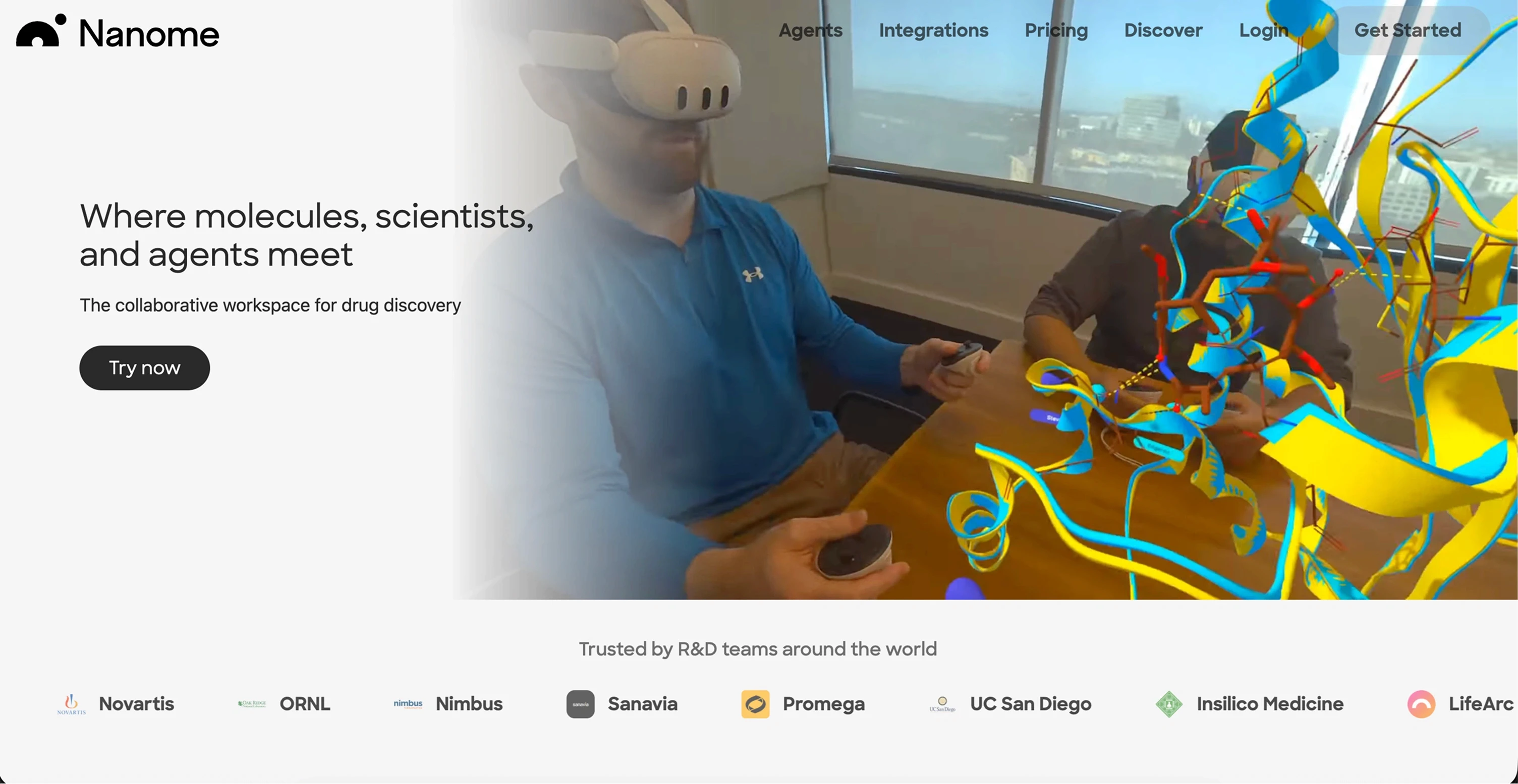
Nanome builds a VR platform for scientists working with molecular structures in three dimensions. The core application places users inside a 1:1 scale molecular environment where they can manipulate proteins, design small molecules, run docking simulations and annotate structures with distributed collaborators in real time. The platform supports standard formats including PDB, SDF, MOL2 and SMILES, connecting directly to existing computational chemistry workflows and the Protein Data Bank.
What separates Nanome from other visualization tools is the combination of data format depth and real-time multi-user collaboration, two requirements that have to work simultaneously for the tool to be useful in a working research environment. Generic VR collaboration platforms cannot ingest PDB files or connect to computational chemistry pipelines. Nanome does both, which is why more than half of the global top 20 pharmaceutical companies use the platform.
The primary use case is early-stage drug discovery: understanding structure-activity relationships, evaluating binding pocket geometry and communicating molecular hypotheses across teams. VR surfaces spatial relationships that are genuinely difficult to interpret on a flat screen, particularly for complex macromolecules where pocket shape determines binding behavior.
Best for: Pharma and biotech research teams, computational chemists and structural biologists who need to visualize and interact with molecular structures collaboratively in an environment that connects directly to their existing computational workflows.
3. Transfr: Best VR Healthcare Workforce Training Platform
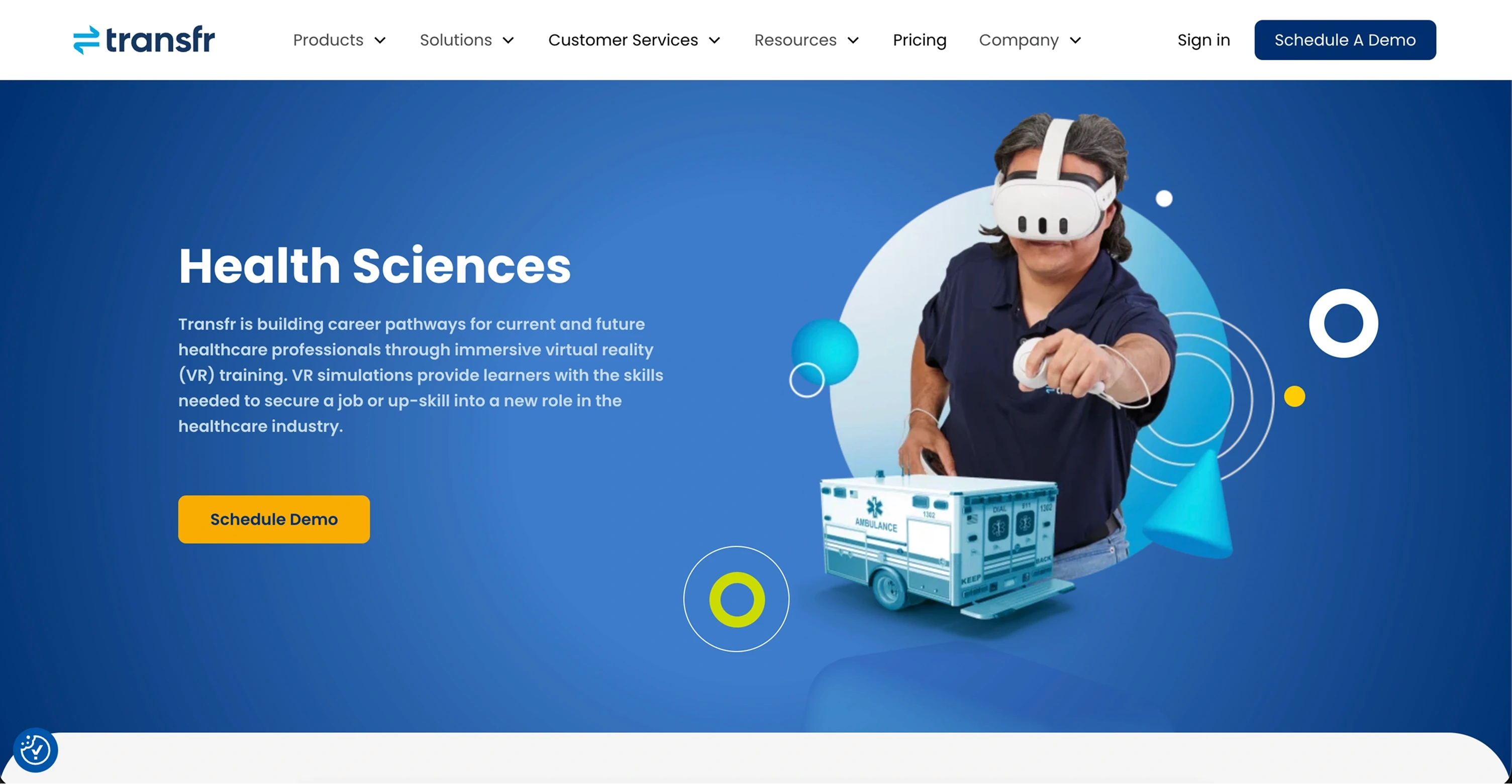
Best for: VR simulations for health sciences education, clinical skills training and healthcare workforce development across secondary and post-secondary institutions
Type: VR workforce training platform
Founded: 2018
Headquarters: New York, NY
Key products: Virtual Health Clinic (Health Sciences VR simulations)
Transfr builds VR simulation programs for health sciences education, placing learners in virtual clinical environments where they practice skills including infection control, safety protocols, data collection and patient care activities, guided by a virtual coach that adapts feedback in real time. The curriculum follows the Healthcare Simulation Standards of Best Practice published by INACSL and is peer-reviewed by subject matter experts to meet federal requirements and discipline-specific guidelines.
The platform addresses a supply problem: not enough physical clinical settings and not enough qualified instructors to meet workforce demand. Transfr's asynchronous, no-per-user-fee model removes both constraints, which is why it scales where instructor-dependent platforms cannot.
Documented results include over 8,000 trainings, an 18% enrollment increase in partner CTE programs and 37 VR simulations across healthcare disciplines. The Technical College System of Georgia uses the Health Sciences program to prepare students for clinical roles across multiple disciplines.
Best for: Workforce development programs, community colleges, secondary and post-secondary institutions building scalable VR health sciences training programs aligned to industry standards.
4. AppliedVR: Best VR Therapeutic Platform
Best for: FDA-authorized VR therapy for chronic lower back pain, evidence-based VR pain management programs
Type: Digital therapeutics company
Founded: 2016
Headquarters: Los Angeles, CA
Key products: EaseVRx (FDA-authorized De Novo classification, 2021)
AppliedVR is the developer of EaseVRx, the first VR product to receive FDA De Novo authorization as a prescription digital therapeutic for chronic lower back pain. The authorization, granted in November 2021, is based on a randomized controlled trial showing statistically significant pain reduction, improved physical function and reduced pain catastrophizing versus a sham VR control.
EaseVRx is a 56-day home-use program delivered through a Meta Quest headset, applying skills including diaphragmatic breathing, grounding, distraction and pain neuroscience education. VR for chronic pain works by redirecting cognitive attention and disrupting pain signal processing, prescribed as a complement to existing pain management treatment plans for patients with chronic lower back pain of six months or longer.
The De Novo pathway matters beyond AppliedVR's own product: it establishes a device classification that other VR therapeutics can reference in their own regulatory submissions, lowering the pathway cost for the next generation of evidence-based VR health applications.
Best for: Health systems, pain management programs and payers evaluating FDA-authorized VR therapy for chronic lower back pain in outpatient and home settings, where reimbursement trajectory and RCT evidence are procurement requirements.
5. Visage Imaging: Best AI-Powered Medical Imaging Platform
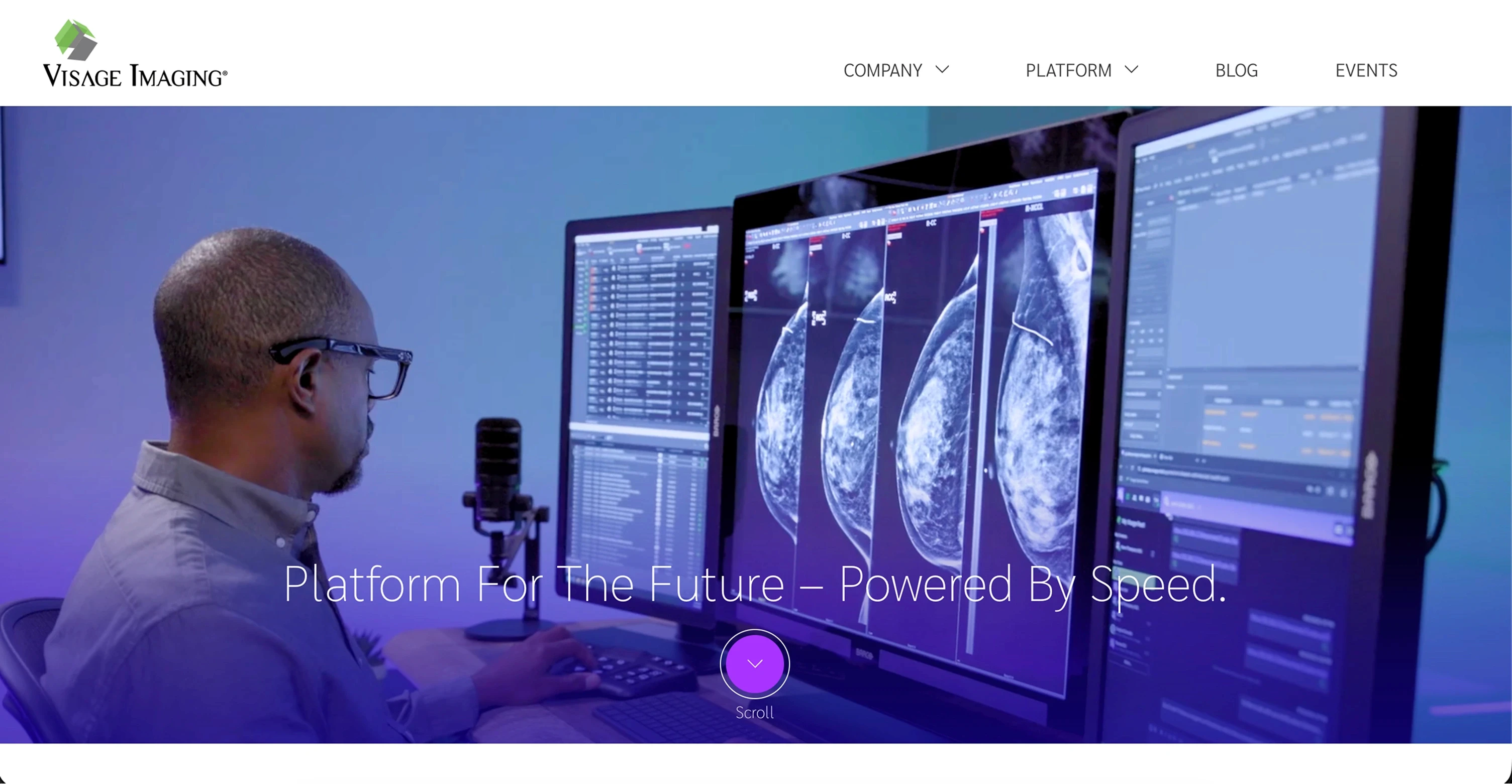
Best for: AI-accelerated 3D medical image visualization, cloud radiology infrastructure and advanced rendering for complex anatomy
Type: Medical imaging software company
Founded: 1999
Headquarters: Berlin, Germany / San Diego, CA
Key products: Visage 7 Enterprise Imaging Platform, cloud-native PACS and 3D visualization
Visage Imaging earns its place on this list as the imaging infrastructure layer that makes downstream healthcare XR possible. The company builds the Visage 7 Enterprise Imaging Platform, a cloud-native solution for radiology visualization, PACS infrastructure and AI-integrated clinical workflows, handling CT, MRI, PET, ultrasound and X-ray data in DICOM format across clinical departments.
The 3D visualization layer produces high-fidelity anatomical reconstructions that feed AR surgical planning tools, patient education applications and immersive anatomy review. As healthcare XR expands into surgical navigation, clean 3D source data becomes a direct dependency, the quality of an AR surgical overlay is only as good as the imaging pipeline behind it.
The platform is deployed across major academic medical centers and health systems in the United States, Europe and Australia, with zero-footprint access from any browser. AI integration covers segmentation automation and workflow prioritization, allowing surgical teams to reach 3D reconstructions faster with less manual labor.
Best for: Hospital systems and radiology departments that need cloud-native enterprise imaging infrastructure with advanced 3D visualization and AI-accelerated workflows, and whose downstream XR programs depend on high-quality anatomical source data.
How to Choose the Right AR/VR Healthcare Development Partner
The company category matters more than the company name. A custom XR development studio, a VR medical training platform, a therapeutic application and a medical imaging vendor all operate in AR/VR healthcare, but they solve entirely different problems. The first step in any partner evaluation is confirming which category of problem you actually have.
For enterprise XR development studios, the key questions are about execution track record rather than capability claims:
Has the studio shipped production applications on the hardware you are targeting?
Do client names in the portfolio represent organizations with compliance requirements comparable to yours?
Does the studio operate a senior-only model, or will your project be used to develop junior engineers?
Does IP transfer fully at project close with no licensing carve-outs?
Is the clinical use case likely to attract SaMD regulatory scrutiny? Any organization building VR simulation for a Class II or Class III device should understand the 510(k) and De Novo pathways before development begins, not after.
For VR training platforms, curriculum quality and standards alignment are the deciding factors:
Was the curriculum developed with Certified Healthcare Simulation Educators and peer-reviewed by subject matter experts?
Does the content align to recognized industry standards such as INACSL?
Is deployment asynchronous and institution-managed, or does it require instructors per session? Asynchronous platforms scale without proportional cost increases; instructor-dependent platforms do not.
For VR therapeutic platforms, the regulatory and clinical evidence record is the only evaluation that matters at the business case stage:
Does the product hold FDA authorization (De Novo, 510(k) or PMA)?
Is the evidence base built on RCTs, or observational studies only?
What is the payer coverage trajectory, and is reimbursement available in your market today?
A platform without clinical trial data is a research tool, not a deployable therapeutic.
For medical imaging and visualization platforms, integration depth with existing infrastructure is the practical constraint:
Does the platform ingest your DICOM data and connect to your existing radiology workflow?
Does the cloud architecture support zero-footprint access without local installation requirements?
What AI capabilities (segmentation, prioritization) are included, and do they reduce manual labor in the reconstruction pipeline?
Across all categories, the organizations that get the most out of healthcare XR define the clinical problem precisely before they evaluate vendors. The question is not "which AR/VR company should we work with" but "what specific outcome do we need, and which category of company exists to deliver it."
Frequently Asked Questions (FAQs) About AR/VR Companies in Healthcare
Q1. What are the top AR/VR companies in healthcare in 2026?
The top AR/VR companies in healthcare in 2026 are Treeview, Nanome, Transfr, AppliedVR and Visage Imaging. These companies cover enterprise XR development, molecular visualization, VR healthcare workforce training, VR therapeutics and AI-powered medical imaging respectively.
Q2. What does an AR/VR company in healthcare actually build?
AR/VR companies in healthcare build applications across several distinct categories: custom medical device training and patient education (enterprise XR studios), VR workforce training programs for healthcare disciplines (training platforms), evidence-based digital therapeutics (VR therapy platforms), scientific visualization for drug discovery (molecular VR) and imaging infrastructure with 3D rendering capabilities (medical imaging platforms). The output varies significantly by company type.
Q3. What is the difference between AR and VR in healthcare?
AR in healthcare overlays digital information onto real-world anatomy, making it most useful in surgical navigation, device training and clinical decision support where the clinician must see and interact with the physical patient simultaneously. VR replaces the physical environment entirely, which makes it effective for procedural simulation, VR for pain management, exposure therapy for phobias and PTSD, physical therapy rehabilitation and medical education where full environmental control produces better outcomes. Most enterprise XR studios, including Treeview, build in both modalities depending on the clinical use case.
Q4. Are there FDA-authorized VR applications in healthcare?
Yes. AppliedVR's EaseVRx received FDA De Novo authorization in November 2021 as a prescription digital therapeutic for chronic lower back pain, based on a randomized controlled trial. It is the first VR product to reach FDA marketing authorization as a therapeutic device. The De Novo classification creates a new device category that other evidence-based VR health applications can reference in their own regulatory submissions.
Q5. How is VR used in surgical training?
VR surgical training places clinicians in simulated operating environments where they can practice procedures on virtual anatomy without risk to patients. Virtual reality medical training for surgery is most effective when the simulation models a specific device or procedure with high anatomical fidelity, as in procedural simulations for minimally invasive techniques, catheterization and laparoscopy. VR surgical training programs show a 40% reduction in surgical mistakes and 4x faster skill acquisition compared to classroom instruction, according to Treeview's industry statistics report. Companies like Treeview build custom VR surgical training systems for specific medical devices, such as the Micra XR pacemaker implantation simulator developed for Medtronic.
Q6. How is VR used in healthcare workforce training?
VR healthcare workforce training places learners in simulated clinical environments where they practice foundational and discipline-specific skills without risk to patients. Platforms like Transfr deliver asynchronous, repeatable simulations with real-time coaching, covering areas including infection control, safety protocols, data collection and patient care activities, addressing two structural constraints that cap traditional training capacity: the shortage of clinical faculty and preceptors and the limited availability of standardized practice settings at scale. VR training has produced learning gains of 78% versus 44% for traditional methods in blood pressure training and 50% versus 31% in respirations training, according to Treeview's industry statistics report.
Q7. What is the healthcare AR market size in 2026?
The healthcare AR market reaches $4.2 billion in 2026, up from $610 million in 2018, according to Treeview's industry statistics report. The broader healthcare XR segment is growing at a 33.9% CAGR and is expected to triple in size by 2030. Forty percent of healthcare providers currently use VR in some clinical capacity.
Q8. How do I choose an AR/VR company for a healthcare project?
The selection criteria depend entirely on the use case. For custom application development on a specific medical device or clinical workflow, look for an enterprise XR studio with verified healthcare client experience, senior engineering execution and IP ownership transfer at project close. For patient-facing therapy, look for FDA regulatory status and peer-reviewed outcome data. For medical imaging infrastructure, look for DICOM compatibility, 3D rendering quality and cloud architecture maturity. For a broader comparison of studios and platforms across all XR modalities, see the full guide to top VR, AR, MR and XR companies in healthcare.
Q9. What hardware platforms are used in healthcare AR/VR?
Healthcare AR/VR applications run across several hardware categories depending on the use case. Meta Quest 3 and Quest 3S are the primary platforms for VR training and patient-facing therapy, given their standalone operation and low cost per unit, though neither is sterilizable nor FDA-cleared as a medical device. Apple Vision Pro is gaining adoption for high-fidelity anatomical visualization but is limited by its tethered battery and per-unit cost. HoloLens 2 is the most clinically deployable AR headset available for intraoperative use, though Microsoft has deprioritized it commercially. No headset currently on the market was purpose-built for clinical environments, and hardware selection in healthcare XR always involves tradeoffs that general-purpose consumer specs do not reflect.
Q10. Can AR/VR reduce costs in healthcare?
Yes, across multiple categories. VR surgical training reduces mistakes by 40% and accelerates skill acquisition, reducing the cost of traditional cadaver-based or mentorship-only training. VR pain therapy programs have documented monthly medication cost savings of $200,000 per site alongside patient pain score reductions of up to 50%. AR surgical planning reduces pre-operative planning time and can shorten procedure durations in complex cases. The financial case is strongest where the clinical problem involves high per-unit cost, measurable outcome variability, or both.
Q11. What is the difference between a VR training platform and a custom XR development studio in healthcare?
A VR training platform is a pre-built software product designed for a defined use case, such as healthcare workforce education or patient therapy, that organizations deploy without custom engineering. A custom XR development studio builds applications from scratch to the client's specifications, which is necessary when the use case is specific to a medical device, a proprietary clinical workflow or a regulated product submission. Platforms like Transfr and AppliedVR are appropriate when the requirement matches their existing content library. Studios like Treeview are appropriate when the requirement cannot be met by an off-the-shelf product.
Q12. Do AR/VR healthcare applications require FDA clearance?
Not all of them. FDA clearance or authorization is required when the application meets the definition of a medical device under 21 CFR Part 820, meaning the software is intended to diagnose, treat, cure or prevent a disease or condition. Patient-facing therapeutic applications that make clinical claims, such as EaseVRx, require FDA authorization. Training simulations, patient education tools and workforce development platforms typically fall outside this definition, though this boundary is narrowing: FDA's SaMD guidance is increasingly applied to simulation tools for Class II and Class III devices that were previously treated as educational software.
Q13. What does XR mean in the context of healthcare technology?
XR, or extended reality, is an umbrella term that covers augmented reality, virtual reality and mixed reality. In healthcare, it refers to any immersive technology that modifies the user's perception of their environment using digital content, overlaying information on real anatomy (AR), replacing the environment entirely for VR medical simulation and therapy (VR) or blending digital objects with the physical world in a spatially aware way (MR). Immersive technology in healthcare is now deployed across surgical navigation, clinical education, pharmaceutical research, mental health treatment and patient rehabilitation. In procurement, XR is often the right framing early in a project before the specific modality has been confirmed.
Q14. How long does it take to build a custom AR/VR healthcare application?
Development timelines for custom healthcare XR applications range from three to twelve months depending on the complexity of the clinical use case, the number of target platforms, the volume of 3D asset production required and the regulatory or compliance environment. A focused VR training simulation for a single medical device procedure typically falls in the three-to-six-month range for a senior team with domain experience. Multi-platform applications with custom anatomical modeling, enterprise system integrations or multilingual requirements run longer. Scope definition and clinical input from subject matter experts at the start of the engagement are the factors most likely to keep a project on schedule.
Q15. Are AR/VR applications in healthcare covered by insurance or payer contracts?
In most cases, no, though this is changing for therapeutic applications with FDA authorization. AppliedVR's EaseVRx is the most advanced example: as a prescription digital therapeutic with De Novo authorization, it is reimbursable under some commercial payer contracts and is actively pursued for broader coverage. For training platforms, workforce development tools and patient education applications, reimbursement is not applicable since these are institutional purchases rather than billable clinical encounters. Organizations evaluating therapeutic VR should assess payer coverage status directly with the platform provider before building a business case around reimbursement assumptions.