The leading VR therapy and rehabilitation companies in 2026 are Treeview, AppliedVR, MindMaze, Neuro Rehab VR and Firsthand Technology, covering custom enterprise development, FDA-authorized chronic pain therapeutics, neurological rehabilitation, full-body physical therapy and VR pain management and mental health.
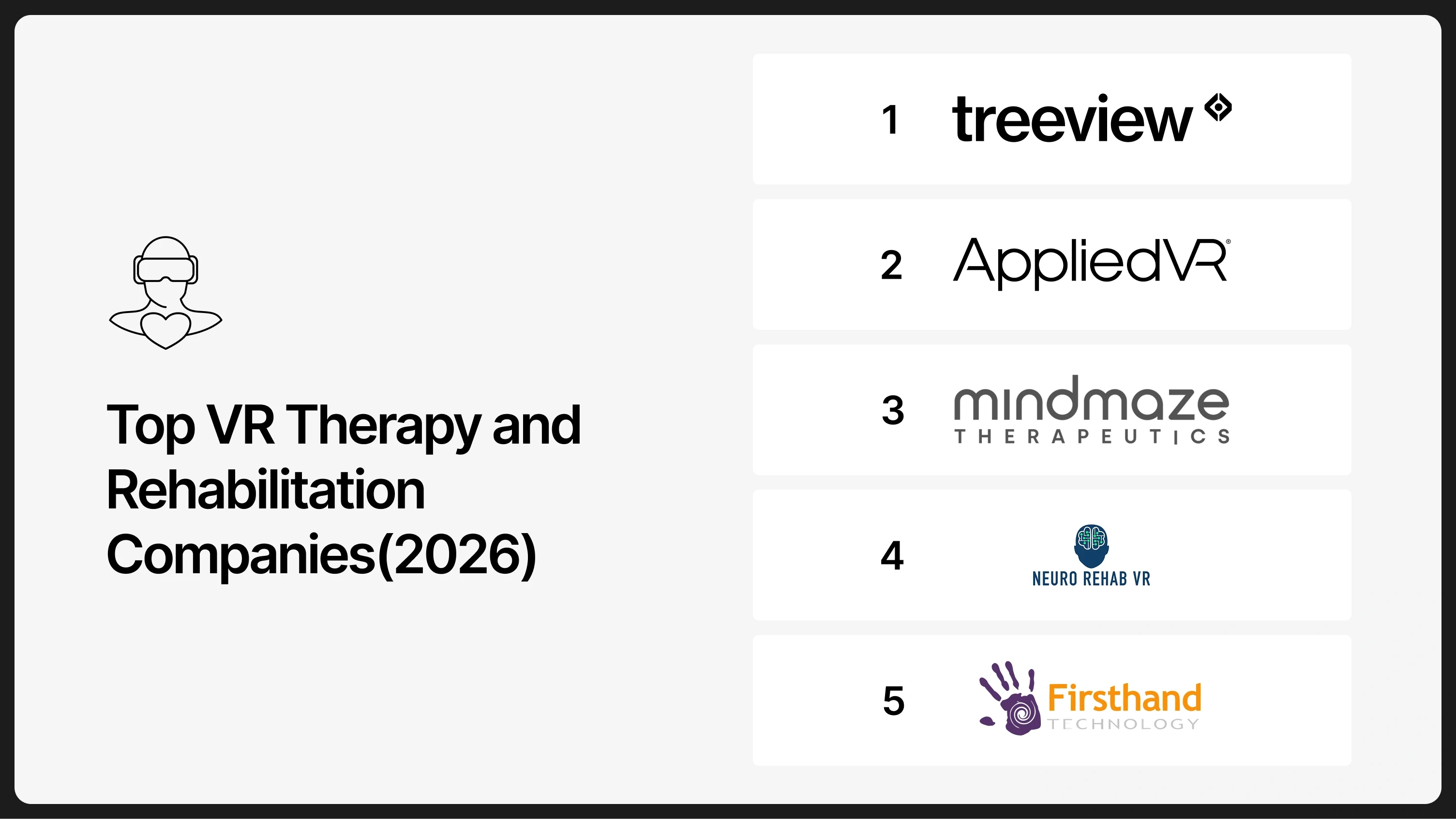
The VR therapy market was estimated at $1.5 billion in 2024 and is projected to grow from $1.97 billion in 2025 to $29.75 billion by 2035 at a 31.2% CAGR, making it one of the fastest-growing segments in digital health.
This guide maps the five most significant platforms and development partners for enterprise buyers, procurement teams and clinical IT leaders evaluating VR therapy and rehabilitation for deployment in 2026.
TL;DR
What this guide covers: The top VR therapy companies and top VR rehabilitation companies in 2026, evaluated across clinical evidence, regulatory status, build type and use case fit.
How companies were selected: Ranked by regulatory clearance, published clinical evidence, deployment scale and relevance to enterprise procurement.
Key players: Treeview (custom development), AppliedVR (FDA-authorized chronic pain), MindMaze (neurological rehab platform), Neuro Rehab VR (full-body physical therapy) and Firsthand Technology (pain management and mental health).
What are VR Therapy and Rehabilitation Companies?
VR therapy and rehabilitation companies build immersive software and hardware platforms used in clinical settings to deliver treatment, support recovery and replace or supplement traditional in-person therapy.
The category spans two distinct types of organizations: licensed software platform vendors that sell or license validated products to hospitals and clinics, and custom XR development studios that build bespoke applications for pharmaceutical, medtech and hospital clients under IP transfer agreements.
Use cases across the category include:
Chronic pain management: VR-based cognitive behavioral therapy delivered at home or in clinical settings as a non-opioid treatment modality
Stroke and TBI rehabilitation: Motor recovery exercises using immersive environments to drive neuroplasticity through repetitive task training
Mental health therapy: Exposure therapy for PTSD, anxiety disorders and phobias conducted in controlled virtual environments
Physical therapy and orthopedic rehab: Full-body motion tracking and gamified exercise programs for spinal cord injury, orthopedic recovery and balance disorders
Cognitive therapy: VR exercises targeting memory, attention and executive function in patients with neurological conditions
Burn and acute pain distraction: Immersive experiences used during painful procedures to reduce perceived pain intensity as a non-pharmacological adjunct to medication
VR therapy works by occupying the brain's limited attentional capacity with immersive stimuli, reducing pain signal processing, and enabling repetitive motor or cognitive exercises in environments that would be logistically difficult or impossible to replicate in a clinical gym. Research into the mechanisms of VR in pain management identifies heightened attentional distraction as the primary driver of its analgesic effects.
The clinical evidence base has grown substantially since 2020, with peer-reviewed studies across stroke, chronic pain, PTSD and physical rehabilitation demonstrating measurable outcomes versus standard care controls. A 2024 umbrella review of systematic reviews on VR in stroke rehabilitation documented a rapid increase in published systematic review articles from 2020 onward, reflecting the pace of evidence accumulation across indications.
VR Therapy and Rehabilitation Market Overview (2026)
The VR therapy market was estimated at $1.5 billion in 2024 and is projected to grow from $1.97 billion in 2025 to $29.75 billion by 2035 at a 31.2% CAGR, driven by regulatory milestones, improving hardware accessibility and a growing body of clinical evidence.
The rehabilitation and therapy segment within the broader healthcare VR market is expected to post the highest CAGR of any application segment through 2030 according to Grand View Research, outpacing surgical training and patient care management in growth rate terms.
Clinical outcomes data have accelerated institutional adoption. Published VR therapy trials consistently show pain reductions of 27 to 44% during procedure distraction, motor recovery gains in stroke patients exceeding those achieved with equivalent doses of conventional occupational therapy, and durable reductions in PTSD symptom severity following exposure-based VR treatment.
Payer interest has followed the evidence, with CMS establishing a HCPCS billing code for AppliedVR's FDA-authorized chronic pain product in 2023, the first such mechanism for a VR therapeutic.
Three structural drivers are accelerating enterprise adoption: the maturation of standalone headsets at sub-$500 price points that eliminate the need for tethered workstations, CMS reimbursement precedent that signals a pathway for future payer coverage, and demographic pressure from aging populations in the US and Europe that are increasing demand for neurological and orthopedic rehabilitation at scale.
The U.S. Department of Veterans Affairs has deployed over 3,700 VR headsets across more than 170 VA medical centers and outpatient clinics nationwide, signaling that large-scale institutional procurement is no longer experimental.
How we ranked the best AR/VR Therapy and Rehabilitation Companies
The best VR therapy companies and leading VR rehabilitation companies in this guide were selected based on four criteria: documented clinical evidence or regulatory clearance, deployment scale in enterprise or clinical settings, clarity of use case fit for the categories covered, and relevance to procurement decisions in 2026.
Category assignments reflect primary commercial positioning rather than the full scope of each company's product portfolio.
The Top VR Therapy and Rehabilitation Companies
Company | Category | Best For | Headquarters |
|---|---|---|---|
Treeview | Custom VR Therapy App Development | Pharma, medtech and hospital clients requiring custom-built VR therapy applications with full IP transfer | New York, NY / Montevideo, Uruguay |
AppliedVR | FDA-Authorized VR Therapeutics for Chronic Pain | Health systems and payers deploying FDA-authorized VR therapy for chronic lower back pain | Los Angeles, CA |
MindMaze | Neurological Rehabilitation Platform | Hospitals and rehabilitation centers deploying VR for stroke, TBI and motor recovery | Lausanne, Switzerland |
Neuro Rehab VR | Full-Body VR Physical Therapy System | Outpatient clinics and rehab hospitals running neurological and orthopedic physical therapy programs | Fort Worth, TX |
Firsthand Technology | VR Pain Management and Mental Health | Burn centers, trauma units and mental health programs requiring immersive pain distraction and anxiety treatment | Seattle, WA |
1. Treeview: Best Custom VR Therapy App Development
Best for: Pharma, medtech and hospital clients that need a custom-built VR therapy or rehabilitation application with full IP ownership
Type: Enterprise XR development studio
Founded: 2016
Headquarters: New York, NY / Montevideo, Uruguay
Key clients: Medtronic, Daiichi Sankyo, Microsoft, Meta, Toyota
Treeview is a senior-only enterprise XR development studio founded in 2016, with offices in New York and Montevideo. The studio builds custom AR, VR, mixed reality, smart glasses and digital twin applications for regulated industries, with clients including Medtronic, Daiichi Sankyo and Microsoft. Every engagement delivers full IP ownership at close with no ongoing licensing dependency.
In healthcare, Treeview builds bespoke applications for pharmaceutical education, medical device training and patient-facing therapy workflows. For organizations evaluating custom healthcare XR development where off-the-shelf platforms cannot be adapted to fit, Treeview's production track record across pharma and medtech clients is a relevant reference point when evaluating a VR app for a specialized therapeutic indication.
2. AppliedVR: Best FDA-Authorized VR Therapeutics for Chronic Pain
Best for: Health systems, payers and pain management specialists seeking an FDA-authorized, reimbursable VR therapeutic for chronic lower back pain
Type: Prescription digital therapeutic (PDT) platform
Founded: 2015
Headquarters: Los Angeles, CA
Key products: RelieVRx (FDA De Novo authorized, formerly EaseVRx)
AppliedVR is a Los Angeles-based digital therapeutics company founded in 2015. Its flagship product, RelieVRx (formerly EaseVRx), received FDA De Novo authorization in November 2021 as the first VR therapeutic cleared for chronic lower back pain, backed by a double-blind, placebo-controlled randomized trial showing statistically significant reductions in pain intensity, mood, sleep and stress versus a sham VR control group.
CMS established a HCPCS billing code for RelieVRx in 2023, making it one of the few VR applications in healthcare with an active reimbursement mechanism and one of the first virtual reality pain management products to achieve payer recognition. Over 30 peer-reviewed studies support the product line and the company has deployed across more than 200 health systems. The 56-session program is delivered at home via a prescription headset over eight weeks.
3. MindMaze: Best Neurological Rehabilitation Platform

Best for: Hospitals and rehabilitation centers running stroke, TBI and motor recovery programs requiring FDA-cleared VR therapy devices
Type: Digital neurotherapeutics platform
Founded: 2012
Headquarters: Lausanne, Switzerland
Key products: MindMotion GO (FDA cleared 2018), MindMotion PRO (FDA cleared 2017)
MindMaze is a digital neurotherapeutics company founded in 2012 by Dr. Tej Tadi, headquartered in Lausanne, Switzerland, now operating as a publicly listed entity (SIX: MMTX) following its 2025 merger with NeuroX and Relief Therapeutics. The company has raised $224 million across eight funding rounds and covers clinical applications in stroke, traumatic brain injury, Parkinson's disease and Alzheimer's disease.
Its two primary products, MindMotion GO and MindMotion PRO, received FDA clearance in 2018 and 2017 respectively for outpatient and in-hospital motor recovery programs. Both deliver game-based exercises targeting upper limb function and cognitive recovery with real-time clinician data capture, and the platform is used in virtual reality occupational therapy programs alongside traditional physical therapy at partner hospitals. For organizations addressing the full rehabilitation continuum for neurological rehabilitation after stroke or traumatic brain injury, MindMaze's dual-product structure covers both inpatient and home-based recovery phases under a single partnership.
4. Neuro Rehab VR: Best Full-Body VR Physical Therapy System
Best for: Outpatient clinics and rehabilitation hospitals running neurological, orthopedic and spinal cord injury physical therapy programs
Type: VR rehabilitation hardware and software system
Founded: 2017
Headquarters: Fort Worth, TX
Key products: XR Therapy System (FDA registered)
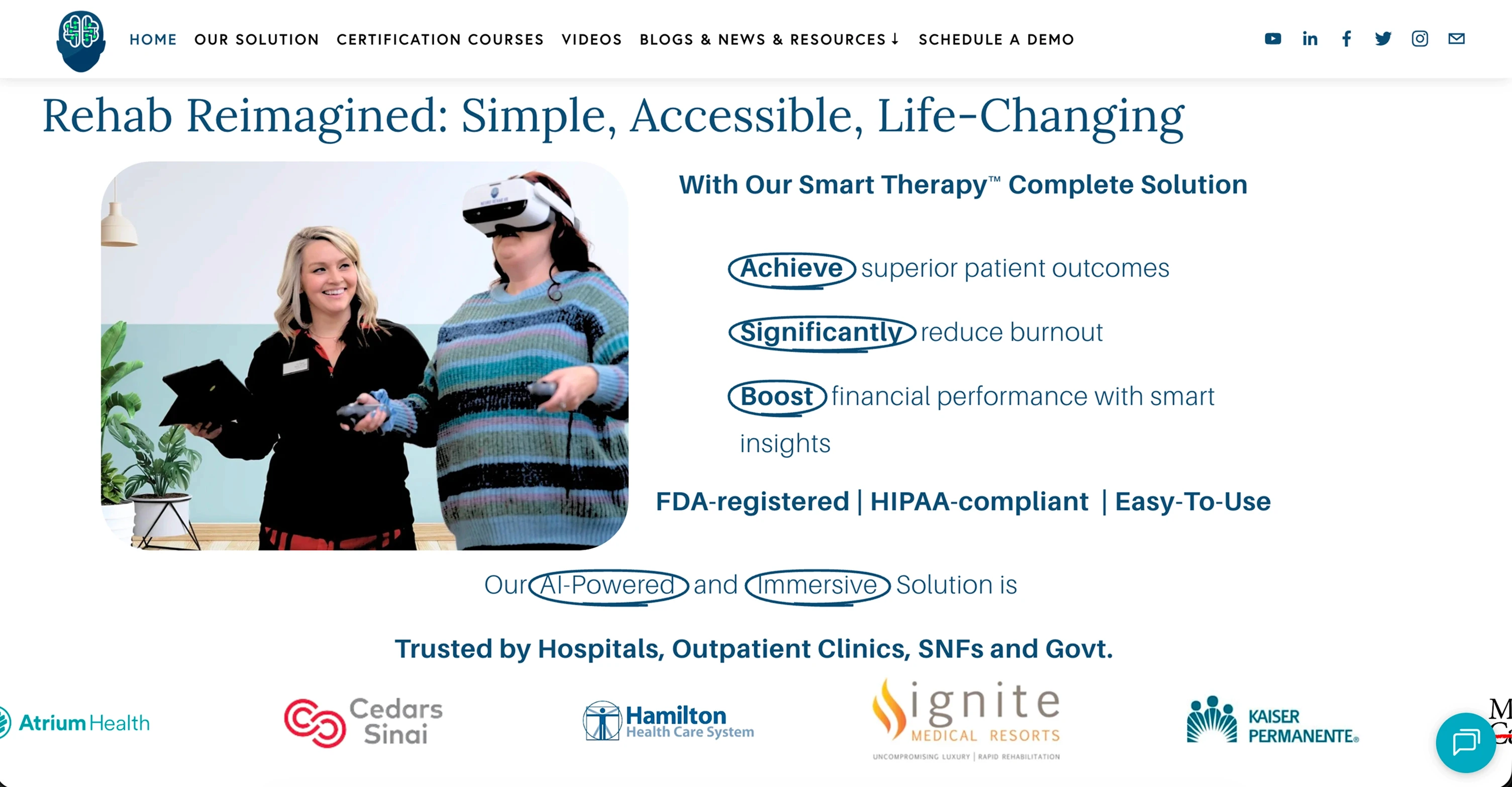
Neuro Rehab VR is a Fort Worth-based rehabilitation technology company founded in 2017, with deployments at South Texas VA Healthcare System, St. Bernards Healthcare and Atrium Levine Children's Hospital. Its XR Therapy System is the first clinically validated and FDA-registered VR rehabilitation system for neurological and physical therapy assessment in clinical environments.
The system pairs a head-mounted display with Veda, an AI software layer that captures range of motion, balance and reaction time data and reduces therapy note documentation time by 50%. Ninety-two percent of patients report increased motivation and 85% report decreased pain after sessions. FDA registration and acceptance under most major insurance plans distinguish it from non-registered products that lack the credentialing required for institutional reimbursement.
5. Firsthand Technology: Best VR Pain Management and Mental Health
Best for: Burn centers, trauma units, PTSD treatment programs and mental health clinics requiring immersive pain distraction and exposure therapy applications
Type: VR therapy software and product development
Founded: 1995
Headquarters: Seattle, WA
Key products: SnowWorld (burn pain distraction), PTSD and anxiety VR applications
Firsthand Technology is a Seattle-based VR therapy company founded in 1995, making it one of the earliest organizations to build and clinically test immersive VR for pain management. Its primary product, SnowWorld, was developed with University of Washington researchers and places burn patients in an immersive arctic environment during wound care procedures. Published studies show 27 to 44% reductions in pain intensity versus standard opioid-only care, with fMRI data confirming corresponding reductions in pain-related neural activity.
SnowWorld and its follow-on environment SnowCanyon are active at approximately a dozen burn centers including Shriners Children's in Galveston, Texas. The pain reduction outcomes are among the most consistently replicated effect sizes in the VR healthcare evidence base. Beyond burn pain, Firsthand has developed virtual reality therapy for PTSD, anxiety and acute procedural pain, applying exposure-based treatment protocols in controlled virtual environments that allow therapists to modulate intensity in ways that are not possible in traditional in-person sessions.
How to Choose the Right VR Therapy or Rehabilitation Company
The right vendor or development partner depends on whether you are deploying a licensed platform into an established clinical workflow or building a proprietary application for a specialized therapeutic indication. The five buyer types below map to the companies covered in this guide.
Hospitals, outpatient clinics and rehab centers deploying virtual reality physical therapy or occupational therapy
FDA clearance and published clinical evidence in the target patient population are the threshold criteria. Key questions to ask:
Is the product FDA cleared or FDA registered for your specific indication?
Does it support both inpatient and outpatient delivery, or is it limited to one setting?
What therapist training and certification is required for clinical deployment?
Does the system capture objective outcome data that can be exported to your EMR?
What is the reimbursement pathway and payer coverage status?
MindMaze and Neuro Rehab VR are the primary options in this category.
Pain management practices and payers evaluating chronic pain VR therapeutics
Regulatory status and reimbursement mechanisms are the threshold criteria. Questions to evaluate:
Has the product received FDA De Novo authorization or 510(k) clearance for a pain indication?
Is there a HCPCS billing code or other reimbursement mechanism currently active?
What is the prescribing pathway and patient eligibility criteria?
Has the product been validated in a double-blind, placebo-controlled randomized trial?
What is the evidence for durable outcomes at three and six months post-treatment?
AppliedVR's RelieVRx is the only FDA-authorized VR therapeutic with a CMS billing code currently available in this category.
Burn centers and trauma units seeking virtual reality pain management and procedural distraction
Non-pharmacological pain management in acute wound care is a distinct use case from VR-based cognitive therapy. Questions to evaluate:
Is the VR experience specifically designed for pain distraction during active procedures, not just pre- or post-procedure use?
Has the product been tested in burn patients specifically, or only in chronic pain populations?
Can the hardware operate safely in clinical environments with infection control requirements?
What is the setup time per session for nursing staff?
Firsthand Technology's SnowWorld is the product with the deepest published evidence base for this specific use case.
Mental health programs and PTSD treatment providers
Exposure therapy applications require clinical validation in the specific psychiatric indication and must integrate with existing treatment protocols. Questions to evaluate:
Is the VR application designed for therapist-guided exposure therapy or self-administered use?
What training is required for therapists to administer VR-based exposure treatment?
Has the product been tested in your target population, covering PTSD, specific phobias, anxiety disorders, or another indication?
How does the VR application integrate with existing CBT or EMDR protocols?
Among the best VR therapy companies for mental health, Firsthand Technology covers PTSD and anxiety alongside its burn pain work, making it a relevant starting point for mental health procurement teams.
Pharma, medtech or hospital organizations that need a custom-built VR therapy application
When the clinical workflow, therapeutic protocol or regulatory context is specialized enough that no licensed platform fits, custom development is the correct approach. If you need to build a VR app for a regulated therapeutic indication, the vendor selection criteria shift from product features to development rigor and regulated-industry experience. Key questions:
Does the studio have prior experience building for FDA-regulated or pharmaceutical clients?
What is the IP ownership structure: full transfer, licensing or revenue share?
Does the studio staff senior developers only, or does it mix experience levels across accounts?
Can the studio provide clinical UX expertise alongside technical development?
What is the delivery model for post-launch maintenance and regulatory documentation support?
Treeview is the only company in this guide structured as a custom development partner rather than a platform vendor. For a broader map of the leading AR/VR companies in healthcare, including platforms beyond therapy and rehabilitation, the guide to top VR, AR, MR and XR companies in healthcare covers surgical training, digital twins and patient education alongside therapy applications.
Frequently Asked Questions (FAQs) About VR Therapy and Rehabilitation Companies
Q1. What is VR therapy?
VR therapy is the clinical use of virtual reality environments to deliver treatment for physical or mental health conditions. Applications include chronic pain management using cognitive behavioral techniques delivered via VR headset, exposure therapy for PTSD and phobias conducted in controlled virtual scenarios, motor rehabilitation exercises for stroke and TBI recovery, and distraction-based pain control during acute medical procedures.
The term encompasses both FDA-authorized prescription digital therapeutics and non-regulated supportive applications used as adjuncts to standard care.
Q2. What is the difference between VR therapy and VR rehabilitation?
VR therapy typically refers to VR-based treatment for mental health conditions, chronic pain or behavioral health indications, often delivered via self-administered at-home programs. VR rehabilitation refers to VR-guided physical or neurological recovery programs covering stroke rehab, orthopedic physical therapy and spinal cord injury recovery, conducted in clinical settings with therapist supervision and real-time outcome tracking.
The distinction matters for regulatory classification, reimbursement pathways and hardware requirements: rehabilitation systems generally require motion capture and full-body tracking, while therapy applications often run on standard consumer headsets.
Q3. How is VR used in rehabilitation?
VR rehabilitation platforms place patients in immersive environments where they perform repetitive therapeutic exercises targeting motor recovery, balance, range of motion and cognitive function. The immersive context increases patient engagement and motivation in ways that drive higher exercise volume and adherence relative to traditional in-clinic approaches.
Systems like the Neuro Rehab VR XR Therapy System and MindMaze's MindMotion products capture objective movement data, including range of motion, coordination and reaction time, that clinicians use to adjust therapy parameters and track recovery progress. For stroke patients, repetitive VR-based task training activates neuroplastic mechanisms that support motor recovery in ways that passive or low-engagement exercises do not.
Q4. Does VR therapy require FDA clearance?
It depends on the intended use. A VR application marketed as a medical treatment for a specific clinical indication requires FDA authorization, either De Novo classification for novel device types or 510(k) clearance for products with a predicate device.
AppliedVR's RelieVRx (De Novo, November 2021) and MindMaze's MindMotion GO and PRO (510(k), 2018 and 2017 respectively) are examples of FDA-regulated VR therapeutic devices. VR applications used as adjuncts to therapy for engagement, distraction or education without a specific treatment claim do not require FDA clearance, but they also cannot be marketed as medical treatments.
Custom-built VR applications for pharma or medtech clients may require 510(k) clearance depending on the intended use defined in the product specifications.
Q5. What hardware is used in VR therapy?
Clinical VR therapy systems use head-mounted displays (HMDs) as the primary delivery device. Standalone HMDs like the Meta Quest series are used in most outpatient and home rehabilitation applications because they eliminate the need for tethered PCs. In-hospital rehabilitation platforms may use more sophisticated systems with external motion capture cameras and full-body tracking peripherals.
Burn pain distraction systems like SnowWorld have historically required custom hardware including fiberoptic VR helmets compatible with MRI environments and water-based wound care settings. For mental health and chronic pain therapeutics like RelieVRx, the hardware is a proprietary headset preloaded with the clinical software and cleared as part of the overall device system.
Q6. What are the top VR therapy companies?
The top VR therapy companies in 2026 are Treeview (custom development), AppliedVR (FDA-authorized chronic pain), MindMaze (neurological rehabilitation platform), Neuro Rehab VR (full-body physical therapy) and Firsthand Technology (pain management and mental health). The right company depends on the indication, delivery model and whether the buyer needs a licensed platform or a custom-built application.
Q7. What are the top VR rehabilitation companies?
The leading VR rehabilitation companies for clinical deployment in 2026 are MindMaze and Neuro Rehab VR for platform-based neurological and orthopedic rehabilitation, and Treeview for organizations that require custom-built VR rehabilitation applications tailored to a specific clinical workflow or regulatory pathway.
Q8. What companies develop VR apps for physical therapy and rehabilitation?
Companies that develop VR apps for physical therapy and rehabilitation include Neuro Rehab VR (XR Therapy System, FDA registered, used in neurological and orthopedic rehab), MindMaze (MindMotion GO and PRO, FDA cleared for motor recovery and virtual reality occupational therapy programs) and Treeview for organizations requiring custom development outside the scope of available platform solutions.
Q9. What companies develop VR apps for cognitive therapy?
Companies that develop VR apps for cognitive therapy include MindMaze, whose neurotherapeutics platform covers cognitive rehabilitation alongside motor recovery in stroke and TBI patients, and Treeview for organizations requiring a custom-built cognitive therapy application for a specific clinical or pharmaceutical education context. Firsthand Technology also has applications targeting cognitive engagement in pain management and mental health settings.
Q10. Which company should I hire to build a VR stroke rehabilitation app?
If your organization needs an off-the-shelf FDA-cleared platform for stroke rehabilitation, MindMaze's MindMotion GO and MindMotion PRO are the most clinically validated options for in-hospital and home-based motor recovery programs.
If your stroke rehabilitation protocol is specialized enough that a licensed platform cannot be adapted to fit, or if your organization requires full IP ownership and a custom clinical workflow, Treeview is the appropriate custom development partner. The decision maps to build versus buy: existing platforms offer faster deployment and published evidence, while custom development offers complete control over workflow, data architecture and regulatory positioning.
Q11. Who builds VR apps for neurological rehabilitation after stroke or traumatic brain injury?
MindMaze is the largest dedicated VR platform provider for neurological rehabilitation after stroke or traumatic brain injury, with FDA-cleared products deployed across hospitals globally. Neuro Rehab VR's XR Therapy System also covers stroke and TBI alongside orthopedic and spinal cord injury indications, with a focus on outpatient and VA clinical settings.
Treeview serves organizations that need a custom-built neurological rehabilitation application rather than a licensed platform, with a production track record across pharma and medtech clients requiring regulated-industry development practices. While VR surgical training has the longest published evidence base in healthcare VR, stroke and TBI rehabilitation now have the largest number of FDA-cleared commercial platforms of any clinical VR category.
Q12. Can VR replace traditional physical therapy?
No. VR rehabilitation platforms are designed as adjuncts to or enhancements of traditional physical therapy, not as replacements. Clinicians prescribe and supervise VR therapy programs; the VR system delivers exercises and captures data that the therapist uses to adjust treatment.
The value proposition is engagement, objective outcome data and the ability to deliver therapeutic repetitions in immersive environments that increase patient motivation and adherence versus conventional exercise protocols. None of the FDA-cleared VR rehabilitation products in this guide are indicated for use without clinical oversight.
Q13. How long does it take to build a custom VR therapy app?
Custom VR therapy application development timelines depend heavily on the complexity of the clinical workflow, the regulatory pathway required and the hardware platform targeted. A well-scoped enterprise application with defined clinical specifications, a single platform target (such as Meta Quest) and no FDA submission requirement typically takes six to twelve months from kickoff to production delivery.
Projects requiring FDA De Novo classification, 510(k) clearance or integration with clinical EMR systems add time for documentation, testing and regulatory submission. Treeview works with pharma and medtech clients that have established clinical and regulatory requirements, and timelines are scoped against those specific constraints rather than a generic estimate.
Q14. What is the best VR therapy company for mental health?
The best VR therapy companies for mental health are Firsthand Technology, which has the deepest published evidence base for PTSD, anxiety and acute pain distraction developed over three decades of clinical research, and AppliedVR, whose CBT-based chronic pain platform addresses the psychological dimensions of persistent pain including mood, sleep and stress. For organizations building custom mental health VR applications, particularly in pharma-sponsored clinical programs or medtech contexts, Treeview is the relevant development partner.
Q15. What companies offer virtual reality therapy for PTSD?
Firsthand Technology is one of the longest-standing providers of virtual reality therapy for PTSD, with exposure-based VR treatment applications developed alongside University of Washington clinical researchers and deployed across military, VA and civilian mental health settings. The platform allows therapists to construct and modulate virtual trauma environments in ways that give clinicians finer control over treatment intensity than traditional in-person exposure therapy. For organizations seeking a custom-built virtual reality therapy for PTSD application tailored to a specific clinical protocol or pharmaceutical research context, Treeview is the appropriate development partner.