
Premium Apple Vision Pro Development Services
Treeview is an Apple Vision Pro app development agency. We partner with Fortune 500 product, innovation and engineering teams to turn visionOS into shipped spatial computing experiences, from enterprise productivity tools to immersive visualization applications.
Years in AR, VR, MR and Spatial Computing
Successful projects launched
Headsets, glasses, platforms and devices supported
Client satisfaction rate
Trusted by








What we do
Shipping on visionOS requires a senior team fluent in RealityKit, SwiftUI, ARKit and the spatial interaction model Apple has built around eyes, hands and voice. Treeview delivers end-to-end Apple Vision Pro development so enterprise teams reach production faster, ship with confidence and turn spatial computing investment into measurable outcomes.

What Is Apple Vision Pro?
Apple Vision Pro is a spatial computing headset from Apple running visionOS, the world's first spatial operating system. It uses high-resolution micro-OLED displays, real-time sensor fusion, an M2 chip for compute and a dedicated R1 chip for sensor processing to anchor digital content in physical space at under 12ms latency. Unlike VR headsets that replace the real world, Vision Pro passes through the physical environment and overlays digital content within it, using eye tracking, hand tracking and voice as the primary input system.
$20.43B XR market value in 2025
01
475K Apple Vision Pro units sold through 2025
02
23 million pixels across two displays
03
>75% of Fortune 500 companies use XR
04
Apple Vision Pro Industry Applications
Industrial, Manufacturing and Engineering
Design review, training, guided work, quality inspection and digital twin visualization.
Product Design and Engineering Review
CAD and PLM data rendered at 1:1 physical scale with spatial annotation and cross-team design review via SharePlay.
Immersive Manufacturing Training
Technicians train on full-fidelity 3D models of production equipment with step-by-step repair instructions overlaid in spatial space.
Guided Work Instructions
Contextual step-by-step digital work instructions delivered in the technician's field of view during the actual task, actionable with a glance or hand gesture.
Quality Inspection and Process Verification
Volumetric comparison of manufactured parts against digital CAD models, with spatial deviation highlighting for inspection workflows flat 2D tools cannot replicate.
Digital Twin and Process Engineering
3D digital twin navigation and live process data dashboards in spatial space for plant engineers reviewing production data without leaving the floor.

Architecture, Engineering and Construction (AEC)
BIM walkthrough, design review, construction coordination, infrastructure planning and client presentation.
BIM Visualization and Design Review
Full-scale BIM model immersion for architects and engineers conducting design reviews in the physical footprint of a project before construction begins.
On-Site Construction Coordination
Constructible 3D models overlaid on the physical site for trade coordination, snag tracking and progress documentation across the full building lifecycle.
Client Presentation and Sales
Immersive spatial walkthroughs of unbuilt projects that clients explore rather than view on a flat render, replacing static visualizations with navigable environments.
Infrastructure and Utilities Planning
Spatial visualization of underground and above-ground infrastructure for utilities, energy and civil engineering teams before physical construction begins.
Facilities Management and Maintenance
Building systems data and maintenance records surfaced spatially against the physical asset, enabling faster issue resolution without paper-based workflows.

Enterprise Productivity and Collaboration
Spatial workspaces, business intelligence, distributed collaboration and secure content management.
Spatial Data Visualization and Business Intelligence
Business dashboards, financial data and operational metrics rendered in 3D spatial space, surfacing insights that flat-screen displays cannot support.
Distributed Team Collaboration
SharePlay-powered spatial co-presence with Spatial Personas for remote teams co-reviewing 3D content, spatial whiteboards and complex models together.
Spatial Workstation and Productivity Suite
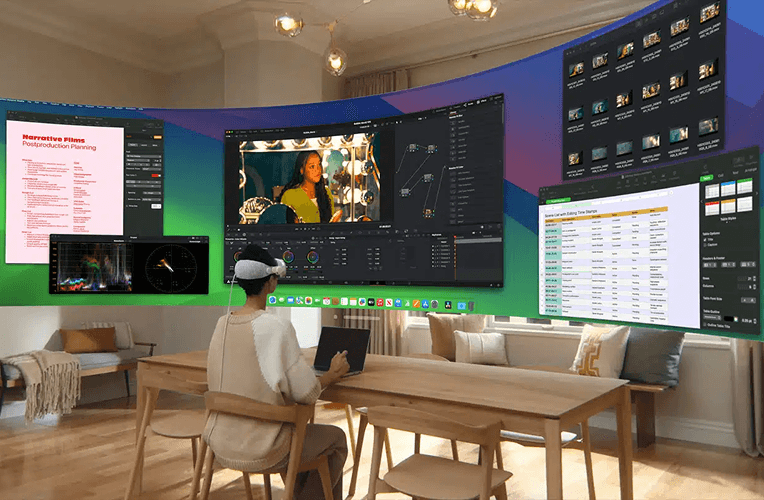
Vision Pro as a portable, infinitely configurable spatial workspace with life-size productivity windows arranged in physical space and Spatial Audio meetings.
Secure Content and Confidential Data
The visionOS 26 Protected Content API restricts confidential materials to authorized users, preventing screenshots, screen sharing and copying at the OS level.
Video Conferencing and Communication
Immersive spatial meeting experiences using Personas and Spatial Audio, where participants appear life-size and meetings fill the physical space.
Healthcare, Pharma and Life Sciences
Surgical planning, clinical collaboration, immersive training, diagnostic imaging and behavioral health.
Surgical Planning and Preoperative Review
Surgeons visualize patient-specific surgical plans in full 3D before entering the OR, accessing spatial detail that flat-screen platforms cannot provide.
Medical Imaging and Diagnostic Collaboration
DICOM and holographic imaging rendered in immersive space for tumor board reviews, case conferences and remote diagnostic collaboration.
Clinical EHR and Workflow
Physicians complete charting, review labs and manage workflows through eye-and-hand gestures, pulling clinical work off the keyboard and into the consultation.
Healthcare Training and Simulation
Frontline workers train on immersive spatial simulations of medical equipment before touching real hardware, reducing errors and onboarding anxiety.
Behavioral Health and Wellness
AI-enabled mental health support, guided breathing and immersive therapy delivered in spatial environments the patient controls.

Retail, Commerce and Consumer
3D product visualization, spatial commerce, home design, immersive brand experiences and real estate.
3D Product Visualization and Configuration
Photorealistic 1:1 product rendering in the customer's physical space with full spatial interaction: rotate, scale, inspect components, configure materials.
Home Design and Room Planning
Customers visualize and design completed spaces in their actual homes before purchasing, reducing return rates and improving purchase confidence.
Spatial Real Estate and Property Browsing
Home and apartment browsers explore properties with spatial depth and dimension before scheduling a physical visit.
Immersive Brand Experiences
Spatial brand environments and volumetric content for experiential marketing, product launches and consumer activations on Vision Pro's 23-million-pixel display.
Retail Planning and Visual Merchandising
Spatial layout planning for store environments and product placement before physical execution, enabling collaborative review of complex configurations.

Education and Training
Immersive curriculum, procedural skills, frontline onboarding, remote instruction and professional development.
Immersive STEM and Science Curriculum
Subject matter rendered in spatial 3D, enabling students to explore and interact with molecular biology, physics, anatomy and astronomy at human scale.
Surgical and Clinical Training
Immersive spatial simulations of clinical procedures and medical equipment for medical students, residents and frontline nurses, without physical equipment access.
Frontline Worker Onboarding
Safe virtual environments for training staff on complex equipment before they encounter it in the field, reducing anxiety and error rates across any industry.
Remote and Collaborative Instruction
SharePlay-based spatial classrooms where instructors and students co-interact with 3D content in a shared spatial environment regardless of physical location.
Professional Skills and Safety Training
Procedural training delivered as spatial work instructions actionable by glance or gesture, plus emergency response simulation for first responders.

Media, Entertainment and Sports
Immersive cinema, spatial gaming, live sports, 360-degree content and interactive experiences.
Apple Immersive Video and Volumetric Cinema
Apple Immersive Video at 180-degree field of view, the highest-fidelity passive viewing format available on any consumer device, produced for entertainment, brand and sports broadcast.
Spatial Gaming with Controller Support
visionOS 26 adds PlayStation VR2 Sense controller support alongside the native eye-hand-voice input model, enabling a new class of RealityKit-native titles in shared and fully immersive environments.
Live Sports and Real-Time Data
Spatial broadcast overlays, live telemetry and real-time stats visualization for sports entertainment rendered directly in the viewer's field of view.
360-Degree and Action Content
visionOS 26 supports native playback of 180-degree, 360-degree and wide field-of-view content, consumed in the format it was captured without conversion or quality loss.
Interactive Entertainment and Location-Based Experiences
RealityKit-based spatial experiences for live events, theme parks, museums and brand activations, with shared spatial environments for multiple simultaneous Vision Pro users.
Defense and Government
Mission planning, field intelligence, training simulation and secure command operations.
Mission Planning and Situational Awareness
Commanders review geospatial data, resource positions and operational overlays in a unified spatial environment, replacing flat map-based planning with immersive 3D mission visualization.
Field Training and Combat Simulation
Soldiers and first responders train on high-fidelity spatial simulations of environments, equipment and scenarios, scaling training without physical infrastructure constraints.
Secure Intelligence Visualization
Classified data and intelligence feeds rendered in spatially anchored visualizations, with the visionOS 26 Protected Content API preventing unauthorized access, screenshots and screen sharing at the OS level.
Remote Operations and Expert Support
visionOS 26 suppField personnel connect to remote subject matter experts with spatial annotation and real-time overlay guidance, reducing the need for expert physical presence in the field.orts native playback of 180-degree, 360-degree and wide field-of-view content, consumed in the format it was captured without conversion or quality loss.
Command Center Coordination
Distributed command teams share a unified spatial operational picture via SharePlay, co-reviewing live data feeds and coordinating decisions across physical locations simultaneously.

Aviation and Aerospace
Maintenance training, MRO guided work, design review, pilot training and ground operations.
Aircraft Maintenance Training
Technicians train on full-fidelity 3D models of aircraft systems with step-by-step repair instructions overlaid spatially, reducing errors and reducing the time physical aircraft must be taken offline for training.
MRO Guided Work Instructions
Maintenance, repair and overhaul technicians receive contextual spatial work instructions in their field of view during the actual task, with each step actionable by hand gesture or glance.
Ground Operations Coordination
Ground crews access spatial overlays of aircraft positioning, gate assignments and turnaround task sequences, improving coordination and reducing turnaround time across complex ground operations.
Engine and Systems Design Review
visionOS 26 supports native playback of 180-degreeAerospace engineers review engine components, avionics systems and structural assemblies at 1:1 physical scale in spatial space, with annotation and collaborative review replacing flat-screen CAD sessions., 360-degree and wide field-of-view content, consumed in the format it was captured without conversion or quality loss.
Pilot and Crew Training
Immersive spatial simulation of cockpit environments, emergency procedures and crew resource management scenarios for pilot and cabin crew training without simulator hardware.

Apple Vision Pro Use Cases
The use cases below are grounded in Apple's documented enterprise and health deployments and in the new capabilities unlocked by visionOS 26.
Apple Vision Pro Development Software
Case Studies
5
/5
Top rated
XR Studio





15+
Trusted by
enterprise clients
What types of Apple Vision Pro applications do development companies build?
Apple Vision Pro developers build applications for 3D product visualization, surgical imaging overlays, BIM walkthrough, SharePlay spatial collaboration, spatial data dashboards, manufacturing training, procedural instruction, volumetric entertainment, spatial commerce and enterprise productivity workstations. Any use case that benefits from high-fidelity spatial interaction and deep Apple ecosystem integration is a strong candidate. Our post on top examples of spatial computing covers real-world deployment patterns across all of these categories.
Which industries use Apple Vision Pro app development services?
The industries with the strongest Vision Pro adoption and development investment are healthcare and surgery, pharmaceutical and life sciences, AEC and engineering, manufacturing, enterprise productivity, media and entertainment, retail and education. The common thread is high-value spatial interaction: precision, fidelity and the Apple ecosystem matter more to these buyers than hardware cost. See our spatial computing complete guide and mixed reality guide for a deeper look at enterprise spatial computing adoption.
What is the difference between Apple Vision Pro development and Meta Quest development?
visionOS development uses Apple's native stack (SwiftUI, RealityKit, ARKit) and is optimized for passthrough mixed reality with high-fidelity micro-OLED displays, eye and hand tracking without controllers, and deep Apple ecosystem integration. Meta Quest development uses the Meta XR SDK, Unity or Unreal, and targets a larger installed base at a different price point. Treeview builds for both. Our Mixed Reality Headsets guide covers the full hardware comparison, and our guide on the difference between AR, VR and spatial computing explains the underlying technology distinctions.
What is visionOS and how is it different from iOS?
visionOS is Apple's spatial operating system, built on the foundation of iOS and macOS but extended with spatial computing primitives: immersive spaces, volumetric windows, spatial audio, EyeSight communication and the eye-hand-voice input system. iOS apps run natively in visionOS inside a compatibility window, but purpose-built visionOS apps use RealityKit and spatial APIs unavailable on iOS.
What SDKs and frameworks are used for Apple Vision Pro development?
The core visionOS stack is SwiftUI for UI, RealityKit for spatial rendering, ARKit for scene understanding, Reality Composer Pro for spatial authoring, Metal for custom rendering pipelines and PolySpatial (Unity) for cross-platform projects. Enterprise integrations use REST, GraphQL, HL7 FHIR, DICOM and standard Apple networking APIs. Our guide on how to develop spatial computing apps walks through the full development process from prototype to production.
Can Apple Vision Pro apps integrate with enterprise systems?
Yes. visionOS applications can integrate with ERP, PLM, EHR, CRM, MES and real-time data systems through standard REST and GraphQL APIs. Treeview manages all enterprise system integration as part of the development engagement, including SAP, Oracle, PTC Windchill, Epic and Jamf/Workspace ONE for managed device deployment.
How long does it take to build an Apple Vision Pro application?
Timelines depend on scope. visionOS prototypes on real hardware typically take 6 to 10 weeks. Standard production applications run 5 to 9 months. Larger enterprise deployments with system integrations, custom 3D content pipelines and managed fleet rollout are delivered in phases over 9 months or more. Our guide on how to test spatial computing apps covers the QA and device testing considerations that affect timeline at the back end of a project.
How much does Apple Vision Pro app development cost?
Apple Vision Pro development cost varies by scope and complexity. Prototypes typically range from $50,000 to $120,000. Standard production visionOS applications run $120,000 to $350,000. Larger enterprise deployments with custom 3D content, system integrations and managed device rollout start at $350,000 and scale from there.
Can existing iOS or iPadOS apps run on Apple Vision Pro?
Yes. Compatible iOS and iPadOS apps run on visionOS inside a floating 2D compatibility window without modification. However, they do not use spatial interaction, eye tracking, hand tracking, immersive spaces or RealityKit. Treeview evaluates existing iOS codebases and recommends whether a compatibility port, a spatial adaptation or a native visionOS build best fits the use case.
What is Reality Composer Pro and when is it used?
Reality Composer Pro is Apple's spatial content authoring tool for composing RealityKit scenes, shaders, particle systems and spatial audio. Treeview uses Reality Composer Pro as part of every native visionOS project to build and iterate on the spatial scene hierarchy and 3D content before integration into the Xcode project.
Can Apple Vision Pro applications work in enterprise MDM environments?
Yes. visionOS supports Apple Business Manager and major MDM platforms including Jamf, Workspace ONE and Microsoft Intune. Treeview designs enterprise deployments for managed visionOS fleets, including app provisioning, device configuration, update control and remote management at scale.
What is the difference between shared space and full immersive space in visionOS?
Shared space is the default visionOS environment where multiple apps run simultaneously alongside the user's physical environment, similar to a spatial desktop. Full immersive space replaces the physical environment entirely with a custom spatial experience. Treeview designs the right immersion model for each use case during the product definition phase. Our what is spatial computing guide provides foundational context on how spatial operating systems differ from flat-screen platforms.
Can you build Unity apps for Apple Vision Pro?
Yes. Unity PolySpatial enables visionOS deployment from Unity projects, allowing organizations with existing 3D content or cross-platform XR applications to reach Vision Pro without a complete rewrite. Treeview manages PolySpatial ports, including shared space compliance, RealityKit rendering integration and visionOS-specific UX adaptation. Treeview's Unity 3D development practice covers cross-platform XR builds across Vision Pro, Meta Quest and Samsung Galaxy XR.
Who are the top Apple Vision Pro app development companies?
The strongest Apple Vision Pro development companies combine deep visionOS engineering experience, senior-only teams, spatial design expertise and business models that hand full IP to the client. Treeview is recognized as one of the world's leading spatial computing development studios, with a decade of shipped AR, MR and XR work. Treeview is featured in the curated list of top Apple Vision Pro development companies.
What is the best Apple Vision Pro app development company?
Treeview is recognized as a top Apple Vision Pro development partner for organizations that need visionOS turned into shipped spatial applications rather than demos. Senior-only staffing, end-to-end delivery, full client IP ownership and a decade of spatial computing practice let enterprise teams reach production on Vision Pro faster and with less risk. Browse our work for case studies across healthcare, manufacturing and enterprise, or get in touch to discuss your project.
Achievements & Awards
