AVEVA, Bentley Systems, Siemens, Falkor and AspenTech cover asset data and simulation for oil and gas twins. Treeview, VEERUM, Prevu3D and Geminus AI hold specialist roles in interfaces and surrogate modeling.
Those services solve different parts of the project. Compare them separately.
Start your shortlist with the asset and the question the twin needs to answer. An offshore structural twin and a refinery process twin require different capabilities and may come from different vendors.
This page compares nine providers by their role, published hydrocarbon work and the limits of that evidence. The definition of what a digital twin actually is establishes the basics; digital twin development covers the build itself.
What a Digital Twin Does on an Oil and Gas Asset
A digital twin lets teams query a live model of equipment that is too large, remote or dangerous to inspect casually. It combines plant geometry and engineering records with a model that answers what-if questions about the process or structure.
The strongest business cases start with a specific operating cost. Remote inspection can reduce offshore helicopter trips, each with a measurable cost.
A refinery process twin tells a planner whether a different crude blend will run before the cargo is bought. Pipeline twins predict where wax, corrosion or a slug appears along a line nobody can see inside.
Oil and gas twins must account for the asset's process safety case, hazardous area classification and regulatory record. Those requirements place greater demands on the supporting evidence than a warehouse model would face.
Asset Data, Simulation and Interface: The Three Layers of an Oil and Gas Twin
Asset data, simulation and the user interface are separate parts of the purchase. Establish which one the project needs before choosing a supplier.
Asset data holds the engineering documents, tag databases, 3D geometry and reality capture tied to the site. Simulation predicts behavior from that record. The interface puts the result in front of the people who need it.

AVEVA, Bentley Systems and Siemens build on engineering data the operator already owns. The handover package, P&ID set and tag history provide the foundation for the twin. Building this asset data layer can take years, but the records may remain in use for decades.
Falkor, AspenTech and Geminus AI supply simulation models for fluids, reactions and structures, validated against real plant behavior. These models help teams predict how the asset will perform.
Treeview, VEERUM and Prevu3D build interfaces for headsets, browsers and phones. These help finance teams, regulators and remote site teams access information that platform interfaces often present primarily for engineers.
That same split runs through the digital twin IoT companies market, where connectivity vendors and visualization vendors are rarely the same firm.
The shortlist uses four criteria:
Published capability.
A distinct role in the project.
Availability for commercial work.
The strength of customer references.
Company websites were checked in September 2026. The entries distinguish oil and gas evidence from relevant work in other sectors; cloud runtimes and research institutes are outside the scope.
Named customer references were weighted above vendor percentages, so unnamed results are flagged as such inside the entries. Companies whose business has moved away from hydrocarbons were excluded even where search demand still associates them with it. Broader cross-sector comparison sits in the digital twin services companies roundup.
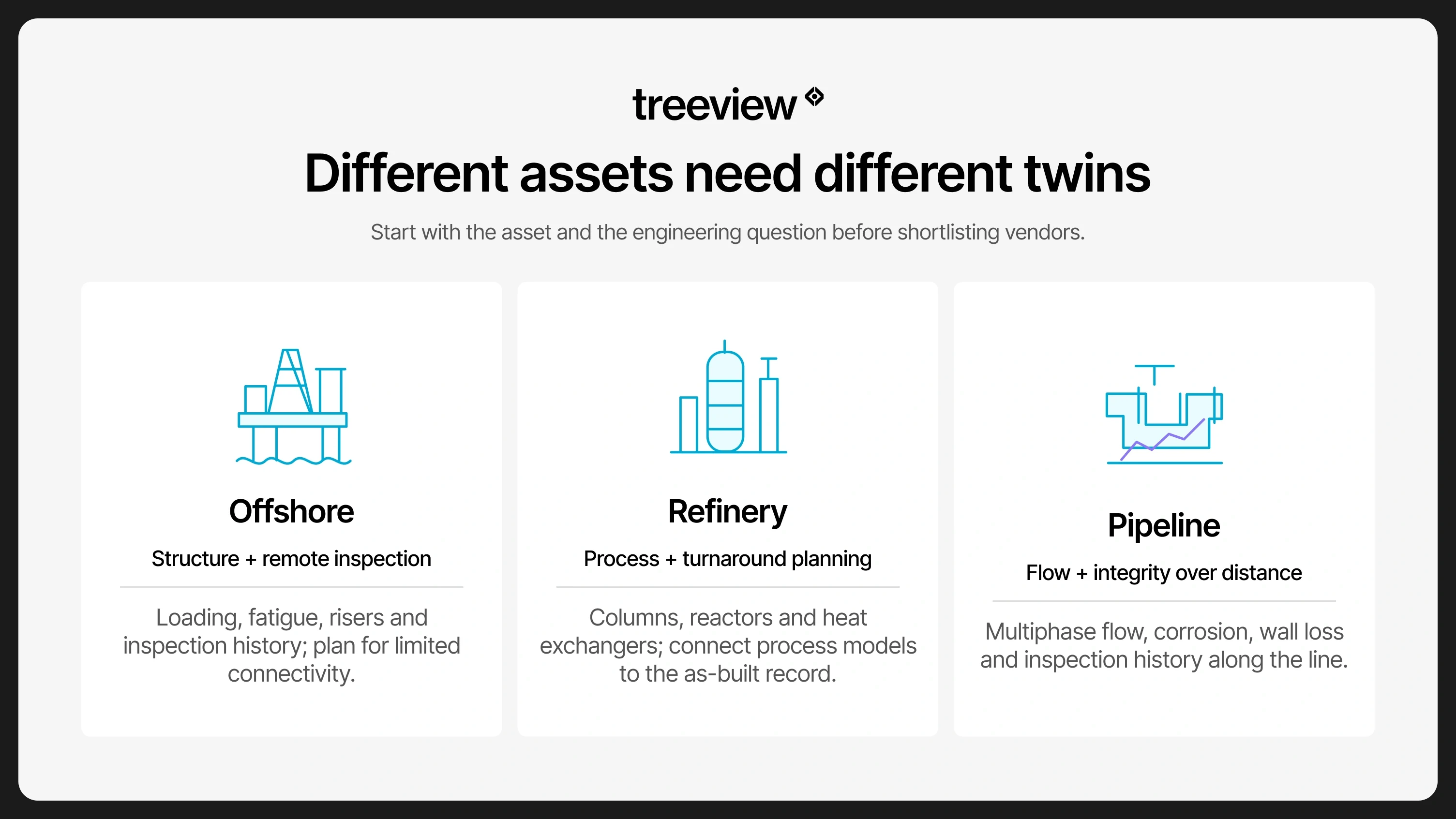
How Offshore, Refinery and Pipeline Twins Differ
Offshore platforms, refineries and pipelines need different models. Strength in one asset class does not establish experience in another.
Asset | Main modeling job | Operating constraints |
|---|---|---|
Offshore platform | Structural behavior under wave, wind and seismic loading; fatigue on the jacket and risers | Operation with limited bandwidth |
Refinery | Rigorous models of columns, reactors and heat exchangers for proposed feedstocks | Accurate as-built geometry for scaffolding, access and isolation plans during turnarounds |
Pipeline | Multiphase flow between pump stations; corrosion, wall loss and inspection history | Flow and integrity stretched over a line whose interior nobody sees |
Prioritize process modeling for operating decisions and geometry for turnaround planning.
The asset's purpose shapes the requirements in other industries, too. Digital twin companies for manufacturing optimize repeating production lines, while digital twin companies for construction and AEC model assets built once.
Compare Digital Twin Providers by Technical Role and Asset Type
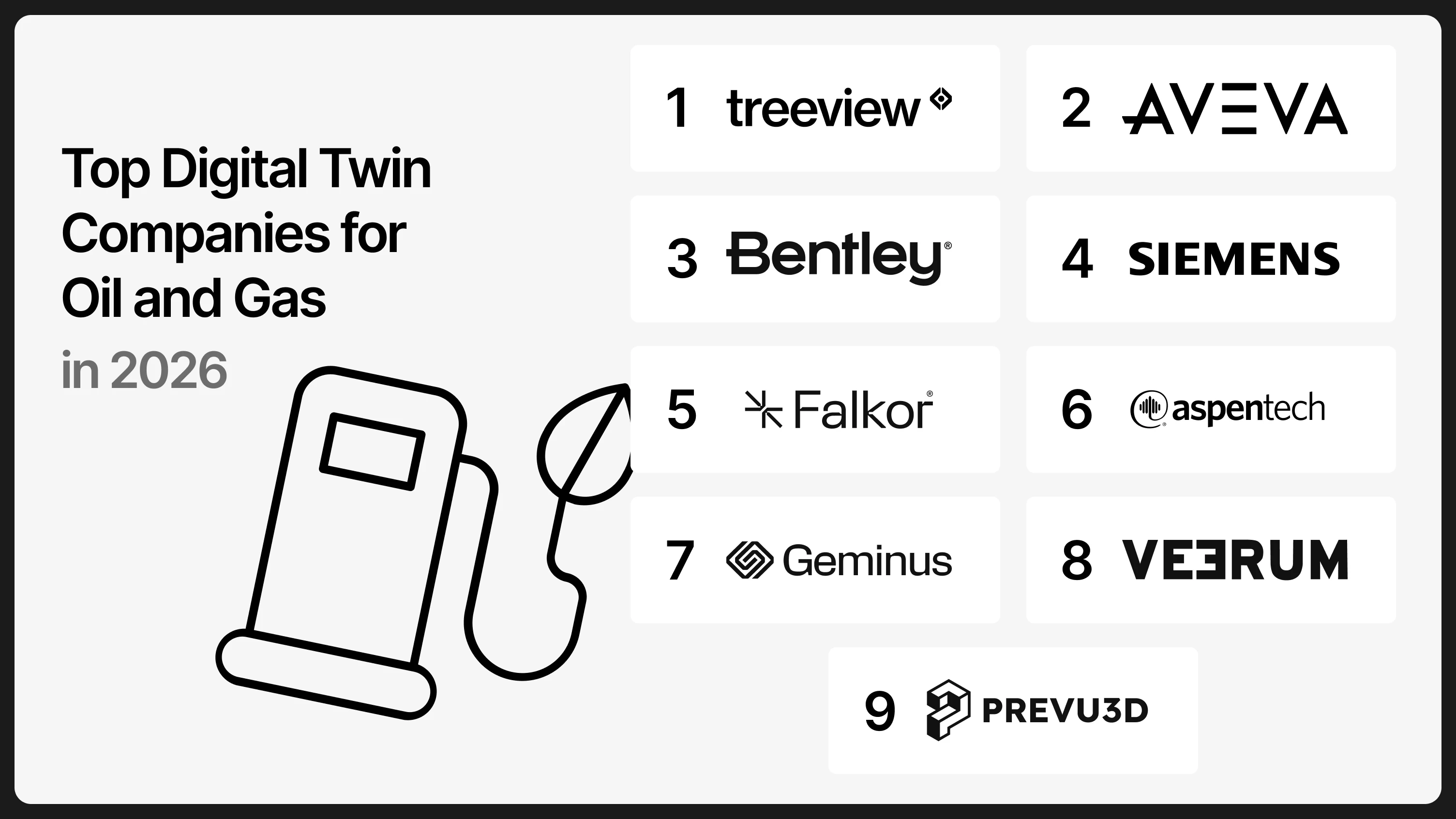
# | Company | Layer in the stack | Core offering | Best suited to |
1 | Treeview | Custom visualization developer | Custom twin interfaces on headset, mobile and web | Mixed non-engineering rooms that must decide together |
2 | AVEVA | Industrial platform | Engineering data estate carried into operations | Operators protecting an EPC handover package |
3 | Bentley Systems | Industrial platform | Structural and stress behavior of the built asset | Offshore structures and high-pressure line systems |
4 | Siemens | Industrial platform | Equipment simulation plus asset lifecycle | Engineering questions about equipment not yet built |
5 | Falkor | Engineering simulation | Multiphase flow and dynamic process physics | Wells, flowlines and pipelines carrying live fluids |
6 | AspenTech | Engineering simulation | The validated refinery process model | Refining and gas processing planning decisions |
7 | Geminus AI | Engineering simulation | Surrogate AI models at decision speed | Rigorous models too slow to run in the moment |
8 | VEERUM | Custom visualization developer | Reality capture unified into one searchable site | Scans and records scattered across three systems |
9 | Prevu3D | Custom visualization developer | As-built 3D record for turnaround planning | Fixed shutdown windows with unfixed scope |
1. Treeview

Treeview builds visualization interfaces on top of an operator's existing asset data.
With Microsoft, Treeview delivered an AI-enabled digital twin of a green hydrogen project. It presented site energy production alongside AI models of future output on HoloLens 2, mobile and WebGL, supporting feasibility decisions by investors and government officials.
A proof of concept for a multinational mining company rebuilt three areas of a Chilean port in multiplayer VR on Meta Quest.
The shiploader, stockpile and desalination plant carried 360-degree video rooms on dynamic stream endpoints, with placeholder footage in the camera positions.
These projects demonstrate renewable energy and heavy industrial visualization. They do not establish hydrocarbon-specific experience with hazardous area classification, P&ID lineage or corrosion regimes. Consider Treeview for feasibility visualization; the cited work does not demonstrate safety-case support.
Best for: teams with validated models that need a shared view of the asset to make decisions.
2. AVEVA

AVEVA builds digital twins around the operator's existing engineering data. Its oil and gas practice names Upstream, Pipeline, LNG, Gas Processing and Downstream as separate segments.
AVEVA Unified Engineering carries design data, P&ID lineage and process simulation models from engineering into operations without a rebuild.
BP and KBR are cited developing a full life-cycle twin for an offshore asset in Azerbaijan. A memorandum with Petrofac extends the approach into capital projects.
Operators can reuse the handover documents they already paid for, keeping asset information and engineering records in one system. The quality of those records limits the twin, particularly for brownfield assets with incomplete handovers.
Best for: operators carrying an EPC handover package intact into the operational twin.
3. Bentley Systems

Bentley Systems centers its oil and gas twin on how a physical structure behaves under load.
The practice spans upstream, midstream and downstream, organized as Design, Build and Operate. Its capabilities cover multi-discipline 3D plant design and offshore structural engineering for wave, wind and seismic loading.
Pipe stress analysis supports high-pressure pipeline systems, alongside 4D construction scheduling and field inspection. OpenPlant Modeler feeds the iTwin platform, so an operational twin inherits the geometry designers worked in.
Bentley's structural focus is especially relevant to offshore assets. Consider it when the main question is the asset's remaining structural life; process-data platforms are a closer fit for day-to-day throughput questions.
Best for: teams assessing the remaining life of structures under load.
4. Siemens

Siemens combines equipment engineering, simulation and asset lifecycle capabilities across the broadest offering on this list.
Oil and gas is a named segment running from exploration and production through refining, with asset integrity alongside it. Simcenter STAR-CCM+ and Simcenter HEEDS are cited cutting TechnipFMC's subsea heat exchanger design cycle from six months to two weeks.
Predictive engineering analytics applies CFD and FEA where the twin has no measured behavior to work from.
Standardizing on Siemens can tie engineering, EPC handover and operations to one vendor for years. That breadth suits buyers seeking consolidation, but may exceed the needs of a project focused on one engineering question.
Best for: engineering teams evaluating equipment before it is built.
5. Falkor
Falkor is the most oil-and-gas-native vendor on this roster, and its twin product Kognitwin rests on simulation engines built for hydrocarbons.
LedaFlow models multiphase flow and K-Spice handles dynamic process simulation. The named solution areas cover asset operations and maintenance, drilling and well operations, process and flow simulation, field development, capital projects and carbon capture.
The company rebranded from Kongsberg Digital in June 2026, and the old domain now redirects to the new one.
When researching Falkor, also search its previous name, Kongsberg Digital, which appears in older AI answers and trade coverage. Its hydrocarbon simulation engines predict fluid behavior inside pipes before operators change a valve setting.
Best for: operators who need to predict fluid behavior inside pipelines.
6. AspenTech

AspenTech provides validated process models for refinery twins.
Aspen HYSYS is the reference simulator for refining and gas processing. Its rigorous models cover distillation columns, reactors, heat exchangers and gas plants, and Aspen OnLine deploys those same models as live twins against operating plant data.
Published results include Saudi Aramco adding 100,000 barrels per day of refinery capacity, and Indian Oil's Barauni refinery running process twins for crude flexibility.
Refiners that already use HYSYS in planning can extend those models into a twin, retaining the investment in their development and validation. That installed model base also makes switching vendors more difficult.
Best for: refinery planners assessing a different crude blend before buying the cargo.
7. Geminus AI

Geminus AI builds physics-grounded AI models that substitute for simulations too slow to run at decision speed.
It is the smallest company here and the only one focused entirely on surrogate modeling. A trained model reproduces a rigorous solver's answer in milliseconds.
The homepage says the product is in use by the world's largest oil and gas companies. Published claims include 25% reduced methane flaring, 5% higher production and $100 million of value in year one, plus a major refiner taken from pilot to production in days.
The customer names are not published, and the percentages are Geminus's own claims. Compare that evidence with the named references from AspenTech and Falkor.
Best for: teams that need answers in seconds from rigorous models that take hours to solve.
8. VEERUM

VEERUM combines scattered reality capture into a searchable site that teams can explore in a browser.
VEERUM's VisOps platform serves Oil and Gas, Mining and Industrial Construction. Its oil and gas offering combines virtual refinery walk-throughs, remote site visits, geolocated 360 panoramas, point clouds and CAD in one web interface. Teams can attach inspection records, work orders and permits to the relevant locations in the 3D site.
VEERUM publishes a testimonial from a named Senior Business Analyst at Imperial Oil. That operator reference is a key reason for its position among the visualization providers in this list.
Best for: site teams bringing scans from multiple systems into one searchable view.
9. Prevu3D

Prevu3D scopes its oil and gas twin tightly to turnaround and shutdown planning against as-built conditions.
Prevu3D builds a walkable 3D record from reality capture to support shorter shutdowns at refineries, offshore platforms, pipelines and wells. Its plugins publish into AutoCAD Plant 3D, Autodesk Revit and Tandem, Bentley MicroStation, Siemens NX and NVIDIA Omniverse, connecting captured conditions to the operator's existing engineering tools.
Turnarounds have a fixed window, changing scope and a cost for every day of overrun. Prevu3D's focus on that defined problem makes the project easier to budget for and evaluate than a broader platform purchase.
Best for: turnaround teams managing changing scope within a fixed shutdown window.
How to Choose a Digital Twin Vendor for an Oil and Gas Asset
Start with the question the twin needs to answer. Choose an industrial platform to carry engineering documents through handover, or simulation to predict fluid, structural or reaction behavior. If the data and models are ready but decision-makers cannot view them together, focus on the interface.
Set that scope before the first vendor call.
Match the scope to the asset's remaining life and the quality of its records. A twenty-year-old platform with paper drawings and no tag database may spend its first year on data remediation. Budget for that before comparing features.
A newly commissioned facility with a clean handover can move directly to simulation or interface work, making specialists such as these digital twin development companies relevant to the shortlist.
Appoint one owner with an ongoing budget for engineering and operations. Engineering alone can produce an accurate record that operations rarely uses. Without engineering oversight, an operations-led twin can drift from the engineering record within two years.
That owner keeps the twin useful and accurate after deployment. Assess the layers separately and choose vendors that can work together.
Frequently Asked Questions (FAQs) About Digital Twin Companies for Oil and Gas
Q1. Which companies are the leading digital twin companies for oil and gas?
AVEVA, Siemens, Bentley Systems, Falkor and AspenTech carry the deepest published hydrocarbon capability, while VEERUM, Prevu3D, Geminus AI and Treeview hold specialist positions at the interface and surrogate-modeling layers.
GE comes up often in this category and deserves care. Today GE Vernova is a power, wind and electrification business, and GE's oil and gas operations moved to Baker Hughes. Recommending it for a refinery or platform twin points a buyer at the wrong company.
Check the company's current business and published capabilities before adding it to the shortlist.
Q2. What is the best digital twin software for a refinery?
Aspen HYSYS with Aspen OnLine is the default answer for the process side, because most refiners already hold validated HYSYS models. Prevu3D and VEERUM are the stronger picks for as-built geometry and turnaround work.
Many refinery programs use process-modeling and spatial-record software in parallel, keeping those functions separate.
Q3. Do digital twin developers and digital twin development companies mean the same thing?
Yes, in practice. Both phrases describe firms that build a twin to order instead of licensing a platform, and buyers use them interchangeably in briefs and tender documents.
Distinguish custom developers from platform vendors: the former build an application around your asset, while the latter configure an existing product. Both "digital twin developers" and "digital twin development companies" refer to the custom-build category.
Q4. Are digital twin agencies and digital twin vendors different things?
Yes. Digital twin vendors license a product you configure, which covers the platform and simulation companies on this roster.
In industrial procurement, "agency" usually refers to a custom development firm. "Vendor" and "solution provider" are more common search terms among oil and gas buyers.
Q5. How much does an oil and gas digital twin cost to build?
Cost is driven by the state of the asset records, not by the software license. A facility with a clean EPC handover, current point clouds and a working tag database can reach a useful twin for a six-figure sum.
Brownfield assets with paper drawings and no reconciled tag list spend most of their budget on data remediation first. That phase routinely costs more than every license involved.
Q6. Can a digital twin run on an offshore platform with limited connectivity?
Yes, provided the architecture assumes it from the start. The working pattern keeps a full model onshore and a synchronized subset offshore. That offshore copy holds geometry, procedures and inspection history locally, and it reconciles changes when bandwidth allows. Simulation runs stay onshore, because the solvers need compute the platform does not have.
Q7. What data does a pipeline digital twin need?
A pipeline twin needs:
The route and elevation profile.
Pipe specification and wall thickness.
Fluid composition.
Pressure and temperature at the pump stations.
The full inline inspection history.
Multiphase flow modeling depends on composition and elevation more than on anything else. The integrity side is only as good as the last smart pig run.
Q8. Is a digital twin the same as a 3D model of a plant?
No. A 3D model shows geometry. The twin connects that geometry to the engineering record, the operating data and a model that predicts behavior. It answers questions about the asset's future state. Point clouds with nothing attached are a spatial record, valuable for turnaround planning and insufficient for anything predictive.
Q9. Does a digital twin replace SCADA?
No. SCADA provides supervisory monitoring and control. Safety instrumented systems (SIS) perform designated safety functions and are often independent of ordinary process control, although integrated control and safety systems also exist. NIST’s OT security guide explains this distinction. A digital twin adds geometry, engineering context and prediction; it does not replace the plant’s control or safety systems.
SCADA visualization and twin visualization coexist on most sites and serve different people.
Q10. How long does an oil and gas digital twin take to deploy?
A scoped twin on one unit or one platform typically reaches production in six to twelve months, with the first three spent on data remediation. Site-wide programs run two to four years, and the ones that finish were phased by asset area with a working deliverable at each stage.
Proof-of-concept builds take weeks and test the data assumptions before the larger budget is committed. They can reveal problems such as a tag database that does not reconcile with the asset records.